
Why Was My Claim Denied? A Student Guide to Insurance Payouts
Why Claim Rejection Reasons Student Applicants Face Are More Common Than You Think
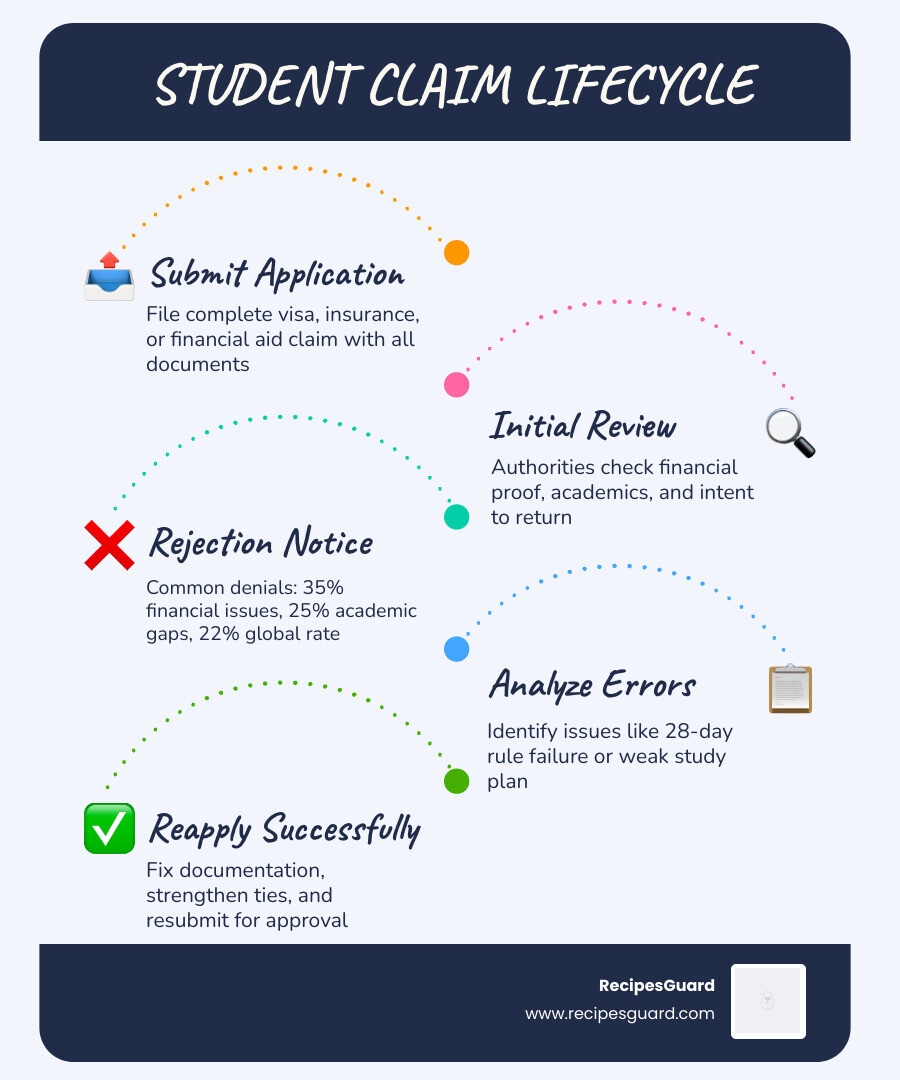
Understanding claim rejection reasons student applicants run into is the fastest way to protect yourself — whether you’re dealing with a visa, insurance payout, or financial aid application. Here are the most common reasons claims get denied:
Top reasons student claims are rejected:
- Insufficient financial proof — missing bank statements, unclear fund sources, or failing the 28-day rule (35% of rejections globally)
- Academic credibility issues — course mismatches, unexplained study gaps, or weak statements of purpose (25%)
- Doubtful intent to return home — weak ties to your home country (20%)
- Incomplete or incorrect documentation — missing signatures, wrong dates, or mismatched details
- Language proficiency gaps — IELTS or TOEFL scores below the required threshold
- Insurance-specific denials — ineligible dates, pre-existing conditions, or non-covered services
- Wrong visa category or poor interview performance
- Administrative errors — SEVIS violations, FAFSA reject codes, or missed deadlines
If you’ve just received a denial letter, you’re not alone. As of May 2026, the global average student visa rejection rate has climbed to 22% — up from 18% just three years ago. For students from high-scrutiny countries like India, Nigeria, or Bangladesh, that number can reach 35%.
And it’s not just visas. Insurance claims, financial aid applications, and study permit renewals all come with their own rejection triggers — many of which catch students completely off guard.
The frustrating part? Most denials are entirely preventable. A single missing document, one inconsistent bank statement, or an unprepared interview answer can unravel months of planning.
This guide breaks down every major rejection category — visa, insurance, and financial aid — so you know exactly what went wrong and what to do next.
Must-know claim rejection reasons student terms:
- Australia Student Medical Claim
- How to File Insurance Claim
- How Long Do I Have to File an Insurance Claim
Top Claim Rejection Reasons Student Applicants Face Globally

When we look at the global landscape in 2026, the reasons for rejection remain remarkably consistent across major study destinations like Australia, Canada, the UK, and the USA. While every case is unique, the vast majority of “no” votes from immigration officers or claim adjusters fall into three main buckets: money, brains, and roots.
Financial documentation issues are the heavyweight champion of denials, accounting for roughly 35% of all student visa rejections. Authorities need to be 100% certain that you won’t run out of money mid-semester and resort to unauthorized work. Academic credibility follows closely at 25%, where officers question if you are a “genuine student” or just using a degree as a back door for migration. Finally, about 20% of rejections stem from a lack of “intent to return,” where the applicant fails to prove they have enough reasons to go home after graduation.
To understand the specifics, we can look at Why Your Student Claim Might Get Rejected and How to Fix It. Often, it isn’t just about what you provide, but how you present it.
| Country | Average Rejection Rate (2026) | Primary Rejection Trigger |
|---|---|---|
| USA | 28% | Section 214(b) (Immigrant Intent) |
| UK | 24% | 28-Day Maintenance Rule |
| Canada | 19% | Proof of Funds / LOA Validation |
| Australia | 16% | GTE (Genuine Student) Requirements |
Insufficient Financial Proof and Documentation Errors
Money is the most sensitive part of your application. If a visa officer or financial aid administrator sees a “circular transaction” — where a large sum of money suddenly appears in your account right before you apply — they will flag it as “borrowed money” for show.
In Australia and the UK, the rules are particularly strict. The UK’s 28-day rule requires that the necessary maintenance funds must have been in your bank account for at least 28 consecutive days ending no more than 31 days before the date of your application. If your balance drops by even one dollar during that window, it is an automatic rejection.
For those applying for US-based aid, FAFSA Reject Codes can be equally punishing. Simple errors like a missing signature or a mismatched Social Security Number (SSN) can leave your Student Aid Index (SAI) blank, effectively stalling your funding. For a deep dive into the technicalities of these errors, you can refer to Appendix A – Reject Codes And Reject Reasons.
Weak Study Plans and Academic Mismatches
Your Statement of Purpose (SOP) isn’t just a formal essay; it’s your narrative. A common claim rejection reasons student pitfall is a “course mismatch.” For example, if you have a Master’s in Computer Science and you apply for a Diploma in Business, the officer will likely reject you for lack of academic progression. Why would you take a lower-level degree in an unrelated field?
We also see rejections based on What are the reasons for a claim to be rejected? when students fail to explain study gaps. If you spent two years away from school, you must document exactly what you were doing. Were you working? Taking a certificate? If you leave it blank, they assume the worst.
Navigating Insurance and Health Coverage Denials

If you are studying in Australia, Overseas Student Health Cover (OSHC) is mandatory. However, just because you have the policy doesn’t mean every claim will be paid. We often see students panic when a medical bill is denied, but usually, it’s a simple matter of policy interpretation.
The most common reason for an OSHC “red card” is the pre-existing condition waiting period. Most policies have a 12-month waiting period for pre-existing mental health or physical conditions. If you seek treatment for a condition you had before arriving in Australia within that first year, the claim will be rejected. For more on this, check out Don’t Panic if Your OSHC Claim Gets the Red Card.
Government-based claims also have strict procedural rules. For instance, Rejecting an ABSTUDY claim often happens because the student didn’t meet basic qualification provisions or failed to notify the agency of a change in circumstances.
Common Claim Rejection Reasons Student Travelers Encounter
Travel insurance is a different beast. Unlike health insurance, travel insurance is designed for “unforeseen” events. If you try to claim for a flight you missed because you overslept, you’re going to have a hard time.
Common triggers for travel claim denials include:
- Ineligible dates: Trying to claim for an incident that happened before the policy started or after it expired.
- Missing receipts: If you can’t prove you paid for the item or service, the insurer won’t reimburse you.
- No proof of purchase: For educational reimbursement claims, an unpaid invoice isn’t enough; you need a receipt showing the balance is zero.
If you find yourself in this position, don’t lose hope. There are specific steps for What to Do if Your Student Travel Insurance is Denied that can help you overturn the decision.
Policy Exclusions: Illegal Acts and High-Risk Activities
We all want to have fun while studying abroad, but some “adrenaline junkie” habits can void your policy instantly. Most student insurance plans explicitly exclude “high-risk activities” like skydiving, bungee jumping, or off-piste skiing unless you’ve paid for a specific rider. You can learn more about this in Don’t Let Your Adrenaline Junkie Habits Void Your Policy.
Even more serious are exclusions for illegal acts. This doesn’t just mean major crimes; it can include working more hours than your student visa allows (unauthorized employment) or incidents involving excessive alcohol consumption. If you are injured while under the influence, many insurers will use that as a reason to say “no.” Check out Why Your Insurance Says No to Illegal Acts to understand where the line is drawn.
Country-Specific Rejection Triggers and Policy Changes
In 2026, immigration authorities are using more technology than ever. AI verification is now standard in Canada and the UK to detect fraudulent bank statements and “templated” SOPs.
In Canada, the Letter of Acceptance (LOA) validation is a critical hurdle. Designated Learning Institutions (DLIs) now have a tiny 10-day window to validate your LOA with the government after you submit your application. If they miss that window, your application is returned as incomplete.
In the US, the dreaded 214(b) code remains the most common rejection reason. This is a “catch-all” for applicants who fail to convince the officer that they have strong enough ties to their home country to ensure their return. Meanwhile, recent updates like the Update on FAFSA Reject Code 68 show how even internal system shifts can leave students without their Student Aid Index (SAI) if they don’t follow the new real-time matching protocols.
Administrative Failures and SEVIS Claim Rejection Reasons Student Applicants Overlook
Sometimes, the rejection happens after you arrive. For US students, the SEVIS system is the “eye in the sky.” Your status can be terminated for:
- Failure to enroll: If you don’t register for classes by the deadline.
- Unauthorized employment: Working off-campus without DSO approval.
- Address reporting: Failing to update your US address within 10 days of moving.
Many students are shocked to learn that a “10-second rejection” can happen during the visa interview. If your first three sentences sound scripted or if you can’t explain why you chose a specific university (beyond “it’s ranked high”), the officer may decide to deny you before you even finish your introduction. We’ve seen students ask Why is my FAFSA rejected? only to find out it was a simple misspelling of their name that didn’t match their Social Security record.
How to Appeal and Overcome a Denied Claim
A rejection is a detour, not a dead end. The first thing we recommend is to read your refusal letter carefully. It usually contains a code or a specific reason (like “insufficient funds” or “lack of immigrant intent”).
If it’s an insurance claim, you can often provide additional documentation to satisfy the adjuster. We’ve put together a guide on How to Successfully Appeal a Denied Insurance Claim that walks you through the “Request for Reconsideration” process.
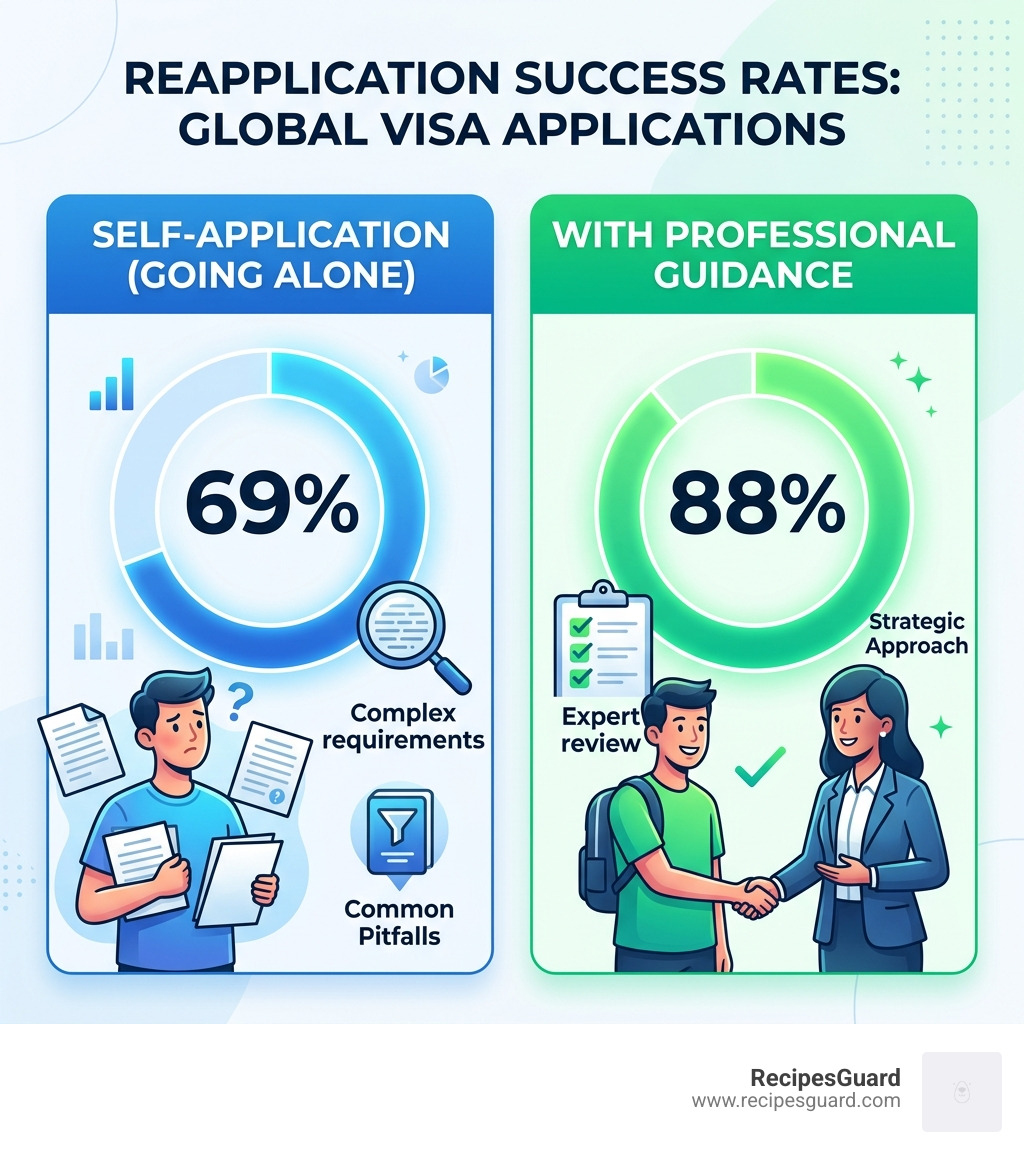
For visa rejections, you generally have two choices: Administrative Review (if you think the officer made a legal mistake) or Reapplication. Statistics show that students who use professional guidance have an 88% success rate on reapplication, compared to just 69% for those who try to go it alone again. You can find more strategies in our article Claim Denied: Here is How Students Can Fight Back and Win.
Frequently Asked Questions about Student Claim Denials
Can I reapply immediately after a student visa or insurance claim rejection?
For insurance claims, yes — as soon as you have the missing information or receipts. For visas, it depends. If the rejection was for a missing document, you can reapply once you have it. However, if the rejection was for “lack of intent” or “academic credibility,” reapplying the next day without changing your profile will almost certainly lead to a second rejection. Most experts suggest waiting 2–6 months to build a stronger case.
Which countries currently have the lowest student visa rejection rates in 2026?
Australia currently leads the major study destinations with the lowest rejection rate at 16%, followed by Canada at 19%. Countries like Germany, Finland, and Malaysia also report very high approval rates (often over 90%) due to their streamlined, document-heavy processes that rely less on subjective interviews.
What are the most common FAFSA reject codes and how do I fix them?
The most common are Reject Code 1 (Missing asset info), Reject Code 18 (SSN not confirmed by SSA), and Reject Code 15/16 (Missing signatures). To fix these, you usually need to log into your StudentAid.gov account, make the correction (like re-entering your SSN or signing electronically), and resubmit.
Conclusion
At RecipesGuard, we know that a denied claim feels like a heavy blow to your dreams. Whether it’s a claim rejection reasons student hurdle in your visa application or a medical bill that OSHC won’t cover, the key is to stay calm and stay informed.
Most rejections are not about you as a person; they are about the paperwork. By following our student-focused, step-by-step tutorials and ensuring your documentation is “bulletproof” before you hit submit, you can join the 92.7% of students who successfully navigate the global mobility process.
Don’t let a “no” today stop your “yes” tomorrow. Start your successful claim journey today and let us help you get back on track.

My name is Bianca, and my journey into the world of fermentation and food safety began with a costly mistake. I once lost an entire season’s harvest of chili peppers because I relied on guesswork instead of science. That failure was my turning point.
