
Your OSHC Claim Step by Step: What Every International Student Needs to Know
The oshc claim step by step process is simpler than most students expect — and knowing it in advance can save you serious stress when you actually need it.
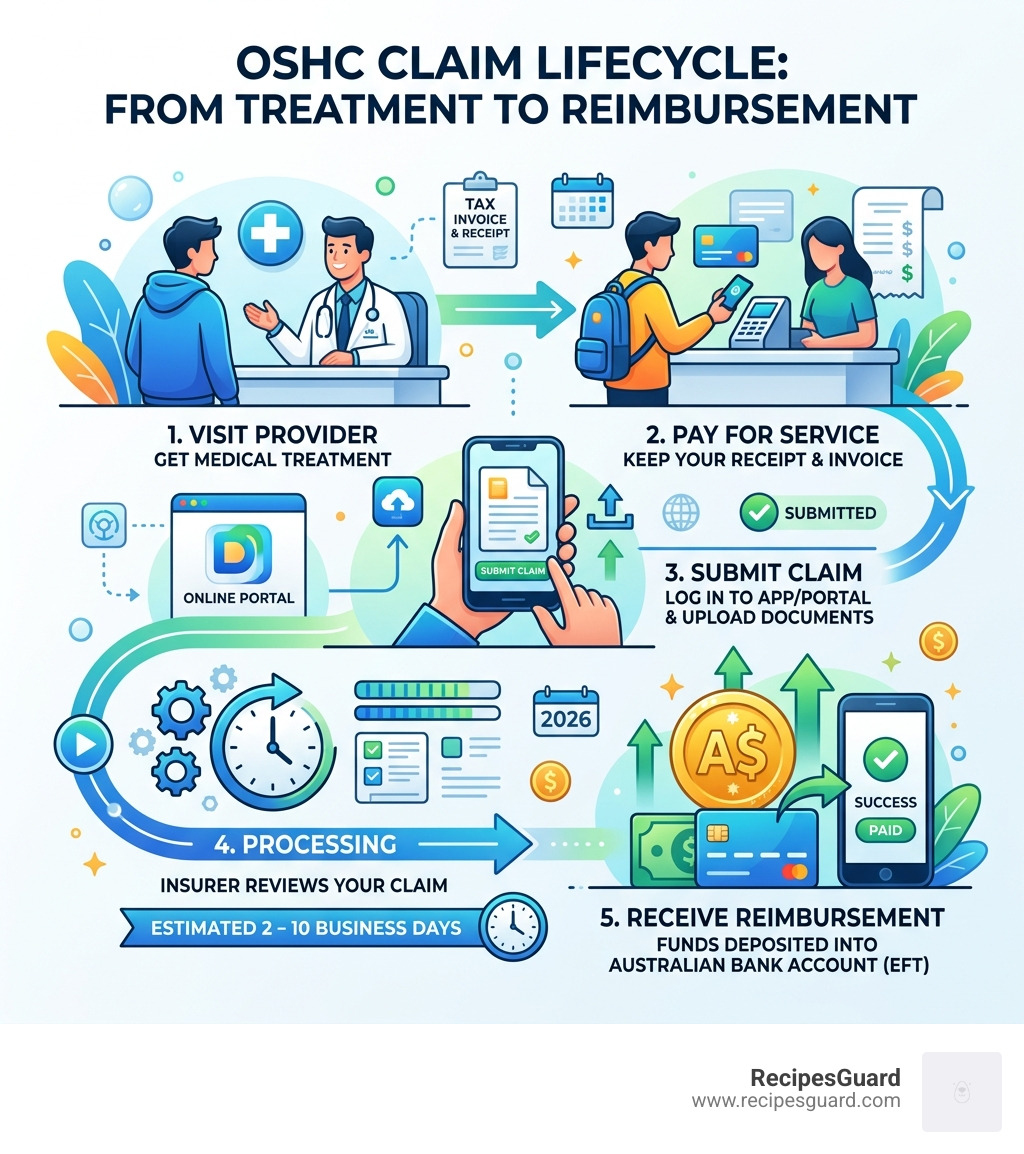
Here is a quick overview of how an OSHC claim works:
- Visit a recognised healthcare provider (GP, specialist, or hospital)
- Pay for the service (or use direct billing if your provider offers it)
- Collect your tax invoice and receipt
- Log in to your insurer’s app or portal (e.g., myBupa, Medibank, Allianz MyHealth)
- Upload your documents and submit your claim
- Receive reimbursement via Electronic Funds Transfer (EFT) into your Australian bank account
Most online claims are processed within 2 to 10 business days, depending on your provider.
Overseas Student Health Cover (OSHC) is mandatory for anyone studying in Australia on a Visa subclass 500. It covers essentials like GP visits, hospital stays, specialist consultations, and emergency ambulance transport. But having the cover is only half the battle — knowing how to actually use it is what protects you financially when something goes wrong.
Many students pay out of pocket and never claim back what they are owed, simply because the process feels unfamiliar. This guide walks you through every step clearly, so you know exactly what to do.
Understanding Your Coverage Before You File
Before you dive into the oshc claim step by step submission, it is vital to know what you are actually entitled to. Think of your OSHC as your “safety net” while navigating the Australian healthcare system in 2026.
Generally, OSHC is designed to mirror the benefits Australians receive through Medicare. This includes:
- GP Consultations: Visits to a local doctor for illness or general health advice.
- Specialist Visits: Consultations with doctors who specialize in specific areas (like a dermatologist or cardiologist), though you usually need a referral from a GP first.
- Pathology and Radiology: Blood tests, X-rays, and other diagnostic scans.
- Public Hospital Stays: Treatment and accommodation in a public hospital.
For a deeper dive into the specifics of what is included in your policy, check out The Ultimate Guide To Oshc Whats In And Whats Out.
It is also important to remember that OSHC is a requirement for maintaining your visa status. According to Overseas Student Health Cover (OSHC) – Study Australia, you must maintain this cover for the entire duration of your stay. If you let it lapse, you are not just risking your health; you are risking your visa.
Essential Documents for Your Claim
To ensure your oshc claim step by step journey doesn’t hit a roadblock, you need to be a bit of a “document hoarder.” In the digital age of May 2026, most insurers prefer digital copies, but the information required remains the same.
You will need:
- Tax Invoices: This is the bill the doctor gives you. It must show the provider’s details, the date of service, and the “item numbers” (codes used to identify the treatment).
- Medical Receipts: Proof that you have paid the bill (if you paid upfront).
- Policy Number: Found on your physical or digital membership card.
- Australian Bank Account Details: You need an Australian BSB and Account Number. Insurers generally will not reimburse into overseas accounts.
If you are filling out a physical form instead of using an app, The Ultimate Guide To The Australia Student Medical Claim Form can help you navigate the tricky fields.
The OSHC Claim Step by Step Submission Process

Now, let’s get into the “how-to.” Depending on where you go for treatment, your oshc claim step by step experience will follow one of three main paths:
1. Direct Billing (The “Easy” Way)
Some clinics have an agreement with your insurer. You show your membership card, and the clinic sends the bill directly to the insurer. You may only have to pay a “gap fee” (the difference between what the doctor charges and what the insurer covers) on the spot.
2. Online/App Submissions (The “Fast” Way)
You pay the full amount at the clinic, take a photo of your receipt, and upload it via your insurer’s member portal or mobile app.
3. Manual/Postal Claims (The “Old School” Way)
You print a form, attach original receipts, and mail them to the insurer. We generally recommend avoiding this unless you have a very complex claim, as it takes much longer.
| Feature | Online/App Submission | Mail-in Claim |
|---|---|---|
| Processing Time | 2–5 Business Days | Up to 10+ Business Days |
| Convenience | High (Snap and Send) | Low (Printing and Posting) |
| Tracking | Real-time via App | Limited |
| Risk of Loss | Low | Medium (Postal issues) |
For more details on these pathways, How to Make An OSHC Claim: Step-by-Step Guide – OSHC Australia offers excellent provider-specific insights.
OSHC Claim Step by Step for Online and App Submissions
In 2026, the mobile app is your best friend. Whether you are with Medibank, Bupa, Allianz, or CBHS, the process is remarkably similar:
- Log In: Open your insurer’s app. If it’s your first time, you’ll need your policy number to register.
- Select ‘Make a Claim’: Look for the claims button on the home screen.
- Confirm Bank Details: Ensure your Australian bank account is correctly listed so the money goes to the right place.
- Upload Documents: Use your phone’s camera to take a clear, well-lit photo of your tax invoice and receipt. Make sure the provider’s name and the item numbers are visible.
- Submit: Review the details and hit send.
Using these digital tools is the best way to ensure you don’t lose your mind while managing insurance. For more tips on staying organized, see How To Master Oshc Insurance Australia Without Losing Your Mind.
OSHC Claim Step by Step for Pharmacy and Ambulance
Claiming for medicine and emergency transport works a little differently.
Pharmacy (PBS) Claims: Most OSHC policies help with the cost of prescription medicines listed under the Pharmaceutical Benefits Scheme (PBS). However, you don’t get the whole amount back.
- The Co-payment: You must pay the first $42.30 (as of 2026) of the cost yourself.
- The Reimbursement: Your insurer typically covers the remainder, up to a limit (often $50 per item).
- The Process: You pay the pharmacy, get a “PBS receipt” (ask the pharmacist for a receipt for insurance purposes), and upload it to your app just like a doctor’s visit.
Ambulance Claims: Emergency ambulance transport is usually covered 100% by OSHC. If you receive a bill from the ambulance service, do not panic. Simply upload the invoice to your insurer’s portal, and they will usually pay the service directly. You can find more about these specific benefits in The Essential Guide To Oshc Coverage And Extras.
Timelines and Tracking: What to Expect After Filing

Once you hit “submit,” the waiting game begins. But how long is the wait?
- Online/App Claims: Most providers like Medibank and CBHS International aim to process these within 3 to 5 business days. Bupa often processes app-lodged claims in 2 to 5 business days.
- Hospital Claims: These are more complex and can take up to 28 days, though if the hospital direct-bills, you won’t be waiting for a reimbursement anyway.
- Bank Clearance: Even after the claim is approved, it might take another 1 to 2 business days for the money to actually appear in your bank account.
Most modern apps provide status tracking. You can see if your claim is “Received,” “In Progress,” or “Completed.” Many insurers will also send you an SMS or email alert once the payment has been sent. If you’re wondering if the cost of OSHC is worth these benefits, our article How Much Does Oshc Australia Cost And Is It Worth It breaks down the value proposition.
Troubleshooting: Why Claims Get Rejected or Delayed
It is a sinking feeling when you check your app and see “Claim Rejected.” Don’t panic! Most of the time, it’s a simple fix.
Common reasons for delays or rejections include:
- Unclear Photos: If the insurer can’t read the doctor’s provider number or the date, they can’t process the claim.
- Missing Information: Forgetting to include the “itemized” part of the invoice.
- Waiting Periods: If you are claiming for a pre-existing condition (like a chronic illness you had before coming to Australia), there is usually a 12-month waiting period.
- Incorrect Bank Details: The money might have been sent, but it bounced back because of a typo in your BSB.
- Expired Policy: If you haven’t renewed your cover, your claim will be automatically declined.
If your claim gets the “red card,” Dont Panic If Your Oshc Claim Gets The Red Card is your go-to resource for fixing the issue.
How to Handle a Rejected Claim
If your oshc claim step by step journey hits a snag, follow these steps:
- Read the rejection reason: The insurer will usually provide a code or a short sentence explaining why.
- Contact the provider: If the invoice was missing info, ask the clinic to print a new one.
- Call your insurer: Sometimes a five-minute phone call can clear up a misunderstanding.
- Appeal: If you believe the claim was wrongly rejected, every insurer has a formal appeals process.
Frequently Asked Questions about OSHC Claims
How long does it take to receive my money back?
For online and app submissions, you can generally expect the money in your Australian bank account within 5 business days. Manual or postal claims can take significantly longer, often exceeding 10 business days.
Can I claim for dental or optical services?
Standard OSHC does not cover dental, glasses, or contact lenses. These are considered “Extras.” If you want coverage for these, you need to purchase a separate “Extras” policy. For more on finding the best deals for long-term stays, see The Best Oshc Deals For Long Term International Students.
What is direct billing and how does it work?
Direct billing is when the medical provider bills the insurance company directly. This means you don’t have to pay the full amount upfront. You usually just show your OSHC card, pay any “gap fee,” and the clinic handles the rest. This is the most “stress-free” way to manage your health costs.
Conclusion
At RecipesGuard, we know that being an international student is an adventure, but navigating insurance shouldn’t be the scary part of that adventure. By following this oshc claim step by step guide, you can ensure that you are never left out of pocket for the healthcare you are entitled to.
Remember to keep your receipts, use your insurer’s mobile app for the fastest results, and always ensure your Australian bank details are up to date. With these simple habits, you can focus on your studies and enjoy your time in Australia with total peace of mind.
Ready to take the stress out of your student journey? Get started with your claim today and let us help you navigate the Australian insurance landscape with confidence!

My name is Bianca, and my journey into the world of fermentation and food safety began with a costly mistake. I once lost an entire season’s harvest of chili peppers because I relied on guesswork instead of science. That failure was my turning point.
