
The Clock is Ticking: How Long Do You Have to File an Insurance Claim?
Why Insurance Claim Deadlines Can Make or Break Your Coverage
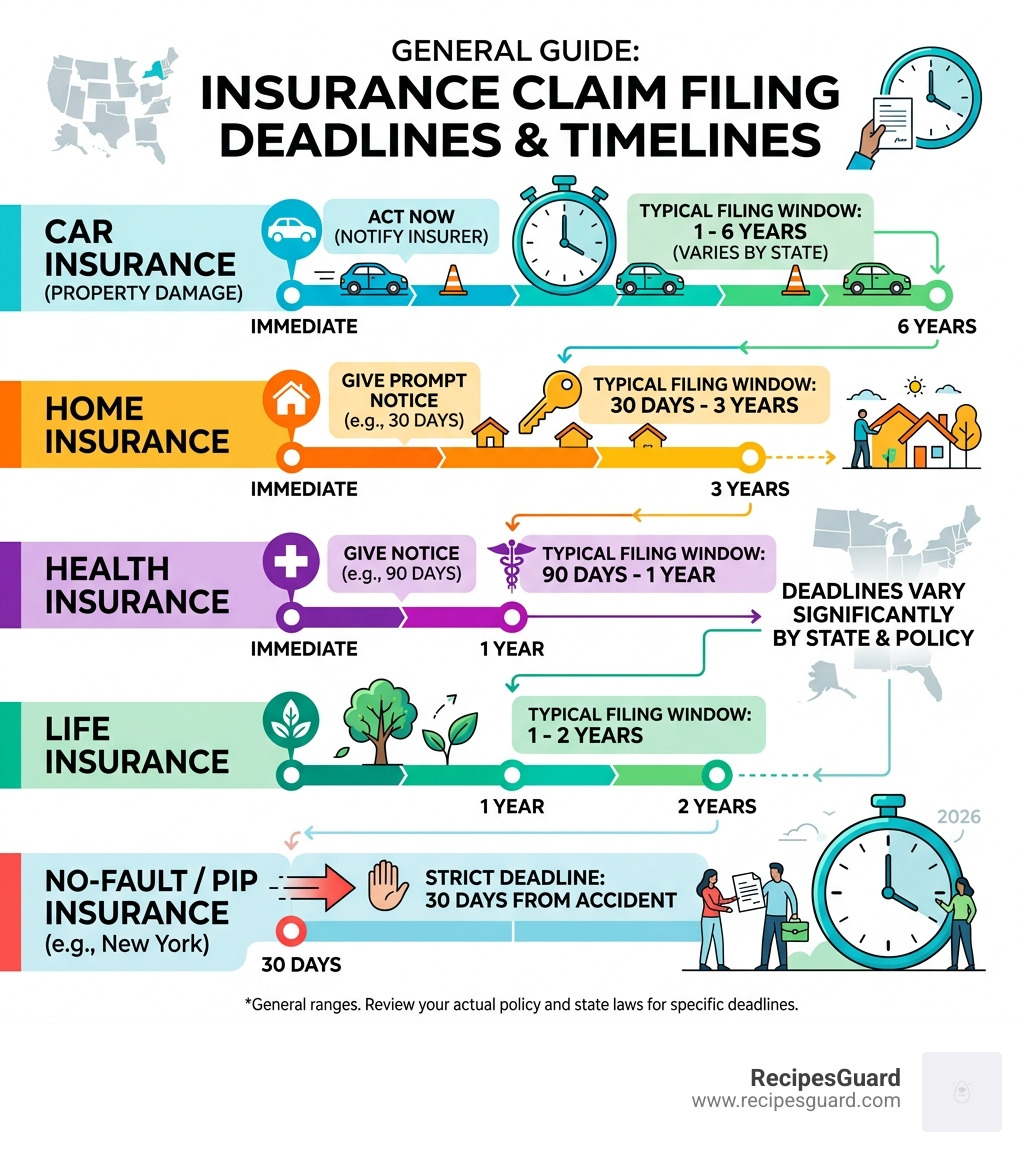
How long do I have to file an insurance claim depends on three things: your policy type, your state’s laws, and your insurer’s specific requirements. Here’s a quick overview:
| Insurance Type | Typical Filing Window |
|---|---|
| Car insurance (bodily injury) | 1-4 years (varies by state) |
| Car insurance (property damage) | 1-6 years (varies by state) |
| Home insurance | 30 days to 3 years |
| Health insurance | 90 days to 1 year |
| Life insurance | 1-2 years |
| No-fault/PIP (e.g., New York) | 30 days from accident |
These are general ranges. Your actual deadline could be shorter.
You’ve just been in a car accident, or a storm just damaged your roof. You’re dealing with stress, logistics, and recovery all at once. The last thing you want to think about is paperwork.
But here’s the hard truth: missing a filing deadline can get your claim denied entirely — even if it’s a completely valid claim.
Insurance policies are legal contracts. They set strict windows for when you must report a loss and when you must formally file. State laws add another layer, with statutes of limitations that vary from as little as one year (Tennessee, for bodily injury) to six years (Maine). On top of that, your insurer may require you to give notice within 24 to 72 hours of an incident.
The good news? If you act quickly and know what’s expected, you can protect your right to be paid.
How Long Do I Have to File an Insurance Claim?
When we ask, “how long do i have to file an insurance claim,” we are actually looking at two different “clocks” running at the same time. The first is the statute of limitations, which is a law set by the state. The second is the contractual deadline, which is the fine print inside your specific insurance policy.
In the insurance world, these clocks start ticking the moment the “event” happens—whether that’s a car crash, a burst pipe, or a medical emergency. However, there are nuances. For example, the California Department of Insurance notes that while you have a legal window to sue, the insurer also has strict deadlines to acknowledge and process your claim once you start it.
Two terms you’ll see often are Notice of Loss and Proof of Loss.
- Notice of Loss: This is the “hey, something happened” call or app notification. Many policies require this “promptly” or within 24–72 hours.
- Proof of Loss: This is the formal, signed statement detailing the damage and the cost. You might have 60 to 180 days to submit this after the initial notice.
Understanding the Statute of Limitations by State
The statute of limitations is the maximum time you have to file a lawsuit to seek damages. If you miss this date, you lose your legal leverage to force an insurance company to pay.
As of April 2026, these legal timeframes vary wildly:
- Tennessee: One of the strictest, giving you only 1 year for bodily injury claims.
- California & Texas: Generally 2 years for personal injury.
- Maine: A generous 6 years for most property damage.
If you are a student traveling abroad or studying in Australia, these local laws become even more critical. We always recommend checking the specific jurisdiction where the incident occurred, as that is the law that will govern your claim.
Contractual vs. Statutory Deadlines
Don’t let a 3-year statute of limitations fool you into waiting. Your insurance policy is a contract. If your policy says you must report an accident “immediately” or “as soon as practicable,” and you wait six months, the insurer might deny the claim for “breach of contract.”
Statutory deadlines are the absolute “claim killers,” but contractual deadlines are the ones insurers use to manage their daily business. While a judge might be lenient if you had a good reason for a slight delay, insurance companies have the discretion to flag late claims for extra scrutiny.
Car Accident Timelines: Reporting vs. Filing

There is a massive difference between reporting an accident and filing a claim. You might report an accident to the police because it’s the law, but you might choose not to file a claim if the damage is less than your deductible.
How long do i have to file an insurance claim for vehicle damage?
For vehicle damage, the timeline is often shorter than for injuries. Most drivers want their cars fixed immediately, so the process moves fast. However, if you discover “hidden” damage later—like a frame issue that wasn’t visible at the scene—you can usually still file a claim as long as you are within your state’s property damage statute of limitations (typically 2 to 3 years).
According to ValuePenguin, insurers generally have about 30 days to investigate your claim once filed, though this varies by state. If you’re dealing with a total loss, the valuation process might take longer as the adjuster compares your vehicle to similar ones in the local market.
| Action | Deadline | Who to Notify |
|---|---|---|
| Police Report | Immediate to 10 days | Local Law Enforcement |
| DMV Report | 24 hours to 10 days | Department of Motor Vehicles |
| Notice of Loss | 24 hours to “Promptly” | Your Insurance Company |
| Official Claim Filing | 1 to 6 years | Your or At-Fault Insurer |
No-Fault States and Personal Injury Protection (PIP)
If you live in a no-fault state like New York or Florida, the rules change. In New York, for example, you must provide written notice of a no-fault accident to the insurer within 30 days. If you’re seeking reimbursement for medical expenses, you often have a 45-day window after the service is rendered to submit those bills. Because these are “first-party” claims (you are filing with your own insurance), the deadlines are often much tighter and less flexible.
Home and Property Insurance Claim Windows

Home insurance claims for things like storm damage or fire usually have a filing window of 1 to 3 years. However, the “clock” usually starts on the date the damage occurred, not when you found it.
When filing, we suggest keeping a meticulous “Proof of Loss” file. This includes:
- Inventory Lists: Every item damaged, its age, and its replacement cost.
- Temporary Repairs: If you have a hole in your roof, you must cover it with a tarp to prevent further damage. Keep the receipts! Insurance won’t pay for mold that grew because you left the roof open for a month.
- Photos: Take pictures of everything before you move or clean anything.
How long do i have to file an insurance claim for hidden damage?
Hidden damage, like mold behind a wall or a structural crack that appears months after an earthquake, is tricky. The “date of loss” is still the date of the event. However, most states follow the “discovery rule,” which means the clock starts when a “reasonable person” would have discovered the damage. If you find mold six months after a flood, you should file immediately upon discovery to prove you weren’t being negligent.
The Consequences of Late Filing and Missing Deadlines
If you miss the deadline, the most likely outcome is a flat denial. The insurance company will argue that your delay “prejudiced” their ability to investigate.
As noted by the Insurance Claims Authority, when you wait too long:
- Evidence disappears: Skid marks on the road fade; damaged car parts are scrapped.
- Witness memories fail: People forget the details of who had the green light.
- Fraud suspicion rises: Insurers wonder why you waited. Did you have a second accident that caused the damage?
Why You Should File Immediately Even if You Have Time
Even if you have three years to file, we always recommend doing it ASAP. Why?
- Faster Payouts: The sooner you file, the sooner you get your check.
- Adjuster Availability: After a major storm, adjusters are spread thin. Being first in line matters.
- Rental Car Limits: Most policies only cover a rental for 30 days. If you delay filing, you might run out of rental coverage before your car even enters the shop.
Extenuating Circumstances and Deadline Extensions
Sometimes, life happens. If you were hospitalized or a natural disaster made it impossible to contact your insurer, you might be granted an extension. This is known as “tolling” the deadline. You will need extensive documentation—like hospital records—to prove why you couldn’t file on time.
Essential Steps and Documentation for a Successful Claim
To ensure your claim isn’t tripped up by a technicality, follow these steps:
- Call the Police: Even for minor accidents, a police report is a “gold standard” of evidence.
- Document the Scene: Use your phone to take video and photos of all angles.
- Exchange Info: Get names, insurance policy numbers, and witness phone numbers.
- Seek Medical Care: Even if you feel fine, go to a doctor. This creates a medical record that links any future pain to the accident.
- Keep a Log: Write down every person you talk to at the insurance company, the date, and what was said.
For more legal nuances, Nolo suggests that following up verbal notifications with a written letter or email is the best way to prove you met your contractual obligations.
Frequently Asked Questions about Claim Deadlines
Can I file a claim for injuries that appear weeks after an accident?
Yes, but it is harder. Conditions like whiplash or concussions often have delayed symptoms. The key is to have a medical professional document the symptoms as soon as they appear and explicitly link them back to the date of the accident. If you wait months to see a doctor, the insurer will likely argue that your injuries were caused by something else.
How long does it take for an insurance company to pay a claim?
In most states, insurers are required to act within a specific timeframe. For example, in California, they must accept or deny a claim within 40 days of receiving proof of loss. Once accepted, they usually have 30 days to issue payment. Straightforward claims often settle in about 30 days, while complex injury cases can take a year or more.
What is the difference between reporting an accident and filing a claim?
Reporting is an information-sharing step. You are telling the state or your insurer that an event occurred. Filing a claim is a formal request for money. You can report an accident to your insurer “for informational purposes only” if you plan to pay for the repairs yourself to avoid a rate hike.
Conclusion
At RecipesGuard, we understand that navigating insurance—especially as a student in a new country like Australia—can feel overwhelming. The rules for how long do i have to file an insurance claim are strict, but they are manageable if you stay organized.
Whether you are dealing with a travel mishap, a car accident, or property damage, the best advice is always the same: don’t wait. Use our step-by-step tutorials to gather your evidence, check your policy’s fine print, and get your claim started while the details are still fresh.
Need more help with your specific situation? More info about our services is available to help you protect your rights and your wallet. The clock is ticking—make sure you’re ahead of it!

My name is Bianca, and my journey into the world of fermentation and food safety began with a costly mistake. I once lost an entire season’s harvest of chili peppers because I relied on guesswork instead of science. That failure was my turning point.
