
Don’t Panic if Your OSHC Claim Gets the Red Card
What to Do When Your Australia OSHC Claim Gets Denied
Australia OSHC claim denied decisions happen more often than you’d think — and they almost always come as a shock, especially when you’re already dealing with medical bills in a foreign country.
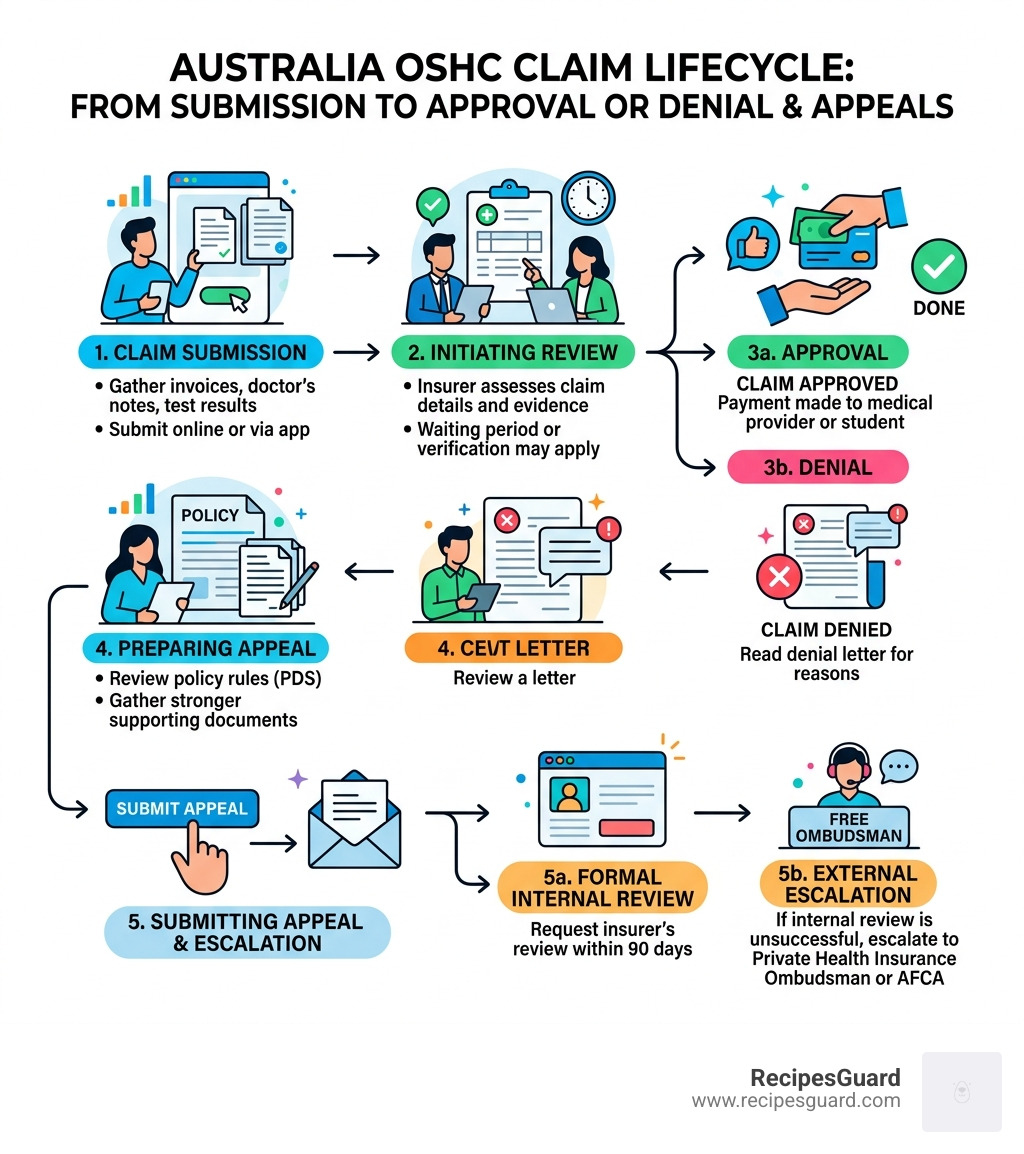
Here’s a quick overview of what you can do right now:
- Read the denial letter carefully — find the exact reason given
- Check your Product Disclosure Statement (PDS) — see if the denial aligns with your policy terms
- Contact your insurer’s review team — request clarification in writing within 90 days
- Gather supporting documents — invoices, doctor statements, test results
- Submit a formal appeal — with a clear letter and all evidence attached
- Escalate if needed — to the Private Health Insurance Ombudsman or AFCA (both free)
OSHC — Overseas Student Health Cover — is mandatory for international students in Australia. It’s tied directly to your student visa under visa condition 8501, which requires you to hold adequate health insurance for your entire stay. Without it, your visa can be cancelled.
OSHC is designed to cover the costs of unplanned medical and hospital care, ambulance services, and limited pharmaceuticals. But “mandatory” doesn’t mean “automatically paid.” Insurers can — and do — reject claims for reasons ranging from waiting periods and pre-existing conditions to paperwork errors and lapsed policies.
The good news? A denied claim is not the end of the road. Most denials can be challenged, and many are successfully overturned with the right evidence and approach.
Common Reasons for an australia oshc claim denied Notice
Receiving an australia oshc claim denied notice can feel like a personal rejection, but it is usually a bureaucratic hurdle. In our experience at RecipesGuard, most rejections stem from strict adherence to the OSHC Deed—the government document that sets the minimum standards for student health insurance.
As of April 2026, we are operating under the updated 2025 OSHC Deed, which clarified many of the rules that insurers must follow. However, these rules also give insurers clear grounds to say “no” if your situation doesn’t fit the criteria.
Most Common Rejection Reasons:
- Waiting Periods: This is the heavyweight champion of claim denials. If you seek treatment for a condition before you have served your waiting period, the insurer will not pay.
- Pre-existing Conditions: If you had signs or symptoms of an illness in the six months before arriving in Australia, it is considered pre-existing. These usually carry a 12-month waiting period.
- Out-of-Network Providers: Some insurers have “preferred” or “network” hospitals. If you go to a private hospital that doesn’t have an agreement with your insurer, you might find your australia oshc claim denied or only partially paid.
- Non-Medical Necessity: OSHC is for essential health care. Elective surgeries, cosmetic procedures, or treatments not deemed “medically necessary” by a doctor are excluded.
- Policy Lapse: If you forgot to renew your OSHC or your payment failed, your cover is inactive. Even a one-day gap can lead to a rejection.
- PBS Co-payment: For pharmacy claims, OSHC only pays for medicines listed on the Pharmaceutical Benefits Scheme (PBS) that exceed the current co-payment threshold. If your medicine costs less than the threshold, the claim will be rejected.

Rejection Codes and Their Meanings
When you receive a digital rejection, it often comes with a cryptic code. Here is a table to help you decode what your insurer is actually saying:
| Rejection Message | What it Actually Means | What You Should Do |
|---|---|---|
| Annual limit reached | You have used up your “Extras” or specific service cap for the year. | Wait until January 1st for limits to reset. |
| Service during waiting period | You haven’t been a member long enough for this specific cover. | Check your PDS for the exact waiting period duration. |
| Provider not registered | The doctor or clinic isn’t recognized by the insurer. | Verify the provider number and resubmit. |
| Inactive membership | Your premiums are overdue or the policy has ended. | Pay outstanding premiums and ask for a backdated activation. |
| Duplicate claim | You or the provider already submitted this. | Check your claim history in your member app. |
For more detailed information on the official standards insurers must follow, you can visit the Understanding OSHC Claim Procedures and Standards | Department of Health and Aged Care.
Analyzing the australia oshc claim denied Letter
Don’t throw the letter away in frustration! It contains the “DNA” of your appeal. You need to look for the specific claim reference number and the exact clause in the Product Disclosure Statement (PDS) that the insurer is citing.
Often, a claim is denied simply because of evidence gaps. Maybe the doctor didn’t include an item number, or the invoice didn’t show the date of service. If the reason is “missing information,” this is the easiest type of denial to fix.
Impact of the 2025 OSHC Deed on Rejections
The 2025 OSHC Deed brought some much-needed standardization to the industry. Before this update, different insurers had wildly different rules. Now, there are maximum limits on what they can make you wait for:
- Maternity Coverage: The waiting period is standardized at 12 months.
- Pre-existing Hospital Treatment: Also capped at a 12-month waiting period.
- Psychiatric Care: Usually carries a 2-month waiting period, regardless of whether it is pre-existing.
If your insurer tries to enforce a 15-month wait for a pre-existing condition, they are violating the Deed, and you have a very strong case for an appeal.
Immediate Steps to Resolve Your Denied Claim
Once you’ve stopped panicking, it’s time to get organized. You generally have a 90-day window to lodge an internal review request with your insurer. Some providers are more generous and allow up to 180 days, but we recommend acting as soon as you get the “Red Card.”

Gathering Evidence for a Successful Appeal
To win an appeal, you need more than just a “pretty please.” You need clinical evidence. We suggest gathering the following:
- Medical Records: Ask your GP for a copy of your consultation notes.
- Specialist Referrals: If you were referred to a specialist, that referral proves the GP deemed the service necessary.
- The “6-Month Rule” Statement: If the denial is based on a pre-existing condition, ask your doctor in your home country to provide a statement confirming you had no symptoms or treatment for that issue in the six months prior to your arrival in Australia.
- Pathology and Imaging Reports: Results from blood tests or X-rays can help prove that a condition was acute (sudden) rather than chronic (long-term).
Writing the Official Appeal Letter
Your appeal letter should be factual, polite, and structured. Avoid emotional language; instead, focus on the facts.
Pro Tip: Always include an “Attachment List” at the bottom of your letter so the person reviewing your file knows exactly what documents they should be looking at. Mention your policy number and the specific claim reference code in the subject line.
If you are unsure where to start with a complaint, the Search | Commonwealth Ombudsman website has resources that explain how to phrase your grievances effectively.
Escalating Disputes to the Ombudsman or AFCA
What happens if the insurer reviews your claim and says “no” a second time? This is where the Australian government’s consumer protection kicks in. You can escalate your dispute to the Private Health Insurance Ombudsman or the Australian Financial Complaints Authority (AFCA).
These services are free for international students. They act as independent referees. If they find that the insurer has treated you unfairly or hasn’t followed the OSHC Deed, they can compel the insurer to pay the claim.
The Timeline for Escalation:
- Internal Review: 30 to 90 days.
- Ombudsman Assessment: Can take several weeks to several months depending on the complexity.
You should only escalate once you have received a “Final Response” letter from your insurer’s internal dispute resolution team. Keep a log of every phone call and email you’ve sent—this “paper trail” is gold for an Ombudsman investigation. You can find more information on how to start this process at Search | Commonwealth Ombudsman.
Handling OSHC Refunds After a Visa Rejection
Sometimes, the “denial” isn’t about a medical claim, but about your right to be in Australia. If your student visa is rejected by the Department of Home Affairs (formerly DIAC), you are entitled to a full refund of your OSHC premium.
While a visa rejection is stressful, getting your OSHC money back is usually the easiest part of the process. Most insurers have a dedicated refund form for this exact scenario.
Key Refund Rules:
- 30-Day Rule: Most insurers will not issue a refund if there is less than 30 days of cover remaining on the policy.
- Duplicate Policies: If you accidentally bought two policies, you can get a refund for one by showing proof of the other.
- Permanent Residency: If you are granted PR while on a student visa, you can cancel your OSHC and get a pro-rata refund for the remaining time, as you are now eligible for Medicare.
For a step-by-step tutorial on these processes, check out our General Guidelines for OSHC Refunds and Cancellations | RecipesGuard Resources.
Documentation Required for OSHC Refunds
To get your money back after a visa refusal, you will need:
- The Visa Refusal Letter from the Department of Home Affairs.
- Your Flight Itinerary or boarding pass (if you were already in Australia and had to leave).
- Bank Details: For an Electronic Funds Transfer (EFT). International transfers can take up to 15 business days to clear.
Frequently Asked Questions about OSHC Claims
Can I switch providers after an australia oshc claim denied?
Yes, you can switch providers at any time. However, it won’t magically make your denied claim get paid by the new company. The new insurer will only cover services that occur after your policy with them starts.
The good news is that if you switch without a gap in cover, your waiting periods usually carry over. This means if you already served 6 months of a 12-month wait with Provider A, you only have 6 months left to wait with Provider B.
What are the typical timelines for an appeal?
- Initial Assessment: Usually 10 working days for the insurer to look at your new evidence.
- Internal Review: If it goes to a formal dispute committee, expect 30 to 90 days.
- Ombudsman Window: You generally have up to 12 months from the date of the insurer’s final decision to take it to the Ombudsman.
How do pre-existing conditions affect my claim?
Under the 2025 Deed, a pre-existing condition is defined by the “symptoms” rule. If a medical practitioner appointed by the insurer determines that you had symptoms of the condition in the 6 months before your visa started, they can apply a 12-month waiting period.
It doesn’t matter if you didn’t know you had the condition; if the symptoms were there, it counts. The only exception is psychiatric care, which has a much shorter wait (usually 2 months) even if it is pre-existing.
Conclusion
At RecipesGuard, we know that being an international student is hard enough without having to fight an insurance giant. An australia oshc claim denied notice is a hurdle, but with the right documentation and a bit of persistence, it is a hurdle you can clear.
We specialize in providing student-focused tutorials that break down these complex insurance “boss battles” into simple, winning steps. Whether you need to file an appeal, request a refund after a visa refusal, or just understand why your pharmacy bill wasn’t paid, we are here to help you navigate the Australian healthcare system with confidence.
Don’t let a rejection letter ruin your study experience. Gather your evidence, write that appeal, and remember—you have rights under the OSHC Deed!
More info about travel insurance claim services

My name is Bianca, and my journey into the world of fermentation and food safety began with a costly mistake. I once lost an entire season’s harvest of chili peppers because I relied on guesswork instead of science. That failure was my turning point.
