
What Every Student Must Know About Filing a Lost Phone Claim
Lost phone claim student situations happen fast — and knowing exactly what to do in the first few hours can save you hundreds of dollars.
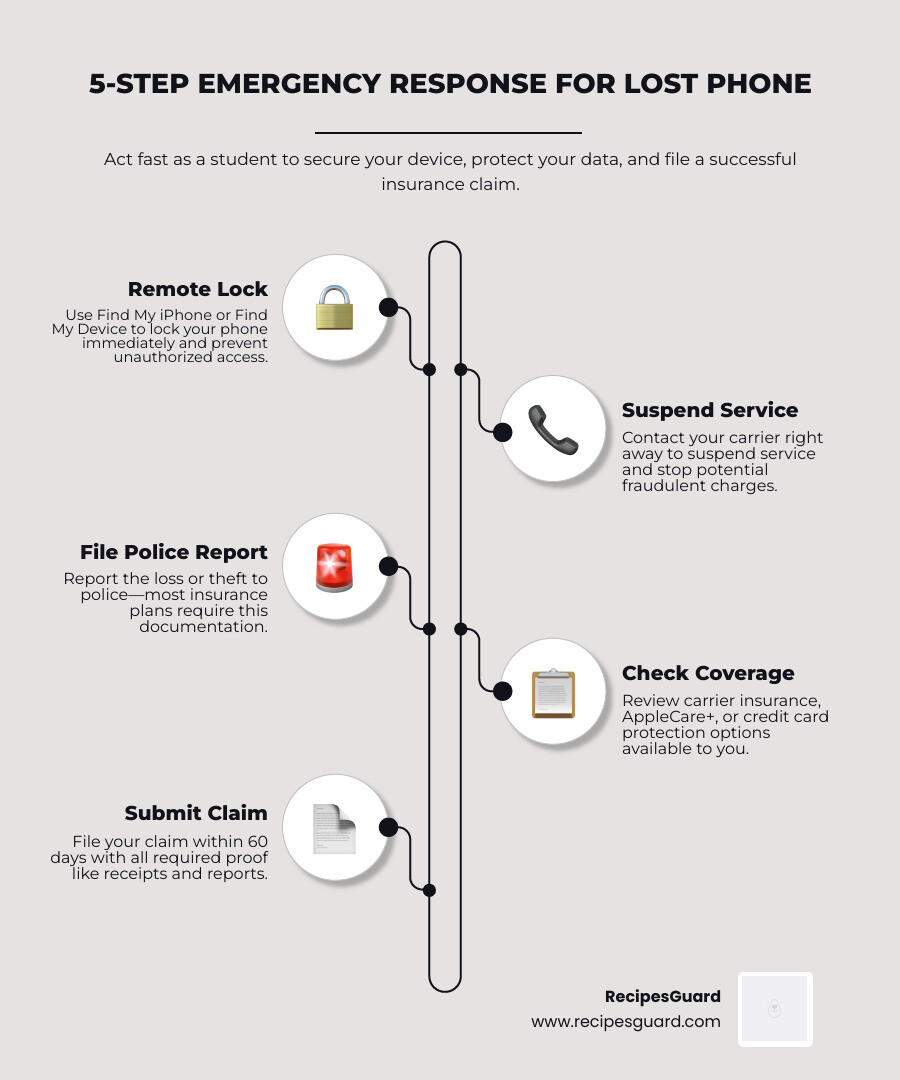
Here is a quick answer if you need it right now:
- Lock your phone remotely using Find My iPhone or Google’s Find My Device
- Contact your carrier to suspend service immediately
- File a police report — most insurance plans require one for theft or loss
- Check your coverage (carrier insurance, AppleCare+, or credit card protection)
- Submit your claim within the deadline — many plans require filing within 60 days
Losing your phone as a student is stressful enough. But if you’re studying abroad or navigating a foreign city, it hits even harder. You’re dealing with lost contacts, missing campus access cards, and a claims process you’ve likely never done before — all at once.
The good news? Most students have more coverage than they realize.
Carrier plans like AT&T Protect Advantage, T-Mobile Protection 360, and Boost Protect all cover loss and theft. AppleCare+ with Theft and Loss covers up to two incidents per year. And if you pay your phone bill with certain credit cards, you may have secondary cellphone protection at no extra cost.
The bad news? Missing a deadline or having Find My iPhone turned off can get your claim denied instantly.
This guide walks you through every step — from the moment you realize your phone is gone to the moment a replacement arrives at your door.
Basic lost phone claim student vocab:
- Australia student medical claim
- How long do I have to file an insurance claim
- How to file insurance claim
Immediate Steps for a Lost Phone Claim Student

The moment you realize your pocket is lighter than it should be, your adrenaline kicks in. Take a breath. We’ve seen this a thousand times at RecipesGuard, and the key is acting methodically. Your first priority isn’t the insurance claim; it’s data security and recovery.
1. Use Tracking Tools Immediately
Whether you are on a campus in Sydney or traveling during a semester break, the first move is to use “Find My iPhone” or “Find My Device” (Android). Log in from a friend’s phone or your laptop. If the device is moving, do not try to play hero and confront a thief. Instead, use the tool to “Mark as Lost.” This locks the device with a passcode and disables features like Apple Pay.
2. Remote Lock and Wipe
If you are certain the phone is gone for good, you may consider a remote wipe. However, be careful: some insurance policies require “Find My” to stay active to prove the device is still missing. For example, AppleCare+ with Theft and Loss requires the feature to be enabled throughout the claims process.
3. Suspend Your Service
Contact your mobile carrier immediately. Whether you’re with a major Australian provider or an international carrier, you need to suspend your service. This prevents a thief from racking up massive data charges or using your number for two-factor authentication scams. Lost or Stolen Devices | Office of Technology and Digital Innovation suggests that locking down the device quickly is the best way to prevent unauthorized account access.
4. Gather Your Evidence
To win a lost phone claim student battle, you need proof. Take screenshots of your phone’s last known location. If you suspect it was stolen at a cafe or the library, ask if there is CCTV. We always recommend students learn How To Gather Evidence For Your Travel Insurance Claim Like A Pro/ because the same principles apply here: the more documentation, the faster the payout.
Securing Your Digital Wallet and Campus ID
Your phone isn’t just a communication tool; it’s your wallet and your key to the dorm. If you use a digital campus ID like a CatCard or DartCard, losing your phone means you might be locked out of your building or unable to use your meal plan.
Most universities have a specific portal (like GET Funds) where you can click “I Lost My Card.” This immediately deactivates the digital token on your phone. If your physical wallet was also taken, you’ll need to report those cards as well. Loss or Theft | CatCard notes that deactivating these accounts is vital for protecting your “CatCa$h” or meal plan funds.
For more on managing property loss, check out Baggage Claim Blues Navigating Student Travel Insurance Claims/.
Navigating Insurance and Protection Plans
Not all insurance is created equal. As a student in May 2026, you likely have three main options for protection: carrier-provided insurance, manufacturer plans (like AppleCare+), or credit card benefits.
Comparison of Popular Protection Plans
| Feature | Carrier Plans (Asurion/T-Mobile/Boost) | AppleCare+ (Theft & Loss) | Credit Card Protection |
|---|---|---|---|
| Monthly Cost | $7 – $26 | Varies by model | $0 (Included with card) |
| Deductible | $40 – $349 | Fixed Service Fee | $25 – $100 |
| Claim Limits | Up to 5 per 12 months (T-Mobile) | 2 per 12 months | Usually 2 per 12 months |
| Coverage Type | Primary | Primary | Secondary |
In Australia, it is worth checking Mobile phone, tablet and laptop insurance – Moneysmart.gov.au to understand how “add-on” insurance works. Often, these plans are sold at the point of purchase, but they might not always be the best value compared to a dedicated student travel policy or a high-end credit card benefit.
If you are just starting out with insurance, we recommend reading The Simple Student Tutorial For Filing Any Insurance Claim/ to get the basics down.
Credit Card Cellphone Protection for Students
This is the “hidden” insurance many students miss. If you pay your monthly phone bill with a credit card like the Capital One Venture X or certain premium Australian bank cards, you might have built-in coverage.
How it works:
- It is Secondary: This means it kicks in after any other insurance you have. If you don’t have carrier insurance, it becomes your primary source of reimbursement.
- Requirements: You must pay your previous month’s bill with that specific card.
- Theft vs. Misplacement: Most credit cards cover “theft” (which requires a police report) but specifically exclude “misplaced” phones (where you just left it on a bus).
Before you file, make sure you have the Essential Baggage Loss Claim Documents You Need Right Now/, as many of the same requirements—like proof of purchase and account statements—apply to phone claims.
How to File a Successful Claim

Filing a lost phone claim student doesn’t have to be a nightmare if you follow the rules. Insurance companies are looking for any reason to say “no,” so your goal is to be the perfect applicant.
1. Respect the Deadlines
Most carriers (like AT&T) require you to file within 60 days of the loss. If you wait until the end of the semester to deal with it, you’re likely out of luck.
2. Use the Right Portal
- For iPhones: If you have AppleCare+, go directly to iPhone Theft and Loss Claims — Official Apple Support. You will need to sign in with your Apple ID and mark the device as lost within their system.
- For Android/Carrier Plans: Use portals like mytmoclaim.com (T-Mobile) or phoneclaim.com (AT&T/Asurion).
Documentation for a Lost Phone Claim Student
You cannot just say “it’s gone” and expect a new iPhone 15 Pro. You need a paper trail.
- Police Report: This is non-negotiable for theft claims. Even if the police tell you they won’t investigate, you need the “Case Number” or a copy of the report. Lost or Stolen Device: Report Loss and File Insurance Claim | IT@UMN emphasizes that for university-related claims, the serial number must be on the police report.
- Proof of Ownership: A receipt or a copy of your phone bill showing the device’s IMEI number.
- Statement of Loss: A clear, concise description of what happened. (e.g., “On May 12, 2026, at 2:00 PM, my phone was taken from my backpack at the University library.”)
Timeline for a Lost Phone Claim Student
How long will you be phoneless?
- Approval: Usually takes 24–48 hours if your documentation is solid.
- Shipping: Most carrier plans (like T-Mobile Protection 360) ship a replacement the next business day. Some premium plans even offer same-day replacement in major cities.
- International: If you are abroad, Apple can ship replacements to covered countries, but it may take up to 4 working days.
For more tips on handling delays, see The Ultimate Survival Guide For Delayed Baggage Claims/.
University-Provided Devices and Campus Policy
Many students today use laptops or tablets provided by their university’s loaner program. If you lose one of these, the process is slightly different because you don’t actually own the device — the institution does.
The Replacement Cost Trap
Per most technology agreements, if you lose a loaned device, the replacement cost is charged directly to your student account. This can be thousands of dollars. However, there is often a way to get these fees waived. For instance, at many universities, providing a police report with the device’s serial number allows the school to file its own insurance claim, sparing your bank account.
What happens if a UNM mobile device is lost or stolen? points out that students must follow specific IT protocols to ensure they aren’t held personally liable for the full retail price of the tech.
Managing Institutional Data Security
Losing a university device is a major security risk. It’s not just about the hardware; it’s about the access to university networks.
- Notify IT within 24 hours: Most schools require a report to their security office almost immediately.
- Security IDs: You will likely be given a “Security ID” or ticket number. Keep this! You’ll need it for all future correspondence.
- Data Classification: If you had sensitive research or student data on the device, the university needs to know so they can perform a remote wipe and audit.
As noted in the Lost or Stolen Device | Information Technology Systems and Services | University of Minnesota Duluth guide, coordinating between the police, IT, and risk management is the only way to ensure your data stays safe.
Avoiding Common Claim Denials
There is nothing worse than paying for insurance for two years only to have your lost phone claim student denied. Here are the “gotchas” we see most often:
- Find My iPhone was Disabled: For AppleCare+ Theft and Loss, if you turned this off to save battery, your claim is dead on arrival.
- Missing the Filing Window: If you wait 61 days to file a claim with a 60-day limit, there is very little room for negotiation.
- Cosmetic Damage Only: If you still have the phone but the back is just scratched, insurance won’t replace it. It must be a “functional” loss or theft.
- Checked Baggage: Many credit card policies exclude phones stolen from checked luggage. Always keep your tech in your carry-on!
If you find yourself in this situation, don’t give up. Read our guide on How To Successfully Appeal A Denied Insurance Claim/ to learn how to fight back.
Student-Specific Tips for Claim Success
- Use Campus Security: A report from campus security is often faster to get than one from the city police and is usually accepted by insurers.
- Study Abroad Coverage: If you are traveling, check if your student travel insurance covers “Personal Effects.” This might be a better route than your phone carrier if your deductible is high.
- Temporary Access: If you lose your phone and your digital ID, visit your residence life office. They can often provide a physical temporary card so you aren’t sleeping in the hallway.
Lost your phone while traveling abroad? Here’s what you need to do suggests that for international losses, having your IMEI number written down in a notebook (not just on your phone!) is a lifesaver.
If a claim is rejected, check out Claim Denied Here Is How Students Can Fight Back And Win/.
Frequently Asked Questions about Student Phone Claims
What is the typical deductible for a student phone claim?
Deductibles vary wildly. For a standard screen repair, it might be as low as $29. However, for a full lost phone claim student replacement, expect to pay between $149 and $349, depending on how expensive your phone is. AppleCare+ typically has a flat service fee for theft and loss (often around $149 in Australia).
Can I file a claim if I lost my phone while studying abroad?
Yes, but it’s more complicated. If you have AppleCare+, they can ship replacements to many countries. If you are using carrier insurance, they may only ship to your home address in Australia. In this case, you might need to have a parent receive the phone and courier it to you. This is where travel insurance often shines, as they may offer cash reimbursement instead.
Does my university cover my personal phone if it’s stolen on campus?
Generally, no. Universities have insurance for their property, but they rarely cover personal student property. Your best bet is your own insurance or checking if your parents’ home insurance (contents insurance) covers your belongings while you are away at university.
Conclusion
Losing your phone feels like losing a limb, but it doesn’t have to be a financial disaster. By acting fast, gathering the right documentation, and knowing the specifics of your coverage, you can turn a crisis into a minor inconvenience.
At RecipesGuard, we are dedicated to helping students navigate the confusing world of insurance. Whether it’s a lost phone or a missing suitcase, our step-by-step tutorials are designed to help you get what you’re owed. Don’t let the insurance companies win by default — be informed, stay organized, and get back to your studies.
For more expert advice on protecting your belongings, visit RecipesGuard and Master The Art Of Getting Paid For Your Missing Suitcase/.

My name is Bianca, and my journey into the world of fermentation and food safety began with a costly mistake. I once lost an entire season’s harvest of chili peppers because I relied on guesswork instead of science. That failure was my turning point.
