
What to Do if Your Student Travel Insurance is Denied
When Your Travel Sickness Insurance Claim Gets Denied: What Students Need to Know First
A travel sickness insurance claim is how you request reimbursement from your insurer when illness forces you to cancel, cut short, or seek medical care during your trip. Here’s a quick overview of how it works:
How to file a travel sickness insurance claim:
- Notify your insurer immediately when you get sick or need to cancel
- See a doctor and get written confirmation of your illness within 72 hours
- Collect all documents — medical certificates, receipts, physician statements
- Submit your claim online through your insurer’s portal within 90 days of the loss
- Track your claim and respond quickly to any requests for more information
You may be reading this because your claim was already denied — or because you want to make sure it isn’t. Either way, you’re not alone.
Studies of international travelers show that insurance companies fully paid only about two-thirds of travel health insurance claims. The two biggest reasons for rejection? Pre-existing conditions and poor documentation. For students studying abroad with no prior claims experience, both of these traps are easy to fall into.
Medical costs abroad can be brutal. A medical evacuation alone can run anywhere from $25,000 within North America to over $250,000 for remote locations. Without a successful claim, those costs land on you.
The good news: most denials are fixable — or preventable — once you know what insurers are actually looking for.
Handy travel sickness insurance claim terms:
Understanding Why Your Travel Sickness Insurance Claim Was Rejected

It’s a Monday morning in April 2026, you’ve just returned from a semester in Tokyo, and you open an email only to see the words: “Claim Denied.” Your heart sinks. You spent three days in a Japanese clinic with a nasty bout of the flu, and now you’re staring at a bill that costs more than your textbooks for the year.
At RecipesGuard, we see this all the time. Understanding the “why” is the first step toward fixing it. Most rejections boil down to specific clauses buried in the Product Disclosure Statement (PDS) that you probably skimmed while packing your bags.
The 2/3 Success Rate Reality
As of April 2026, the statistics haven’t changed much: only about 66% of travel health claims are fully paid. That means one in three travelers walks away empty-handed. The primary culprits are pre-existing illnesses and a lack of proper documentation. If you can’t prove you spent the money or why you spent it, the insurance company isn’t going to write a check.
For students, this is often a “documentation gap.” You might have the receipt from the pharmacy, but do you have the official medical certificate from the doctor who saw you? Without both, your travel sickness insurance claim is on shaky ground. How To Gather Evidence For Your Travel Insurance Claim Like A Pro provides a deeper dive into the specific items you need to keep your claim alive.
Pre-existing Condition Lookback Periods
This is the “gotcha” that catches most students off guard. Most policies have a “lookback period”—often 120 days—before you purchased the policy. If you sought treatment, took medication, or even just had symptoms for a condition during that window, the insurer might label it “pre-existing.”
For example, if you have asthma and had a check-up three months before your trip, any respiratory issues abroad might be scrutinized. Some insurers even look at whether you were hospitalized in the 90 days prior to travel. If your claim was denied for this reason, we need to look at whether your policy offered a “pre-existing condition waiver,” which is often only available if you bought the insurance within a week or two of your first trip payment.
| Covered Illness Scenario | Common Exclusion / Denial Reason |
|---|---|
| Sudden pneumonia requiring hospitalization | Chronic condition with no prior disclosure |
| Severe food poisoning confirmed by a doctor | Illness due to drug or alcohol use |
| Injury from a standard activity (e.g., hiking) | High-risk activities (e.g., skydiving without a rider) |
| Life-threatening illness of an immediate family member | Non-life-threatening illness of a distant relative |
Essential Documentation for a Successful Travel Sickness Insurance Claim
If your claim was denied due to “insufficient information,” don’t panic. This is the easiest denial to appeal. You just need to become a master of the paper trail. When filing or appealing a travel sickness insurance claim, the insurer isn’t just taking your word for it—they need cold, hard facts.
Gathering Evidence Like a Pro
We recommend creating a digital folder for every trip. If you get sick, you need:
- Itemized Receipts: A credit card statement isn’t enough. You need the receipt that shows exactly what you were charged for (consultation, tests, medication).
- Carrier Verification: If your sickness caused a travel delay, you need a report from the airline or bus company confirming the delay.
- Proof of Other Settlements: If the airline gave you a $50 voucher, your insurer needs to know. They want to ensure they aren’t paying for something you’ve already been reimbursed for.
For those of us studying abroad, the paperwork can get even more complex. How To File A Study Abroad Medical Claim Without The Headache is a great resource for navigating the specific forms required by international universities and their partner insurers.
Medical Certificates and Physician Statements
The “Medical Certificate” is the holy grail of your claim. This isn’t just a note saying “Sam was sick.” It needs to be a formal document completed by a licensed physician.
Most Australian insurers require a 72-hour rule: you must be examined by a doctor within 72 hours of the event that caused you to cancel or interrupt your trip. If you waited a week to see a doctor because you thought you’d get better, the insurer might argue the illness wasn’t “disabling” enough to warrant a claim. The statement must include a diagnosis and a clear recommendation that you were unfit to travel.
Immediate Steps to Take When You Get Sick Abroad
Let’s talk about the “Right Now.” If you’re currently abroad and feeling under the weather, or if you’ve just been denied and are planning your next steps, timing is everything.
Navigating the Online Portal for Your Travel Sickness Insurance Claim
Most modern insurance providers offer online portals. These are your best friend. Instead of mailing physical papers to an office and hoping they don’t get lost, you can upload photos of your documents directly.
When you log in, you’ll need your policy number and a clear description of the incident. Be honest but concise. Instead of saying “I felt bad,” say “I experienced severe abdominal pain and fever starting at 2:00 PM on April 12th.” For more student-specific tips, check out Medical Emergencies Abroad The Importance Of Travel Insurance For Students.
Seeking Treatment at In-Network Facilities
Before you head to the nearest clinic, call your insurer’s 24/7 emergency assistance line. They can often direct you to “in-network” facilities. Why does this matter?
- Direct Payment: In some cases, the insurer can arrange to pay the hospital directly, so you aren’t stuck putting $5,000 on your student credit card.
- Guarantee of Payment: It ensures the facility is recognized by your provider, reducing the chance of a denial later.
If you can’t find an in-network provider, the Australian Embassy or Consulate website usually maintains a list of local hospitals and English-speaking doctors. To learn more about the filing process specifically for students, see How To Effectively File A Travel Insurance Claim As A Student.
Emergency Medical Evacuation and Repatriation Coverage
This is the part of travel insurance we hope we never use, but it’s the reason we buy it. If you’re in a remote part of Southeast Asia and develop a condition that local clinics can’t handle, you might need a medevac.
When Evacuation is Deemed Medically Necessary
A common point of contention in a travel sickness insurance claim is whether an evacuation was “necessary.” You don’t get to decide this; the insurance company’s medical team does. They will consult with the local doctors to determine if the care available is adequate.
If they decide you need to be moved, the costs are staggering. We’re talking $25,000 for a short hop and upwards of $250,000 for long-haul transport from remote islands. If your claim for evacuation was denied, it’s usually because the insurer believes you could have been treated locally. You’ll need a strong statement from the local treating physician explaining why their facility was insufficient. For more on this, read Understanding Medical Emergency Coverage In Student Travel Insurance.
Repatriation of Remains and Family Travel
Comprehensive policies also cover “repatriation of remains” and “emergency reunion” benefits. If a student is hospitalized for a certain number of days (usually 3 to 7), some policies will pay for a parent to fly out and sit by their bedside. This is a “non-insurance assistance service” that provides huge peace of mind. If this was denied, check your policy for the “minimum days hospitalized” requirement.
Appealing a Denial and Coordinating Benefits
A denial isn’t the end of the road; it’s just a detour. In Australia, you have the right to appeal an insurer’s decision. You can also review general information about consumer complaint pathways through the Australian Financial Complaints Authority, which handles disputes between consumers and financial firms.
How to Handle Secondary Insurance Claims
Sometimes, a travel sickness insurance claim is denied because the insurer believes another party should pay first. This is called “Coordination of Benefits.”
- Primary vs. Secondary: Many travel policies are “secondary,” meaning they only pay after your regular health insurance (or your credit card’s travel cover) has paid its share.
- Explanation of Benefits (EOB): If you have other insurance, you must first file a claim with them. Once they pay (or deny) the claim, they will give you an EOB. You then give this EOB to your travel insurer, and they cover the remaining “out-of-pocket” costs.
Medicare generally does not cover you outside of Australia. However, if you have private health insurance at home, check if they have any international reciprocal agreements.
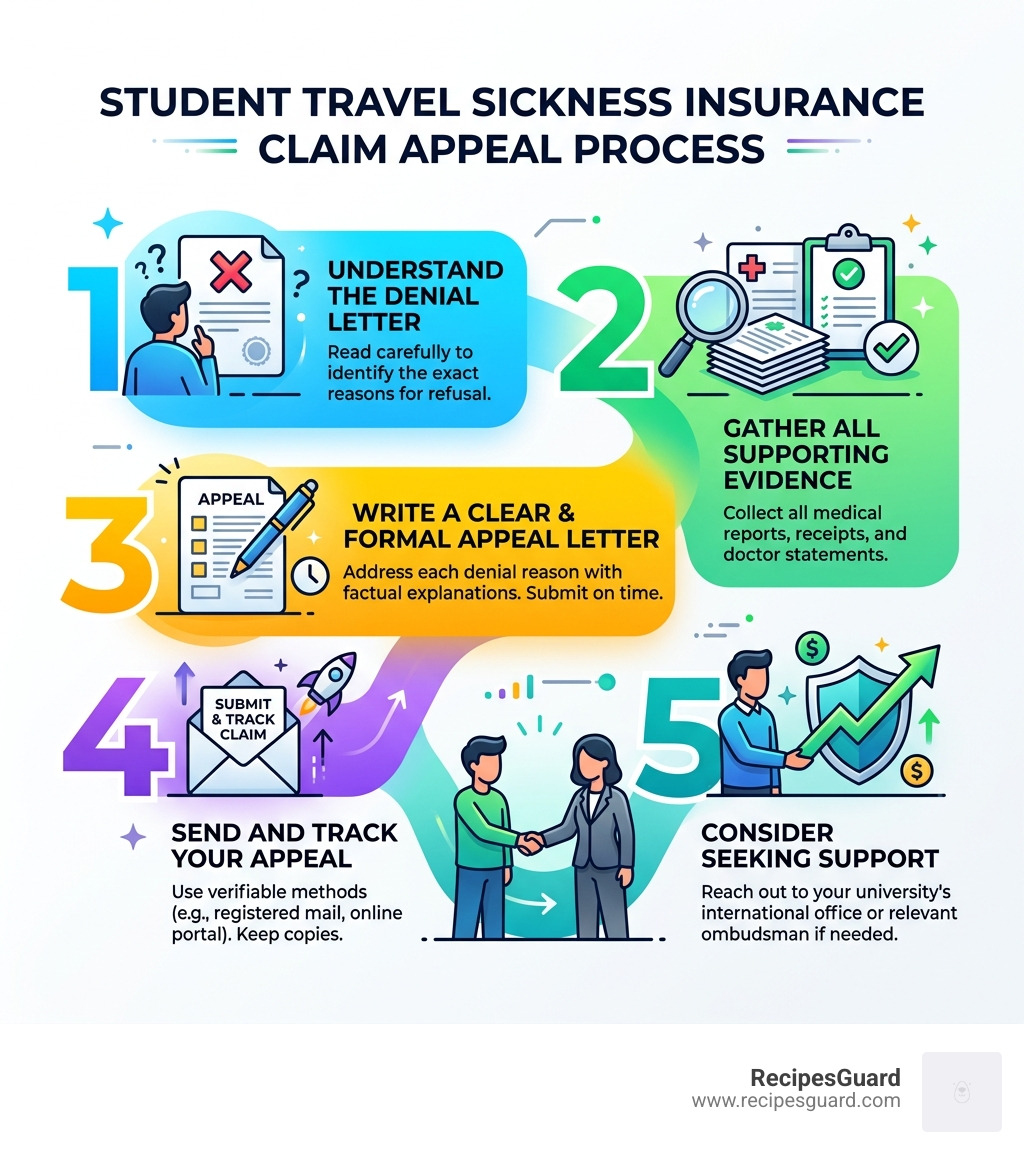
The Appeals Process and Timelines
In April 2026 insurance regulations, you generally have 90 days from the date of the “loss” to provide written notice of a claim. If you’ve been denied, you should:
- Request a written explanation: Ask the insurer to cite the specific policy wording they used to deny the claim.
- Gather new evidence: If they denied you for a pre-existing condition, get a letter from your GP at home stating the condition was stable.
- Internal Dispute Resolution (IDR): Every Australian insurer must have an IDR process. Submit your appeal here first.
- Ombudsman: If the IDR fails, you can take your case to the Australian Financial Complaints Authority (AFCA).
For a step-by-step guide on how to master this, check out How To Master The Student Travel Claim Process.
Frequently Asked Questions about Travel Sickness Claims
What qualifies as a ‘covered illness’ for trip cancellation?
A “covered illness” is typically one that is “disabling” enough to make a reasonable person cancel their trip, as advised by a doctor. It must be unexpected. A mild cold usually won’t cut it, but a high fever, infectious disease, or anything requiring hospitalization certainly will.
Does travel insurance cover pre-existing conditions for students?
Yes, but often only if you meet specific criteria. You usually need to purchase the “Pre-existing Medical Condition” waiver within 14–21 days of making your initial trip deposit. You must also be “fit to travel” at the time you buy the policy.
How long does it take to process a travel sickness claim?
While it varies, most Australian insurers aim to provide a response within 10 to 15 business days once all documentation is received. If you’re missing a single receipt, that clock resets!
Conclusion
At RecipesGuard, we believe that being a student traveler should be about exploring new cultures, not navigating a mountain of medical debt. A travel sickness insurance claim might seem daunting, especially if your first attempt was rejected, but the system is based on rules and documentation.
By following our student-focused tutorials and keeping a meticulous paper trail, you can turn a “Denied” into a “Reimbursed.” Don’t let a bout of the flu or a complex policy document ruin your international experience.
Need more help? Explore our Step By Step Guide To Filing A Travel Insurance Claim As A Student or visit us at RecipesGuard for more expert advice on protecting your journey.
Internal Links for further reading:
- How To Handle An Insurance Claim After An Accident
- Dont Let The Flu Ruin Your Trip Or Your Wallet
- Your Overseas Student Claim Guide For Stress Free Travel
- Mastering The Student Medical Claim Process In 5 Easy Steps
- Claiming Medical Expenses As A Student Made Easy
- Claim For Medical Expenses Without The Headache
- The Simple Student Tutorial For Filing Any Insurance Claim
- How To File A Travel Insurance Claim As A Student
- Overseas Student Claims Made Easy

My name is Bianca, and my journey into the world of fermentation and food safety began with a costly mistake. I once lost an entire season’s harvest of chili peppers because I relied on guesswork instead of science. That failure was my turning point.
