
The Best Student Travel Insurance for Lost Luggage Claims
What Every Student Abroad Needs to Know About Lost Luggage Coverage
A lost luggage claim student travel policy is a type of insurance benefit that reimburses students when their checked or carry-on bags are permanently lost, stolen, or damaged during a covered trip – and knowing how it works before you board can save you hundreds of dollars.
Here’s a quick overview of your main options:
| Coverage Type | Example | Max Reimbursement | Key Condition |
|---|---|---|---|
| Standalone student travel insurance | Comprehensive student plan | Up to $2,000 | Primary or secondary |
| Premium credit card benefit | Eligible premium travel card | Up to $3,000/person | Must pay fare with card |
| Group student plan | Student program plan | Up to $1,000 | Enrolled through program |
| University-provided insurance | University-arranged cover | Up to $1,000/bag | Exhaust airline claim first |
| Budget student plan | Entry-level travel plan | Varies by plan | Secondary coverage |
The short version: Airlines are legally required to compensate you first. Travel insurance or credit card benefits typically pay the difference after that. Most policies require you to file a report at the airport, notify your insurer within 20 days, and submit full documentation within 90 days.
More than 300,000 U.S. students study, intern, or volunteer abroad each year. And while airlines only mishandle roughly 5.9 bags per 1,000 passengers, that number adds up fast when millions of students are traveling every semester.
When it does happen to you – standing at the baggage carousel watching it spin empty – the financial hit can be real. A single bag packed with a laptop, textbooks, and clothing can easily represent $1,000 or more in losses.
The problem? Most students don’t know what their policy actually covers before something goes wrong. And by the time they find out, they’ve already missed a filing deadline or thrown away a key receipt.
This guide cuts through the confusion. We compare the top student travel insurance options for lost luggage protection, explain exactly what’s covered (and what isn’t), and walk you through the claim process step by step.
Must-know lost luggage claim student travel policy terms:
- flight missed claim student policy
- student trip delay compensation claim
- student flight cancellation claim guide
Understanding the Lost Luggage Claim Student Travel Policy

When we talk about a lost luggage claim student travel policy, we are essentially looking at a safety net designed to catch the costs that airlines won’t pay. In May 2026, as travel volume hits record highs, understanding the “fine print” of these policies is more critical than ever for students heading to Australia or elsewhere.
Most student travel insurance policies act as secondary coverage. This means you can’t just call your insurer the moment your bag goes missing. You first have to deal with the “Common Carrier” (the airline, bus line, or cruise ship). The insurance policy then kicks in to cover the gap between what the airline pays and the actual value of your items.
To get started with the basics, check out our guide on Lost Luggage Insurance 101. It’s also important to understand the emotional and logistical hurdles you’ll face, which we cover in Baggage Claim Blues Navigating Student Travel Insurance Claims.
| Feature | Standalone Student Insurance | Credit Card Baggage Benefits |
|---|---|---|
| Typical Limit | $1,000 – $3,000 | Up to $3,000 (varies by card) |
| Academic Items | Often includes textbooks/laptops | May exclude some categories |
| Medical/Evac | Included | Usually limited or separate |
| Cost | 5% – 9% of trip cost | Included in annual card fee |
Eligibility for Student-Specific Policies
Not everyone can grab a student-specific plan. Usually, you must be a full-time student at an accredited university. Some plans have age caps (often up to 25 for certain benefits), while others are flexible up to age 35 for post-grad researchers. If you’re unsure if you qualify, read our breakdown on How To Qualify For Student Travel Insurance.
Primary vs. Secondary Reimbursement
This is where students often get tripped up. Under international laws like the Montreal Convention, airlines are legally responsible for your bags. However, their payouts are often capped and based on weight rather than the value of your $2,000 MacBook.
A student travel policy provides “excess coverage.” You exhaust the airline’s liability first, then turn to your policy to recover the rest. To maximize these payouts, you need to understand the valuation methods insurers use. Learn more at How To Get The Best Luggage Compensation Payouts.
Key Coverage Limits and Exclusions for Students

While a $3,000 limit sounds great, it’s rarely a “blank check.” Most lost luggage claim student travel policy documents include “sub-limits.” For example, a policy might cover $2,000 total but limit “high-value items” (jewelry, electronics, furs) to just $500 in aggregate.
For a student, this is a major pitfall. If your bag contains a laptop, a tablet, and a nice camera, a $500 sub-limit won’t even cover the charger! Always check the Essential Baggage Loss Claim Documents You Need Right Now to see how to document these items before you leave. You should also look into How To Secure Checked Baggage Insurance For Your Next Trip to ensure your specific gear is protected.
Common Policy Exclusions
It’s a bit of a joke in the industry that insurance covers everything except what you actually lose. Common exclusions include:
- Cash and Currency: Never pack cash in checked bags; it is never covered.
- Contact Lenses and Eyeglasses: Often excluded or heavily limited.
- Business Equipment: If you’re interning and lose a company laptop, standard student policies might deny the claim.
- Reckless Behavior: If you leave your bag unattended in a hostel common room, don’t expect a payout.
For a deeper dive, see Understanding Common Travel Insurance Exclusions.
High-Value Item Riders
If you are traveling with expensive musical instruments or high-end photography gear for a film course, a standard policy isn’t enough. You may need a “rider” or scheduled personal property coverage. This ensures that if your bag is smashed or lost, you get the full replacement value. We discuss this further in Travel Insurance Luggage Damage From Smashed Bags To Successful Claims.
Step-by-Step Guide to Filing a Lost Luggage Claim Student Travel Policy
Filing a claim is a race against the clock. Most credit card providers (like Chase or Amex) require you to notify the Benefit Administrator within 20 days of the loss. If you wait until you get home from your semester abroad, your claim will be denied instantly.
Immediate Actions at the Airport
The moment you realize your bag isn’t coming, head to the airline’s baggage service desk.
- File a Property Irregularity Report (PIR): This is the “birth certificate” of your claim. Without a PIR, neither the airline nor your insurance will talk to you.
- Get a Copy: Take a photo of the PIR and keep the physical copy.
- Ask for Essentials: Some airlines provide “overnight kits” or small cash vouchers for immediate needs.
This phase is critical for both loss and delay claims. See The Ultimate Survival Guide For Delayed Baggage Claims for more tips.
Maximizing Your Lost Luggage Claim Student Travel Policy Reimbursement
Insurers typically pay the lesser of the following:
- The actual cash value (depreciated value based on age).
- The cost to repair the item.
- The cost to replace the item with a similar one.
To get the most money back, you need to prove what you owned. This is where Master The Art Of Getting Paid For Your Missing Suitcase comes in handy.
Documentation Required for a Lost Luggage Claim Student Travel Policy
You will typically need to submit your full claim within 90 days. The “Golden List” of documents includes:
- Your travel itinerary and boarding passes.
- A copy of the PIR from the airline.
- A copy of the settlement (or denial) letter from the airline.
- Original receipts for items over a certain value (usually $150).
- Credit card statements showing you paid for the trip.
Having The Essential List Of Student Travel Insurance Forms ready before you travel can make this process much smoother.
Special Considerations for Study Abroad and Gap Years
Students on long-term trips face unique risks. If you’re in Australia for a full academic year, a standard 30-day travel policy won’t cut it. You need a policy that covers the entire duration and accounts for the fact that you might be carrying your entire life in two suitcases.
Academic-focused plans often include “Tuition Protection,” which is a lifesaver if a lost luggage incident (or a medical emergency) forces you to withdraw from your program. We explore these student-specific nuances in The Baggage Claim Survival Guide For Students and Lost Luggage Student Australia What To Do When Your Books Go Missing.
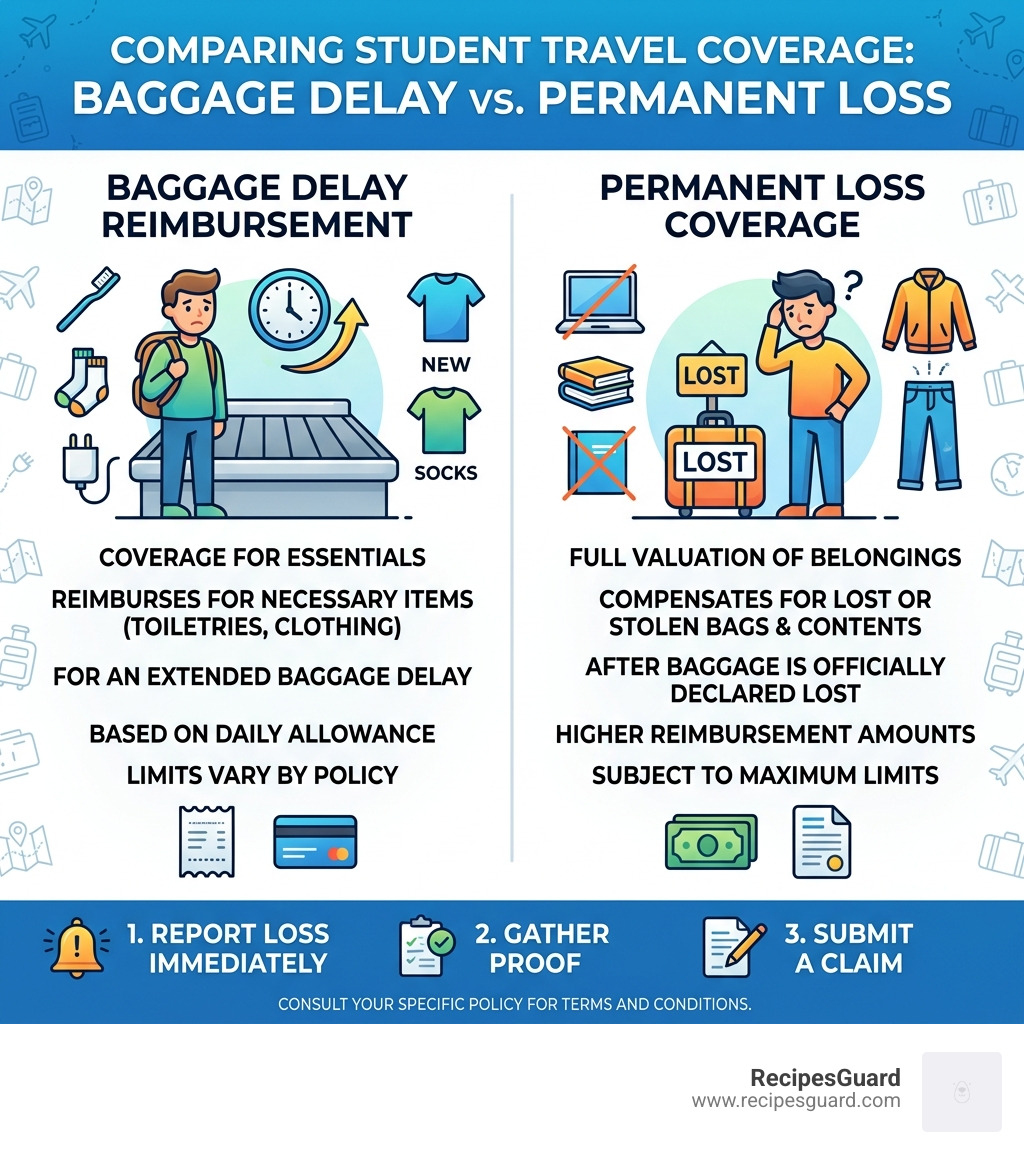
Baggage Delay vs. Permanent Loss
These are two different benefits:
- Baggage Delay: Reimburses you for “essential items” (toiletries, a change of clothes) if your bag is late by a certain number of hours (usually 6 to 12).
- Permanent Loss: Reimburses you for the total value of the bag after the airline officially declares it “lost” (usually after 21-28 days).
Many students make the mistake of buying a whole new wardrobe on a delay claim. Most policies cap delay reimbursement at $100–$200 per day. For the full breakdown, read The Baggage Delay Claim Process Explained For Weary Travelers.
Interaction with Homeowners or Renters Insurance
Did you know your parents’ homeowners insurance might cover your lost luggage? Many policies include “off-premises” coverage for personal property. However, the deductible is often $500 or $1,000, which might be more than the value of the lost bag.
Travel insurance is usually the better route because the deductibles are much lower (often $0 to $50). We compare these options in The Ultimate Guide To Stolen And Delayed Luggage Insurance.
Frequently Asked Questions about Student Baggage Claims
What is the typical reimbursement limit for a student policy?
Most student-specific plans offer between $1,000 and $2,000 for baggage loss. Premium credit cards can go up to $3,000. However, always check the “per-item” limit, which is often capped at $250 or $500.
Does insurance cover stolen bags from a hostel or shared dorm?
Yes, but only if you weren’t “negligent.” If your bag was in a locked locker and the locker was broken into, you’re covered. If you left it on your bed while you went to grab a coffee, your claim will likely be denied.
How long does the airline have to find my bag before it is “lost”?
Under most carrier policies, a bag is considered “delayed” for the first 21 days. After 21 days, it is officially “lost,” and you can begin the permanent loss claim process with your insurer.
Conclusion
Navigating a lost luggage claim student travel policy doesn’t have to be a nightmare. At RecipesGuard, we specialize in providing students with the step-by-step tutorials and advisory they need to win their insurance battles. Whether you’re heading to the UK, Europe, or staying right here in Australia, having the right protection ensures that a missing suitcase is just a minor detour, not the end of your adventure.
Ready to secure your gear? Protect your next academic journey with our expert guides and claim-filing checklists. Safe travels!

My name is Bianca, and my journey into the world of fermentation and food safety began with a costly mistake. I once lost an entire season’s harvest of chili peppers because I relied on guesswork instead of science. That failure was my turning point.
