
What Every International Student Needs to Know About Health Coverage
International student health coverage is a type of medical insurance designed specifically for students studying outside their home country — and in the U.S., it is almost always required, not optional.
Here’s a quick answer to what you need to know:
- Who needs it: All international students on F1, M1, J1, and OPT visas studying in the U.S.
- Why it’s required: U.S. universities mandate it, and some visa types (like J1) require it by federal law
- What it covers: Doctor visits, hospitalization, mental health care, telehealth, and emergency evacuation
- What it costs: Independent plans start around $29/month; university plans can run over $3,800/year
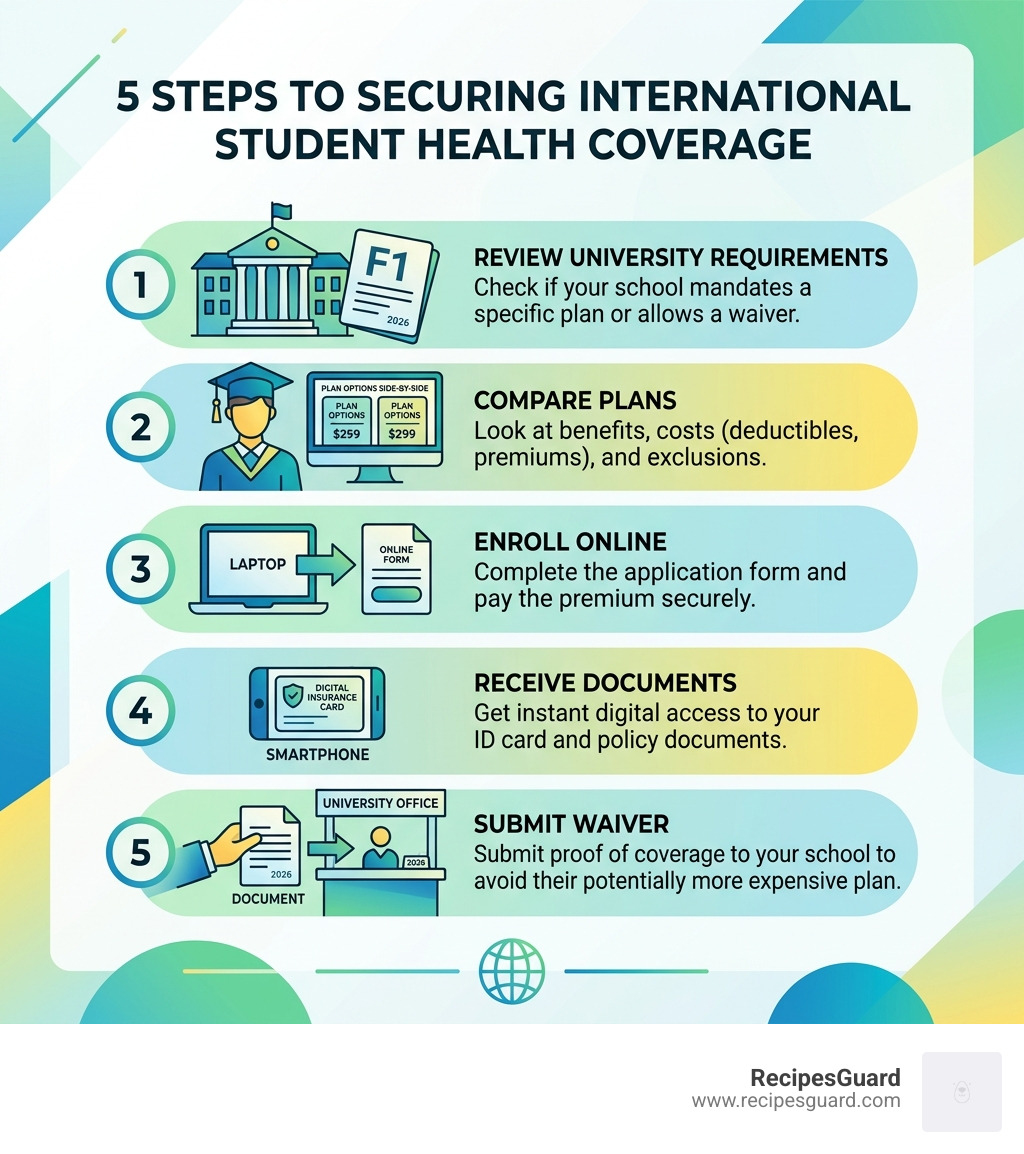
- How to get it: Enroll online, receive instant documents, and submit for a university waiver
U.S. healthcare is among the most expensive in the world. A single emergency room visit can cost thousands of dollars out of pocket. Without the right plan in place, one unexpected illness or injury can derail your entire study experience — financially and academically.
The good news? The right coverage doesn’t have to be complicated or costly.
Whether you’re just arriving on an F1 visa, transitioning to OPT after graduation, or bringing dependents with you, understanding your options puts you firmly in control.
International student health coverage terms to remember:
- medical bill dispute guide
- hospital stay claim process
- insurance claim student visa
Why International Student Health Coverage is Essential
As we move through May 2026, the landscape of global education continues to grow, with over one million international students and scholars pursuing their dreams in the United States alone. At RecipesGuard, we have seen how essential proper international student health coverage is for a successful academic journey. We have helped protect students across 3,000+ US schools, ensuring that medical bills don’t turn a dream degree into a financial nightmare.
The primary reason this coverage is essential is the sheer cost of the American healthcare system. Unlike many countries where healthcare is subsidized or public, the U.S. system is largely privatized. Without insurance, a simple flu visit could cost $200, and a more serious surgical procedure could exceed $50,000.
Beyond the bills, having a dedicated plan provides:
- Emergency Medical Access: Guaranteed admission to hospitals and access to specialists without waiting for weeks.
- 24/7 Support: Most plans we recommend include multilingual support teams who understand the unique stresses of being an expat student.
- Peace of Mind: Knowing that if you trip during a weekend hike or fall ill during finals, your focus remains on recovery, not your bank balance.
To dive deeper into the specifics of why you shouldn’t skip this step, check out Everything You Need To Know About Student Study Abroad Insurance.
Navigating Visa Requirements and University Waivers
Understanding the legal side of insurance is half the battle. Depending on your visa type (F1, M1, or J1), the U.S. government and your university will have different “must-haves” for your policy. At RecipesGuard, we have assisted students from over 185 countries in matching their plans to these strict requirements.
For example, the J1 visa (often for scholars and exchange students) has federal requirements set by the Department of State. If your insurance doesn’t meet these specific benchmarks, you could be in violation of your visa status. F1 students usually have more flexibility from the government but face strict rules from their specific universities.
Most schools automatically enroll you in their own “sponsored” plan. However, these are often the most expensive options. To save money, you can apply for a “waiver.” This means you prove to the school that you’ve purchased a private plan that provides the same level of protection. If you want to learn more about keeping your costs down, read our guide on University Health Insurance: How To Get Covered Without Going Broke.
Understanding J1 and F1 International Student Health Coverage Requirements
The requirements for J1 and F1 visas often overlap, but J1 holders must be particularly careful. The U.S. Department of State mandates that J1 plans include:
- Medical benefits of at least $100,000 per accident or illness.
- Repatriation of remains in the amount of $25,000.
- Medical evacuation coverage of at least $50,000.
- A deductible not to exceed $500 per accident or illness.
F1 students, while not always bound by these federal minimums, must often meet “ACA-compliant” or “Minimum Essential Coverage” (MEC) standards set by their university. This ensures that things like pre-existing conditions and preventative care are covered.
Meeting University Waiver Criteria with Private Plans
To successfully waive your school’s insurance, you need to be proactive. Most universities have a “waiver deadline” (often around the start of the semester). For the upcoming term, many schools have deadlines as early as April or May 2026.
You will typically need to provide:
- An Insurance Certificate (proof of coverage).
- A Summary of Benefits (showing what the plan covers).
- A Waiver Form signed by your insurance provider.
Many private providers now offer “guaranteed waiver approval.” This means if the school rejects the plan, you get your money back. For a step-by-step breakdown of this process, see Navigating The Maze Of Student Health Insurance Plans In The Usa.
Comparing Plan Types, Costs, and Benefits
When we compare international student health coverage options, we usually look at two paths: the University-Sponsored Plan and the Independent (Third-Party) Plan.
| Feature | University-Sponsored Plan | Independent Plan (e.g., RecipesGuard advised) |
|---|---|---|
| Cost | High (Average $3,804/year) | Low (Starting at $29-$39/month) |
| Flexibility | Fixed dates and benefits | Customizable levels (Economy to First Class) |
| Network | Usually local or state-wide | Nationwide PPO networks |
| Enrollment | Automatic | Instant online enrollment |
| Dependents | Often excluded or very expensive | Easy to add spouses and children |
Independent plans often use Preferred Provider Organization (PPO) networks. This is a massive advantage because it allows you to access over one million doctors across the U.S. with lower out-of-pocket costs.
Factors Affecting the Cost of International Student Health Coverage
Pricing isn’t one-size-fits-all. Several factors will determine what you pay for your international student health coverage:
- Age: Plans are typically age-banded. A 19-year-old will pay less than a 35-year-old PhD candidate.
- Plan Level: Choosing a “Basic” or “Economy” plan with a higher deductible will lower your monthly premium, while “Platinum” plans with $0 deductibles cost more upfront.
- Duration: Some plans offer daily billing, allowing you to pay only for the exact days you are in the country.
- Location: While many plans are nationwide, some costs may fluctuate based on the state where your university is located.
For a deep dive into budgeting for these expenses, refer to The Ultimate Guide To Student Health Coverage And Costs.
Key Benefits and Common Exclusions to Watch For
A good plan is about more than just emergency room visits. In May 2026, we are seeing a much higher demand for comprehensive wellness benefits. Look for plans that include:
- Mental Health Support: Essential for coping with the stress of studying abroad.
- Telehealth: 24/7 access to doctors via your phone, often with a very low co-pay (sometimes as low as $5).
- Sports Injuries: If you plan on playing intramural soccer or basketball, make sure your plan doesn’t exclude “organized sports.”
- Emergency Evacuation: If you need to be moved to a better medical facility or flown home for treatment.
Common Exclusions: Most plans will not cover elective cosmetic surgery, routine vision (glasses/contacts) unless specified, or injuries sustained while under the influence of illegal substances. Be sure to check the “waiting period” for pre-existing conditions, which can range from 6 to 12 months. More details can be found at Budgeting For Wellness The Real Cost Of International Student Health Insurance.
How to Access Care and Manage Medical Claims

Once you are insured, the next step is knowing how to use it. Most students find the U.S. “claims” system confusing, but we aim to simplify it. When you feel sick, your first step should be finding an in-network doctor. Using an in-network provider means the insurance company has a pre-negotiated rate with that doctor, saving you money.
Many modern plans provide a digital ID card. You simply show this at the front desk of the clinic. If the provider is in-network, they will often use “direct billing,” meaning they send the bill straight to the insurance company, and you only pay your co-pay (a small fixed fee) at the time of the visit.
Filing a Claim Without the Stress
If you end up at a clinic that doesn’t offer direct billing, don’t panic. You will need to pay upfront and then file a claim for reimbursement. At RecipesGuard, our specialty is providing step-by-step tutorials on exactly how to do this.
The Claim Checklist:
- Itemized Bill: Ask the doctor for a “HCFA” or “UB04” form. A simple receipt is usually not enough.
- Claim Form: Fill out the form provided by your insurance company.
- Medical Records: Sometimes the insurer will ask for a “Doctor’s Note” to explain why the visit was necessary.
- Explanation of Benefits (EOB): After you submit, you’ll receive an EOB. This isn’t a bill; it’s a document showing what the insurance covered and what (if anything) you still owe.

Frequently Asked Questions about Student Insurance
Can I keep my health insurance while on OPT or STEM OPT?
Yes! Optional Practical Training (OPT) is a critical time for international students. Often, there is a gap between when your university insurance ends and when your new employer’s insurance begins. We recommend dedicated OPT plans, which can start as low as $39/month. These plans allow you to maintain your F1 status and stay protected while you start your career. For a full breakdown, see our Stem Opt Health Insurance Complete Guide.
Does international student insurance cover me during summer breaks or travel?
Most high-quality international student health coverage provides “worldwide coverage,” excluding your home country. This means if you go on a spring break trip to Mexico or a summer tour of Europe, you are still protected. However, always check if your plan requires a “travel rider” for certain high-risk activities like scuba diving or mountain climbing.
What is the difference between a deductible and a co-pay?
- Deductible: This is the amount you must pay out of your own pocket before the insurance company starts paying. For example, if you have a $100 deductible and a $500 bill, you pay the first $100, and the insurance handles the rest.
- Co-pay: A small, fixed amount you pay for a specific service (e.g., $25 for a doctor visit or $10 for a prescription).
- Out-of-Pocket Maximum: This is the most you will ever have to pay in a single year. Once you hit this limit, the insurance covers 100% of everything else.
Conclusion
As you prepare for your upcoming semester in May 2026, don’t let insurance be an afterthought. Securing the right international student health coverage is a vital part of your “study abroad” checklist, right alongside your visa and your plane tickets.
By choosing an independent plan, you can save thousands of dollars compared to university-sponsored options while still meeting all the necessary waiver requirements. Remember to check your university’s waiver deadlines early—missing a deadline can result in being forced to pay for the school’s expensive plan.
At RecipesGuard, we are committed to making sure you never have to navigate a medical bill alone. From finding the right plan to our student-focused claim filing tutorials, we are here to ensure your focus stays on your education.
Ready to find the perfect plan? Explore our resources and get protected today at https://www.recipesguard.com/.
External Resources for Further Reading:
- Overseas Student Health Cover (OSHC) – Study Australia
- University Health Insurance Plan (UHIP) – Centre for International Experience
- U.S. Department of State – Insurance Requirements for J-1 Visa Holders

My name is Bianca, and my journey into the world of fermentation and food safety began with a costly mistake. I once lost an entire season’s harvest of chili peppers because I relied on guesswork instead of science. That failure was my turning point.
