
The Essential List of Student Travel Insurance Forms
What a Claim Form Student Travel Actually Is (And Where to Get One)
Claim form student travel paperwork is what you file with your insurance provider to get reimbursed after paying for medical care, a cancelled trip, or lost luggage while studying away from home.
Here are the most common student travel claim forms you may need:
- Medical/Accident Claim Form – for doctor visits, hospital stays, or prescriptions paid out of pocket
- Trip Cancellation/Interruption Claim Form – for non-refundable travel costs lost due to illness or emergencies
- Baggage Loss/Damage Claim Form – for stolen, lost, or damaged luggage
- Study Abroad Travel Expense Form – for travel costs during overseas study periods (e.g., UK Student Finance forms)
- Prescription Reimbursement Form – for medication costs not billed directly to your insurer
Most insurance providers offer downloadable PDF claim forms on their websites or through an online member portal.
Here’s the thing most students don’t realize until it’s too late: when you receive care abroad, you often pay upfront first, then claim reimbursement afterward. That means paperwork is unavoidable.
Whether it’s a sudden illness in another country or a delayed flight wiping out prepaid hotel costs, the process almost always starts with the same step — finding the right form and filling it out correctly.
The good news? Once you know what each form covers and what documents to attach, the process is far more manageable than it looks.
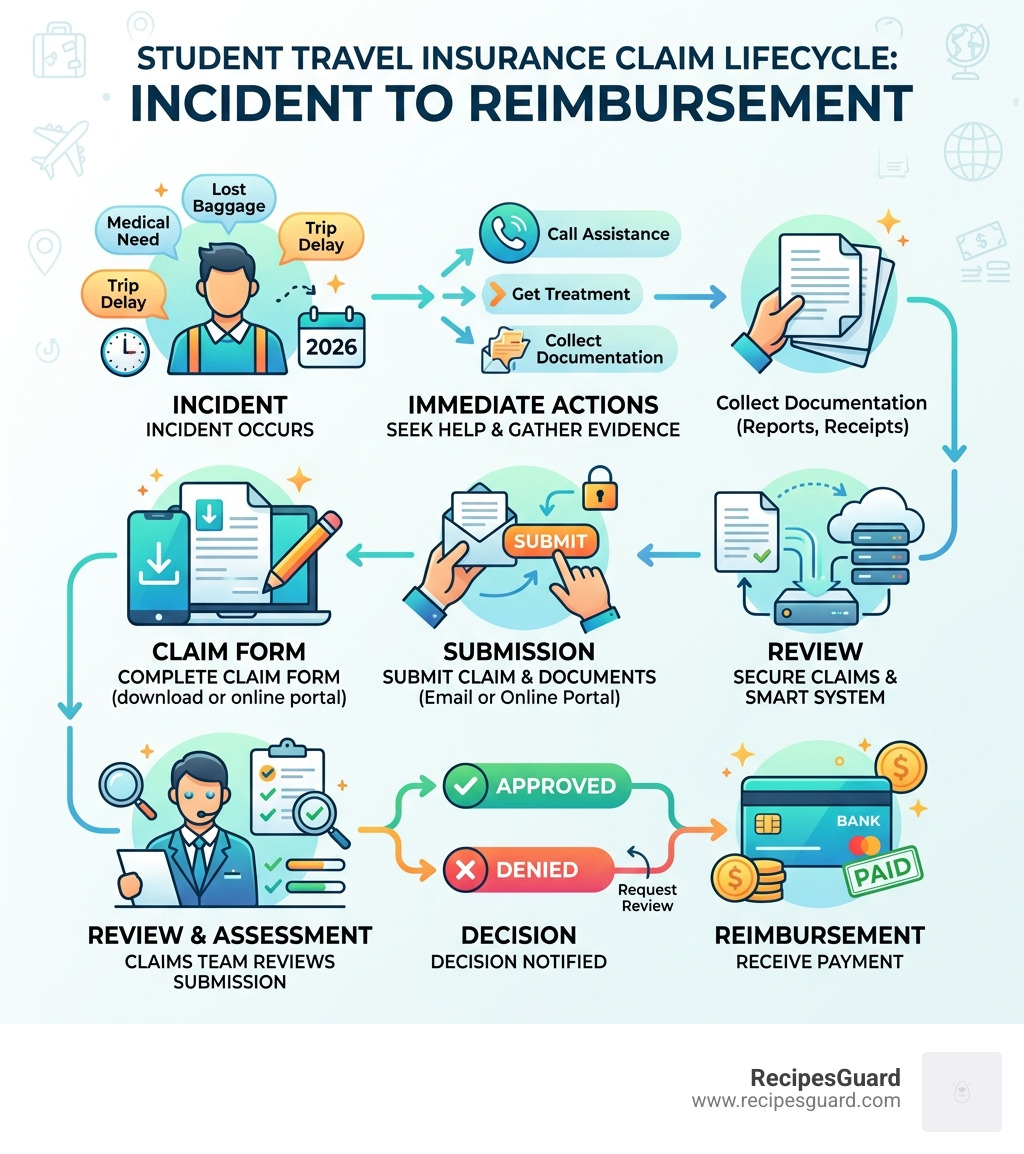
Easy claim form student travel word list:
Common Types of Claim Form Student Travel

Navigating insurance as a student can feel like trying to solve a Rubik’s cube in the dark. However, identifying the specific claim form student travel you need is the first step toward getting your money back. In April 2026, the landscape of student travel remains diverse, covering everything from health emergencies to government-backed travel allowances.
The most frequent forms we see students using include:
- Medical Expense Reimbursement: Used when you have paid a doctor or hospital upfront.
- Trip Cancellation: For when life happens and you can’t make your flight.
- Baggage and Personal Effects: For when your suitcase decides to take a solo vacation to a different continent.
- Fares Allowance: Specific to programs like ABSTUDY Fares Allowance Claim form (SY032) – Services Australia , which helps Australian students cover the costs of traveling between their home and study location.
For many Canadian students, the Travel Claim Request Form is the primary gateway to initiating a refund. Many modern providers now use “initiation forms” online to gather your basic data before sending you the full legal paperwork via email.
Medical and Accident Reimbursement
Medical claims are the “heavy hitters” of the insurance world. If you trip over a cobblestone in Rome or catch a nasty flu in Sydney, you’ll likely need to file for reimbursement. Most international student plans allow for 100% reimbursement of covered services, but you must provide itemized bills. An itemized bill isn’t just a credit card receipt; it must show the date of service, the specific diagnosis (why you were there), and a breakdown of the charges.
We always recommend that students Claiming Medical Expenses As A Student Made Easy by asking the doctor for a “medical report” or “clinical summary” before leaving the office. Without a diagnosis code or description, your insurer won’t know if the visit was for a covered illness or a non-covered routine check-up.
Study Abroad and Fares Allowance
For students on government grants or specific university programs, travel isn’t just about insurance—it’s about reimbursement for the journey itself. Forms like the Claim for Reimbursement of Travelling Expenses for Study Periods Abroad 2025-2026 are essential for UK-based students.
There are often specific thresholds involved. For instance, many student finance grants require the student to pay the first £303 of travel costs out-of-pocket before the grant kicks in. If your household income is higher (typically £59,200 or more for post-2018 courses), that out-of-pocket threshold might jump to £1,000. These forms also allow you to claim back 40% of your medical insurance premium and the costs of mandatory visas and vaccinations.
Essential Documentation for Your Claim
If the claim form student travel is the heart of your request, the documentation is the backbone. Without proof, an insurance company is just taking your word for it—and they rarely do that.
To ensure your claim isn’t dead on arrival, you need to gather:
- Itemized Receipts: These must show exactly what you paid for.
- Proof of Payment: A copy of your bank statement or a “paid” stamp on the invoice.
- Medical Reports: Documentation from the physician explaining your symptoms and diagnosis.
- Police Reports: Absolutely mandatory for stolen items or motor vehicle accidents.
- Travel Itineraries: To prove you were actually in the location where the incident occurred.
Knowing What Documents Students Need For Travel Insurance Claims before you leave can save you hours of international phone calls later. We suggest you learn How To Gather Evidence For Your Travel Insurance Claim Like A Pro by keeping a dedicated folder (digital or physical) for every receipt you collect while abroad.
Pro Tip: Even if you use your ID card for direct billing, keep a copy of the paperwork. Sometimes providers forget to send the diagnosis to the insurer, and you’ll be asked to fill out a “Claimant’s Statement” later to fill in the gaps.
How to Properly Complete a Claim Form Student Travel
Filling out the form is where most students get a bit “creative,” which is a polite way of saying they make mistakes. Accuracy is your best friend here.
| Feature | Medical Claim Requirement | Non-Medical (Baggage/Trip) Requirement |
|---|---|---|
| Policy Number | Mandatory | Mandatory |
| Incident Date | Date of first symptoms/injury | Date of loss or cancellation |
| Description | Symptoms and diagnosis | Detailed account of what happened |
| Supporting Docs | Medical bills & physician info | Receipts, police reports, itineraries |
| Signature | Required (often digital) | Required |
When you sit down to fill out your claim form student travel, have your policy document open. You must match your name and ID number exactly as they appear on your insurance card. If you are an international student, pay close attention to the address field. Many providers require a permanent address in your home country or a specific U.S. address to avoid policy exclusions.
Follow our Step By Step Guide To Filing A Travel Insurance Claim As A Student to ensure you don’t skip the “Authorization to Release Information” section. If you don’t sign that, the insurer can’t talk to your doctor, and your claim will stall indefinitely.
Tracking Your Claim Form Student Travel Status
Once you hit “submit,” the waiting game begins. Most major insurance providers offer online portals where you can track your status.
- Initial Review: Usually takes about 15 business days.
- Requests for Info: If something is missing, they will email you. Check your spam folder!
- Payment Processing: Once approved, it takes another 7-10 business days for a check to arrive via mail.
If you want to stay on top of things, How To Master The Student Travel Claim Process involves logging into your portal once a week. Don’t just wait for a letter in the mail; digital updates are much faster in 2026.
Special Requirements for International Students
International students face a unique set of hurdles. If you are studying in the U.S. and visiting your home country, you must use your permanent U.S. address on the claim form student travel. Using your home country address can lead to a denial because many policies exclude coverage in your “home country.”
Furthermore, if your medical bills are not in English, you may need translation services. Many insurance providers often offer these services, but you must request them. The Student Travel Claim Form specifically asks for details on whether you’ve had the condition before, which is a common sticking point for students with pre-existing conditions.
Submission Deadlines and Reimbursement Methods
Time is of the essence. Most student travel insurance policies have a 90-day deadline for submitting claims. If you wait until the semester ends to file for a doctor’s visit that happened in the first week, you might be out of luck.
When it comes to getting paid, you usually have three options:
- Check: The default method, usually mailed to a U.S. or Australian address.
- Direct to Provider: If the bill hasn’t been paid yet, the insurer can pay the hospital directly.
- Wire Transfer: Often preferred for international reimbursements, though some providers have a $250 minimum for wire transfers.
Understanding How To Submit Claim Paperwork And Actually Get Paid means choosing the reimbursement method that works best for your current banking situation. If you’re moving between countries, a wire transfer is often safer than a check that might get lost in the mail.
Avoiding Common Pitfalls and Rejections
Why do claims get rejected? Usually, it’s not a conspiracy; it’s a missing signature or an incomplete form.
Common mistakes include:
- Missing Signatures: Even digital forms often require a “drawn” signature or a specific tick-box.
- Vague Incident Descriptions: Writing “I felt sick” isn’t enough. You need to describe the onset of symptoms and what the doctor actually found.
- Invalid Receipts: Cash register receipts that just say “Pharmacy $50” won’t work for prescriptions. You need the pharmacy receipt that lists the medication name and dosage.
If your claim is knocked back, don’t panic. Learn Why Your Student Claim Might Get Rejected And How To Fix It so you can provide the missing info. If the denial seems unfair, Claim Denied Here Is How Students Can Fight Back And Win by filing a formal appeal with additional evidence.
Frequently Asked Questions about Student Travel Claims
What is the typical deadline for filing a student travel claim?
For most international safety and security reimbursements, you must submit your claim form student travel and all supporting documents within 90 days of receiving care. Missing this window is one of the most common reasons for claim denial. Always file as soon as you are stable and have your receipts in hand.
Can I claim for costs other than medical emergencies?
Yes! Depending on your policy and government grant eligibility, you can often claim for:
- Visas: Mandatory entry permits for your study destination.
- Vaccinations: Required medical tests or shots for travel.
- Travel Grants: Programs like the Turing Scheme, Erasmus+, or Taith often provide specific allowances for travel costs that can be reimbursed via official student finance forms.
How long does it take to receive a reimbursement check?
The standard processing time for a review is about 15 business days. Once approved, if you are receiving a check via USPS, expect an additional 7 to 10 business days for delivery. If you are using an online portal, you can often see the “Approved” status a few days before the payment is actually dispatched.
Conclusion
Navigating a claim form student travel doesn’t have to be a nightmare. By staying organized, keeping your receipts, and filing within that crucial 90-day window, you can ensure that your focus stays on your studies rather than your bank balance.
At RecipesGuard, we pride ourselves on being your go-to insurance advisory experts. Our goal is to simplify the complex and provide the student-focused, step-by-step tutorials you need to get your claims across the finish line. Whether you’re studying in Australia or heading overseas, we are here to help you master the paperwork.
Ready to take the next step? Start Mastering the student travel claim process today with our comprehensive guides and expert advice. Safe travels!

My name is Bianca, and my journey into the world of fermentation and food safety began with a costly mistake. I once lost an entire season’s harvest of chili peppers because I relied on guesswork instead of science. That failure was my turning point.
