
Master the Art of Getting Paid for Your Missing Suitcase
Your Baggage Rights and How to Get Paid When Your Luggage Goes Missing
Knowing how get luggage compensation can save you hundreds of dollars when an airline loses, delays, or damages your bags. Here’s the short answer:
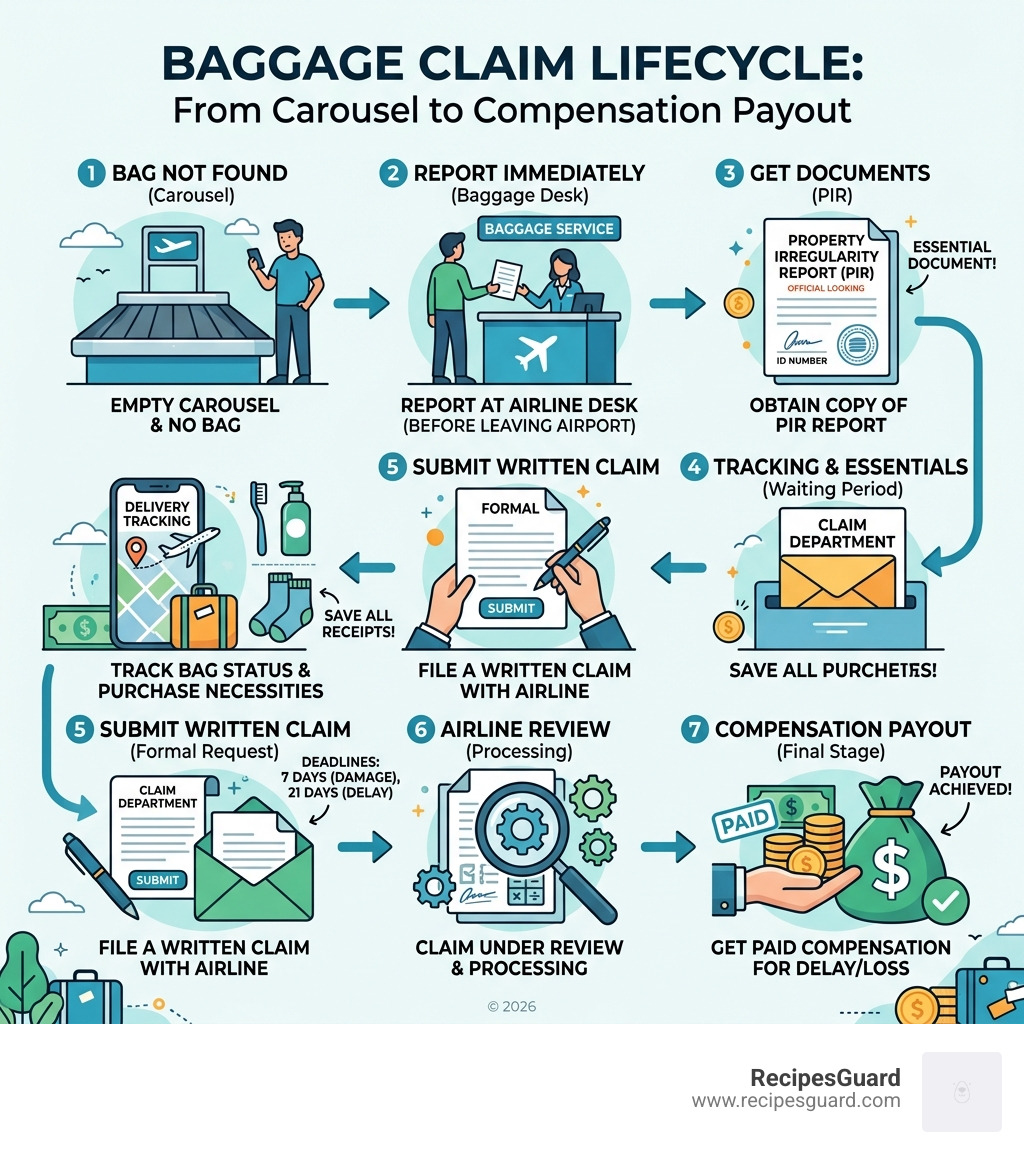
How to get luggage compensation — quick steps:
- Report the issue immediately at the airline’s baggage service desk before leaving the airport
- Fill out a Property Irregularity Report (PIR) and keep your copy
- Save every receipt for essential items you buy while waiting for your bag
- File a written claim with the airline within the deadlines (7 days for damage, 21 days for delays)
- Claim the full amount you’re owed — up to $4,700 on US domestic flights or ~$2,175 USD on international flights under the Montreal Convention
Every year, millions of bags are lost, delayed, or damaged by airlines. And most passengers walk away with far less than they’re owed — or nothing at all — simply because they didn’t know the rules.
The process isn’t complicated. But it is deadline-driven. Miss the window, and the airline can legally deny your claim outright, even if the fault is entirely theirs.
This matters especially if you’re a student traveling internationally. You may be carrying everything you need for a semester abroad — and a delayed or missing bag can leave you scrambling for essentials in an unfamiliar city with little cash to spare.
The good news? The rules are on your side. International treaties like the Montreal Convention set clear liability limits and passenger rights. Domestic regulations in the US, Canada, and elsewhere add further protections. And airlines are required to compensate you for reasonable expenses — they just don’t advertise it.
Essential how get luggage compensation terms:
- Australia Student Luggage Insurance
- Travel Insurance Luggage Damage
- Lost Luggage Insurance
Immediate Actions: What to Do at the Airport
The moment you realize your suitcase isn’t joining you at the carousel, the clock starts ticking. We know you’re tired and probably just want to get to your hostel or dorm, but leaving the airport without a paper trail is the number one mistake travelers make.
First, head straight to the airline’s baggage service desk. Do not pass go; do not head to the taxi stand. You need to file what is known as a Property Irregularity Report (PIR). This is a formal document that logs your case into the airline’s tracking system.
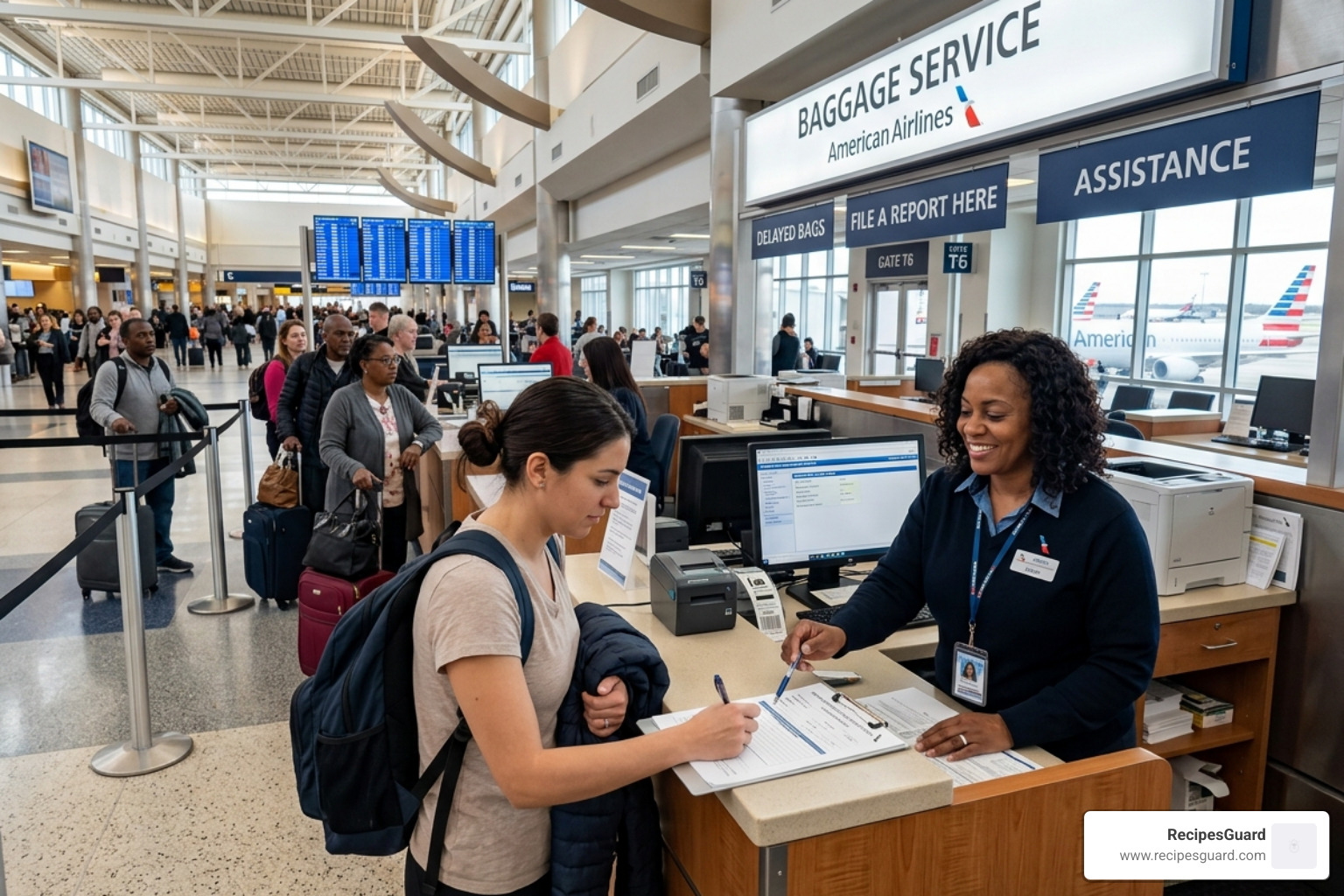
When filling out the PIR, be as detailed as possible. Describe the color, brand, and any identifying features of your bag (like that bright neon ribbon you tied to the handle). Make sure you receive a copy of the PIR and, most importantly, the 10-digit file reference number. This number is your golden ticket; without it, tracking your bag or filing a future claim becomes a nightmare.
While you are at the desk, ensure you also:
- Keep your baggage tags: Those little sticky barcodes they gave you at check-in are vital evidence.
- Gather contact info: Get the name of the agent you spoke with and a direct phone number for the baggage office.
- Take photos: If your bag arrived but is smashed, torn, or open, take high-quality photos immediately at the carousel.
According to the US Department of Transportation, you should stay in close communication with the airline during the location process. If you’re a student in Australia or traveling internationally, being proactive here ensures the airline knows you aren’t going to just “let it go.”
Understanding Your Rights and How Get Luggage Compensation
To successfully navigate how get luggage compensation, you need to know which law applies to your flight. It usually boils down to whether your flight was domestic or international.
For most international travel, the Montreal Convention is the governing treaty. As of April 2026, the maximum liability for international flights is 1,519 Special Drawing Rights (SDR). Since SDRs are a “basket” of global currencies, the value fluctuates, but it currently sits at approximately $2,175 USD (€1,800 / C$2,780 / £1,800) per passenger.
If you are flying domestically within the United States, the protections are even higher. The US Department of Transportation sets a maximum liability limit of $4,700 per passenger for lost, damaged, or delayed baggage.
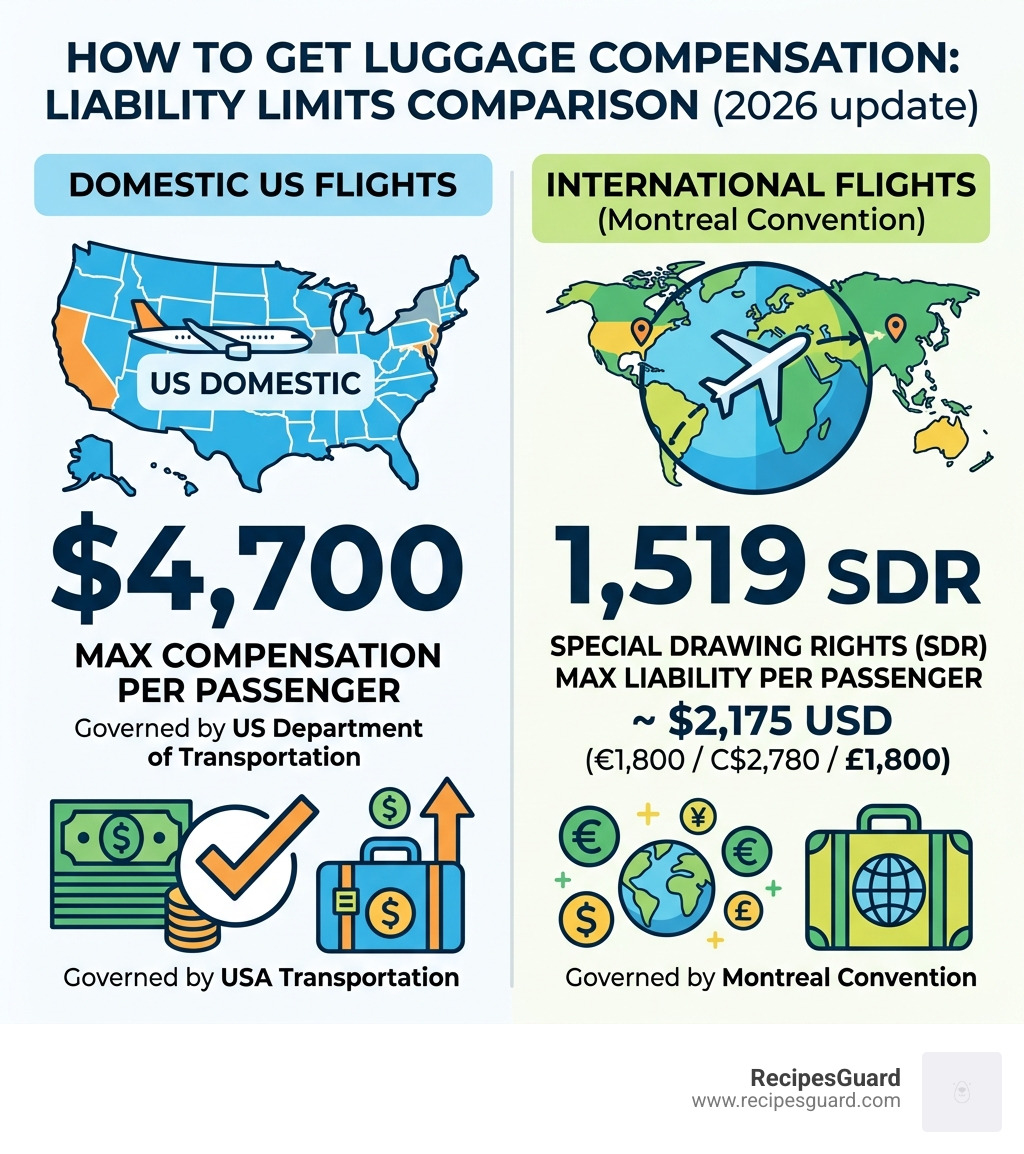
In Canada, the Air Passenger Protection Regulations (APPR) align closely with international standards, offering a maximum compensation of approximately C$2,780 for baggage issues as of late 2024.
| Flight Type | Governing Rule | Max Compensation (Approx.) |
|---|---|---|
| International | Montreal Convention | ~ $2,175 USD (1,519 SDR) |
| US Domestic | 14 CFR Part 254 | $4,700 USD |
| Canada Domestic | APPR | $2,780 CAD |
How get luggage compensation for delayed bags
If your bag is just late (delayed), the airline is responsible for reimbursing you for “reasonable” and “necessary” expenses. But what does that actually mean?
Airlines are required to cover the cost of items you need because you don’t have your suitcase. This typically includes:
- Toiletries (toothbrush, toothpaste, deodorant)
- Basic clothing (underwear, socks, a change of clothes)
- Necessary items for a specific event (a suit for a wedding or a coat for a cold climate)

Pro-tip for students: Don’t go on a luxury shopping spree. Airlines will fight claims for designer labels unless you can prove you actually had those items in your bag and needed an exact replacement for a formal event. Stick to mainstream brands and keep every single itemized receipt. You have a 21-day window from the time you receive your bag to submit these receipts for reimbursement.
How get luggage compensation for lost or damaged items
A bag is officially considered lost if it hasn’t been returned to you within 21 days. However, many airlines will declare it lost much sooner—usually between 5 and 14 days. Once it’s “lost,” you can claim the value of the bag and its entire contents, up to the legal limits mentioned above.
For damaged baggage, the rules are stricter. You generally have only 7 days from the date you received the bag to file a written claim.
Be aware that airlines often apply depreciation to your items. They won’t give you the “new” price for a three-year-old laptop or a pair of worn sneakers. They also frequently exclude “fragile” items, cash, and jewelry from liability on domestic flights. However, as noted by Citizens Advice, for international flights, airlines are generally responsible for these items if they accepted them for transport.
Strict Deadlines and Essential Documentation
The fastest way to lose your right to compensation is to miss a deadline. Airlines love technicalities, so we recommend setting calendar alerts the moment your bag goes missing.
- Damaged Baggage: Report it at the airport immediately. If you discover the damage later, you must submit a written claim within 7 days.
- Delayed Baggage (International): You must submit your written claim for expenses within 21 days of the bag being delivered to you.
- Delayed Baggage (Domestic): Check the airline’s “tariff” (their legal contract), but usually, you should file as soon as possible, often within 24 hours to 7 days.
- Lost Baggage: File the claim immediately once the 21-day mark hits (or as soon as the airline admits they lost it).
- Legal Action: Under the Montreal Convention, you have 2 years to take the airline to court, but you must have filed the initial claims within the 7/21-day windows first.
To win your claim, you need an “evidence package.” We suggest keeping a digital folder with:
- Your boarding pass and e-ticket.
- The original baggage tag (the sticker).
- A copy of your Property Irregularity Report (PIR).
- Photos of the bag’s exterior and interior contents (taken before you flew, if possible).
- All receipts for interim purchases.
- Proof of value for lost items (original receipts, bank statements, or even photos of you wearing the items).
The Air Passenger Protection guidelines emphasize that a “written complaint” is required. A casual DM on X (Twitter) or a phone call doesn’t count as a formal claim. Use the airline’s official online form or send a registered letter.
Maximizing Payouts: Airline vs. Travel Insurance
One of the most common questions we get at RecipesGuard is: “Should I claim through the airline or my travel insurance?”
The answer is often both, but with a caveat.
Airlines pay “actual loss” and often factor in heavy depreciation. Travel insurance, especially “new-for-old” policies, might offer a higher payout. However, most travel insurance policies require you to attempt to claim from the airline first. They then “top up” whatever the airline didn’t cover.
Student-Specific Tip: Many student travel insurance policies have lower excesses (the amount you pay out of pocket) and better coverage for items like laptops and textbooks. If you’re a student in Australia, check your policy—it might be much easier to deal with your insurer than a foreign airline’s customer service department.
Double-Recovery Warning: You cannot get paid twice for the same pair of jeans. If the airline pays you $100 for a lost jacket, you must disclose that to your insurance company. Claiming the full amount from both is considered insurance fraud. However, you can claim the $100 from the airline and then ask your insurer to cover the remaining $50 if the jacket was worth $150.
Don’t forget to check your credit card benefits. Many premium cards include baggage delay and loss protection as a built-in feature, provided you used the card to book the flight.
Frequently Asked Questions about Baggage Claims
When is a bag officially considered lost?
Under international rules (Montreal Convention), a bag is legally “lost” if it has not arrived within 21 days. However, in practice, most airlines will declare it lost much sooner—usually between 5 and 14 days. Once it transitions from “delayed” to “lost,” your claim changes from seeking “interim expenses” to seeking the “total value” of the bag and its contents.
Can I claim for luxury items or electronics?
This is tricky. For US domestic flights, airlines explicitly exclude liability for electronics, jewelry, and valuables in their “Contract of Carriage.” You should never check these items. For international flights, the Montreal Convention makes airlines liable for these items if they were in the bag, but the total payout is still capped at the 1,519 SDR limit (~$2,175). If your MacBook is worth $2,500, the airline won’t cover the full cost. This is where high-quality travel insurance is essential.
What if the airline denies my claim?
Airlines often deny claims on the first try, hoping you’ll go away. If you have the evidence, don’t give up.
- Escalate: Ask for a supervisor or file a formal complaint with the airline’s headquarters.
- Regulators: If the flight touched the US, file a complaint with the Department of Transportation (DOT). If it was in the UK, contact the Civil Aviation Authority (CAA).
- ADR: Many airlines belong to Alternative Dispute Resolution schemes which act as an ombudsman.
- Small Claims: As a last resort, you can take them to small claims court. In Australia, the threat of a formal complaint to the airline’s customer advocate often gets things moving.
Conclusion
Losing your luggage doesn’t have to be a financial disaster. By acting fast at the airport, keeping meticulous receipts, and understanding the 1,519 SDR limit under the Montreal Convention, you can ensure you aren’t left out of pocket.
At RecipesGuard, we specialize in helping students navigate the maze of travel insurance and airline claims. Whether you’re studying in Melbourne or heading off on an exchange program in London, we provide the step-by-step tutorials you need to get your money back.
Don’t let the airlines pocket the money that belongs to you. Armed with the right documentation and a bit of persistence, you can master the art of baggage compensation.
Secure your baggage compensation today

My name is Bianca, and my journey into the world of fermentation and food safety began with a costly mistake. I once lost an entire season’s harvest of chili peppers because I relied on guesswork instead of science. That failure was my turning point.
