
The Ultimate Guide to Stolen and Delayed Luggage Insurance
What Is Baggage Delay Insurance and How Does It Work?
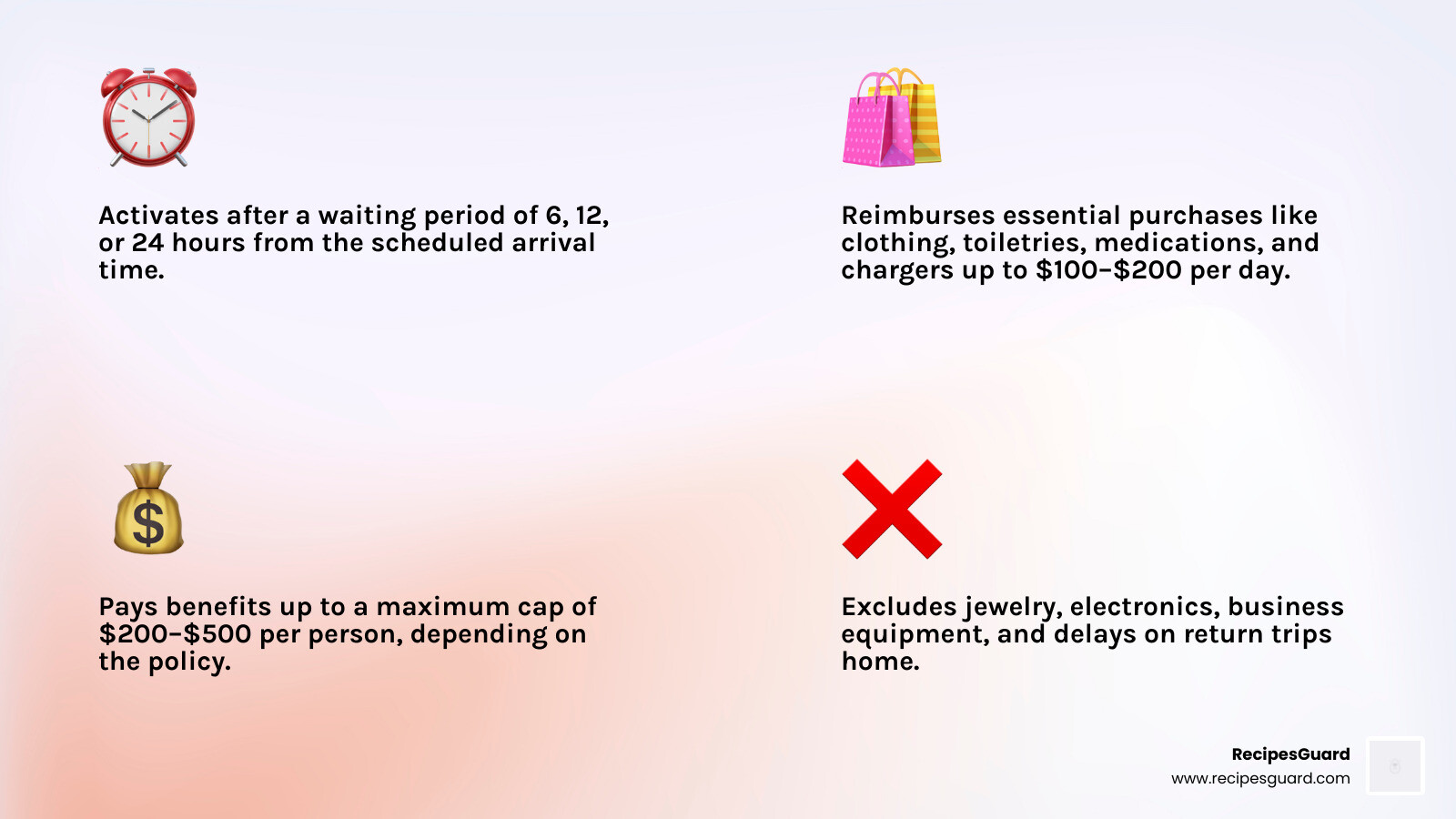
Baggage delay insurance is a type of travel coverage that reimburses you for essential items — like clothing, toiletries, and chargers — when your checked luggage doesn’t arrive on time.
Here’s a quick summary of what you need to know:
- What it covers: Necessary personal items you buy while waiting for your delayed checked luggage (clothing, toiletries, medications, chargers)
- When it kicks in: After a set waiting period — typically 6, 12, or 24 hours depending on your policy
- How much you get: Usually $100–$200 per day, up to a total of $200–$500 per person
- Where to get it: Through standalone travel insurance plans or as a free perk on premium credit cards
- What it doesn’t cover: Jewelry, electronics, business equipment, or delays on your return trip home
- How to claim: Report the delay to the airline, get written confirmation, keep your receipts, then file with your insurer within 20–90 days
It’s not the same as baggage loss insurance, which covers luggage that’s permanently missing or stolen.
Imagine landing in a new country for your first semester abroad — exhausted, excited — only to stand at an empty baggage carousel watching everyone else collect their bags. Your checked luggage, containing everything you packed for the next three months, is nowhere to be found.
This happens more than you’d think. And when it does, you’re left scrambling to buy basics just to get through the next day or two — out of pocket, stressed, and unsure if you’ll ever be paid back.
That’s exactly the problem baggage delay insurance solves. But most travelers (and especially students new to international travel) don’t fully understand what it covers, what it excludes, or how to actually file a claim and get reimbursed.
This guide breaks it all down in plain language — so you know what you’re covered for before you need it.
Baggage delay insurance definitions:
- Lost luggage insurance
- Travel insurance luggage damage
- Lost bag claim australia
Understanding Baggage Delay Insurance vs. Baggage Loss
When your bag doesn’t show up on the belt, your mind probably jumps to the worst-case scenario: “My bag is gone forever.” However, in the insurance world, there is a massive legal and financial difference between a bag that is late and a bag that is lost.
Baggage delay insurance is designed to keep you going in the short term. It assumes your bag is eventually coming back, but you need a toothbrush and a fresh pair of socks right now. This coverage pays for “reasonable essential items” to replace what is currently sitting in a cargo hold three time zones away.
Baggage loss coverage, on the other hand, kicks in when the airline officially declares your bag “lost” (usually after 21 days) or if it is stolen from you. This benefit reimburses you for the actual cash value of the suitcase and everything inside it, up to a much higher limit—often between $1,500 and $3,000.
For students, the distinction is vital. If your bag is 12 hours late, you cannot claim for a whole new wardrobe under “loss.” You must use the “delay” benefit. To help you navigate these nuances, we’ve put together a resource on Understanding Baggage Delay Benefits | RecipesGuard.
| Feature | Baggage Delay Insurance | Baggage Loss Insurance |
|---|---|---|
| Primary Goal | Short-term essentials | Permanent replacement |
| Activation Trigger | Delay of 6, 12, or 24 hours | Loss, theft, or damage |
| Typical Limits | $100–$200 per day | $1,500–$3,000 total |
| Key Requirement | Itemized receipts for new buys | Original receipts/proof of value |
| Journey Focus | Outbound only (usually) | Entire trip |
How Baggage Delay Insurance Works: Waiting Periods and Limits

You can’t just run to the nearest luxury boutique the moment the carousel stops moving. Baggage delay insurance has specific “waiting periods” that must pass before you are eligible to spend.
The Waiting Period
Most policies require your bags to be delayed by a “Common Carrier” (that’s insurance-speak for an airline, bus line, or train) for a minimum amount of time. Common thresholds include:
- 6 Hours: Often found in premium credit card benefits.
- 12 Hours: The standard for many mid-tier travel insurance plans.
- 24 Hours: Common in basic or budget-friendly insurance policies.
If your bag arrives 5 hours and 59 minutes after you landed, and your policy has a 6-hour trigger, you aren’t getting reimbursed for that new shirt.
Benefit Limits and Caps
Once the clock hits the threshold, you are typically given a daily allowance. A standard limit is $100 per day for up to 5 days, or a total maximum cap of $500 per person. Some high-end plans may offer a fixed “inconvenience payment” where you get $100 just for proving the delay, no receipts required. However, for most claims, you’ll need to show exactly what you spent.
Primary vs. Secondary Coverage
In Australia and abroad, most baggage delay insurance is “secondary.” This means you must first ask the airline for compensation. If the airline gives you a $50 voucher but you spent $150 on essentials, your insurance will cover the $100 gap. For a deeper dive into these numbers, check out Baggage Delay Insurance Coverage Details | RecipesGuard.
Essential Items Covered by Baggage Delay Insurance
So, what can you actually buy? The rule of thumb is “reasonable and necessary.” If you are a student traveling to a cold climate and your heavy coat is in your checked bag, buying a new jacket is reasonable. Buying a designer leather trench coat? Probably not.
Commonly covered items include:
- Toiletries: Toothbrush, toothpaste, deodorant, shampoo, and basic skincare.
- Clothing: A change of clothes, pajamas, and enough underwear to last until the bag arrives.
- Chargers: Phone and laptop cables if they were in your checked luggage.
- Medications: Essential prescription refills if your supply was in the delayed bag (though we always recommend keeping meds in your carry-on!).
To see a full list of what we consider “safe” purchases, visit Essential Items Coverage | RecipesGuard.
Common Exclusions in Baggage Delay Insurance
Insurance companies are very specific about what they won’t pay for. Even if these items were in your bag, you generally cannot claim replacements for them under the delay benefit:
- High-Value Electronics: Laptops, cameras, and tablets are almost always excluded from delay coverage.
- Jewelry and Watches: These are considered luxury items, not essentials.
- Business Equipment: If you’re traveling for a student conference, professional gear or samples are usually excluded.
- The Return Trip Home: This is the big one. Most baggage delay insurance only applies to the outbound portion of your trip. The logic is that if you are back at your primary residence, you already have clothes and a toothbrush, so the delay isn’t an “emergency.”
- War and Illegal Acts: Losses caused by civil unrest or carrying prohibited items won’t be covered.
Step-by-Step Guide to Filing a Successful Claim
At RecipesGuard, our mission is to provide students with step-by-step claim filing tutorials. Filing a claim for baggage delay insurance isn’t hard, but it requires discipline. If you miss one document, the insurer can deny the whole thing.
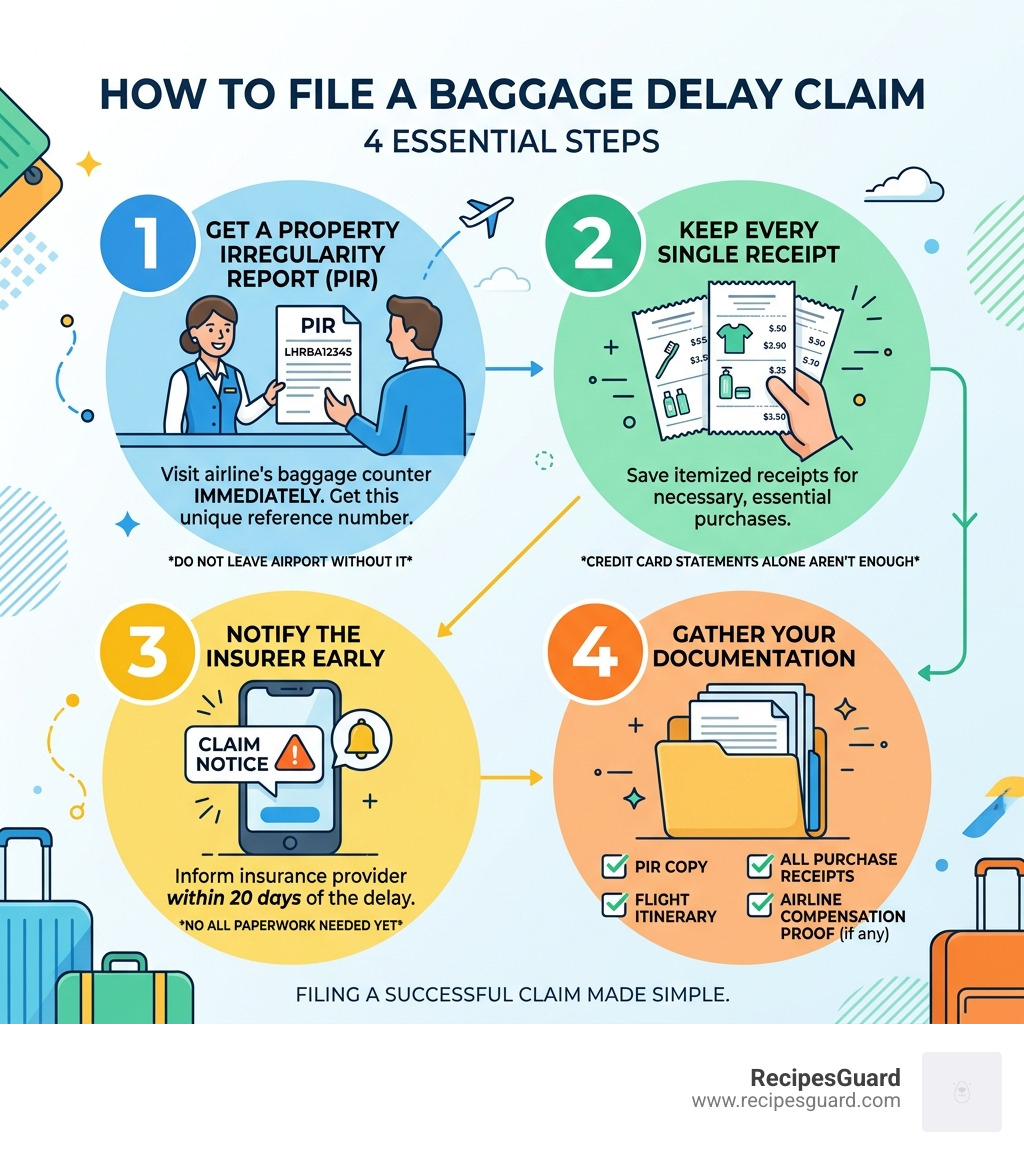
Step 1: The Property Irregularity Report (PIR)
The moment you realize your bag isn’t coming, go to the airline’s baggage service counter. Do not leave the airport without a Property Irregularity Report (PIR). This is a document with a unique file reference number (e.g., LHRBA12345) that proves the airline knows they messed up. Without this, your insurance claim is dead on arrival.
Step 2: Keep Every Single Receipt
Every time you buy a “necessary” item, keep the itemized receipt. A credit card statement is sometimes accepted as backup, but the actual receipt showing what you bought is much better.
Step 3: Notify the Insurer Early
Most policies require you to give “notice of claim” within 20 days of the delay. You don’t have to have all your paperwork ready yet, but you need to let them know a claim is coming.
Step 4: Gather Your Documentation
You will typically need:
- Your flight itinerary.
- A copy of the PIR from the airline.
- All receipts for your purchases.
- Proof of any compensation the airline already gave you.
For more detailed help on the paperwork, see How to File a Baggage Claim | RecipesGuard.
Frequently Asked Questions about Luggage Protection
Does baggage delay insurance cover my return flight?
In almost all cases, no. Baggage delay insurance is designed to provide you with the items you need to continue your trip. If you land back in your home city in Australia and your bag is delayed, the insurance company assumes you can just go home and use the clothes in your closet. Unless your policy specifically states “Return Flight Coverage,” don’t expect a reimbursement for purchases made at home.
Is baggage delay insurance worth it for students?
Absolutely. For students on a tight budget, an unexpected $200 spend on clothes and toiletries can ruin a month’s grocery budget. If you are traveling for a study abroad program, check if your credit card already includes this. If not, a standalone policy is a small price to pay for the peace of mind that you won’t be stuck wearing the same outfit for three days in a foreign lecture hall.
How do I get a Property Irregularity Report (PIR)?
You must visit the airline’s baggage claim office before you exit the arrivals hall. Provide them with your baggage claim tag (the little sticker they gave you at check-in). They will enter your details into their system and hand you a printed PIR. Make sure your contact details and the description of your bag are 100% correct before you walk away.
Conclusion
Dealing with a baggage delay is a rite of passage for many travelers, but it doesn’t have to be a financial disaster. By understanding your baggage delay insurance—from the 6-hour waiting periods to the “essential items” rule—you can turn a stressful situation into a minor detour.
At RecipesGuard, we specialize in helping students navigate the complex world of insurance advisory. We know that as a student, every dollar counts, and the last thing you want to do is spend hours fighting with an insurance company over a $15 toothbrush. That’s why we provide the step-by-step tutorials you need to get your money back fast.
For more guides on making the most of your travel protection, visit our More info about travel insurance services page. Safe travels, and keep your receipts!

My name is Bianca, and my journey into the world of fermentation and food safety began with a costly mistake. I once lost an entire season’s harvest of chili peppers because I relied on guesswork instead of science. That failure was my turning point.
