
How to Secure Checked Baggage Insurance for Your Next Trip
What Is Checked Baggage Insurance — and Do You Actually Need It?
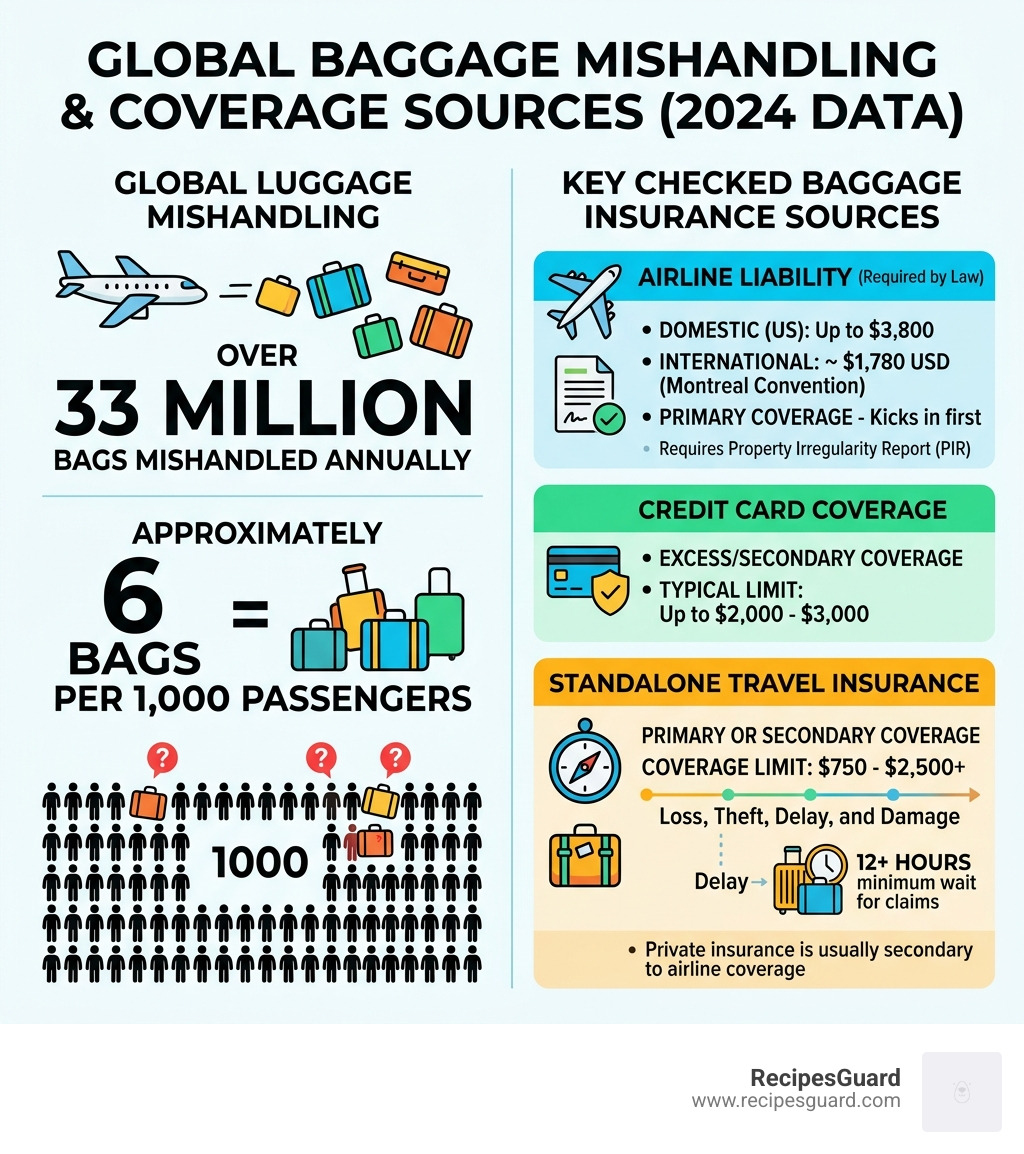
Checked baggage insurance is coverage that reimburses you when your checked luggage is lost, delayed, damaged, or stolen during a trip. Here’s a quick look at your main options:
| Source | Coverage Type | Typical Limit |
|---|---|---|
| Airline (domestic, US) | Liability (required by law) | Up to $3,800 |
| Airline (international) | Montreal Convention liability | ~$1,780 USD |
| Credit card (e.g., Amex) | Excess/secondary coverage | Up to $2,000–$3,000 |
| Standalone travel insurance | Primary or secondary | $750–$2,500+ |
Key things to know fast:
- Airline coverage kicks in first — private insurance is usually secondary
- Most policies cover loss, theft, delay, and damage — but not cash, jewelry above low limits, or electronics in many cases
- Baggage delay coverage usually requires a minimum 12-hour wait before you can claim essentials like clothing and toiletries
- You’ll need a Property Irregularity Report (PIR) from the airline to file most claims
Imagine landing after a long international flight, excited to start your semester abroad — only to find yourself standing alone at the baggage carousel as it grinds to a halt. Your bag never arrived. No spare clothes, no toiletries, and no idea what to do next.
It’s a stressful situation, and it’s more common than you’d think. A 2024 air transportation study found that over 33 million bags are mishandled globally every year — roughly 6 bags per 1,000 passengers on major airlines.
The good news? Checked baggage insurance exists precisely for this moment. Whether it comes through your credit card, a standalone travel insurance policy, or a combination of both, the right coverage can reimburse you for lost belongings and essential purchases while you wait for your bags to arrive.
The tricky part is knowing which coverage you have, what it actually pays for, and how to file a claim successfully — especially if you’ve never done it before.
This guide breaks all of that down in plain language.
Checked baggage insurance terms to remember:
- australia student luggage insurance
- delayed bag compensation australia
- lost bag claim australia
Understanding Checked Baggage Insurance and How It Works
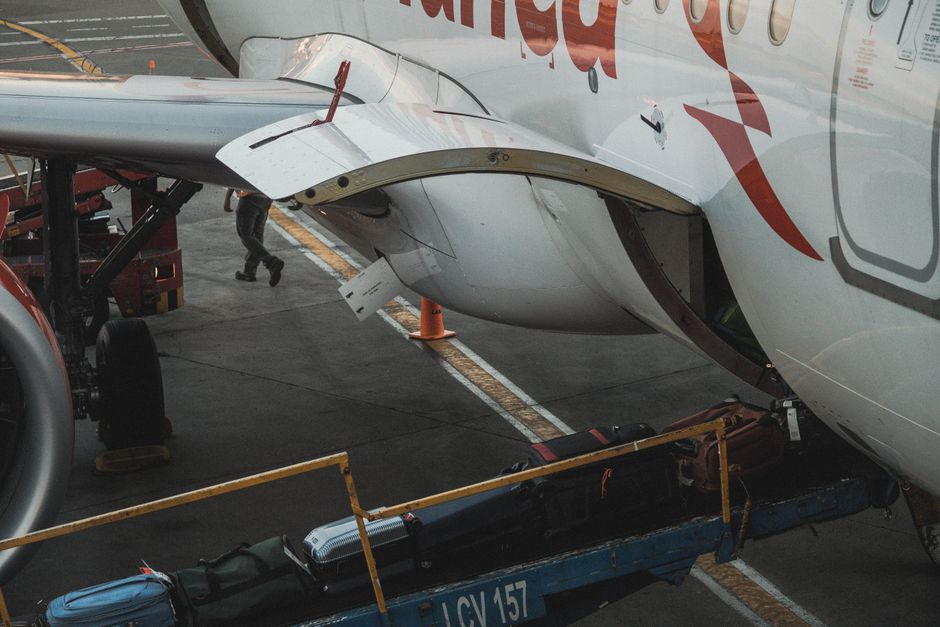
When we talk about checked baggage insurance, we are looking at a specific safety net designed for the items you hand over at the check-in counter. While “baggage insurance” is a broad term, the checked variety is unique because the items are out of your sight and under the care of a “common carrier” (usually an airline).
In April 2026, the travel landscape has become more automated, yet bags still manage to take vacations of their own. This insurance typically covers four main “uh-oh” moments:
- Baggage Loss: Your bag is officially declared gone (usually after 5–14 days).
- Baggage Delay: Your bag is late, and you need to buy a toothbrush and some clean socks right now.
- Baggage Damage: Your suitcase arrives, but it looks like it lost a fight with a tractor.
- Theft: Someone decides your belongings look better in their house than in your hotel room.
Comprehensive coverage for personal effects ensures that you aren’t just reimbursed for the physical suitcase, but for the clothes, shoes, and travel essentials inside. For students heading to Australia, this is vital. You aren’t just losing a bag; you’re losing your life-for-the-next-six-months.
Checked Baggage Insurance Limits for Credit Cards
Many travelers don’t realize they might already have checked baggage insurance sitting in their wallets. Premium credit cards often include this as a built-in perk. However, there is a catch: most of these are secondary insurance.
This means if the airline loses your bag, you must first squeeze every cent you can out of the airline. Your credit card insurance then acts as “excess coverage,” picking up the remaining balance up to their policy limit. For example, high-end American Express cards often provide up to $2,000 for checked baggage and $3,000 combined for checked and carry-on.
The limits usually have two “caps”:
- The Policy Maximum: The total amount they will pay per person (e.g., $3,000).
- Per-Item Caps: The maximum they will pay for any single item (often $250 to $500). If you packed a $1,200 designer jacket, a $250 cap is going to hurt.
Common Exclusions in Checked Baggage Insurance Policies
Insurance companies aren’t in the business of replacing your diamond tiara or your stack of cash. Every policy has a “naughty list” of items they won’t cover. Common exclusions include:
- High-Value Jewelry: Most policies have very low limits for jewelry or exclude it entirely from checked bags.
- Electronics: Laptops, tablets, and cameras are frequently excluded from checked bag claims. Pro tip: Always keep these in your carry-on!
- Cash and Documents: If you lose a wad of cash or your passport, the insurance usually won’t pay for the cash itself (though some may help with passport replacement fees).
- Perishables and Animals: No, they won’t cover the fancy cheese that went bad or (heaven forbid) a pet.
- Recklessness: If you left your bag unattended in the middle of a busy train station, don’t expect a payout.
Sources of Protection: Airlines vs. Private Insurance
It is important to understand the hierarchy of who pays when things go wrong. In Australia and globally, the airline is your first port of call.
| Feature | Airline Liability | Private/Credit Card Insurance |
|---|---|---|
| Domestic Limit | Up to $3,800 (DOT) | $2,000 – $3,000 |
| International Limit | ~$1,780 (Montreal Convention) | Varies by plan |
| Status | Primary (Required by law) | Usually Secondary/Excess |
| Payout Type | Depreciated “Actual Value” | Often Actual Cash Value |
Airline liability is governed by strict rules. For international flights, the Montreal Convention sets a limit of approximately $1,780 USD. For domestic flights within the US, the Department of Transportation (DOT) has pushed that limit to $3,800.
However, airlines are notorious for offering the “depreciated value.” That three-year-old laptop might have cost $1,500, but the airline might only offer you $400 for it. This is where private checked baggage insurance fills the gaps. It can provide higher limits and cover items that the airline’s fine print might exclude.
What Does Your Policy Actually Cover?

When you file a claim, you’ll often see the term Actual Cash Value (ACV). This is not the same as “Replacement Cost.” ACV takes the original price and subtracts “depreciation” (wear and tear).
If you bought a pair of jeans for $100 two years ago, the insurance company might decide they are now worth $40. Unless you have a specific “replacement cost” policy, you won’t get the full $100 back.
Delay Thresholds for Reimbursement
Baggage delay coverage is a lifesaver for students. It doesn’t pay for your lost items; it pays for the stuff you have to buy because your bag is stuck in Singapore while you’re in Sydney.
Most policies have a delay threshold. You usually cannot claim anything if the bag is only two hours late. Common triggers include:
- 12-hour delay: Standard for many travel insurance plans (like World Nomads or Travel Guard).
- 24-hour delay: Common for more basic policies.
- 6-hour delay: Found on premium cards like the Chase Sapphire Reserve.
Once you hit that threshold, you can be reimbursed for “necessary items.” This includes toiletries, a change of clothes, and maybe a coat if you’ve landed in a cold climate. Keep your receipts! If you buy a $500 silk gown for a beach vacation, the insurer will likely reject it as not “necessary.”
Step-by-Step Guide to Filing a Successful Claim
We at RecipesGuard specialize in helping students navigate these murky waters. Filing a claim for checked baggage insurance is a bit like a scavenger hunt — you need all the right pieces of paper to win.
- Report it Immediately: Before you leave the airport, go to the baggage service counter. File a Property Irregularity Report (PIR). This document is the “birth certificate” of your claim. Without it, your insurance will almost certainly deny you.
- Notify the Police (if stolen): If your bag was stolen from a hotel or a car, you need a police report within 24 hours.
- Take Photos: Before you even leave home, take a photo of the contents of your bag. It’s much easier to prove you owned that expensive textbook if you have a photo of it in your suitcase.
- Gather Receipts: You’ll need receipts for the items that were lost. If you don’t have them, many insurers (like Travel Guard) will cap reimbursement at $150 per item.
- File with the Airline First: Get their settlement offer (or rejection letter) in writing.
- Submit to Your Insurer: Use your PIR, airline correspondence, original receipts, and receipts for new “essential” purchases to file your secondary claim.
Maximizing Your Payout for High-Value Items
If you are traveling with expensive gear — like a professional camera for your media studies or high-end sports equipment — standard checked baggage insurance might not be enough.
- Baggage Upgrades: Many providers, such as Travelex, offer “Baggage Bundles” that increase per-item limits from $250 to $500 or $1,000.
- Specialty Coverage: If you’re bringing golf clubs or skis to Australia, look for a policy that specifically includes “Sports Equipment” coverage. This often covers the cost of renting replacements while yours are lost.
- Homeowners/Renters Insurance: Sometimes, your home insurance policy covers “off-premises” theft. If you have a very expensive item, check if it’s covered there first.
Frequently Asked Questions about Baggage Protection
How long must baggage be delayed to qualify for reimbursement?
Most policies require a delay of at least 12 hours before you can claim reimbursement for essential items. Some premium credit cards offer coverage after just 6 hours, while budget travel insurance might require 24 hours. Always check your specific “Benefit Guide.”
Is credit card baggage insurance primary or secondary?
In almost all cases, it is secondary. This means it only pays out after the airline has paid their maximum liability. However, some standalone travel insurance policies (like those from Travelex) can be primary, meaning they pay out first, which simplifies the process significantly.
Are high-value electronics covered in checked bags?
Generally, no. Most checked baggage insurance policies explicitly exclude electronics like laptops, smartphones, and tablets from checked luggage coverage. If they are covered, the per-article limit (often $250) is usually much lower than the value of the device. We always recommend keeping electronics in your carry-on.
Conclusion
Losing your luggage doesn’t have to be the end of your trip. By securing the right checked baggage insurance, you turn a potential disaster into a minor inconvenience. Whether you rely on your credit card’s secondary coverage or invest in a primary travel insurance plan, the key is knowing the rules of the game.
At RecipesGuard, we know that as a student, every dollar counts. That’s why we provide step-by-step tutorials to ensure your claims are filed correctly the first time. Don’t let a missing suitcase derail your Australian adventure. Pack smart, document everything, and travel with the peace of mind that you’re protected.
More info about claim filing services

My name is Bianca, and my journey into the world of fermentation and food safety began with a costly mistake. I once lost an entire season’s harvest of chili peppers because I relied on guesswork instead of science. That failure was my turning point.
