The Beginner’s Guide to Safe Home Milk Fermentation
Why Fermenting Milk at Home Is Worth Learning Right Now
Fermenting milk at home is one of the simplest and most rewarding things you can do in your kitchen. You need just two ingredients — milk and a live culture — and about 24 hours.
Here’s the quick version of how it works:
- Add a live starter culture (like kefir grains) to fresh milk in a clean glass jar
- Cover loosely with a breathable cloth
- Leave at room temperature (68–78°F) for 12–24 hours
- Strain out the grains, refrigerate, and drink
That’s it. The beneficial bacteria do all the work.
People have been fermenting milk for thousands of years — long before refrigerators existed. Every dairy-consuming culture developed its own version, from kefir in the Caucasus Mountains to clabbered milk in the American South. The process was born out of necessity, but it stuck around because the results are genuinely good for you.
Today, homemade fermented milk is having a well-deserved comeback. Homemade kefir, for example, contains around 50 strains of beneficial bacteria and yeasts — compared to roughly 10 strains in most store-bought versions. That’s a significant difference if gut health is your goal.
This guide covers everything a beginner needs: the science behind fermentation, how to make kefir, buttermilk, and clabbered milk, what equipment you actually need, how to troubleshoot problems, and how to keep your cultures alive batch after batch.
Understanding the Science of Fermenting Milk at Home
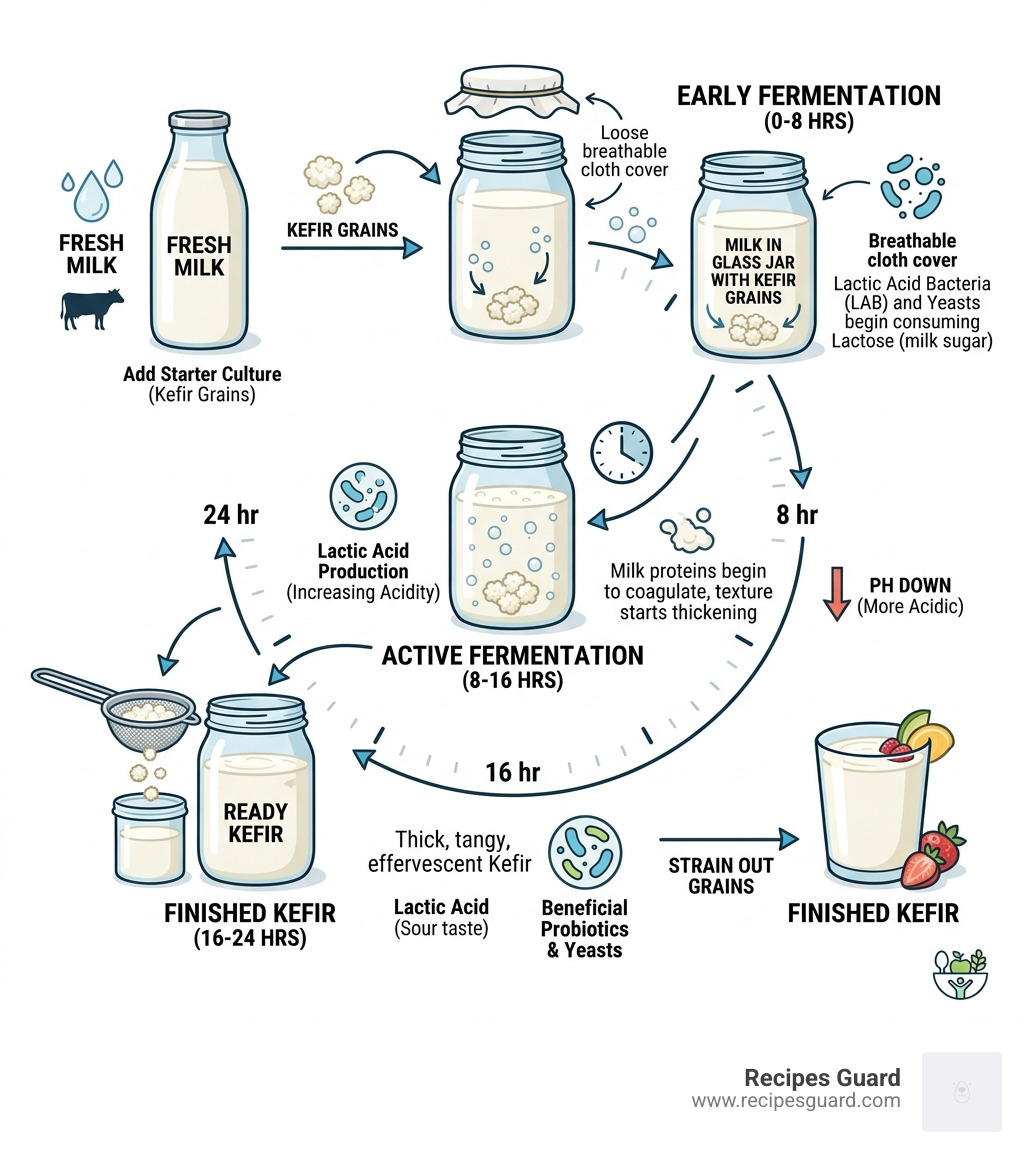
At its heart, fermenting milk at home is a biological transformation. When we introduce specific microbes into milk, we are starting a controlled “pre-digestion” process. The primary players here are Lactic Acid Bacteria (LAB), such as Lactobacillus and Streptococcus strains. These tiny powerhouses consume lactose—the natural sugar in milk—and convert it into lactic acid.
This conversion does two vital things. First, it lowers the pH of the milk, making it more acidic. This acidity causes the milk proteins to coagulate, creating that signature thick, creamy texture we love in yogurt and kefir. Second, the acidic environment acts as a natural preservative, inhibiting the growth of harmful, putrefying bacteria. This is why we say at Recipes Guard that understanding the “why” is just as important as the “how.” For a deeper dive into these principles, check out Safety First: A Guide to Preserving Fermented Foods.
In the case of milk kefir, yeasts also join the party. These yeasts break down a small portion of the lactose into ethanol and carbon dioxide. This results in a very slight alcohol concentration, usually around 0.2-0.3 percent, and gives the drink its characteristic “fizz” or effervescence. More than 92% of the microbes found in healthy kefir grains are Lactobacillus, which ensures a safe and tangy ferment. For those interested in the deep microbial details, you can explore Scientific research on the microbiology of kefir grains.
Milk Kefir: The Probiotic Powerhouse
If yogurt is the popular kid in class, milk kefir is the overachiever. While both are fermented dairy, they differ significantly in their microbial makeup. Yogurt usually contains only a handful of bacterial strains that must be kept warm to thrive. Kefir, however, is fermented at room temperature using “kefir grains”—rubbery, cauliflower-like clusters of bacteria and yeast held together by a polysaccharide called kefiran.
Homemade kefir is a nutritional giant. Because it contains up to 50 different microbial strains, it provides a much broader spectrum of probiotics than almost any store-bought product. It is also highly digestible; the fermentation process breaks down most of the lactose, making it a viable option for many people with lactose intolerance.
Comparing Cultured Dairy
| Feature | Milk Kefir | Yogurt | Cultured Buttermilk |
|---|---|---|---|
| Culture Type | Live Grains (Reusable) | Bacterial Starter | Bacterial Starter |
| Microbial Diversity | ~50 strains | 2–10 strains | 2–5 strains |
| Consistency | Drinkable/Pourable | Thick/Spoonable | Thin/Pourable |
| Temperature | Room Temp (68-78°F) | Warm (110°F) | Room Temp (70-77°F) |
| Flavor Profile | Tangy, Yeasty, Fizzy | Mild, Tart | Tangy, Buttery |
Ready to try more? Explore our Category: Fermented Recipes for more inspiration.
Essential Equipment for Fermenting Milk at Home
One of the best things about fermenting milk at home is that you don’t need a lab. You likely already have most of this in your kitchen:
- Glass Jars: Quart-sized Mason jars are the gold standard. Glass is non-reactive, easy to clean, and allows you to see the separation of curds and whey.
- Plastic Mesh Strainers: This is crucial. While there is some debate, many traditionalists avoid metal strainers because prolonged contact with reactive metals can potentially weaken the kefir grains over time. Stick to nylon or plastic.
- Breathable Cloth Covers: You want to keep fruit flies out but let the gases escape. A coffee filter, tight-weave cheesecloth, or a clean tea towel secured with a rubber band works perfectly.
- Silicone Spatulas: These are great for gently moving the grains around in the strainer without damaging them.
- Digital Thermometer: While not strictly necessary once you get the hang of it, a thermometer helps ensure your milk isn’t too hot (which kills the grains) or too cold (which stalls fermentation).
Step-by-Step Process for Creamy Milk Kefir
Making kefir is a cycle that quickly becomes a rhythmic part of your daily routine. Here is how we do it:
- The Ratio: Use approximately 10 grams (about 1 tablespoon) of active kefir grains per cup of milk. If you want a faster ferment or a thicker result, you can use slightly more grains.
- The Mix: Place your grains in a clean glass jar and pour fresh milk over them. Leave about an inch of headspace at the top.
- The Ferment: Cover the jar with your breathable cloth and place it in a spot away from direct sunlight. The ideal temperature is between 68°F and 78°F.
- The Timeline: Let it sit for 12 to 24 hours. You’ll know it’s ready when the milk has thickened and smells pleasantly tart. If you see small pockets of clear liquid (whey) forming at the bottom, it’s definitely done!
- The Strain: Place your plastic strainer over a clean bowl or jar. Pour the kefir through, using a spatula to gently nudge the grains so the thick liquid passes through.
- The Refresh: Put the grains immediately into a fresh jar of milk to start the next batch.
- The Finish: Put a lid on your finished kefir and store it in the fridge. It will last up to a month, though it’s best within the first week.
Pro Tip: If you want an even creamier, less tart kefir, try a “double fermentation.” After straining out the grains, let the finished kefir sit on the counter in a sealed jar for another 6–12 hours before refrigerating. This mellows the flavor and increases the B-vitamin content!
Beyond Kefir: Making Buttermilk and Clabbered Milk
While kefir is a “wild” ferment managed by grains, other traditional milks rely on different methods.
Clabbered Milk is the most ancient form of fermentation. It involves letting raw, unpasteurized milk sit at room temperature until it naturally thickens. This relies on the “wild” mesophilic bacteria already present in the raw milk. Warning: Never try to clabber pasteurized milk without a starter; because the beneficial bacteria have been killed by heat, pasteurized milk will simply rot and become unsafe. True clabber is a “super-raw” food, and the clear whey you strain from it can be used to kickstart other ferments. If you’ve enjoyed our guide on Don’t Be Afraid of the Funk with This Easy Fermented Garlic Recipe, you’ll love the complexity of clabber.
Traditional Buttermilk was originally the liquid left over after churning butter from cultured cream. Today, we usually make “cultured buttermilk” by backslopping—adding a bit of active buttermilk to fresh milk and letting it sit at room temperature for about 24 hours. It’s significantly more cost-effective than store-bought and produces a much better lift in your Sunday morning pancakes.
Troubleshooting Common Issues When Fermenting Milk at Home
Don’t panic if your first batch isn’t perfect. Fermentation is a living process, and variables change.
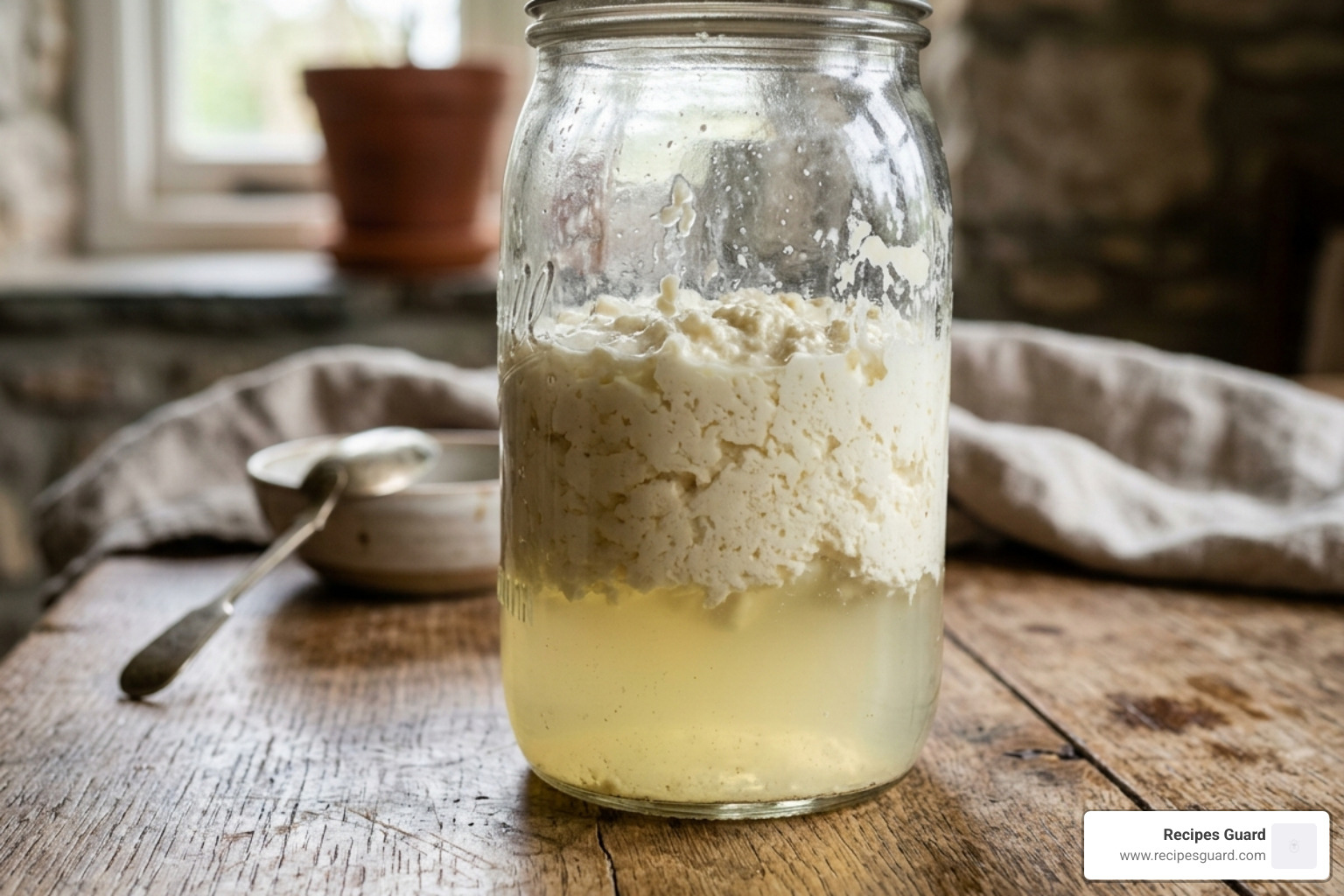
- Separation (Curds and Whey): If your jar looks like clear liquid at the bottom and white clumps at the top, you’ve over-fermented it. It’s still safe! Just shake it up or whisk it. Next time, use fewer grains or shorten the fermentation time.
- Won’t Thicken: This usually happens if the room is too cold. Move the jar to a warmer spot (like the top of the fridge). If you are using new or dehydrated grains, they may need 3–5 batches to “wake up” and start thickening properly.
- Excessive Sourness: High temperatures speed up the bacteria. If your kitchen is hot, your kefir might be ready in as little as 8 hours. Check Scientific research on the effects of temperature on milk fermentation to see how heat impacts microbial speed.
- High MUN Values: If you are using raw milk and it refuses to clabber or thicken, it might be due to high Milk Urea Nitrogen (MUN) levels in the cow’s diet (often over 23). This is a rare issue but worth discussing with your local farmer if you encounter persistent problems.
- Mold: This is the only “hard stop.” If you see fuzzy growth (white, green, or black) on the surface, discard the batch, sterilize your equipment, and start over.
Safety and Storage for Homemade Cultured Dairy
We take safety seriously at Recipes Guard. While fermenting milk at home is very safe due to the protective nature of lactic acid, basic hygiene is non-negotiable.
- Sanitation: Always wash your hands and ensure your jars are “squeaky clean.” You don’t necessarily need to boil your jars every time, but a hot soapy wash and thorough rinse are essential.
- Refrigeration: Once your ferment has reached the desired taste, move it to the fridge. This doesn’t kill the microbes, but it slows them down significantly, preserving the flavor.
- Shelf Life: Most homemade fermented milks last 10–14 days in the fridge for peak flavor, though kefir can remain safe for up to a month in a sealed container.
- Flavoring: If you want to add fruit or honey, do it after the fermentation is complete and you’ve removed the grains. Adding sugar during the ferment can cause the yeast to go into overdrive, leading to an overly alcoholic or “off” flavor.
If you’ve mastered milk, why not try your hand at vegetable fermentation? Our guide on Mastering the Art of Lacto-Fermented Hot Sauce is a great next step.
Frequently Asked Questions about Milk Fermentation
Can I use store-bought kefir as a starter?
Yes, you can use a few tablespoons of store-bought kefir to culture a bowl of milk, but there’s a catch. Store-bought kefir is usually made with a laboratory-grown “powdered starter” containing only about 10 strains of bacteria. Unlike kefir grains, this “starter” is not immortal. You might get 2 or 3 batches out of it before the microbial population weakens and fails to thicken the milk. For a permanent, sustainable supply, you need live kefir grains.
Is raw milk necessary for all fermentation?
No, but it offers unique benefits. Raw milk from grass-fed cows contains its own natural enzymes and microbes that support a very stable, traditional fermentation. However, whole pasteurized milk works beautifully for kefir and buttermilk. The only milk to avoid is ultra-pasteurized (UHT) milk. The high heat used in UHT processing alters the proteins so much that the bacteria often struggle to “set” the milk into a creamy texture.
How do I know if my fermented milk has spoiled?
Trust your senses! Fermented milk should smell clean, tangy, and perhaps slightly yeasty (like bread dough).
- Good: Tart, sour, sharp, or “cheesy” smells.
- Bad: Foul, putrid, rotten-egg, or “garbage” smells.
- Visuals: If you see pink, orange, or black fuzzy mold, or if the milk has turned a strange color, throw it out. When in doubt, toss it out!
Conclusion
At Recipes Guard, we believe that fermenting milk at home is a form of culinary magic that connects us to our ancestors and supports our modern health. Whether you start with a simple batch of buttermilk or dive into the complex world of milk kefir grains, you are taking control of your food supply and inviting a community of beneficial microbes into your life.
Your kefir grains are living things. Treat them well, feed them regularly, and they will multiply, allowing you to share the gift of health with friends and neighbors. It’s a continuous culture in every sense of the word.
Ready to expand your skills? Visit our Category: Preserving Basics to learn more about the foundations of food storage, or Start Your Fermentation Journey Today by grabbing your first jar and some fresh milk.