
The ultimate guide to storage life for fermented foods
What You Need to Know About Homemade Fermented Ketchup (Quick Answer)
Homemade fermented ketchup is a probiotic-rich condiment made by lacto-fermenting tomato paste with a starter culture, salt, and sweetener — no cooking required.
Key facts at a glance:
| Question | Answer |
|---|---|
| How long to ferment? | 2-5 days at room temperature |
| How long does it last? | 3-6 months refrigerated |
| Starter options | Whey, sauerkraut brine, raw ACV, kombucha |
| Main ingredient | Tomato paste |
| Probiotic benefits? | Yes — live cultures support gut health |
Ketchup is one of those condiments that barely needs an introduction. Most of us grew up squeezing it on everything — fries, burgers, eggs, you name it.
But store-bought ketchup has a problem. It’s loaded with high-fructose corn syrup, and the tomato flavor gets buried under sweetness. The real tomato taste barely shows up.
Fermented ketchup fixes that. The lacto-fermentation process deepens the flavor, adds a pleasant tang, and introduces live beneficial bacteria that support your gut. It’s also surprisingly simple to make — mix your ingredients, pack them in a jar, and let time do the work.
It’s the kind of recipe that makes you wonder why you didn’t start making it sooner.
This guide covers everything you need — from picking the right starter culture, to nailing the fermentation window, to maximizing storage life so none of it goes to waste.
Why Homemade Fermented Ketchup Beats Store-Bought
When we look at a bottle of commercial ketchup in April 2026, we see a product designed for shelf stability at the expense of nutrition. Most grocery store brands are essentially tomato-flavored candy. They rely heavily on high-fructose corn syrup and distilled white vinegar, which masks the natural umami of the tomato.
Homemade fermented ketchup flips the script. By using lacto-fermentation, we invite Lactobacillus bacteria to the party. These tiny workers consume the sugars in the tomato paste and convert them into lactic acid. This doesn’t just preserve the sauce; it creates a complex, “grown-up” flavor profile that is savory, tangy, and deeply satisfying.
According to scientific research on the health benefits of fermented plant foods, the fermentation process increases the bioavailability of nutrients. In ketchup, this means the lycopene—a powerful antioxidant found in tomatoes—is more easily absorbed by our bodies. Plus, you get a healthy dose of beneficial enzymes and probiotics that you simply won’t find in a pasteurized bottle of Heinz.
| Feature | Commercial Ketchup | Fermented Ketchup |
|---|---|---|
| Sweetener | High-Fructose Corn Syrup | Raw Honey, Maple Syrup, or Dates |
| Probiotics | None (Pasteurized) | Live & Active Cultures |
| Flavor | One-dimensional (Sweet) | Complex, Umami, Tangy |
| Preservatives | Chemical/High Sugar | Natural Lactic Acid & Salt |
| Digestibility | Can be heavy on the gut | Pre-digested by bacteria |
Choosing the Best Starter for Homemade Fermented Ketchup
To get the fermentation moving quickly and safely, we use a “starter culture.” This is essentially a concentrated dose of good bacteria to ensure the “good guys” win the race against spoilage.
- Liquid Whey: This is the gold standard. If you strain thick yogurt or kefir through cheesecloth, the yellowish liquid that drips out is whey. It is packed with active cultures. Note: use real whey, not the powdered protein supplement!
- Sauerkraut Brine: This is our favorite “sneaky” starter. If you have a jar of raw, unpasteurized sauerkraut in the fridge, a few tablespoons of that salty juice will work perfectly. It adds a wonderful savory depth.
- Raw Apple Cider Vinegar (ACV): Make sure it contains “the mother.” While vinegar is acidic, raw ACV also contains live yeast and bacteria that can kickstart the process.
- Kombucha or Water Kefir: If you brew your own bubbly drinks, a splash of plain kombucha or water kefir works as an excellent vegan-friendly starter.
If you enjoy experimenting with these liquid starters, you might also want to try Mastering the Art of Lacto-Fermented Hot Sauce to expand your probiotic condiment collection.
Why Use Tomato Paste Instead of Fresh Tomatoes
You might be tempted to grab a basket of fresh heirloom tomatoes for your homemade fermented ketchup, but we actually recommend starting with high-quality organic tomato paste. Here’s why:
- Concentration: Tomato paste is already reduced. To get the same thickness from fresh tomatoes, you’d have to simmer them for hours, which can destroy some of the delicate nutrients we want to preserve.
- Texture: Paste provides that iconic, smooth ketchup “glop” that we all know and love. Fresh tomatoes often result in a grainier or more watery sauce unless processed extensively.
- Lycopene: Interestingly, the heat used to create tomato paste actually makes the lycopene more bioavailable than in raw tomatoes.
- Convenience: It turns a day-long project into a 10-minute mixing session.
If you do have a garden glut and insist on fresh, you’ll need to cook them down into a thick sauce first, let it cool completely, and then proceed with the fermentation steps. For more tips on handling fresh produce, check out our guide on Quick and Easy Pickled Vegetables for Every Meal.
Essential Equipment and Ingredients for Success
You don’t need a laboratory to make homemade fermented ketchup, but a few specific tools will make the process foolproof.
- Mason Jars: A pint or quart-sized wide-mouth jar is perfect. Avoid plastic containers, as the acidity of the tomatoes can react with the plastic.
- Airlock Lids: While not strictly mandatory, airlocks are a game-changer. They allow carbon dioxide to escape while preventing oxygen (and mold spores) from entering. This makes the process “set it and forget it.”
- Glass Weights: Since ketchup is thick, it doesn’t usually require a weight to keep it submerged, but keeping the sides of the jar clean is vital.
- Non-Iodized Salt: Use sea salt or Himalayan pink salt. Iodine in table salt can inhibit the growth of beneficial bacteria.
- Natural Sweeteners: Raw honey or maple syrup provide the food for the bacteria to thrive.
Safety is paramount when working with room-temperature foods. We always recommend reading Safety First: A Guide to Preserving Fermented Foods before starting your first batch.
Step-by-Step Guide to Making Homemade Fermented Ketchup

Ready to create your own “funk” in the kitchen? Follow these steps for a perfect batch every time.
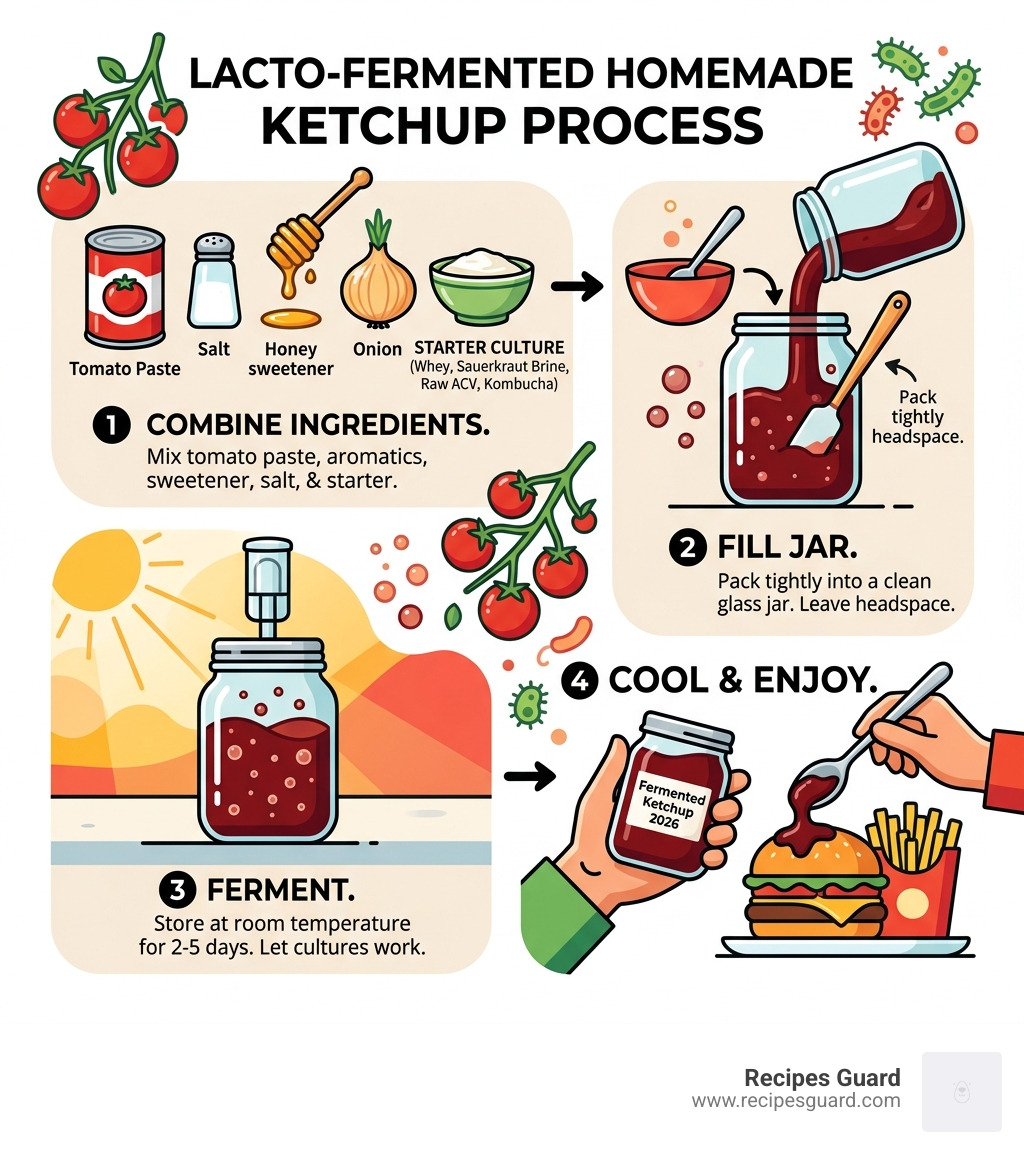
- The Mix: In a large glass or stainless steel bowl, whisk together two 6-ounce cans of organic tomato paste, 1/4 cup of your chosen starter (whey or brine), 2-3 tablespoons of maple syrup or honey, 2 tablespoons of raw ACV, and 1 teaspoon of sea salt.
- Seasoning: Add your spices (see the customization section below). Whisk until the mixture is completely smooth. If it feels too thick, add water one tablespoon at a time until it reaches your desired consistency.
- Jarring: Transfer the mixture to a clean Mason jar. Important: Leave at least 1 to 1.5 inches of “headspace” at the top. Fermentation creates bubbles, and your ketchup will expand!
- The Clean-Up: Use a clean, damp cloth to wipe any stray ketchup off the inside rim of the jar. Mold loves to grow on those little smears of food above the main “line.”
- The Ferment: Seal the jar with an airlock or a loose-fitting lid. Place it in a cool, dark spot (like a pantry) out of direct sunlight.
- Timeline: Let it sit for 2 to 5 days. In warmer weather (like July), it might be ready in 48 hours. In April 2026, it might take 4 days. You’ll know it’s working when you see tiny bubbles or the lid feels slightly pressurized.
- The Move: Once it has a pleasant tang, give it a stir and move it to the refrigerator.
For more foundational techniques, explore our Category: Preserving Basics.
Troubleshooting Your Homemade Fermented Ketchup
Fermentation can feel a bit like a science experiment, and sometimes experiments go sideways.
- Mold: If you see fuzzy white, green, or black spots on the surface, the batch is compromised. Toss it and start over. To prevent this, ensure your equipment is sterile and you have enough acidity.
- Kahm Yeast: This is a flat, white, wavy film on the surface. It’s not harmful but can make the ketchup taste “off.” You can scrape it off, but it’s a sign that your ferment is getting too much oxygen.
- Off-Smells: It should smell tangy and like tomatoes. If it smells like rotten eggs or “dirty socks,” something went wrong. Trust your nose!
- Color Changes: Don’t panic if your ketchup turns a slightly darker, brownish-red. This is a natural result of the fermentation process and the deepening of the tomato flavors.
If you’re nervous about the “funk,” our article Don’t Be Afraid of the Funk with This Easy Fermented Garlic Recipe is a great confidence booster.
Mastering the Storage Life of Fermented Condiments
One of the greatest perks of homemade fermented ketchup is its longevity. Because the lactic acid acts as a natural preservative, this ketchup doesn’t spoil as quickly as a standard “fresh” homemade sauce.
Refrigeration is Key: Once the initial room-temperature fermentation is complete, you must move the jar to the fridge. This slows down the bacterial activity significantly, preserving the flavor you’ve worked so hard to create.
Shelf Life: In a standard refrigerator, your fermented ketchup will easily last 3 to 6 months. Some fermentation enthusiasts have even kept batches for up to a year, though the flavor becomes very sharp and acidic over time.
Maintain the Culture: To keep your ketchup fresh for the full 6 months, follow these rules:
- Never double-dip: Always use a clean spoon or a squeeze bottle. Introducing bacteria from your mouth or other foods will shorten the shelf life.
- Keep it cold: Don’t leave the jar on the counter during a long BBQ. Take what you need and put the jar back in the fridge.
- Check the pH: If you want to be scientifically certain, use a pH strip. A safe fermented food should have a pH of 4.6 or lower (ideally around 3.8 to 4.0 for ketchup).
Customizing Your Recipe with Spices and Variations
The beauty of DIY is that you can move beyond the “standard” flavor. Here are some ways to make the recipe your own:
- The Umami Bomb: Add 1 tablespoon of Worcestershire sauce or a teaspoon of high-quality fish sauce. This mimics the “kecap” origins of the condiment and adds incredible depth.
- Smoky Heat: Mix in a teaspoon of smoked paprika and a pinch of cayenne pepper. This is perfect for backyard BBQs.
- Roasted Garlic: Instead of garlic powder, mash a few cloves of roasted garlic into a paste and whisk it in.
- Sweetener Swaps: If you are following a specific diet like GAPS, use date syrup or blended soaked dates instead of honey.
- The “Worldly Sister”: Add a pinch of allspice, cloves, or cinnamon for that nostalgic, warm spice profile found in premium artisanal brands.
Frequently Asked Questions about Fermented Ketchup
How long does fermented ketchup take to be ready?
Typically, 2 to 5 days at room temperature. The exact time depends on the temperature of your kitchen and the strength of your starter. Always taste-test starting at day 2!
Can I make this recipe without a starter culture?
Technically, yes (this is called wild fermentation), but it is much riskier with tomato paste. Tomato paste is quite dense and acidic, which can make it hard for wild bacteria to take hold before mold does. We strongly recommend using a starter like whey or brine for consistent results.
Is fermented ketchup safe for children to eat?
Yes! In fact, it’s a great way to “sneak” probiotics into a kid-friendly diet. Most children won’t even notice the difference, especially if you keep the sweetener level similar to what they are used to. Just be mindful of the salt content for very young toddlers.
Conclusion
At Recipes Guard, we believe that food preservation is more than just a hobby—it’s a step toward food self-sufficiency and better health. Making homemade fermented ketchup is the perfect entry point for anyone intimidated by fermentation. It requires no specialized skills, very little active time, and the results are far superior to anything you’ll find in a plastic squeeze bottle.
As we move through April 2026, embracing these traditional methods allows us to take control of our pantry. Whether you’re serving this on grass-fed burgers or alongside tallow-fried potatoes, you can feel good knowing you’re nourishing your gut with every dip.
Ready to dive deeper into cultured foods? Check out our Category: Fermented Recipes for more inspiration, or Explore more at Recipes Guard to master the art of the “funk.”