
Navigating the Maze of Student Health Insurance Plans in the USA
Why Student Insurance Comparison Can Save You Thousands of Dollars
A student insurance comparison is one of the most important steps any student — especially an international one — can take before starting school in the USA. Get it wrong, and you could face a $15,000 hospital bill, a visa rejection, or a denied claim when you need help most.
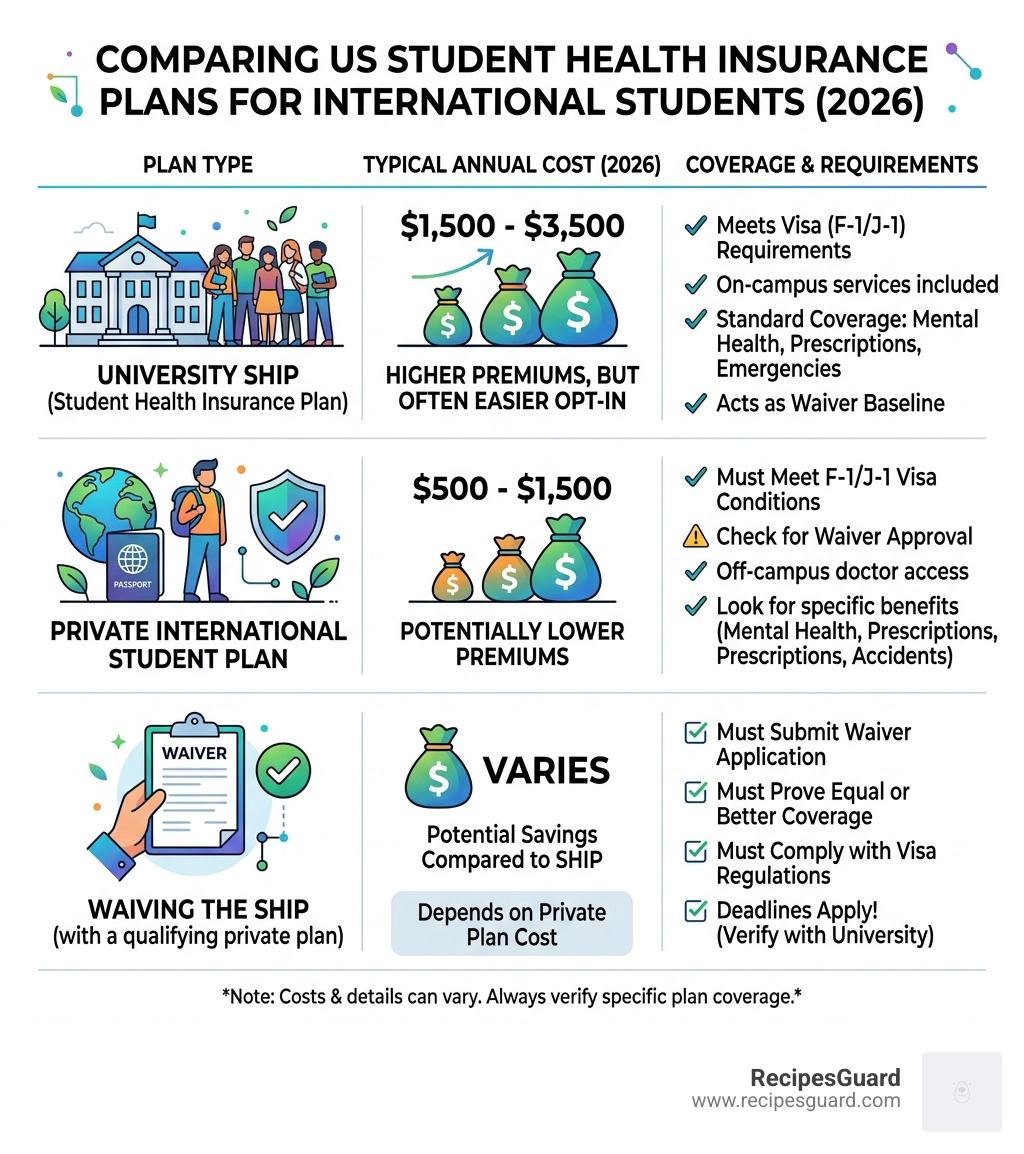
Here is a quick snapshot of your main options in April 2026:
| Plan Type | Typical Annual Cost | Best For |
|---|---|---|
| University SHIP | $1,500 – $3,500 | On-campus access, waiver baseline |
| Private International Plan | $500 – $1,500 | F-1/J-1 visa holders, waiver approval |
| Parent’s Employer Plan | Varies (often free for student) | Domestic students under 26 |
| ACA Marketplace Plan | $0 – $4,800 (after subsidies) | Eligible domestic students |
| Medicaid | $0 | Low-income eligible students |
The gap between the cheapest and most expensive option is enormous. A 21-year-old on their own pays an average of $374 per month for a Bronze marketplace plan — before any subsidies. Meanwhile, some private international plans start well under $100 per month.
But cost is only part of the story. The plan also needs to:
- Meet your university’s waiver requirements
- Comply with your F-1 or J-1 visa conditions
- Cover the care you actually need (mental health, prescriptions, emergencies)
- Work with doctors near your campus
This guide walks you through every major plan type, what they cover, what they cost, and how to avoid the most common — and expensive — mistakes.
Basic student insurance comparison glossary:
- Australian student insurance claims
- claim injury student travel
- illness claim student travel
The Primary Categories of Student Health Coverage

When we look at the American healthcare landscape, it often feels like trying to read a map where the landmarks keep moving. For students, the options generally fall into four “buckets.” Understanding these is the first step in any effective student insurance comparison.
- University Student Health Insurance Plans (SHIP): Most U.S. universities automatically enroll you in their own plan. These are convenient and usually offer great coverage at campus clinics, but they are often the most expensive option, ranging from $1,500 to $3,500 per year.
- Private International Student Plans: These are designed specifically for F-1 and J-1 visa holders. They are often significantly cheaper than SHIPs (sometimes saving you thousands) while still meeting visa and university waiver requirements.
- ACA Marketplace Plans: Through the Affordable Care Act (ACA), students can buy individual plans. These are categorized into tiers: Bronze, Silver, Gold, and Platinum. While a 21-year-old might pay $374/month for a Bronze plan, subsidies can lower this significantly for those who qualify.
- Medicaid: For students with very low income, Medicaid provides free or near-free coverage. However, eligibility varies wildly by state. In 2026, many states have expanded access, but others remain restrictive.
According to Best Health Insurance for College Students – ValuePenguin, choosing the right bucket depends on your health needs and budget. A healthy student might thrive on a Bronze plan, while someone needing regular prescriptions might save more with a Gold plan despite the higher premium.
Comparing University SHIPs vs. Private Plans
The showdown between the “school plan” and “private insurance” is where most students find their biggest savings.
University SHIPs are like a “VIP pass” to the campus health center. They are usually “fully insured” and meet all ACA requirements. The downside? The price tag. You are often paying for a broad network you might not even use.
Private International Plans are the “budget-friendly rebels.” They are often tailored to young, healthy populations, which keeps premiums low—sometimes starting as low as $39 to $50 per month. The trick here is the waiver. To use a private plan, your university must agree that it is “equivalent” to their SHIP. We have seen thousands of students successfully waive their school plans, but it requires careful attention to the fine print.
Coverage for OPT and Exchange Visitors
If you are on Optional Practical Training (OPT) or a J-1 exchange visitor, your needs are unique. Standard university plans usually end when you graduate, leaving a dangerous gap.
- J-1 Visa Holders: The U.S. Department of State mandates specific minimums, including at least $100,000 in medical benefits per accident or illness and $50,000 for medical evacuation.
- F-1 OPT Status: Once you graduate, you are no longer eligible for most SHIPs. Short-term plans or dedicated OPT insurance are lifesavers here. Some providers offer plans specifically for OPT holders starting at very affordable rates, ensuring you don’t lose coverage while transitioning to a career.
Essential Student Insurance Comparison: Costs and Coverage Requirements
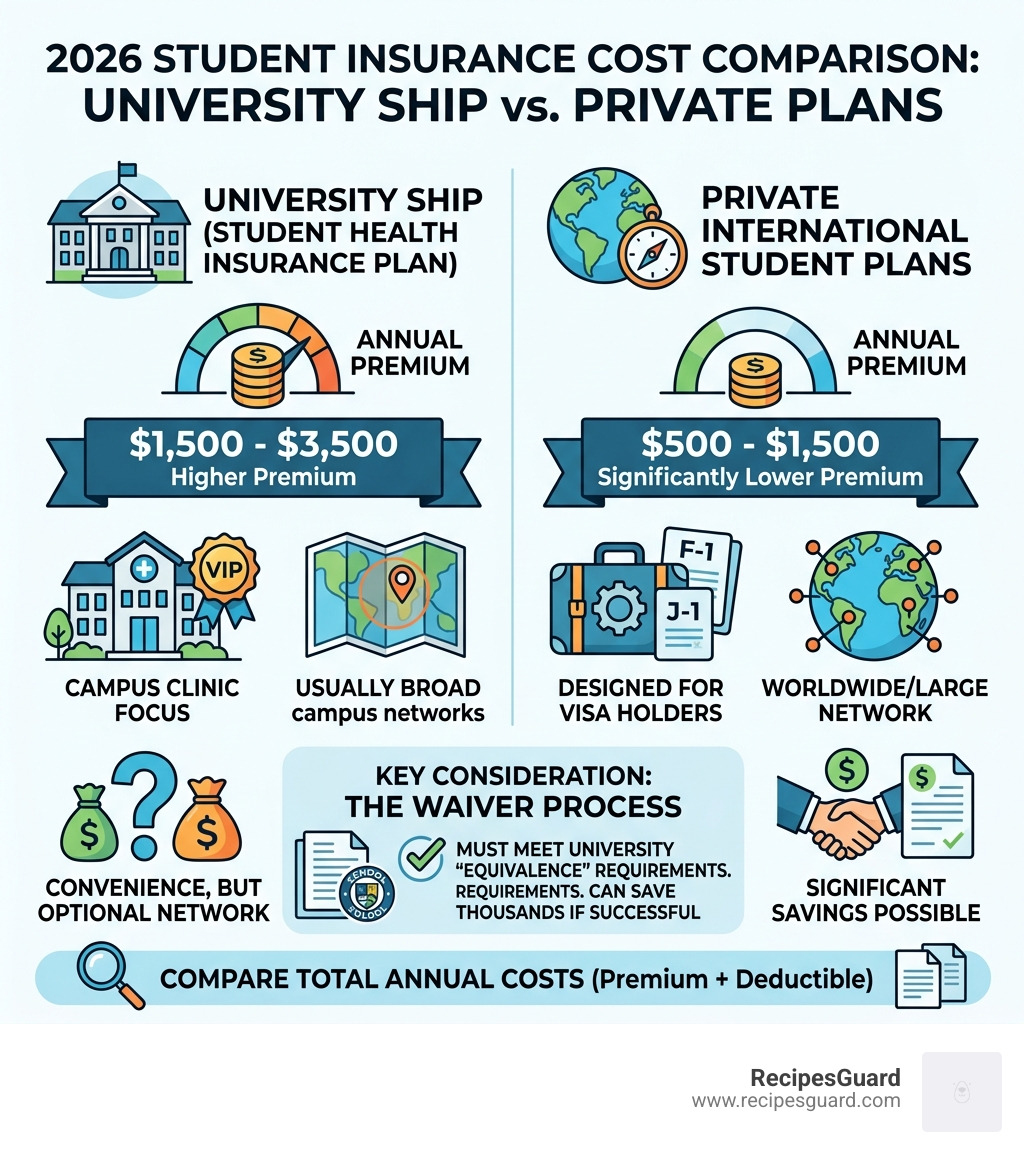
To do a proper student insurance comparison, you need to look past the monthly premium. We recommend looking at the “Total Annual Cost,” which includes your premium plus your deductible and potential out-of-pocket expenses.
| Feature | University SHIP | Private International | Parent’s Plan (if applicable) |
|---|---|---|---|
| Annual Premium | $1,500 – $3,500 | $500 – $1,500 | $0 (if covered as dependent) |
| Deductible | $250 – $500 | $0 – $500 | $500 – $5,000+ |
| Coinsurance | 10% – 20% | 0% – 20% | 20% – 40% |
| Visa Compliance | Guaranteed | High (if chosen correctly) | Often low for international |
As noted in the Student Health Insurance Compared 2026 Guide, the U.S. is the most expensive destination globally for students. While France might cost only €103/year, the U.S. can easily hit $3,000. This 29x difference makes every dollar saved in your comparison vital.
Key Features to Evaluate in Your Student Insurance Comparison
Don’t get blinded by a low price. A plan that doesn’t cover what you need is just an expensive piece of paper. Ensure your comparison includes these “Big Four”:
- Pre-existing Conditions: Does the plan cover asthma, diabetes, or mental health issues you had before signing up? ACA-compliant plans must cover these, but some “short-term” or “budget” plans might have a 6-12 month waiting period.
- Maximum Limits: Some cheap plans cap your total coverage at $50,000. In the U.S., a single night in the hospital can cost $15,000, and a major surgery can exceed $100,000. Look for “Unlimited” or at least $250,000 in total benefits.
- Medical Evacuation: If you are seriously injured and need to be flown home, it can cost $50,000+. This is a mandatory requirement for J-1 visas.
- Repatriation of Remains: It’s a grim topic, but having $25,000 in coverage for this is often a visa and university requirement.
How to Conduct a Student Insurance Comparison for Specialized Care
Most students forget about the “extras” until they have a toothache or need a therapist.
- Mental Health: In 2026, mental health support is a top priority. Check if the plan offers “Virtual Care” or telehealth. Many private plans now include 24/7 counseling via an app, which is often faster than waiting 3-6 months for an in-person appointment.
- Prescription Tiers: Medications are categorized into “tiers.” Tier 1 (generics) are cheap; Tier 4 (specialty) can cost thousands. If you take regular medication, verify that your plan’s formulary covers it.
- Dental and Vision: These are rarely included in standard health plans. You may need to add a “rider” or a separate policy for $15–$25 per month.
Navigating University Waivers and Visa Compliance

The “Waiver Maze” is where many students get stuck. A waiver is simply a request to your university saying, “I have my own insurance, please don’t charge me for yours.”
To win this battle, your private plan must meet the university’s “Compliance Criteria.” These usually include:
- A deductible under a certain amount (e.g., $500).
- Coverage for the entire academic year.
- A claims office located in the USA.
- Coverage that meets ACA “Minimum Essential Coverage” standards.
Meeting F-1 and J-1 Visa Insurance Mandates
The U.S. government doesn’t just suggest insurance; for J-1 scholars, they mandate it. If you fail to maintain insurance that meets Department of State requirements, your visa can be terminated.
The current requirements generally include:
- Medical benefits of at least $100,000 per accident or illness.
- Repatriation of remains in the amount of $25,000.
- Expenses associated with the medical evacuation of the exchange visitor to his or her home country in the amount of $50,000.
- A deductible not to exceed $500 per accident or illness.
Common Pitfalls in the Waiver Process
Even with a great plan, things can go wrong. We often see students miss the Waiver Deadline. Once that date passes, the university will charge your student account for their SHIP, and it is nearly impossible to get a refund.
Another pitfall is Language Support. If your insurance documents are not in English, the university will reject them immediately. We always advise choosing providers that offer US-based support and instant digital copies of your “Waiver Summary” to make the process as smooth as possible.
Maximizing Savings and Avoiding Coverage Pitfalls
We all love saving money, but in insurance, “cheap” can be very expensive. Here is how we recommend you save money without sacrificing your health:
- Annual Payments: Many insurers offer a 5% to 10% discount if you pay for the whole year upfront rather than monthly.
- University Discounts: Sometimes, student organizations have negotiated group rates. Always ask your International Student Office if such a deal exists.
- Premium Tax Credits: If you are a domestic student or an international student who has become a “resident alien” for tax purposes, you might be eligible for subsidies on the ACA Marketplace.
- Cost-Sharing Reductions (CSR): If you choose a “Silver” marketplace plan and have a lower income, the government might lower your deductible and out-of-pocket maximum automatically.
Strategies to Lower Out-of-Pocket Expenses
The premium is what you pay to have insurance; out-of-pocket costs are what you pay to use it. To keep these low:
- Stay In-Network: U.S. insurers have lists of “Preferred Providers.” If you go “Out-of-Network,” you might pay 50% of the bill instead of 20%.
- Use Telehealth: Many plans now offer $0 co-pays for virtual doctor visits. It’s perfect for a cold, flu, or minor rash.
- Preventive Care: Under the ACA, things like annual check-ups and vaccines are often 100% covered. Use them! It’s better to catch a problem early than to end up in the Emergency Room.
Identifying Red Flags in Budget Plans
If a plan seems too good to be true, it probably is. Watch out for these red flags:
- Accident-Only Coverage: These plans won’t pay a cent if you get the flu, appendicitis, or a kidney stone. They only cover “accidents” like a broken leg.
- No Repatriation/Evacuation: This will lead to an automatic visa violation for J-1 holders and many university waiver rejections.
- Extremely High Deductibles: A plan with a $5,000 deductible might be cheap, but do you have $5,000 sitting in the bank to pay the doctor before the insurance kicks in?
Frequently Asked Questions about Student Insurance
Is it cheaper to stay on a parent’s plan or buy student insurance?
If you are under age 26, you can legally stay on your parent’s employer-sponsored plan. This is often the cheapest route for domestic students. However, for students moving across state lines, the “Network” is the problem. Your parent’s plan might cover doctors in Sydney or Melbourne (if they are Australian) or New York, but if you are studying in California, you might find no “In-Network” doctors nearby, making every visit “Out-of-Network” and very expensive.
Can international students qualify for US subsidies?
Generally, international students on F-1 visas are considered “non-resident aliens” for the first five years and are not eligible for marketplace subsidies. However, once you pass the “Substantial Presence Test” and become a resident for tax purposes, you may qualify based on your income.
What happens if there is a gap in my coverage?
A gap in coverage is a major risk. If you are injured during a gap, you are 100% responsible for the bill. Furthermore, for international students, a gap can be seen as a violation of your visa status. We always recommend “Transit Insurance” or a short-term travel medical plan to cover the days between your arrival in the USA and the start of your university plan.
Conclusion
Navigating U.S. healthcare is a daunting task, but a thorough student insurance comparison is your best defense against financial stress. By understanding the difference between SHIPs, private plans, and marketplace options, you can find a balance that protects both your health and your wallet.
At RecipesGuard, we know that finding the right insurance is only half the battle. The real stress starts when you actually have to file a claim. Whether you are dealing with a sports injury or a sudden illness, our mission is to simplify the aftermath. We provide student-focused, step-by-step claim filing tutorials to ensure you actually get the money you are owed without the headache.
Before you sign on the dotted line, take a breath, compare the tiers, and make sure your plan is ready for the “real world” of campus life in 2026. For more expert advice on navigating the complexities of student life abroad, check out our More info about student insurance claims. Safe travels and stay healthy!

My name is Bianca, and my journey into the world of fermentation and food safety began with a costly mistake. I once lost an entire season’s harvest of chili peppers because I relied on guesswork instead of science. That failure was my turning point.
