
Why Student Visa Insurance Requirements Can Make or Break Your Study Abroad Plans
Student visa insurance requirements are the specific health coverage rules you must meet to get — and keep — your student visa in another country.
Here’s a quick summary of what most students need to know:
| Visa Type | Who Sets the Rules | Minimum Medical Coverage |
|---|---|---|
| J-1 (USA) | U.S. Department of State (federal law) | $100,000 per illness/accident |
| F-1 / M-1 (USA) | Your university (not federal law) | Varies by school |
| Student Visa (Australia) | Federal government (OSHC mandatory) | Matches visa duration |
| Student Visa (Finland) | Immigration authority | €120,000 (under 2 years) |
| Student Visa (Schengen/Europe) | Embassy | €30,000 minimum |
The U.S. is the world’s most expensive healthcare system. A single emergency surgery can cost $50,000 or more. Without the right insurance, you risk not just a massive bill — but losing your visa status entirely.
For J-1 exchange visitors, the stakes are especially high. Failing to maintain compliant insurance doesn’t just mean a fine. It means your program gets terminated, and you and any dependents must leave the country immediately — with no option to reinstate your status.
For F-1 students, the federal government doesn’t mandate insurance directly, but almost every U.S. university requires it before you can register for classes. Same result, different rule-maker.
This guide walks you through exactly what coverage you need, how to avoid overpaying, and how to stay compliant no matter where you’re studying.
Understanding Federal vs. Institutional Student Visa Insurance Requirements

When we talk about student visa insurance requirements, the first thing we need to clarify is who is actually making the rules. Depending on your visa type, you might be answering to the federal government or just your university’s international office.
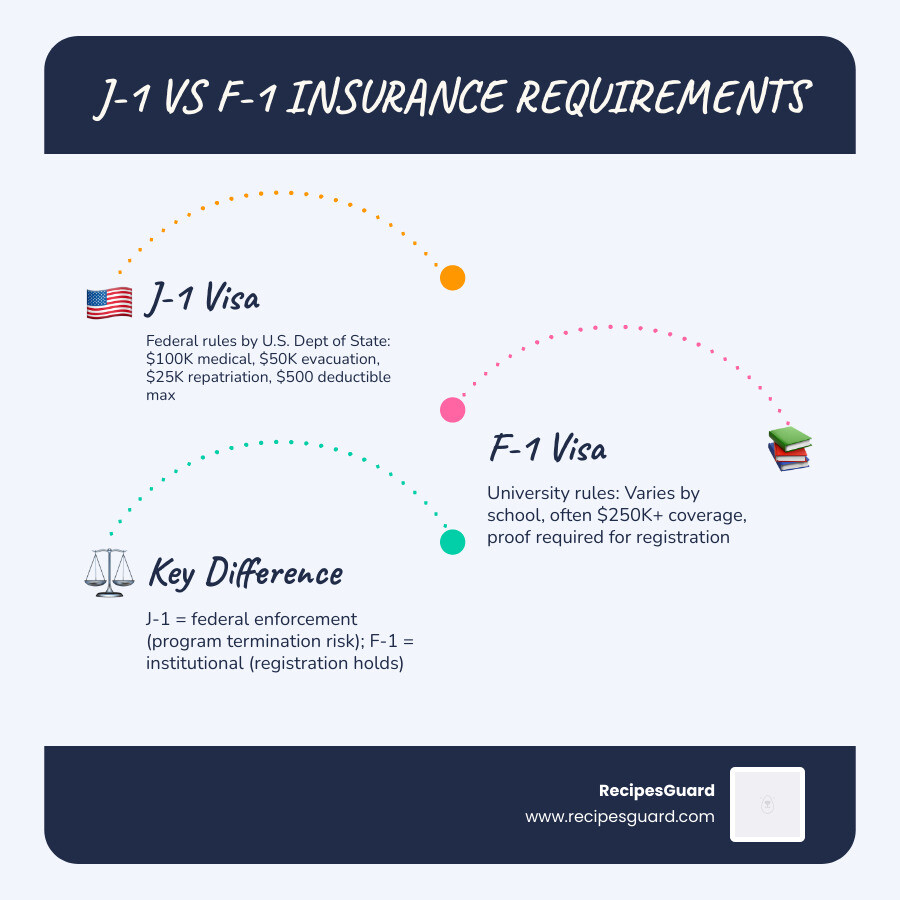
For those heading to the United States, the distinction is vital. If you are on a J-1 visa (Exchange Visitor), your requirements are set by the U.S. Department of State. These are non-negotiable federal laws. However, if you are on an F-1 visa (Academic Student) or an M-1 visa (Vocational Student), the federal government actually doesn’t mandate health insurance. Instead, the “law” is set by your university.
Your Designated School Officer (DSO) is the person who manages your I-20 form (for F-1/M-1) or DS-2019 (for J-1). They are the gatekeepers. If you don’t show proof of insurance that meets their specific criteria, they can place a “registration hold” on your account, preventing you from signing up for classes. This effectively puts you out of status.
Navigating these rules is the first step toward a successful study experience. If you ever find yourself in a situation where you need to use your policy, understanding Visa Claims 101 Navigating The Process For International Students can save you from a mountain of paperwork.
Meeting student visa insurance requirements for F-1 students
For F-1 students, the university is the boss. Most institutions have “mandatory enrollment” policies, meaning they automatically bill you for their own health plan—which can cost anywhere from $3,000 to $6,000 per year.
To meet these student visa insurance requirements without using the school’s plan, you must go through the “waiver process.” This involves proving that your private insurance is “ACA-comparable” or meets a specific checklist of benefits (like mental health coverage and pre-existing condition support). If you’re coming from abroad, you might also want to check out A student guide to Australian insurance claims and visa medicals to see how different systems compare when it’s time to actually see a doctor.
Navigating student visa insurance requirements for J-2 and F-2 dependents

If you’re bringing a spouse or children, they aren’t just along for the ride—they have their own student visa insurance requirements. For J-2 dependents, the rules are just as strict as they are for the J-1 holder. If a spouse’s insurance lapses, the entire family’s visa status is at risk.
F-2 dependents (for F-1 students) often have more flexibility because the university might not mandate coverage for them, but given that a simple doctor’s visit in the U.S. can cost $200–$400 without insurance, going uncovered is a massive financial gamble. For a deeper look at how to handle claims for the whole family, see The international students guide to navigating an insurance claim student visa.
Mandatory Coverage Standards for J-1 Exchange Visitors
The U.S. Department of State does not play around when it comes to J-1 visas. They have set very specific “floor” requirements that every policy must meet. If your plan is missing even one of these, you are technically in violation of federal law.
As of 2026, the mandatory minimums are:
- Medical Benefits: At least $100,000 per accident or illness.
- Medical Evacuation: $50,000 (to transport you to your home country if you are critically ill).
- Repatriation of Remains: $25,000 (to send your body home in the event of death).
- Deductible: Must not exceed $500 per accident or illness.
- Co-insurance: The plan must cover at least 75% of covered medical expenses.
Additionally, the insurance company itself must be financially stable. The government requires a rating of “A-” or above from A.M. Best or a “B+” or above from Weiss Research.
Failure to follow these Adequate health insurance for visa holders guidelines results in immediate program termination. There is no “grace period” for insurance lapses on a J-1 visa. If your coverage ends on Tuesday and you don’t renew until Thursday, you have technically lost your legal right to stay in the country.
How to Save Money: The University Waiver Process
Most international students are shocked when they see the price tag on university-sponsored health insurance. While these plans are usually excellent, they are often “over-insured” for a healthy 20-year-old, leading to premiums that can feel like a second tuition bill.
The good news? You can often save 50-70% by purchasing a private plan that meets the school’s student visa insurance requirements. This is done through a “waiver.”
Here is how the process typically works:
- Get the Checklist: Download the waiver requirements from your university’s health services website.
- Shop Around: Look for reputable international insurance providers that offer plans specifically designed to meet these requirements.
- Submit Proof: Provide your insurance certificate and a completed waiver form to the school before the deadline (usually the first week of classes).
- Confirm Approval: Once approved, the university will remove the insurance charge from your student account.
Before you jump into a private plan, make sure you understand Everything you need to know about overseas student health insurance cover to ensure you aren’t sacrificing essential benefits just to save a few dollars.
| Feature | University-Sponsored Plan | Private Student Plan |
|---|---|---|
| Annual Cost | $3,000 – $6,000 | $1,000 – $2,500 |
| Deductibles | Usually $0 – $250 | Usually $100 – $500 |
| Ease of Use | High (On-campus clinics) | Moderate (PPO Networks) |
| Pre-existing Conditions | Usually covered immediately | May have a waiting period |
Global Perspectives: Insurance Rules in Australia, NZ, and Europe
While much of the focus is on the U.S., other popular study destinations have their own unique student visa insurance requirements.
In Australia, the system is much more centralized. Almost all international students must purchase Overseas Student Health Cover (OSHC). It is a mandatory condition of the Subclass 500 visa. You generally cannot use insurance from your home country; it must be from one of the few government-approved Australian providers. For more details on finding the right policy, check out Overseas Student Health Cover (OSHC) – Study Australia.
New Zealand follows the Education (Pastoral Care of Tertiary and International Learners) Code of Practice 2021. This requires students to have insurance that covers travel to and from New Zealand, medical care, and “repatriation” (sending you home if something goes wrong).
In Europe, specifically the Schengen Area, you’ll need a policy with at least €30,000 in coverage. Finland has a unique rule where students staying for less than two years need €120,000 in coverage, while those staying longer need only €40,000 (because they eventually gain access to the public system). If you’re planning a weekend trip to Paris or Rome while studying, you’ll want to read about Navigating Schengen Visa Insurance For Your Next European Escape.
Frequently Asked Questions about Student Visa Insurance
Does the Affordable Care Act (ACA) apply to international students in 2026?
The ACA (often called “Obamacare”) is the law that governs U.S. health insurance standards. Most international students on F and J visas are considered “non-resident aliens” for tax purposes for their first five calendar years in the U.S. During this time, they are generally exempt from the ACA’s individual mandate.
However, many universities still require your private plan to be “ACA-comparable,” meaning it must cover things like preventive care, maternity, and mental health. Once you pass the 5-year mark, your tax status changes to “resident alien,” and the rules might shift. For long-term students, finding The best OSHC deals for long term international students can help manage costs over multiple years.
What happens if my insurance coverage lapses during my program?
A lapse in coverage is one of the fastest ways to get your visa revoked. For J-1 scholars, the university is legally required to terminate your SEVIS record if they discover you are uninsured.
For F-1 students, while the government might not deport you immediately, the school will likely block your ability to attend classes or graduate. More importantly, if you have an accident during a 2-day lapse, you could be stuck with a $100,000 hospital bill that no insurance company will cover retroactively. It’s “The Waiting Game” you don’t want to play—see The Waiting Game A Guide To Visa Delays And Revocations for more on visa risks.
Can I use my home country’s insurance to meet U.S. requirements?
Technically, yes, but it is very difficult. Most U.S. universities will only accept a home-country plan if:
- The policy is written in English.
- The benefits are listed in U.S. Dollars.
- The company has a claims office located in the United States.
- The provider meets the A.M. Best financial rating requirements.
Most domestic plans from Asia, Latin America, or Europe fail these tests. It’s usually much easier to buy a U.S.-based international student plan. If you’ve already paid for a visa or insurance that was rejected, you might be able to Claim For Visa Fees And Keep Your Travel Budget Intact.
Conclusion
Meeting your student visa insurance requirements doesn’t have to be a financial nightmare. By understanding the difference between federal mandates (J-1) and institutional rules (F-1), and by utilizing the waiver process, you can save thousands of dollars while staying fully protected.
At RecipesGuard, we know that having insurance is only half the battle—knowing how to use it is the other half. We provide student-focused, step-by-step tutorials on how to file insurance claims, ensuring that when you do need medical care, the paperwork doesn’t become a second headache. Whether you are studying in the sunny suburbs of Australia or a bustling U.S. city, our advisory services are here to ensure your financial security.
Ready to secure your status? Start your student insurance journey here and let us help you navigate the complexities of international healthcare with ease.

My name is Bianca, and my journey into the world of fermentation and food safety began with a costly mistake. I once lost an entire season’s harvest of chili peppers because I relied on guesswork instead of science. That failure was my turning point.
