
Everything You Need to Know About Overseas Student Health Insurance Cover
What Is Overseas Student Health Cover — And Why Every International Student in Australia Needs It
What is overseas student health cover (OSHC)? It is a mandatory health insurance product that the Australian Government requires all international students to hold for the entire duration of their studies in Australia.
Here’s a quick summary of what you need to know:
- What it is: Private health insurance specifically designed for international students and their dependants
- Who needs it: Anyone on an Australian student visa (Subclass 500), including partners and children listed on the visa
- What it covers: GP visits, specialist care, hospital treatment, emergency ambulance, and limited prescription medicines
- What it doesn’t cover: Dental, optical, and physiotherapy (unless you add extras cover)
- Who provides it: Five approved private insurers operating under an Australian Government Deed
- How much it costs: From around $437 per year for a single student policy
Without OSHC, you would be responsible for the full cost of any medical treatment you receive in Australia. Those costs can be significant — a single hospital stay or emergency procedure can run into thousands of dollars.
OSHC is not optional. It is tied directly to visa condition 8501, which means letting your cover lapse could put your visa at risk.
The good news? Once you understand how it works, managing your OSHC is straightforward. This guide covers everything — from what’s included in a basic policy to how to make a claim and switch providers.
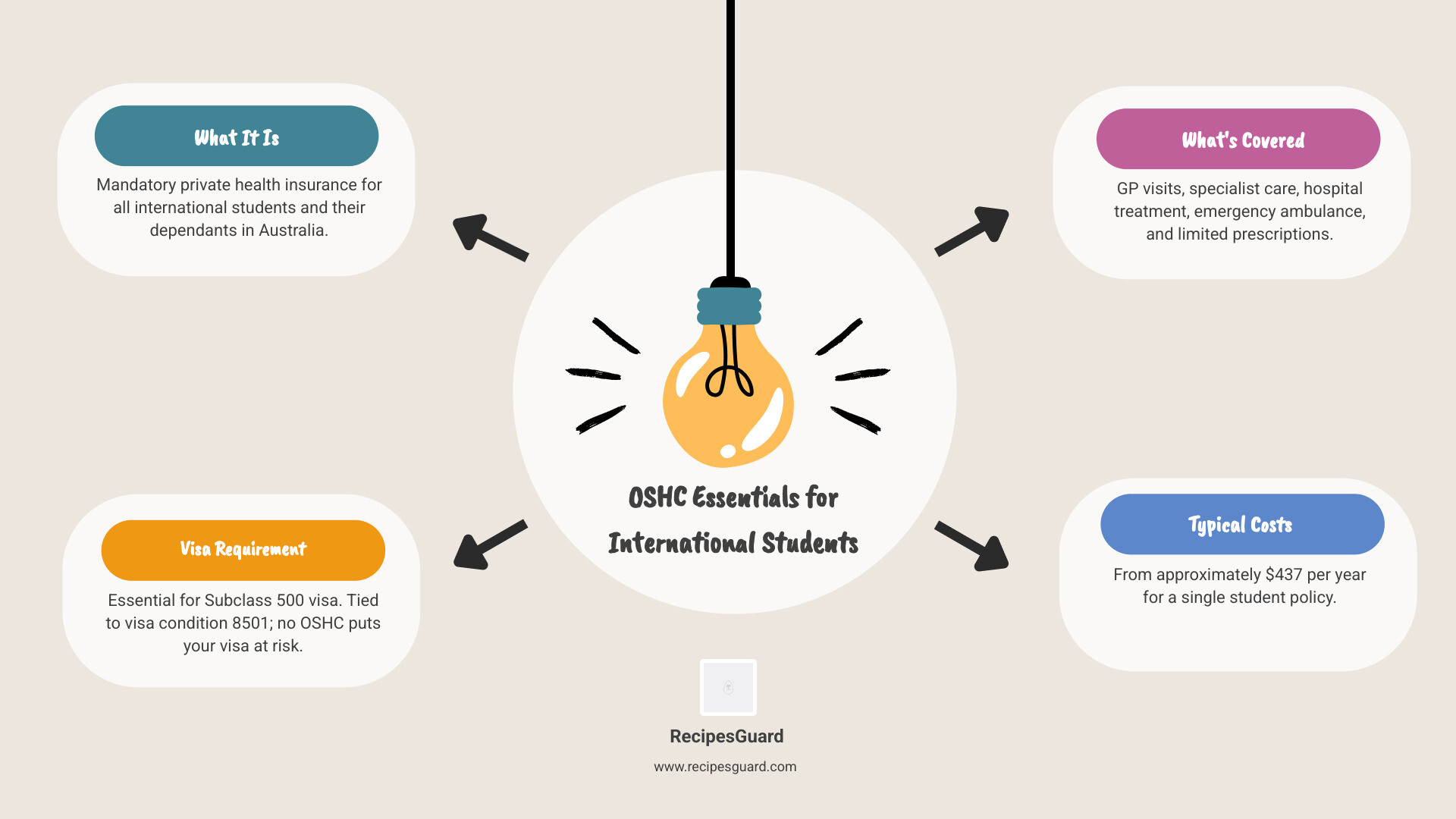
Defining What is Overseas Student Health Cover for Visa Purposes
When we talk about the Subclass 500 student visa, we aren’t just talking about your right to study; we are talking about your residency status. As a temporary resident, you do not have automatic access to Medicare, Australia’s public healthcare system. This is where OSHC steps in as a vital financial safety net.
The Department of Home Affairs is very strict about this: you must have health insurance from the day you arrive in Australia until the day your visa expires. If you are applying for your visa, you’ll usually need to show proof of this cover before your visa is even granted. This ensures that if you fall ill or have an accident, you won’t be left with a mountain of debt. For a deeper look at the official regulations, you can review the Overseas Student Health Cover (OSHC) fact sheet provided by the Australian Government.
Understanding What is Overseas Student Health Cover: Inclusions and Exclusions

To understand what you are paying for, we need to look at the Medicare Benefits Scheme (MBS). The MBS is a list of medical services and the “schedule fee” the government thinks they should cost. Most OSHC policies are designed to mirror the benefits Australians get through Medicare.
Minimum Benefits and Hospital Coverage
Under the OSHC Deed—a legal agreement between the government and insurers—every basic policy must provide a minimum level of cover. Here is what we can expect from a standard policy:
- Doctor (GP) Visits: Your policy will generally cover 100% of the MBS fee for a General Practitioner. However, if the doctor charges more than the MBS fee, you pay the “gap.”
- Specialist Services: If you need to see a dermatologist or a cardiologist, OSHC covers 85% of the MBS fee.
- Blood Tests and X-rays: Pathology and radiology are covered at 85% of the MBS fee.
- Hospital Treatment: If you are admitted to a public hospital as a private patient in a shared ward, your OSHC usually covers 100% of the costs. This includes surgery and post-operative care.
- Emergency Ambulance: This is a big one. In many parts of Australia, ambulance rides are not free. OSHC provides 100% cover for emergency transport to a hospital.
- Prescription Medicines: While not unlimited, OSHC helps with the cost of many medicines. Typically, you can claim up to $50 per item, with annual limits of $500 for singles and $1,000 for families or couples.
For more details on how these benefits are structured, you can visit the Overseas Student Health Cover page on the Private Health website.
Common Policy Exclusions
While OSHC is great for “unplanned” medical needs, it doesn’t cover everything. We often see students surprised by what isn’t included in a basic policy. Standard exclusions usually include:
- Dental: Fillings, cleanings, and wisdom teeth removal are generally not covered.
- Optical: Eye tests and the cost of glasses or contact lenses.
- Physiotherapy: Treatment for sports injuries or chronic pain.
- Elective Surgery: Any procedure that isn’t medically necessary.
- Cosmetic Procedures: Treatments for appearance rather than health.
- Assisted Reproduction: Services like IVF are excluded.
- Non-emergency Transport: If you just want a ride to the clinic, it’s not covered!
If you know you’ll need dental or optical work, we recommend looking into “Extras” or “Ancillary” cover, which can be purchased alongside your OSHC.
Costs, Waiting Periods, and Exemptions
Budgeting for your time in Australia is hard enough without hidden costs. As of early 2026, the cost of OSHC can vary significantly depending on whether you are alone or bringing family.
| Policy Type | Average Annual Cost (Approx.) | Who is Covered? |
|---|---|---|
| Single | $437 | Just the student |
| Couple | $1,222 | Student + spouse/partner |
| Single-Parent | $1,744 | Student + children (under 18) |
| Family | $2,022 | Student + partner + children |
These prices are reviewed annually, so it’s always a good idea to get a fresh quote before you buy. Factors like the length of your visa and the specific insurer you choose will also influence the final premium.
Mandatory Waiting Periods and 2026 Updates
A “waiting period” is the time you must hold your policy before you can claim for certain conditions. This prevents people from buying insurance only when they are already sick.
- Pre-existing Conditions: Usually a 12-month waiting period.
- Pregnancy-related Care: Historically, this has been a 12-month wait.
- Psychiatric Care: Usually a 2-month wait.
The 2026 Update: We have some exciting news for students! From 1 January 2026, approved OSHC insurers will begin removing waiting periods for pregnancy-related treatment on policies that are two years or longer in duration. This is a huge win for students planning long-term studies who might want to start a family.
Waiting periods never apply to emergency treatment. If you have a pre-existing heart condition and suffer a sudden emergency, you are covered immediately.
Who is Exempt from OSHC?
Not every international student needs OSHC. Australia has Reciprocal Health Care Agreements (RHCA) with several countries, though only a few allow students to skip OSHC.
- Norwegian Students: Usually exempt if covered by the Norwegian National Insurance Scheme.
- Swedish Students: Exempt if covered by Kammarkollegiet.
- Belgian Students: Exempt under the specific RHCA between Australia and Belgium.
If you are from one of these countries, you must provide proof of your home-country insurance to the Department of Home Affairs. Also, if you leave Australia for more than 3 months during your studies, you might be eligible for a partial refund on your policy for that period.
How to Purchase and Manage Your Policy

Buying OSHC is usually one of the first things you do after receiving your Letter of Offer. There are currently five (previously six) main insurers that are signatories to the OSHC Deed: Allianz Care Australia, Bupa, Medibank (and ahm), nib, and CBHS International Health.
You can purchase your cover in three ways:
- Through your University: Most institutions have a “preferred provider.” When you pay your tuition deposit, they can arrange the insurance for you.
- Directly from the Insurer: You can go to the insurer’s website, get a quote, and pay yourself. This often allows you to compare prices and save money.
- Via an Agent: Migration or education agents often handle this as part of your visa application.
Your policy should start about 14 days before your course begins. This ensures you are covered the moment you step off the plane.
Navigating the Claims Process for Overseas Student Health Cover
Making a claim shouldn’t be a headache. At RecipesGuard, we specialize in helping students navigate these steps. There are two main ways to handle medical bills:
- Direct Billing: This is the easiest way. Many clinics have agreements with insurers. You show your membership card (on your phone via apps like myBupa or Allianz Care), and the clinic bills the insurer directly. You only pay the “gap fee” on the spot.
- Reimbursement: If the doctor doesn’t offer direct billing, you pay the full amount first. You then take a photo of your receipt and submit it through your insurer’s app or website. The money is usually back in your Australian bank account within a few days.
In a life-threatening emergency, always dial 000. You will be taken to a public hospital emergency department. Once the crisis is over, you or a friend can contact your insurer to handle the paperwork. For more guidance on moving to Australia and setting up your life, check out Overseas Student Health Cover (OSHC) – Study Australia.
Switching Providers and Refund Policies
You are not stuck with the insurer your university chooses. You have the right to switch providers at any time.
If you find a cheaper policy, you can buy the new one and then ask your old provider for a refund of the “unexpired” portion of your premium. Just make sure there is no gap between the two policies, or you will be in breach of your visa.
Refunds are also available if:
- Your visa application is refused.
- You leave Australia permanently before your visa expires.
- You are granted Permanent Residency.
- You have been outside Australia for more than 3 months.
Frequently Asked Questions
Can I add my partner or children to my OSHC?
Yes! You will need to upgrade from a “Single” policy to a “Couple” or “Family” policy. This will increase your premium, but it is a visa requirement that your dependants have the same level of cover as you.
What happens if I forget to renew my health cover?
This is a serious issue. If your cover lapses, you are violating visa condition 8501. If the Department of Home Affairs finds out, your visa could be cancelled. If you realize your cover has expired, renew it immediately. You will likely have to pay for the “gap” period to ensure continuous cover.
How do I find a doctor that offers direct billing?
Most OSHC providers have a “Find a Doctor” tool on their website or mobile app. Look for the “Direct Billing” or “Network Provider” filter. This will show you clinics nearby where you won’t have to pay the full cost upfront.
Conclusion
Understanding what is overseas student health cover is about more than just ticking a box for your visa; it’s about making sure you can focus on your studies without worrying about medical bills. Australia’s healthcare system is world-class, and OSHC ensures you have access to it from day one.
At RecipesGuard, we know that the insurance world can be confusing, especially when you’re in a new country. That’s why we provide student-focused, step-by-step claim filing tutorials to make sure you get every cent back that you’re entitled to. If you ever have a dispute with your insurer that you can’t resolve, the Private Health Insurance Ombudsman is a free service available to help you.
Stay safe, stay covered, and enjoy your Australian adventure! For more help with your student insurance journey, visit More info about student insurance services.

My name is Bianca, and my journey into the world of fermentation and food safety began with a costly mistake. I once lost an entire season’s harvest of chili peppers because I relied on guesswork instead of science. That failure was my turning point.
