
A Student Guide to Australian Insurance Claims and Visa Medicals
Why the Student Travel Insurance Claim Process in Australia Catches So Many Students Off Guard
The student travel insurance claim process Australia can feel overwhelming, especially when you’re already dealing with a medical emergency, lost luggage, or a cancelled flight far from home.
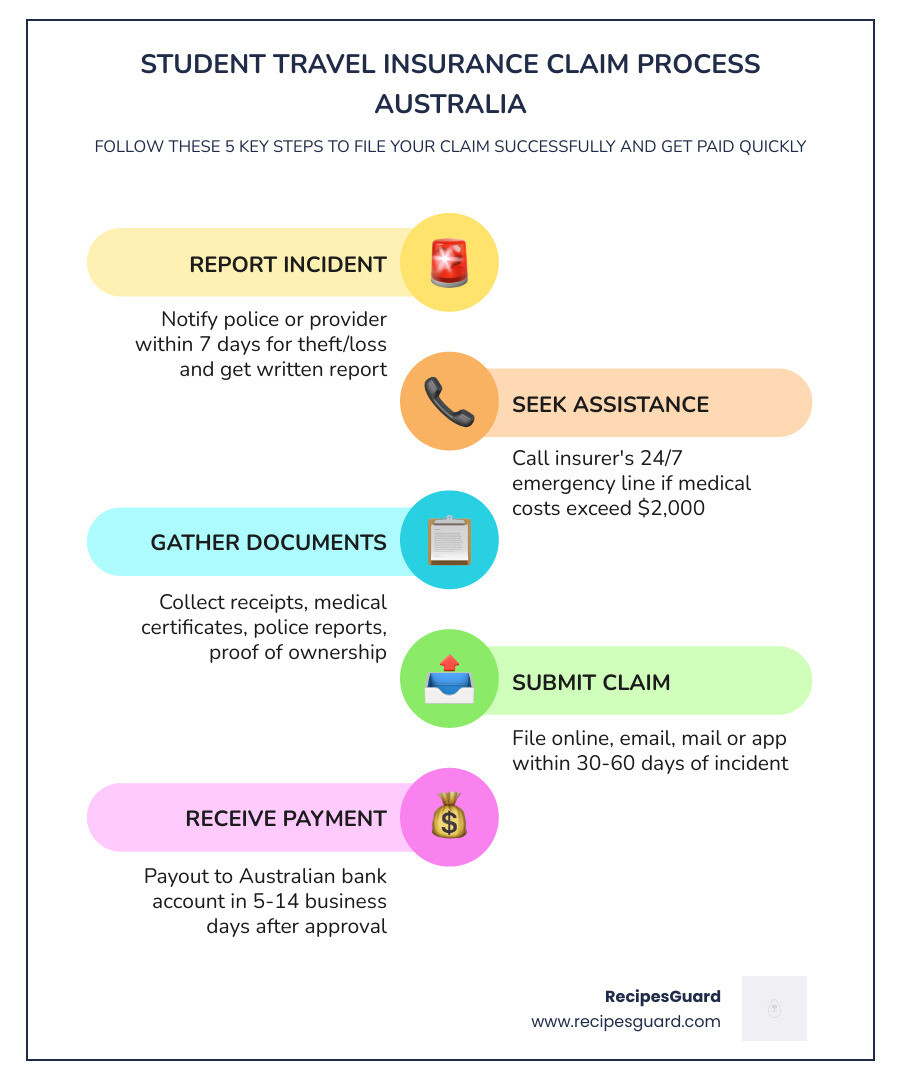
Here’s a quick overview of how the process works:
- Report the incident immediately — for theft or loss, notify the police or transport provider within 7 days and get a written report
- Seek emergency assistance — contact your insurer’s 24/7 emergency line if medical costs are likely to exceed $2,000
- Gather your documents — collect receipts, medical certificates, police reports, and proof of ownership
- Submit your claim — online, by email, by mail, or via a provider app, usually within 30-60 days of the incident
- Receive payment — most insurers pay into an Australian bank account within 5-14 business days after approval
Before diving into the details, it’s worth knowing one critical thing: travel insurance and OSHC (Overseas Student Health Cover) are not the same thing. OSHC is mandatory for international students in Australia and covers medical care within Australia. Travel insurance covers you for things like trip cancellations, lost baggage, and medical emergencies overseas — gaps that OSHC simply doesn’t fill.
Whether you’re heading to Bali on a semester break, doing a formal exchange program in Europe, or just taking a weekend trip interstate, knowing which policy applies to you — and how to actually use it — can be the difference between getting your money back quickly and having your claim denied entirely.
This guide walks you through everything: from understanding your coverage, to filing claims step by step, to avoiding the most common mistakes students make.
Student travel insurance claim process Australia terms at a glance:
- easy online student claim submission
- student trip cancellation insurance claim
- student trip delay compensation claim
Understanding OSHC vs. Student Travel Insurance in Australia
As we navigate international education in April 2026, it is vital to distinguish between your mandatory health cover and your optional (but highly recommended) travel protection.
Overseas Student Health Cover (OSHC) is a non-negotiable visa condition (Condition 8501) for almost every international student in Australia. It ensures you have access to medical necessity services like GP visits, hospital treatment, and emergency ambulance rides while you are on Australian soil. However, OSHC is notoriously “land-locked.” It generally won’t cover you if you hop over to New Zealand for a ski trip or head home to visit family during the holidays.
This is where the student travel insurance claim process Australia enters the frame. Travel insurance provides a safety net for:
- Luggage Protection: Up to $25,000 in cover for lost, stolen, or damaged personal effects.
- Trip Cancellation: Reimbursement for non-refundable flights and accommodation if an “insured event” (like a sudden illness) stops you from traveling.
- Personal Liability: Protection if you accidentally cause damage to someone else’s property or injure a person.
- Medical Emergencies Overseas: Unlike OSHC, travel insurance covers those $300 urgent care visits in New York or emergency evacuations from remote islands.
For more details on managing your health-specific needs, check out our guides on How to claim on your OSHC policy and Standard OSHC claim procedures.
When to use the student travel insurance claim process Australia
We often get asked: “I’m a student, do I really need extra insurance?” The answer depends on your movement. You should look into the student travel insurance claim process Australia during:
- Personal Leisure: Backpacking through Europe or dancing in Ibiza.
- Semester Breaks: Trips back to your home country (though note that medical cover often ceases once you arrive in your country of residence).
- International Exchanges: Formally approved university programs where you might be studying at a partner institution.
- Domestic Travel: Even within Australia, travel insurance can cover trip cancellations or rental vehicle excess that OSHC ignores.
If you are already onshore and need to manage your health expenses, you can use Online claims for student health cover to speed up the process.
Step-by-Step Student Travel Insurance Claim Process Australia

When things go wrong, the clock starts ticking. Here is the exact path we recommend to ensure your claim isn’t just submitted, but actually paid.
- Immediate Contact: If it is a medical emergency, call the local emergency services first. Once safe, call your insurer’s 24/7 emergency assistance team. For most major Australian insurers, you must call them if expenses are likely to exceed $2,000.
- The 7-Day Rule: For any lost or stolen luggage, money, or travel documents, you must report the incident to the police or the relevant transport provider (like an airline) within 7 days. Without a written report, your claim is likely to be rejected.
- The 30-Day Window: While some insurers allow up to 60 days, we suggest lodging your claim within 30 days of the incident. This makes it easier to track down missing paperwork while the event is still fresh.
- Submission Channels:
- Online/App: The fastest way. Most leading providers allow you to upload photos of receipts directly.
- Mail: You can post original documents to your provider’s claims department, but always keep copies for yourself!
For a deeper dive into the logistics, see How to lodge a travel claim or our Step-by-step claim lodgement guide.
Essential documents for your student travel insurance claim process Australia
Think of your claim like a university assignment: you need evidence to get a high mark (or in this case, a full payout). We recommend keeping a digital folder with:
- Medical Certificates: If you were sick, you need a report from the treating doctor.
- Original Receipts: For any out-of-pocket expenses.
- Proof of Ownership: Photos of your laptop, receipts for your phone, or even bank statements showing the purchase.
- Police Reports: Essential for theft or loss.
- Fit-for-Travel Letters: If you have a pre-existing condition, you should have a letter from your doctor dated within 30 days of your departure.
Use our Checklist for travel insurance claims to ensure you haven’t missed a single receipt.
Navigating University-Provided Coverage and Exclusions
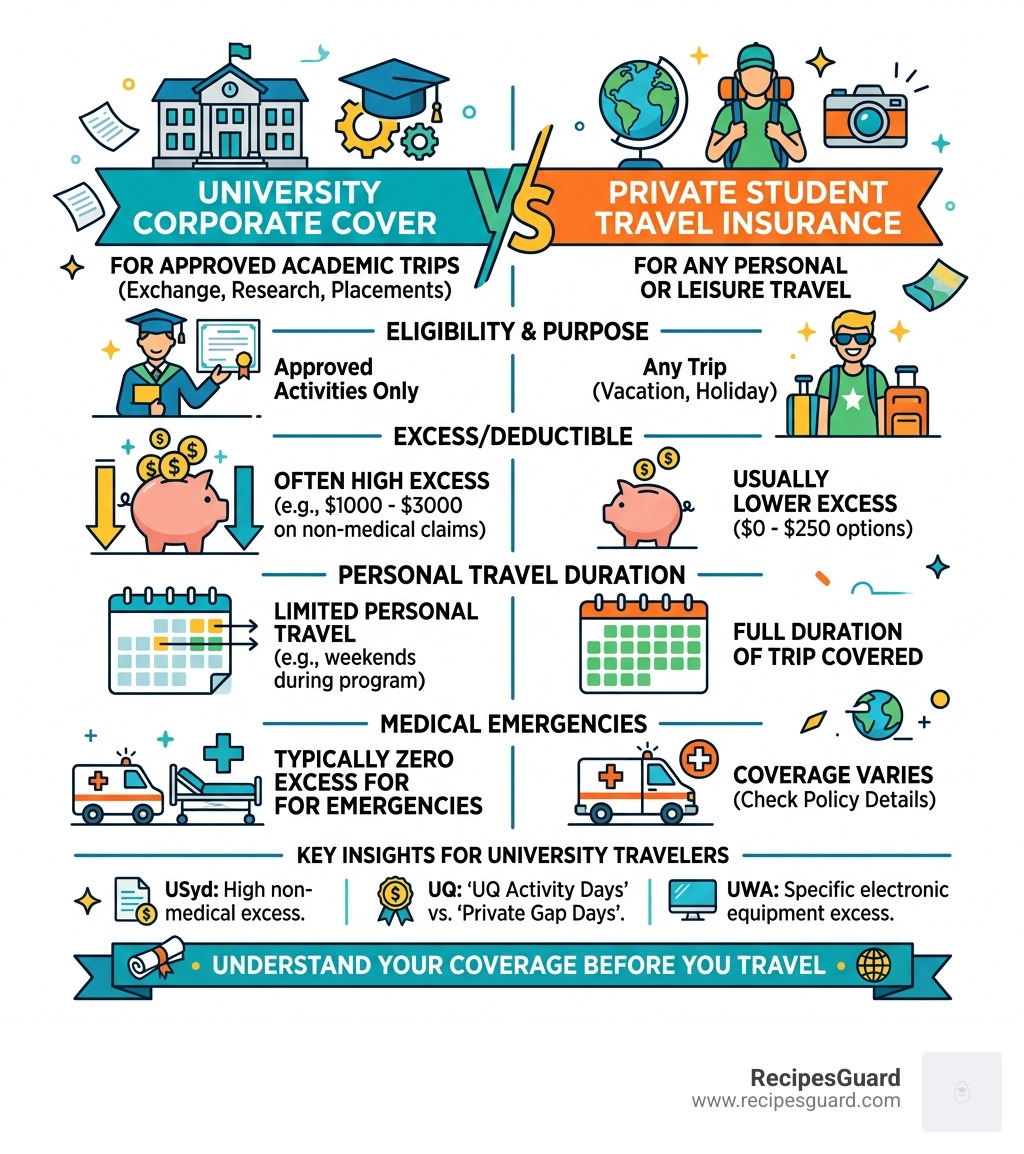
Many students don’t realize that their university (like USyd, UQ, or UWA) often provides a level of “Corporate Travel Insurance” for approved activities. However, these policies have very specific rules.
| Feature | University Corporate Cover | Private Student Travel Insurance |
|---|---|---|
| Eligibility | Approved exchange, research, or placements. | Any personal or leisure travel. |
| Excess | Often high (e.g., $3,000 at USyd for non-medical). | Usually lower ($0 – $250). |
| Personal Travel | Limited (e.g., weekends during the program). | Full duration of your trip. |
| Pre-existing Conditions | Often requires a ‘Fit for Travel’ form. | May require an extra premium or be excluded. |
Key Insights for University Travelers:
- USyd Students: Your policy has a massive $3,000 excess on non-medical claims, though medical emergencies usually have zero excess.
- UQ Students: You are covered for “UQ Activity Days” and a limited number of “Private Gap Days” (usually 2 per week of study).
- UWA Students: There is a specific $300 excess for electronic equipment claims, but most other claims have no excess.
- Exclusions: Almost no policy (university or private) will cover you in “Sanctioned Countries” or if you are participating in professional sports for money. High-risk activities like skydiving often require an “Adventure Pack” add-on.
Maximizing Payouts and Avoiding Claim Denials

To ensure you get the maximum amount back during the student travel insurance claim process Australia, keep these professional tips in mind:
- Watch the Sub-limits: Just because you have $25,000 in luggage cover doesn’t mean you can claim a $10,000 watch. Most policies have a per-item limit (often $700 – $1,000) unless you specify high-value items beforehand.
- Understand Depreciation: Insurance is meant to put you back in the position you were in, not buy you a brand-new upgrade. If your 3-year-old laptop is stolen, the insurer will likely pay the “current value,” not the original price.
- COVID-19 Awareness: In April 2026, most insurers treat COVID-19 on a case-by-case basis. You are usually covered for medical costs if you catch it, but “fear of travel” or general government lockdowns are often excluded.
- Australian Bank Accounts: This is a big one! Most Australian insurance providers will only pay refunds into an Australian bank account. Do not close your local account until all claims are settled.
- Processing Timelines: Expect 5 to 10 business days for digital claims. Hospital claims can take longer (up to 14 days) as the insurer needs to verify records with the facility.
Frequently Asked Questions about Student Insurance
What is the difference between OSHC and travel insurance?
OSHC is for your health while living and studying inside Australia. Travel insurance is for your property and health while traveling outside Australia (or for non-medical travel issues like cancellations within Australia).
How long does it take to process a student travel claim?
For online submissions with all the correct paperwork, most Australian insurers aim to process the claim within 5-10 business days. If you mail in physical documents, it can take 15-20 business days.
What should I do if my claim is denied?
Don’t panic! First, read the letter to see exactly why it was denied. Often, it’s just a missing document. You can use the insurer’s Internal Dispute Resolution (IDR) process. If that fails, you can escalate the matter to the Australian Financial Complaints Authority (AFCA).
Conclusion
Navigating the student travel insurance claim process Australia doesn’t have to be a nightmare. By reporting incidents early, keeping meticulous records, and understanding the difference between your OSHC and travel policies, you can travel with confidence.
At RecipesGuard, we specialize in providing student-focused, step-by-step claim filing tutorials to help you get your money back faster. Before you head out on your next adventure, do a final documentation review and make sure you have your insurer’s emergency number saved in your phone.
For more information about student claim services and to access our full library of tutorials, visit RecipesGuard. Safe travels!

My name is Bianca, and my journey into the world of fermentation and food safety began with a costly mistake. I once lost an entire season’s harvest of chili peppers because I relied on guesswork instead of science. That failure was my turning point.
