
The Best OSHC Deals for Long Term International Students
What International Students Pay for 3 Years of OSHC in Australia (2026)
OSHC cost for 3 years ranges from approximately AUD $1,500 to $2,505 for a single student in 2026, depending on the provider you choose.
Here’s a quick snapshot of what to expect:
| Policy Type | Estimated 3-Year Cost (2026) |
|---|---|
| Single (budget providers, e.g. ahm/nib) | ~$1,500 – $1,800 |
| Single (CBHS Essentials) | ~$1,770 |
| Single (Allianz Care Australia) | $2,505 |
| Single (Bupa, via institution) | ~$2,185 |
| Couple | $7,465 – $13,224+ |
| Family | $11,650 – $25,788+ |
Rates above reflect 2025/2026 pricing. Allianz figures are effective from 1 April 2025.
So you’re planning to study in Australia for three years. You’ve sorted your Confirmation of Enrolment (CoE), you’re working through your Subclass 500 visa application — and then you hit the OSHC requirement.
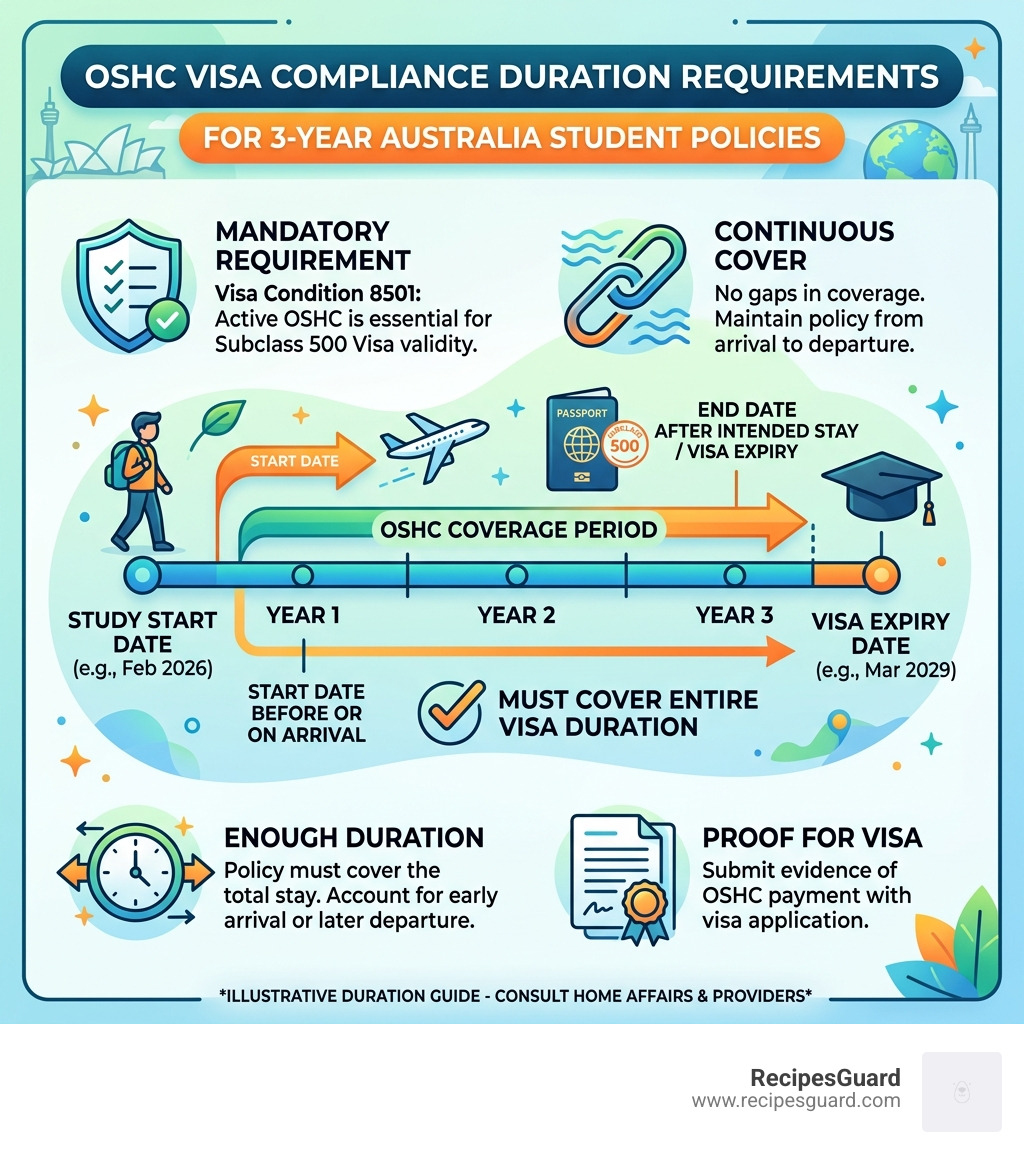
OSHC (Overseas Student Health Cover) isn’t optional. It’s a mandatory visa condition (condition 8501) for every international student in Australia. You must hold a valid policy for your entire stay.
The problem? Most students just accept whatever their university recommends — and end up overpaying by hundreds of dollars. Comparing providers takes about 10 minutes and can save you $300 to $1,000 over a 3-year period.
This guide breaks down exactly what different providers charge for a 3-year policy, what’s actually covered, what’s not, and how to get the best deal without sacrificing the coverage you need.
Relevant articles related to oshc cost for 3 years:
- medical claim student guide
- medical expenses student australia
- student claim hospital expenses
Understanding the OSHC Cost for 3 Years in 2026
As we move into 2026, the landscape of student health insurance has shifted. While the average oshc cost for 3 years remains a significant upfront expense, the range between the “budget” and “premium” providers has widened. For a single student, you are looking at a baseline of roughly $1,500 on the low end (often through providers like ahm or nib) up to over $2,500 for more established names like Allianz Care Australia.

When we look at the Overseas Student Health Cover – Duration & Costs provided by major institutions, it becomes clear that “3 years” in OSHC terms often means 38 or 39 months to account for the extra time granted on your visa before and after your course dates.
Why OSHC cost for 3 years isn’t just 3x the annual rate
You might assume that if a 1-year policy costs $600, then the oshc cost for 3 years would be exactly $1,800. In reality, OSHC pricing is often non-linear. Many insurers apply premium loading for longer-term policies. Why? Because from an actuary’s perspective, a student staying for three years is statistically more likely to require hospitalization or chronic care than someone staying for just six months.
Furthermore, healthcare inflation in Australia typically causes premiums to rise annually. When you buy a 3-year policy upfront, you are essentially “locking in” a rate, but providers build anticipated 2026 and 2027 price updates into that total. It is not uncommon for a 3-year policy to cost slightly more per month than a 1-year policy because of this long-term risk assessment.
Factors influencing the total OSHC cost for 3 years
Several variables determine the final number on your quote:
- Visa Length: Your policy must cover the full duration of your visa. If your course is 3 years, your visa might be for 3 years and 3 months. You must pay for those extra months.
- Policy Type: The jump from Single to Couple or Family is massive. A 3-year single policy might be $2,000, while a multi-family policy for the same period can exceed $25,000.
- Provider Selection: Private companies set their own rates. There is no government-fixed price for OSHC.
- Government Regulations: Changes to the Medicare Benefits Schedule (MBS) can force insurers to adjust their premiums to maintain coverage standards.
Top Providers for Long-Term Student Coverage
Choosing a provider is about balancing your wallet with your peace of mind. In 2026, the primary approved providers are ahm, nib, Medibank, Bupa, Allianz Care, and CBHS International.

According to recent data, comparing OSHC prices 2026 shows that budget providers like ahm and nib remain favorites for those looking to minimize upfront costs. However, “cheapest” doesn’t always mean “best,” especially if you end up with lower benefit limits on prescription medicines or a smaller network of direct-billing doctors.
Finding the cheapest OSHC cost for 3 years
If your goal is strictly to find the lowest oshc cost for 3 years, we recommend looking at “Essentials” plans. For example, CBHS International OSHC Essentials is often cited around $1,770 for a 36-month period (calculated at approximately $49.20 per month).
To keep costs down:
- Avoid University Recommendations: Universities often have a “preferred provider” (like Bupa or Allianz). While convenient, these are rarely the cheapest. Buying independently can save you hundreds.
- Match CoE Dates Exactly: Don’t buy 40 months if your visa only requires 38. Use your CoE and the Department of Home Affairs guidelines to calculate the exact duration.
- Opt for Basic Cover: If you are young, healthy, and don’t require extras like dental or optical, stick to the standard OSHC requirements.
Comparing hospital networks and support services
For a 3-year stay, support services become more important. You aren’t just here for a holiday; you’re living here.
- Medibank and nib: Known for having excellent digital apps that make claim filing easier—a feature we highly value here at RecipesGuard.
- Allianz and Bupa: Often have physical kiosks on university campuses, which can be helpful if you prefer face-to-face support.
- Network Providers: Some insurers have “gap-free” networks. If you use a doctor in their network, you might pay nothing out of pocket. If you go outside that network, your oshc cost for 3 years effectively increases every time you get sick because of “gap fees.”
Hidden Expenses and Coverage Limits to Watch For
The premium you pay upfront is only part of the story. To truly understand the oshc cost for 3 years, we need to talk about out-of-pocket expenses.
Most OSHC policies cover 100% of the Medicare Benefits Schedule (MBS) fee for in-hospital treatments but only 85% for out-of-hospital services like specialist visits or X-rays.
Gap fees and MBS explained
If a specialist charges $200, but the MBS fee for that service is $100, your insurer will usually only pay 85% of that $100 ($85). You are left to pay the remaining $115 out of your own pocket. This is known as the “gap.”
Overseas students coverage details often highlight that while ambulance cover is usually 100% for emergencies, prescription medicines have strict caps. Most plans only cover up to $50 per item, with an annual limit of $300–$500. For a 3-year student, a single chronic condition could quickly exhaust these limits.
Waiting periods and the 2026 pregnancy update
A major change occurring in 2026 is the removal of waiting periods for pregnancy-related treatment for policies with a duration of 2 years or more. Previously, students had to wait 12 months before they could claim pregnancy-related hospital costs.
For students on a 3-year visa, this is a massive benefit. However, for other pre-existing conditions (like asthma or diabetes), the standard 12-month waiting period still applies. This means you cannot claim for treatment related to these conditions during your first year in Australia.
Common exclusions in standard 3-year policies
Don’t expect your OSHC to cover everything. Common exclusions include:
- Elective Cosmetic Surgery: If it’s not medically necessary, it’s not covered.
- Assisted Reproduction: Services like IVF are almost universally excluded.
- Experimental Medicine: Only treatments with an MBS item number are generally eligible.
- Laser Eye Surgery: This is considered elective and is not covered under standard OSHC.
Managing Your Policy: Refunds and Compliance
Life happens. Sometimes a 3-year course turns into a 2-year course, or perhaps a visa is refused.
If you have paid the oshc cost for 3 years upfront and need to leave early, you are entitled to a pro-rata refund. However, rules vary by provider. Some, like nib or Bupa, may offer refunds with no administration fees, while others might deduct a small processing fee.
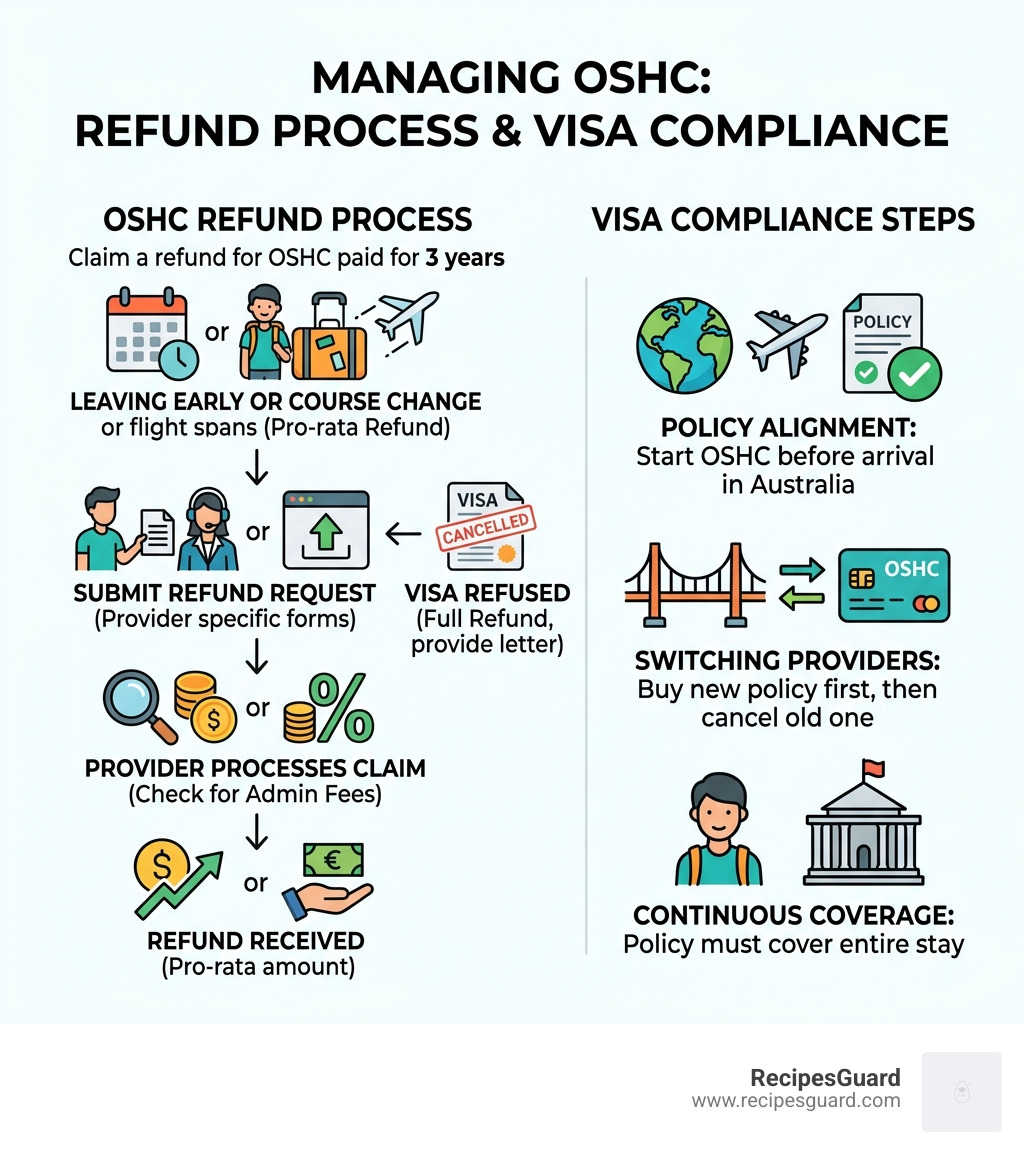
To stay compliant:
- Alignment: Ensure your policy start date is before you arrive in Australia.
- Switching: You can switch providers. If you find a better deal two years into your stay, you can buy a new policy and then cancel your old one for a refund of the remaining time. Check OSHC Australia – Compare and Save for the latest switching rates.
- Refusal: If your visa is refused, you are entitled to a full refund of your premium. You will usually need to provide your visa refusal letter to the insurer.
Frequently Asked Questions about 3-Year OSHC
Is the cheapest 3-year OSHC policy always the best value?
Not necessarily. While a budget policy saves you money today, a slightly more expensive policy might have a better “direct-billing” network. If the cheaper policy requires you to pay $50 out-of-pocket every time you see a doctor, those costs can quickly exceed the $200 you saved on the premium.
Can I switch my OSHC provider if I find a better deal mid-course?
Yes! You are not locked into one provider for the full three years. You simply purchase a new policy that starts the day you want to switch, then send proof of that new policy to your old provider to request a pro-rata refund. Just make sure there is no gap in coverage, or you will be in breach of your visa.
How do I ensure my OSHC duration exactly matches my 3-year visa?
The Department of Home Affairs usually grants visas for a few months longer than the course end date listed on your CoE. A safe rule of thumb is to add 2–3 months to your course duration. If you’re unsure, most comparison tools allow you to enter your specific visa start and end dates to get an exact quote.
Conclusion
Navigating the oshc cost for 3 years is one of the biggest financial hurdles for long-term international students. By taking the time to compare providers rather than going with the university’s default choice, you can easily save enough money to cover a month’s rent or your textbooks for the year.
At RecipesGuard, we believe that understanding your insurance is the first step to a stress-free study experience. We specialize in providing student-focused, step-by-step claim filing tutorials to ensure that when you do need to use your insurance, you get your money back as quickly as possible.
Before you hit “pay” on that visa application, take five minutes to Compare OSHC Australia plans side-by-side. Your future self (and your bank account) will thank you.

My name is Bianca, and my journey into the world of fermentation and food safety began with a costly mistake. I once lost an entire season’s harvest of chili peppers because I relied on guesswork instead of science. That failure was my turning point.
