
Why a Claim Evidence Submission Guide Can Make or Break Your Case
A claim evidence submission guide is the step-by-step framework that tells you exactly what documents to gather, how to organize them, and when to submit them — so your claim gets approved instead of denied.
Here’s what a strong claim evidence submission looks like, at a glance:
- Identify your claim type — medical emergency, trip cancellation, baggage loss, etc.
- Gather core documents — diagnosis reports, receipts, incident records, and policy details
- Add supporting evidence — witness statements, photos, or third-party letters
- Link your evidence to your claim — show a clear connection between what happened and what you’re claiming
- Submit on time — meet all deadlines and keep proof of delivery
- Track your claim — follow up regularly and respond quickly to any requests for more information
The hard truth is this: most claims aren’t denied because the event didn’t happen. They’re denied because the paperwork was incomplete, inconsistent, or missing a critical link.
Whether you’re a student dealing with a medical emergency abroad or navigating a trip cancellation for the first time, the evidence you submit — and how you submit it — is everything. As one principle common across both insurance and veterans’ claims puts it: you win claims with evidence, not with feelings or assumptions.
This guide breaks down exactly what you need, in plain language, so you don’t lose money over a paperwork mistake.
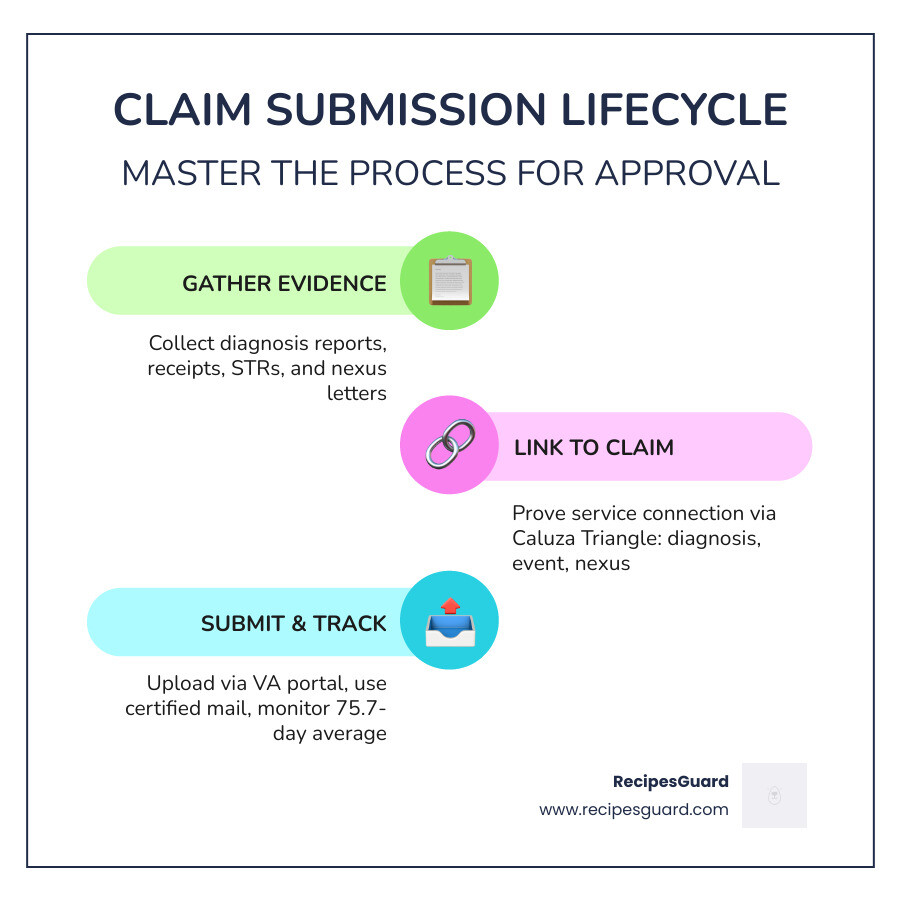
Quick claim evidence submission guide definitions:
- claim timeline extension guide
- buy travel insurance online australia
- best insurance for working holiday visa australia
The Core Pillars of a Claim Evidence Submission Guide
When we talk about submitting a claim, we aren’t just talking about filling out a form and hoping for the best. We are talking about building a case. Whether you are dealing with the Department of Veterans Affairs (VA) or a private travel insurance provider, the “burden of proof” lies with you.
In May 2026, the standard for evidence is higher than ever. You cannot simply tell a story; you must map every symptom or expense to a specific legal or policy-based “lane.” For veterans, there are five primary routes to service connection, and for students, there are specific categories of travel protection. Understanding these pillars is the first step in our claim evidence submission guide.
- Primary Claims: These are direct connections. For a veteran, it’s an injury that happened during service. For a student in Australia, it’s a medical emergency that occurred while on your trip.
- Secondary Connection: This is when one condition causes another. For example, a service-connected back injury leading to nerve damage in the legs (radiculopathy).
- Presumptive Conditions: These are “freebies” of a sort. If you served in a specific location or were exposed to certain toxins (like those covered under the PACT Act), the law presumes your illness was caused by your service.
- Aggravation Claims: This occurs when a pre-existing condition (like scoliosis) was made worse by your military service or a travel-related incident.
- 38 U.S.C. §1151: This specific claim type covers injuries caused by the VA’s own medical treatment—essentially a “medical malpractice” claim within the VA system.
To get the best results, you need to know which lane you are in. If you’re looking for more detail on the logistics of the paperwork, check out How To Submit Claim Paperwork And Actually Get Paid. You can also find official guidance on the Evidence Needed For Your Disability Claim | Veterans Affairs website.
Understanding New and Material Evidence
If you’ve been denied before, don’t lose heart. You can reopen a claim by submitting “new and material” evidence. “New” means the reviewer hasn’t seen it before. “Material” means it actually matters to the outcome—it substantiates a fact that was previously missing.
For instance, if your claim for a knee injury was denied because there was no diagnosis, a fresh MRI report from 2026 showing a tear would be “new and material.” When submitting these, digital clarity is key. Learn more about Submitting Digital Evidence to the VA | VetClaimGuide to ensure your uploads aren’t rejected for being unreadable.
Presumptive Claims and Service Locations
Presumptive claims are powerful because they remove the need to prove a “nexus” or link. If you served in Vietnam and developed heart disease, or were near burn pits in the Middle East and developed certain respiratory issues, the VA assumes the service caused the illness. This is a massive advantage in a claim evidence submission guide because the evidence requirement shifts from “proving cause” to simply “proving location and diagnosis.”

Mastering the Caluza Triangle for Direct and Secondary Connections
If you aren’t filing a presumptive claim, you must satisfy the “Caluza Triangle.” This is a legal framework that reviewers use to decide if your condition is service-connected. If one side of the triangle is missing, the claim collapses.
- A Current Medical Diagnosis: You must have a doctor’s note or report stating you have the condition right now. A diagnosis from ten years ago isn’t enough; the VA wants to see that you are currently suffering.
- An In-Service Event or Injury: You need evidence that something happened while you were in uniform (or while you were traveling, for insurance). This could be a fall documented in your Service Treatment Records (STRs) or a police report from a theft in Sydney.
- A Medical Nexus: This is the bridge. A medical professional must state that your current diagnosis is “at least as likely as not” (50% probability or higher) caused by the in-service event.
For students, this often involves Doctor Visits And Medical Reports Navigating The Paperwork Trail to ensure that every visit is logged and linked to the original incident.
Using a Claim Evidence Submission Guide for Secondary Conditions
Secondary conditions are one of the most underrated ways to increase a rating. A classic example is a veteran with PTSD who develops sleep apnea. Because the weight gain or physiological changes from PTSD can lead to sleep apnea, it is “proximately due to” the original condition. In these cases, your claim evidence submission guide should focus on the “functional impact”—how the first condition physically led to the second. For more on the technical lanes of these appeals, see the Evidence Submission Lane Guide | VetClaim.
The Role of Disability Benefits Questionnaires (DBQs)
DBQs are standardized forms used by the VA to ensure medical evidence aligns with their rating criteria. If you take a DBQ to a private doctor, they can check boxes that correspond exactly to the VA Schedule for Rating Disabilities. This ensures the “severity” of your condition is clearly communicated in a language the rater understands. This is a staple of the Fully Developed Claims Program | Veterans Affairs.
Essential Documents for a Fully Developed Claim (FDC)
The Fully Developed Claim (FDC) program is the “express lane” of the VA. By submitting all your evidence upfront and certifying that you have nothing else to add, you can significantly speed up the process. In March 2026, the average time to complete disability-related claims was 75.7 days—but only if the paperwork was perfect.
| Document Type | Standard Claim | Fully Developed Claim (FDC) |
|---|---|---|
| DD214 | Required | Required Upfront |
| Service Treatment Records | VA will search for them | You provide them immediately |
| Private Medical Records | VA may request (slow) | You provide all copies upfront |
| Lay Statements | Optional | Highly Recommended |
| Processing Time | 4–6 months | 75.7 days (average) |
For students, having your “ducks in a row” is just as vital. See our list of Essential Baggage Loss Claim Documents You Need Right Now to see how similar the organization needs to be. Once you have everything, you can Upload Evidence To Support Your Disability Claim | Veterans Affairs directly.
Strategic Use of Nexus Letters and IMOs
A Nexus Letter is often the single most important document in a claim evidence submission guide. It is an Independent Medical Opinion (IMO) where a doctor uses specific “probability language” to link your condition to your service. Phrases like “more likely than not” are the magic words that raters look for. If you are struggling to prove a link, an IMO is often money well spent. We’ve covered how to How To Provide Bulletproof Travel Insurance Claim Proof which follows a very similar logic of professional verification.
Lay Evidence and Buddy Statements in your Claim Evidence Submission Guide
Don’t underestimate the power of “lay evidence.” These are statements from people who aren’t doctors—friends, family, or the people you served with. Using VA Form 21-4138 (Statement in Support of Claim), you can describe your “bad days” in detail.
A “buddy statement” from someone who witnessed your injury in 2005 can fill a gap if your official records were lost (like many were in the 1973 NPRC fire). For a deep dive on how to write these, check the Lay Evidence Collection Guide | VetClaimGuide.

Navigating Timelines, Appeals, and Common Pitfalls
Timing is everything. In May 2026, the VA and insurance companies are stricter than ever about deadlines.
- Intent to File: This is your best friend. Filing an “Intent to File” preserves your effective date. You then have 365 days to gather your evidence. If your claim is approved, you get back-pay starting from that original date.
- Notice of Disagreement (NOD): If you are denied, you have one year to file an NOD.
- Higher-Level Review (HLR): This is a “de novo” review where a senior rater looks at your file for errors. Crucial Note: You cannot submit new evidence during an HLR.
- Supplemental Claim: This is where you submit that “new and material” evidence we talked about earlier.
If you find yourself in the middle of a rejection, read our guide on How To Successfully Appeal A Denied Insurance Claim.
Avoiding Common Submission Pitfalls
We have seen countless claims die because of silly mistakes. Here is our “Anti-Pitfall” checklist:
- Missing Signatures: An unsigned form is a dead form.
- Blank Fields: Don’t leave them empty; write “N/A” so the rater knows you didn’t just miss it.
- Irrelevant Evidence: Don’t send 500 pages of dental records for a knee claim. It creates “noise” and slows down the rater.
- Ink Color: Use black ink. Blue ink often doesn’t scan properly into the VA’s digital systems.
For more pro tips, see How To Gather Evidence For Your Travel Insurance Claim Like A Pro.
Special Claims: TDIU and Aid and Attendance
Some claims require an extra level of evidence.
- TDIU (Total Disability based on Individual Unemployability): This is for veterans who can’t hold “substantially gainful employment” due to their service-connected disabilities, even if they aren’t rated at 100%. Vocational expert opinions are gold here.
- Aid and Attendance: This is for those who need help with daily activities like bathing or dressing. It requires a specific medical report showing the need for a higher level of care.
For students, this is similar to the level of detail needed for an Everything You Need For A Student Medical Evacuation Claim.
Frequently Asked Questions about Claim Evidence Submission
How long does the VA take to review evidence in 2026?
While the average completion time in March 2026 was 75.7 days, this varies. Initial claims typically take 3–6 months. Supplemental claims and Higher-Level Reviews usually take 4–5 months. If you are going all the way to the Board of Veterans’ Appeals, expect a wait of 12–18 months.
What is the difference between a Nexus Letter and a DBQ?
Think of it this way: A DBQ (Disability Benefits Questionnaire) is about how bad it is. It documents your symptoms and limitations so the VA can assign a percentage. A Nexus Letter is about why it happened. It provides the medical link between your current condition and your time in service.
Can I submit new evidence during a Higher-Level Review?
No. An HLR is a “closed record” review. The senior rater only looks at the evidence that was already in the file when the decision was made. If you have new evidence, you must file a Supplemental Claim instead.
Conclusion
At RecipesGuard, we know that being a student in Australia is an adventure—but it shouldn’t be a gamble. Whether you are navigating the complexities of the VA or filing a claim for a medical emergency in Melbourne, the principles of a claim evidence submission guide remain the same: Organization + Evidence = Success.
Don’t let a missing signature or a vague doctor’s note stand between you and the compensation you deserve. Use certified mail, keep digital backups of everything, and always link your current health to the incident in question.
Ready to get started? Check out The Essential List Of Student Travel Insurance Forms and secure your future with the right student travel insurance for Australia. We are here to help you turn that “denied” into an “approved.”

My name is Bianca, and my journey into the world of fermentation and food safety began with a costly mistake. I once lost an entire season’s harvest of chili peppers because I relied on guesswork instead of science. That failure was my turning point.
