
How to Not Go Broke While Studying Abroad
Why Health Insurance Can Make or Break Your Study Abroad Experience
International student insurance tips are something every student studying abroad needs before they land — not after their first doctor’s visit.
Here is a quick summary of the most important things to know:
- Start early — begin researching insurance at least 3 months before your departure date
- Know your visa rules — J-1 holders face strict federal minimums; F-1 students follow their university’s guidelines
- Don’t rely on home country coverage — it is rarely accepted abroad
- Understand key terms — deductible, copay, coinsurance, and out-of-pocket maximum all affect your real costs
- Compare plans before enrolling — private plans can legally replace expensive university plans if they meet waiver requirements
- Keep documents ready — your insurance certificate, policy number, and emergency contacts should be accessible at all times
The US healthcare system is the most expensive in the world. A single hospital stay without insurance can cost anywhere from $10,000 to $50,000. ER visits alone often exceed $5,000. For students coming from countries with universal healthcare, this can be a shocking reality.
And it is not just about money. In many countries — including the US, Australia, and Germany — health insurance is a legal requirement for your student visa. Getting it wrong can put your enrollment status at risk.
The good news? With the right information, choosing a solid plan is straightforward.
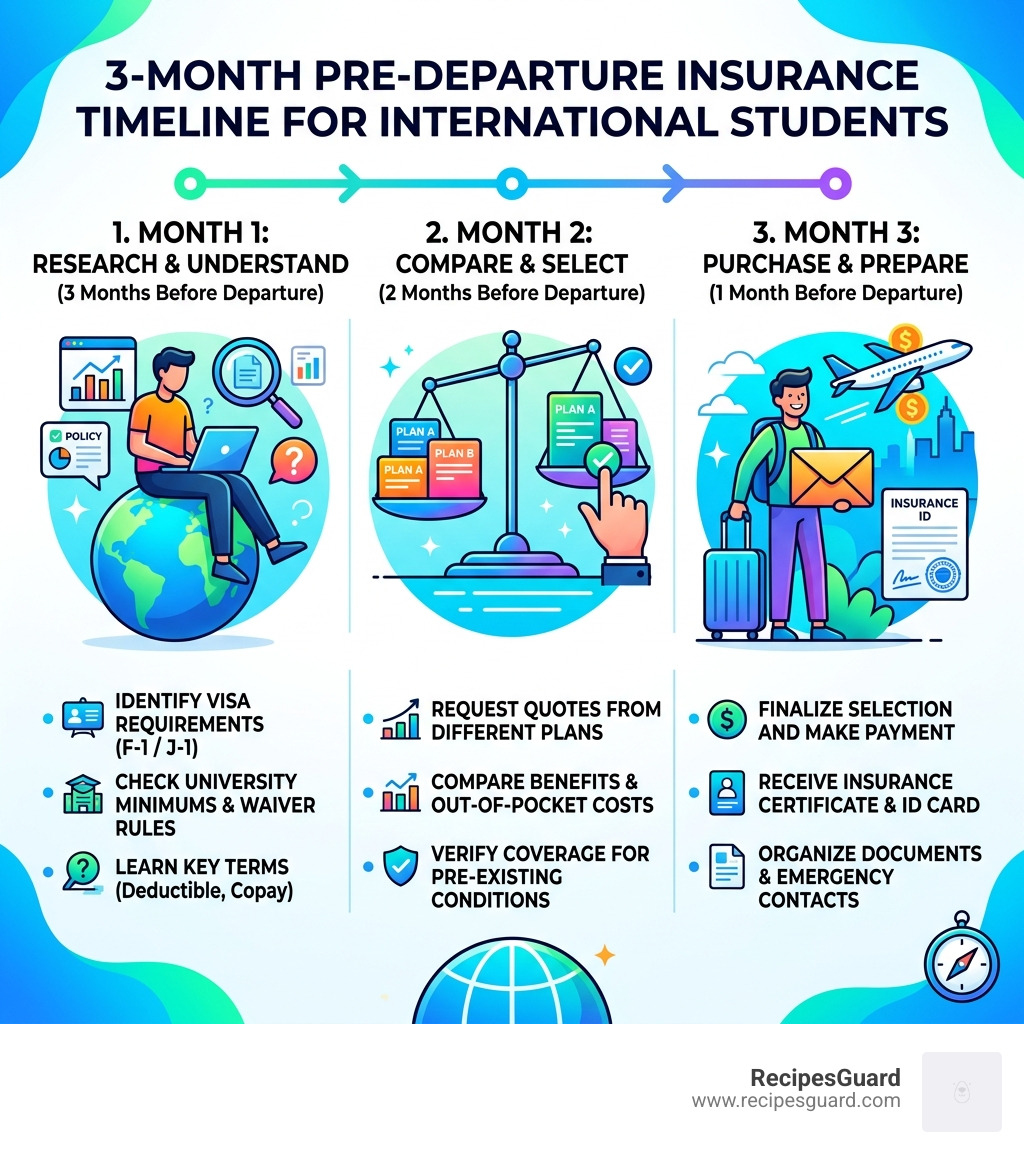
Essential International Student Insurance Tips for 2026

As we move through May 2026, the landscape for international students has shifted. Costs are rising, and regulations are tighter than ever. If you are planning to start your semester soon, the most critical of all international student insurance tips is to respect the “3-month research window.”
Waiting until you land to figure out your coverage is a recipe for financial disaster. In Australia, for instance, premiums for Overseas Student Health Cover (OSHC) saw an average increase of 4.41% in April 2026. Students who locked in their multi-year policies before that hike saved hundreds of dollars.
Whether you are heading to a sunny campus in Australia or a bustling university in the US, you need to understand that your insurance is a legal and financial lifeline. For a deep dive into the specific changes this year, check out this International Student Insurance 2026: The Ultimate Guide to Beating Price Hikes, Staying Visa-Compliant, and Avoiding Costly Mistakes – Studyab.
We also recommend reading up on the basics of what a policy should actually entail. You can find a comprehensive breakdown in our guide on Everything You Need To Know About Student Insurance Cover/.
Top International Student Insurance Tips for Choosing a Plan
Choosing a plan isn’t just about finding the lowest monthly premium. In fact, the “cheapest” plan often ends up being the most expensive when you actually get sick because of high deductibles or limited coverage.
When evaluating a plan, we suggest looking for these four pillars:
- Waiver Compliance: Does the plan meet your university’s specific requirements? If it doesn’t, you’ll be forced to pay for the school’s plan anyway.
- Essential Services: Does it cover doctor visits, hospitalization, and prescriptions?
- Mental Health: Study abroad stress is real. Ensure your plan includes outpatient mental health benefits.
- Nationwide Networks: Can you find a doctor easily, or are you limited to a tiny list of providers?
Here is a quick look at how university-sponsored plans generally stack up against private options:
| Feature | University-Sponsored Plan (SHIP) | Private International Student Plan |
|---|---|---|
| Cost | Usually higher ($1,000 – $3,500/year) | Often lower (starting around $31/month) |
| Convenience | Auto-enrolled, easy to use on-campus | Requires waiver application and approval |
| Coverage | Very comprehensive (includes wellness) | Varies; can be tailored to your needs |
| Network | Broad, often includes school clinic | Large PPO networks (e.g., UnitedHealthcare) |
Navigating Visa-Specific Requirements (F-1, J-1, and OSHC)
Your visa type dictates your insurance “must-haves.” If you ignore these, you aren’t just risking a medical bill—you’re risking your legal right to stay in the country.
The J-1 Visa Mandate The US Department of State is very strict with J-1 exchange visitors. As of 2026, your plan must meet these minimums:
- $100,000 medical benefits per accident or illness.
- $50,000 for medical evacuation (to fly you home if you’re seriously ill).
- $25,000 for repatriation of remains.
- $500 maximum deductible per accident or illness.
The F-1 Visa Guidelines F-1 students don’t have federal insurance mandates, but almost every US university has its own set of rules. For example, all students at UC San Diego are automatically enrolled in UCSHIP unless they provide proof of an equivalent private plan.
Australia OSHC Requirements In Australia, OSHC is a non-negotiable legal requirement. You must have coverage from one of the few government-approved providers for the entire duration of your visa. For more details on staying compliant in the Land Down Under, see The International Student Guide To Staying Covered In Australia/ or consult the Health Insurance for International Students 2026: Complete Study Abroad Guide | Truescho.
International Student Insurance Tips for Post-Graduation (OPT)
Life doesn’t stop at graduation, and neither should your coverage. If you are staying in the US for Optional Practical Training (OPT) or Academic Training, your university plan will likely expire shortly after your degree is conferred.
Maintaining your status requires continuous coverage. Many students switch to dedicated OPT plans, which can be significantly more affordable—sometimes starting as low as $39 per month. Don’t let a gap in coverage jeopardize your visa status during this transition. You can learn more about these transitions in our guide on Everything You Need To Know About Student Study Abroad Insurance/.
Decoding the Fine Print: Terms That Save You Money
The US healthcare system uses a specific vocabulary. If you don’t know these terms, you’ll have no idea how much a doctor’s visit actually costs until the bill arrives.
- Premium: The fixed amount you pay (monthly or annually) just to have the insurance.
- Deductible: The amount you must pay out-of-pocket for covered services before the insurance company starts to pay.
- Copay: A fixed fee (e.g., $20) you pay at the time of service, like a doctor’s visit.
- Coinsurance: The percentage of costs you pay after meeting your deductible (e.g., you pay 20%, they pay 80%).
- Out-of-Pocket Maximum: The most you will have to pay for covered services in a plan year. Once you hit this, the insurance pays 100%.
One of our favorite international student insurance tips is to always stay “In-Network.” Insurance companies partner with specific doctors and hospitals (called a PPO network). If you go to an in-network doctor, the insurance company has already negotiated a lower price. If you go “Out-of-Network,” you might be stuck paying the full, much higher price.
For more help finding affordable plans that use these networks, check out Your Guide To Finding Affordable International Student Insurance Usa/ and the Health Insurance for International Students: Country Guide.
How to Successfully Waive University Plans and Save Thousands
Most universities will automatically bill you for their Student Health Insurance Plan (SHIP). These plans are excellent, but they are often expensive because they include things you might not need, like dental or vision, or they cover a wider range of pre-existing conditions.
If you find a private plan that meets the school’s “Waiver Criteria,” you can opt-out of the SHIP and save anywhere from $1,000 to $3,000 per year.
The Waiver Process:
- Get the Requirements: Download the waiver form or requirements list from your university’s website.
- Compare Plans: Find a private plan that meets every single requirement (e.g., $100k minimum coverage, includes mental health).
- Submit the Form: Fill out the student portion and send it to the insurance company to verify.
- Watch the Deadline: If you miss the waiver deadline, you are stuck paying for the university plan for the entire semester. No exceptions.
Don’t leave this money on the table! We’ve written a dedicated guide on Dont Leave Money On The Table Claiming Your Student Funds/ to help you navigate this.
Managing Medical Emergencies and Claims Without Stress
When you’re sick, the last thing you want to do is fight with an insurance company. Knowing how to use your plan effectively is just as important as buying it.
In an Emergency: If it’s life-threatening, call 911 (in the US) or 000 (in Australia). If it’s not life-threatening—like a bad flu or a minor cut—avoid the Emergency Room (ER). ER visits are incredibly expensive. Instead, look for an “Urgent Care” center or your campus health clinic. They are much faster and cheaper.
The Claim Process: At RecipesGuard, we specialize in helping students navigate the confusing world of claims. Here is the golden rule: Keep every piece of paper.
- Save all receipts and itemized bills.
- Ask the doctor for a “Letter of Medical Necessity” if the treatment is unusual.
- File your claim within 30 days. Many private plans have a strict 90-day cutoff; if you wait too long, they won’t pay.
For step-by-step help, see our tutorials on How To Successfully Claim Your Overseas Student Insurance/ and Dont Let A Medical Emergency Fail Your Semester Abroad/.
Frequently Asked Questions about International Student Insurance
Is health insurance mandatory for international students in 2026?
Yes. In almost every major study destination, including the US and Australia, having health insurance is a condition of your visa or university enrollment. Failing to maintain coverage can lead to the termination of your SEVIS record (in the US) or visa cancellation.
Can I use travel insurance instead of a student health plan?
Generally, no. Travel insurance is designed for short trips and “emergency-only” situations. It usually doesn’t cover routine care, wellness check-ups, or long-term mental health support, which are often required for student visa compliance.
What happens if I don’t have insurance while studying abroad?
Beyond the legal risk of deportation, the financial risk is massive. Without insurance, a broken leg or an appendectomy could cost you $30,000+. Most students would have to drop out of school and return home because they cannot afford the medical debt.
Conclusion
Studying abroad is one of the most exciting chapters of your life. Don’t let a medical bill or a visa technicality turn it into a nightmare. By following these international student insurance tips, starting your research early, and understanding the fine print, you can focus on what really matters: your education and your new adventures.
At RecipesGuard, we are dedicated to making sure you never feel lost in the insurance maze. From understanding OSHC in Australia to filing a complex claim in the US, we provide the step-by-step tutorials you need to stay protected.
Ready to secure your future? Visit RecipesGuard for expert insurance guidance and let us help you navigate your study abroad journey with confidence.

My name is Bianca, and my journey into the world of fermentation and food safety began with a costly mistake. I once lost an entire season’s harvest of chili peppers because I relied on guesswork instead of science. That failure was my turning point.
