
Why Australia Student Travel Insurance Claims Can Make or Break Your Trip
Australia student travel insurance claims are something every international student hopes they’ll never need — but being unprepared when something goes wrong can cost thousands of dollars.
Here’s a quick answer to get you started:
How to make a student travel insurance claim in Australia:
- Contact emergency assistance (24/7 hotline) immediately if it’s a medical emergency
- Gather documents — receipts, invoices, police reports, medical certificates
- Log in to your insurer’s online portal or mobile app
- Complete the claim form and upload your supporting documents
- Note your claim or submission number for tracking
- Receive payment via EFT to an Australian bank account, typically within 5–10 business days
Whether you’re on exchange, backpacking between semesters, or studying abroad long-term, one unexpected event — a medical emergency, lost luggage, or cancelled flight — can spiral into a serious financial problem fast. Medical care alone in countries like the US can cost hundreds or thousands of dollars for even a basic visit.
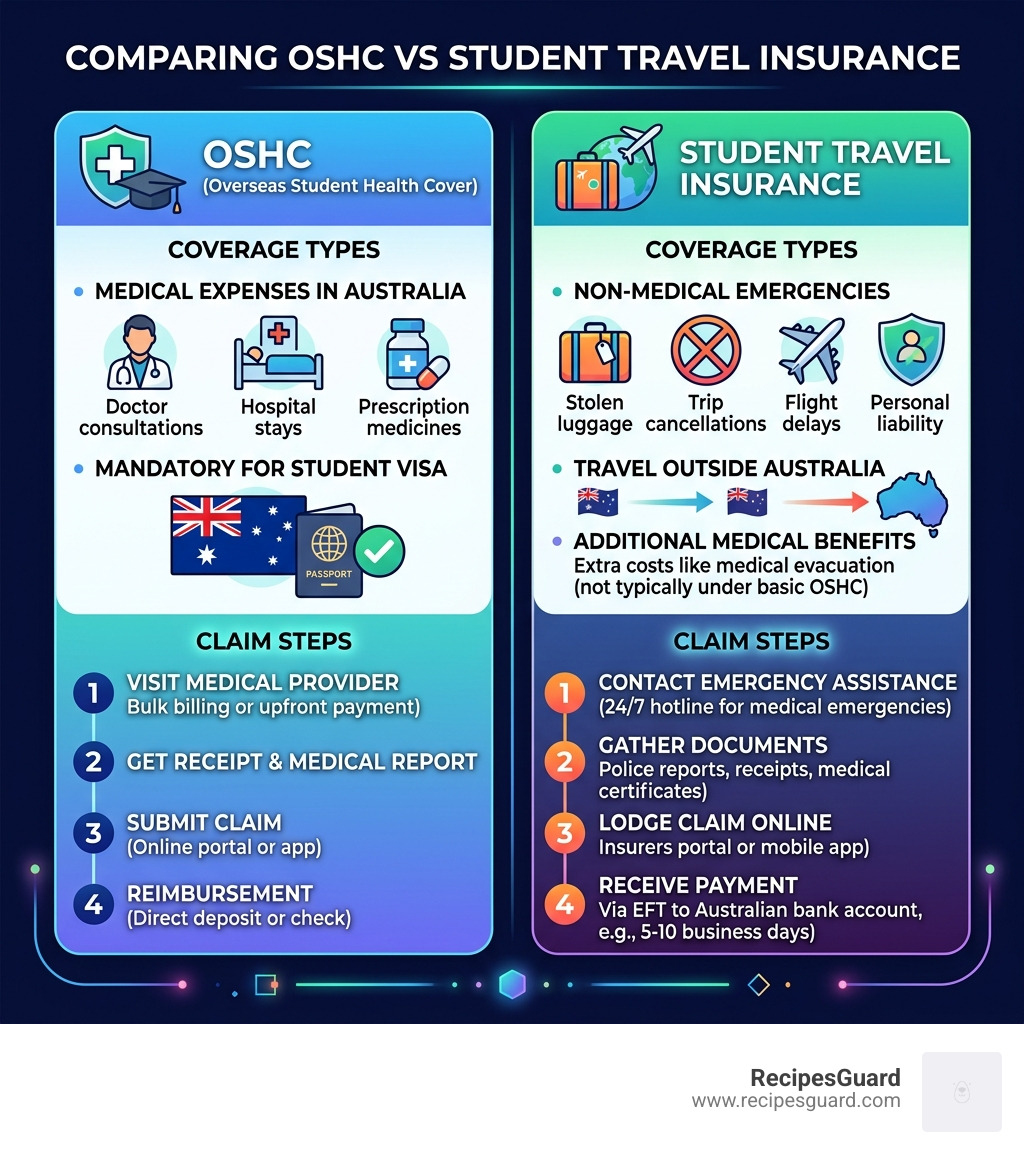
There’s also a common source of confusion: OSHC (Overseas Student Health Cover) is not the same as travel insurance. OSHC covers medical expenses while you’re studying in Australia. Travel insurance covers you when you travel outside Australia — and for non-medical issues like trip cancellations or stolen belongings, regardless of where you are.
Many students assume one covers the other. It doesn’t.
This guide walks you through everything — from understanding your coverage to filing a claim the right way, avoiding rejections, and getting your money back as quickly as possible.
Understanding OSHC vs. Australia Student Travel Insurance Claims

As of May 2026, the landscape for international students in Australia remains strict regarding health coverage. If you are here on a student visa, you are legally required to maintain Overseas Student Health Cover (OSHC). However, we often see students confuse this mandatory health cover with comprehensive travel insurance.
OSHC is essentially your “Medicare equivalent” while you are physically within Australia. It covers GP visits, some hospital treatments, and limited pharmaceuticals. It is designed to keep you healthy while you study. It does not cover you if you take a weekend trip to New Zealand, nor does it pay you back if your laptop is snatched at a cafe in Melbourne.
Travel Insurance, on the other hand, is your safety net for the “unpredictables.” This includes:
- Medical Emergencies Outside Australia: If you’re on a gap year or a short holiday overseas.
- Luggage and Personal Effects: Coverage for stolen or lost bags, phones, and computers.
- Cancellations: Reimbursing flight or accommodation costs if a family emergency forces you to head home early.
- Personal Liability: Protection if you accidentally cause damage to property or people.
While Australia has Reciprocal Health Care Agreements (RHCA) with 11 countries (including the UK, Sweden, and Italy), these are not a substitute for insurance. They often only cover “essential” care and won’t help with medical evacuation or stolen gear. For a deeper dive into these nuances, check out The International Student Guide to Staying Covered in Australia.
Comparison Table: OSHC vs. Travel Insurance
| Feature | OSHC (Overseas Student Health Cover) | Travel Insurance |
|---|---|---|
| Primary Purpose | Medical care within Australia | Travel risks and medical care abroad |
| Lost Luggage | No | Yes (up to limits like $12,000+) |
| Trip Cancellation | No | Yes |
| Dental | Very limited (usually an “extra”) | Emergency dental (up to $2,000) |
| Repatriation | No | Yes (Emergency flights home) |
| Mandatory? | Yes (Visa requirement) | Highly recommended |
Step-by-Step Guide to Filing Your Claim

Filing australia student travel insurance claims doesn’t have to be a nightmare. Most modern providers have moved away from “snail mail” and now offer streamlined digital portals. If you follow a logical sequence, you can drastically reduce the chance of your claim being rejected.
We recommend following these essential steps:
- Report the Incident Immediately: If your bags are stolen, go to the police within 24 hours. If you’re sick, call the 24/7 emergency assistance number on your policy.
- Keep Every Scrap of Paper: Invoices, medical reports, and even boarding passes are vital.
- Check Your Excess: Understand that you might have to pay the first $100–$250 of a claim yourself.
- Submit Online: Use the insurer’s portal or app to upload photos of your documents.
- Track and Follow Up: Use your Online Submission Number (OSN) to check the status.
For a more detailed walkthrough tailored specifically for the Aussie student lifestyle, see The Aussie Student Tutorial for Travel Insurance Claims.
Preparing Your Australia Student Travel Insurance Claims
Documentation is the “make or break” factor in insurance. Insurers are not just being difficult; they need proof that an event occurred and proof of the value of what you lost.
- For Medical Claims: You need a medical report from the treating doctor and all original invoices. In some cases, if you are in your first 12 months of cover, you might need a “medical certificate” to prove the condition wasn’t pre-existing.
- For Stolen Items: A police report is non-negotiable. If you can’t get one (e.g., on a bus), get a report from the transport provider. You also need “proof of ownership”—receipts, bank statements, or even photos of you holding the item.
- For Cancellations: You’ll need a letter from the airline or travel agent confirming any refunds they’ve already given you, plus documentation of the “unforeseen event” (like a doctor’s note for a family member).
Learn more about gathering the right evidence at Essential Documentation for Your Claim | RecipesGuard.
Digital Tools for Australia Student Travel Insurance Claims
In 2026, the “pay first, claim later” model is slowly being challenged. Some providers now offer instant payouts via digital cards or apps.
- Mobile Apps: Many major insurance providers have dedicated apps where you can find “direct billing” doctors. This means the doctor bills the insurer directly, and you don’t pay anything upfront.
- Telehealth: If you’re overseas and have a minor ailment, many student policies now include 24/7 telehealth in multiple languages. This can save you a trip to a foreign hospital and a complicated claim later.
- Online Portals: Most australia student travel insurance claims are now processed through Member Services portals. These allow you to save a claim in progress if you’re waiting on a document.
For tips on mastering these platforms, visit Navigating Digital Claim Portals and Online Submissions.
Coverage Limits and Common Exclusions
It’s easy to think travel insurance is a “blank check” for any mishap, but every policy has boundaries. Understanding these can prevent a “claim denied” email from ruining your day.
1. University-Provided Insurance Gaps Many Australian universities provide “complimentary” insurance for students on official exchange or vocational placements. However, there’s a catch: it often only covers you during the semester or within the specific country of study. If you decide to go backpacking through Europe for three weeks after your semester ends, that university policy might have expired. Always check the Product Disclosure Statement (PDS) to see if you need a private policy for your personal travel.
2. The “Unsupervised” Rule This is the number one reason for denied luggage claims. If you leave your bag on a cafe chair while you go to the bathroom, or leave your phone on a beach towel while you swim, you are considered to have left your belongings “unsupervised.” Most insurers will reject these claims instantly.
3. Alcohol and Illegal Acts If you have an accident while under the influence of alcohol or drugs (unless prescribed by a doctor), your claim will likely be rejected. Similarly, if you’re riding a scooter in Bali without a valid motorcycle license (which is common among students), you aren’t covered.
4. Travel Warnings If the Australian Government’s Smartraveller website lists a destination as “Do Not Travel,” your insurance is usually void for that location. If you’re already there when the warning is issued, contact your insurer immediately to see if you have a window to leave.
For more advice on avoiding these pitfalls, see Don’t Let a Trip Trip You Up: Australian College Claim Guide.
Managing Medical Emergencies and High-Risk Activities
If you find yourself in a medical crisis, the first step is always safety first. Call local emergency services. Once the immediate danger has passed, call your insurer’s 24/7 assistance line. They can often arrange “guaranteed payment” to the hospital, so you aren’t stuck with a $50,000 bill on your credit card.
High-Risk Activities Students love adventure, but activities like bungee jumping, skydiving, or skiing are often not covered under “standard” plans. You may need to add a “Sport or Adventure Boost” to your policy. Even then, there are limits—for example, scuba diving is often only covered up to a certain depth (usually 30 meters).
Pre-existing Conditions If you have a chronic condition (like asthma or diabetes), you must declare it when you buy the policy. You might need a “fit-for-travel” letter from your GP. If you don’t declare it and then try to claim for a related incident, the insurer will deny the claim.
For help with the paperwork, see The Ultimate Guide to the Australia Student Medical Claim Form.
Frequently Asked Questions about Student Claims
Can I extend my policy mid-trip?
Yes, most providers allow you to extend your policy online if your trip runs longer than expected. However, you must do this before your current policy expires (usually by 11:59 pm on the expiry date). If you let it lapse, even by a few minutes, you may have to buy a new “Already Overseas” policy, which often comes with a 72-hour waiting period where you aren’t covered.
What is the excess for student claims?
The “excess” is the amount you agree to pay out-of-pocket for each claim.
- Medical Claims: Many student-specific OSHC and travel policies have a $0 excess for medical emergencies.
- Luggage/Cancellations: These usually have an excess ranging from $100 to $250.
- University Policies: Interestingly, some university corporate policies have a very high excess (up to $3,000) for non-medical claims, though the faculty often covers this if the travel was for study.
How long does claim processing take?
For standard australia student travel insurance claims, expect a turnaround of 5 to 10 business days once all documentation is submitted.
- GP Visits (OSHC): Usually processed within 5 business days.
- Hospital Claims: Can take up to 28 days as the insurer coordinates with the hospital.
- Payments: Benefits are paid via EFT. Crucial Tip: Most Australian insurers can only pay into an Australian bank account. If you’ve already closed your Aussie account and moved home, getting your refund becomes significantly more complicated.
For more on getting your funds back, see Getting Your Money Back and How to Claim Student Insurance Australia.
Conclusion
Navigating australia student travel insurance claims is all about being proactive. At RecipesGuard, we’ve seen that the difference between a successful claim and a stressful denial usually comes down to two things: reading the Product Disclosure Statement (PDS) before you leave and keeping meticulous records of your trip.
Before you head out on your next adventure, run through this final checklist:
- [ ] Did I declare my pre-existing medical conditions?
- [ ] Do I have the 24/7 emergency assistance number saved in my phone?
- [ ] Is my travel to a ‘Do Not Travel’ zone?
- [ ] Have I kept digital copies of my receipts and passport?
Insurance is like a parachute—you hope you never have to pull the cord, but you want to be 100% sure it’s packed correctly if you do. For more survival tips on the Australian medical system, check out The Students Survival Guide to Australian Medical Claims.
Ready to get covered or need help with a current claim? Visit RecipesGuard for step-by-step student insurance support.

My name is Bianca, and my journey into the world of fermentation and food safety began with a costly mistake. I once lost an entire season’s harvest of chili peppers because I relied on guesswork instead of science. That failure was my turning point.
