
The Essential Guide to OSHC Coverage and Extras
Why the OSHC Essentials Plan Matters for International Students in Australia
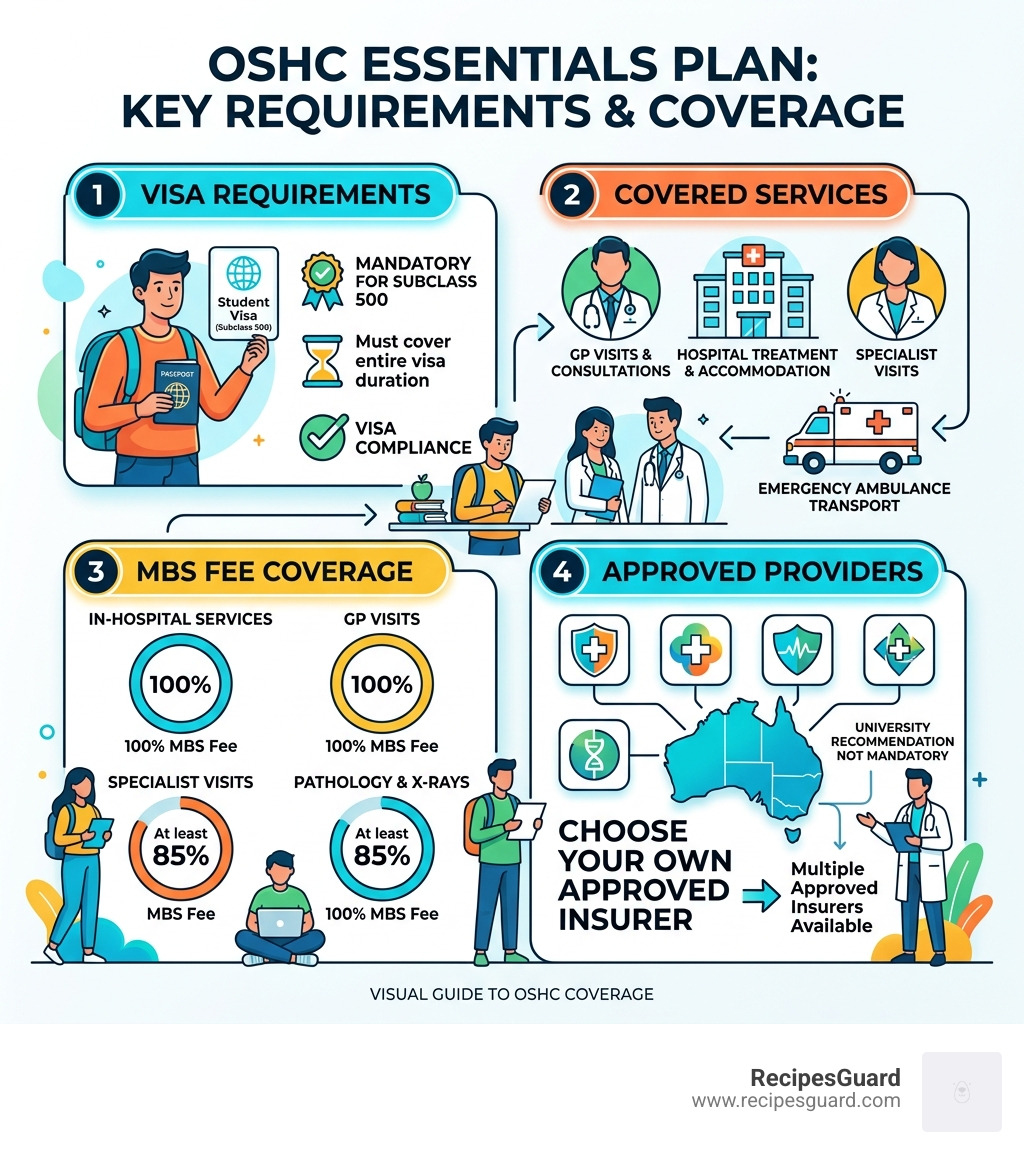
The oshc essentials plan is a mandatory health insurance product for international students on an Australian Student Visa (Subclass 500), covering hospital stays, GP visits, specialist consultations, emergency ambulance services, and some prescription medicines.
Here’s a quick snapshot of what it covers:
| Benefit | Coverage Level |
|---|---|
| In-hospital medical services | 100% of MBS fee |
| GP consultations (including telehealth) | 100% of MBS fee |
| Specialist visits (out of hospital) | At least 85% of MBS fee |
| Pathology and X-rays | At least 85% of MBS fee |
| Emergency ambulance | 100% of transport cost |
| Prescription medicines | Up to $50 per item / $500 per year (single) |
| Pre-existing conditions | 12-month waiting period applies |
If you’re arriving in Australia to study, you cannot access Medicare — Australia’s public health system is not available to most international students. That means without OSHC, you’d pay the full cost of any medical treatment out of pocket.
A simple GP visit can cost $80 or more. Your OSHC insurer would typically pay the MBS schedule fee (around $42–$43), leaving you to cover the gap. For a hospital stay or specialist procedure, those costs can climb fast.
The bottom line: OSHC is not optional. It’s a visa condition — and understanding exactly what your plan covers (and what it doesn’t) can save you from a costly surprise.
There are five approved OSHC insurers in Australia: Allianz Care Australia, Bupa Australia, CBHS International Health, Medibank (and ahm), and nib OSHC. You are not required to use the provider your university recommends — you can choose your own.
Oshc essentials plan vocab to learn:
- medical claim student guide
- medical expenses student australia
- student claim hospital expenses
Understanding the OSHC Essentials Plan for International Students
When we talk about the oshc essentials plan, we are looking at the foundation of your health security while living in Australia. As of April 2026, the Department of Home Affairs is very strict: if you hold a Subclass 500 visa, you must maintain “adequate health insurance” for the entire duration of your stay. If your policy lapses, you risk your visa being cancelled. It’s that serious!
According to the Overseas Student Health Cover (OSHC) | Study Australia guidelines, OSHC is designed specifically because international students are generally ineligible for Medicare, Australia’s tax-funded healthcare system. While Australians use their Medicare cards to see doctors for free (bulk-billing) or at a reduced cost, you will rely on your oshc essentials plan to bridge that gap.
Choosing the Right Policy Type
You aren’t just limited to a “single” policy. Depending on who is joining you on your Australian adventure, you have several options:
- Single Policy: Covers only the primary student visa holder.
- Dual Family Policy: Covers the student plus one dependent (either a partner or one child under 18).
- Multi-Family Policy: Covers the student, their partner, and multiple dependent children.
Policy Duration and Compliance
A common mistake we see at RecipesGuard is students booking their insurance only for the duration of their classes. However, your visa usually extends a few months past your graduation. The Department of Health and Aged Care requires your OSHC to match your visa dates, not just your study dates. For example, if your course is longer than 10 months and finishes in December, you usually need cover until March 15th of the following year.
Key Coverage: Hospital, Medical, and Pharmacy Benefits

The Australian healthcare system uses a benchmark called the Medicare Benefits Schedule (MBS). This is essentially a giant list of every medical service imaginable, with a “fair price” assigned to each by the government.
When you use your oshc essentials plan, the insurer looks at the MBS fee. If a doctor charges more than the MBS fee, you pay the difference—this is known as the “gap fee” or an “out-of-pocket expense.”
Hospital and Medical Benefits in the OSHC Essentials Plan
Under an oshc essentials plan, your hospital coverage is robust but specific. Here is how the numbers break down:
- In-Hospital Medical Services: You are covered for 100% of the MBS fee. This includes the doctors, specialists, and surgeons who treat you while you are admitted to the hospital.
- Hospital Accommodation: You are covered for a shared ward in a public hospital. If you choose a private hospital, your plan will cover the full cost only if the insurer has a “Members’ Choice” or “Contracted” agreement with that facility.
- Specialists and Pathology: For services outside of a hospital (like seeing a dermatologist or getting a blood test), the plan typically pays 85% of the MBS fee.
- Emergency Ambulance: This is a big one. In Australia, an ambulance ride can cost over $1,000. Most oshc essentials plan options cover 100% of emergency transport to the hospital.
Prescription Medicine and Pharmacy Benefits
Don’t expect your OSHC to work like a “free pass” at the pharmacy. Most international visitors are not eligible for the Pharmaceutical Benefits Scheme (PBS), which makes medicine cheap for Australians.
Under an oshc essentials plan, you typically pay a “member contribution” (often around $30) for each item. The insurer then pays the rest, up to a limit (usually $50 or $70 per item).
- Annual Limits: Most plans cap pharmacy benefits at $500 per year for singles and $1,000 for families.
- Exclusions: High-cost drugs (like some oncology treatments), vitamins, and over-the-counter medicines (like aspirin) are generally not covered.
Navigating Waiting Periods and Policy Exclusions
Waiting periods are the “cool-down” time before you can claim for certain conditions. These exist to keep premiums affordable and prevent people from taking out insurance only when they are already sick.
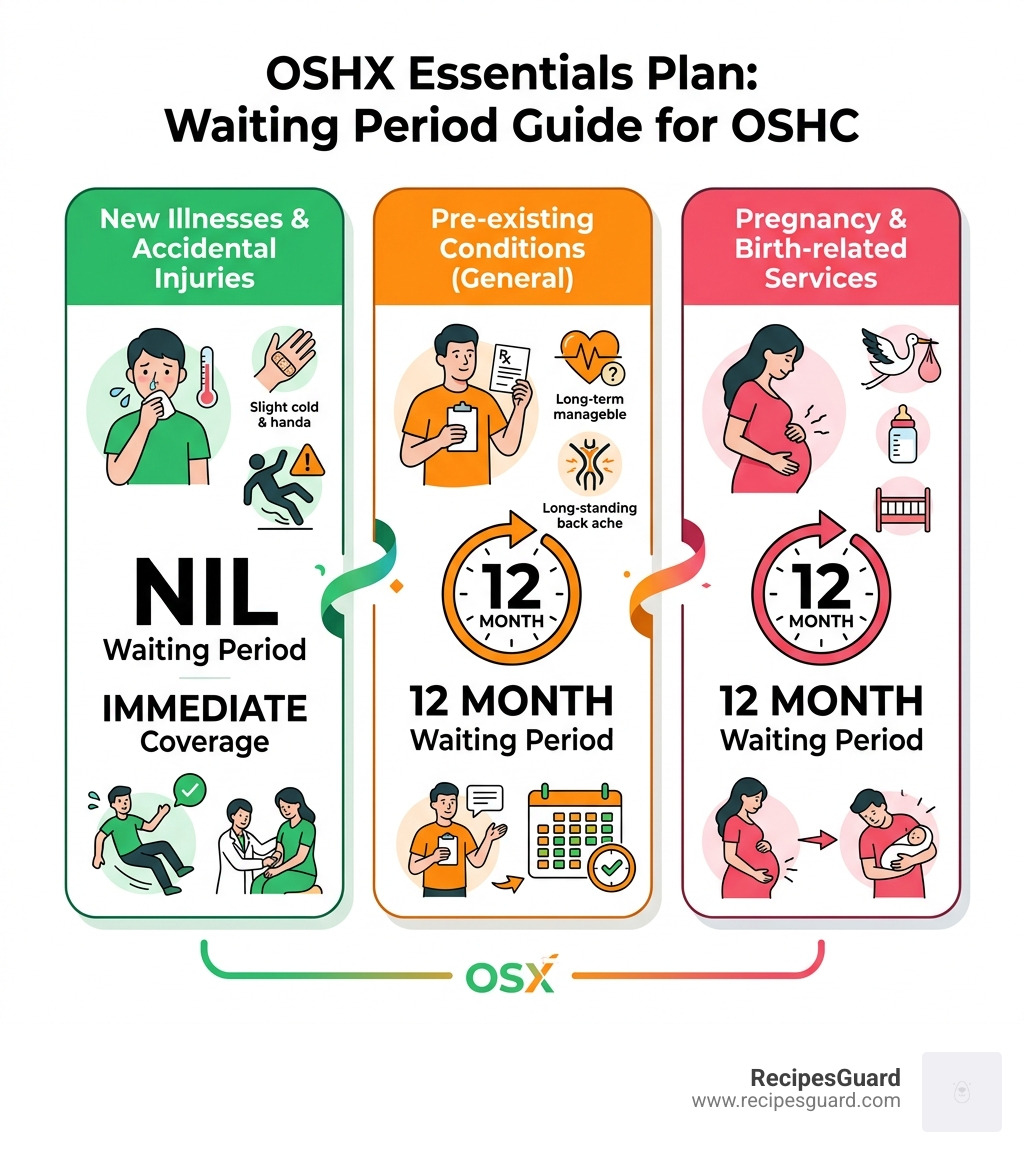
| Condition Type | Waiting Period |
|---|---|
| New illnesses (colds, flu, accidents) | Nil (Immediate) |
| Pre-existing conditions (General) | 12 Months |
| Pregnancy and birth-related services | 12 Months |
| Pre-existing Psychiatric conditions | 2 Months (usually) |
Managing Pre-existing Conditions with an OSHC Essentials Plan
A “pre-existing condition” is any ailment or illness where signs or symptoms existed in the six months before you started your cover. It doesn’t matter if you hadn’t seen a doctor about it yet—if a medical practitioner appointed by the insurer determines the symptoms were there, the 12-month waiting period applies.
One important update for April 2026: Some insurers have begun removing waiting periods for pregnancy-related treatments for students who have held their policies for more than two years. Always check the Overseas Student Health Cover fact sheet for the most current regulatory updates.
Common Exclusions and Extras Cover
The oshc essentials plan is designed for “essential” medical needs. It does not cover everything. Common exclusions include:
- Dental: No check-ups, fillings, or wisdom teeth removal.
- Optical: No eye tests or glasses.
- Physiotherapy/Chiropractic: Usually not covered unless part of a specific hospital recovery plan.
- Cosmetic Surgery: Procedures not medically necessary are never covered.
- Assisted Reproductive Services: IVF and related treatments are excluded.
If you want coverage for these, you’ll need to purchase a separate “Extras” policy.
Frequently Asked Questions about OSHC

What is a hospital excess and when do I pay it?
A hospital excess is an amount you agree to pay upfront if you are admitted to the hospital. For many oshc essentials plan options, this is set at $300. You pay this once per person, per calendar year. The good news? Most insurers waive this excess for dependent children on a family policy. Choosing a policy with a $0 excess usually means your monthly premium will be slightly higher.
How do I find a direct billing doctor to reduce upfront costs?
Direct billing (sometimes called “bulk billing” for students) is your best friend. A direct billing provider sends the bill straight to your insurer, meaning you only pay the “gap” at the time of your appointment—or nothing at all if they charge the MBS fee. You can find these providers using your insurer’s app or website. Just look for the “Find a Provider” tool and filter for “Direct Billing.”
What happens if I need to extend my cover for a visa renewal?
If you decide to stay in Australia for further study, you must extend your OSHC before your current policy expires. If you have a gap in cover, you remain uninsured for that period and cannot claim for any medical costs incurred during that time. Furthermore, insurers are required by law to notify the Department of Home Affairs if a policy is cancelled or not renewed, which could trigger a visa review.
Conclusion
Navigating the oshc essentials plan can feel like a full-time course in itself, but it’s the most important safety net you’ll have while studying in Australia. From understanding MBS fees to managing those 12-month waiting periods, being informed is the best way to avoid financial stress.
At RecipesGuard, we specialize in making the complex simple. Whether you’re trying to figure out if your GP visit is covered or you’re ready to submit your first claim, our student-focused advisory is here to help. We provide step-by-step claim filing tutorials and guides on travel insurance claims to ensure you get back every cent you’re entitled to.
Don’t let medical bills distract you from your studies. Start your claim journey with us today and let our experts guide you through the process of handling your Australian medical expenses with ease. Safe travels and happy studying!

My name is Bianca, and my journey into the world of fermentation and food safety began with a costly mistake. I once lost an entire season’s harvest of chili peppers because I relied on guesswork instead of science. That failure was my turning point.
