
How to File a Student Travel Sickness Claim Without the Headache
When a Medical Emergency Hits Abroad, Your Claim Process Starts Now
A student medical evacuation claim guide is exactly what you need if you’re an international student facing a medical emergency far from home — and you need to know how to get your insurance to pay for it fast.
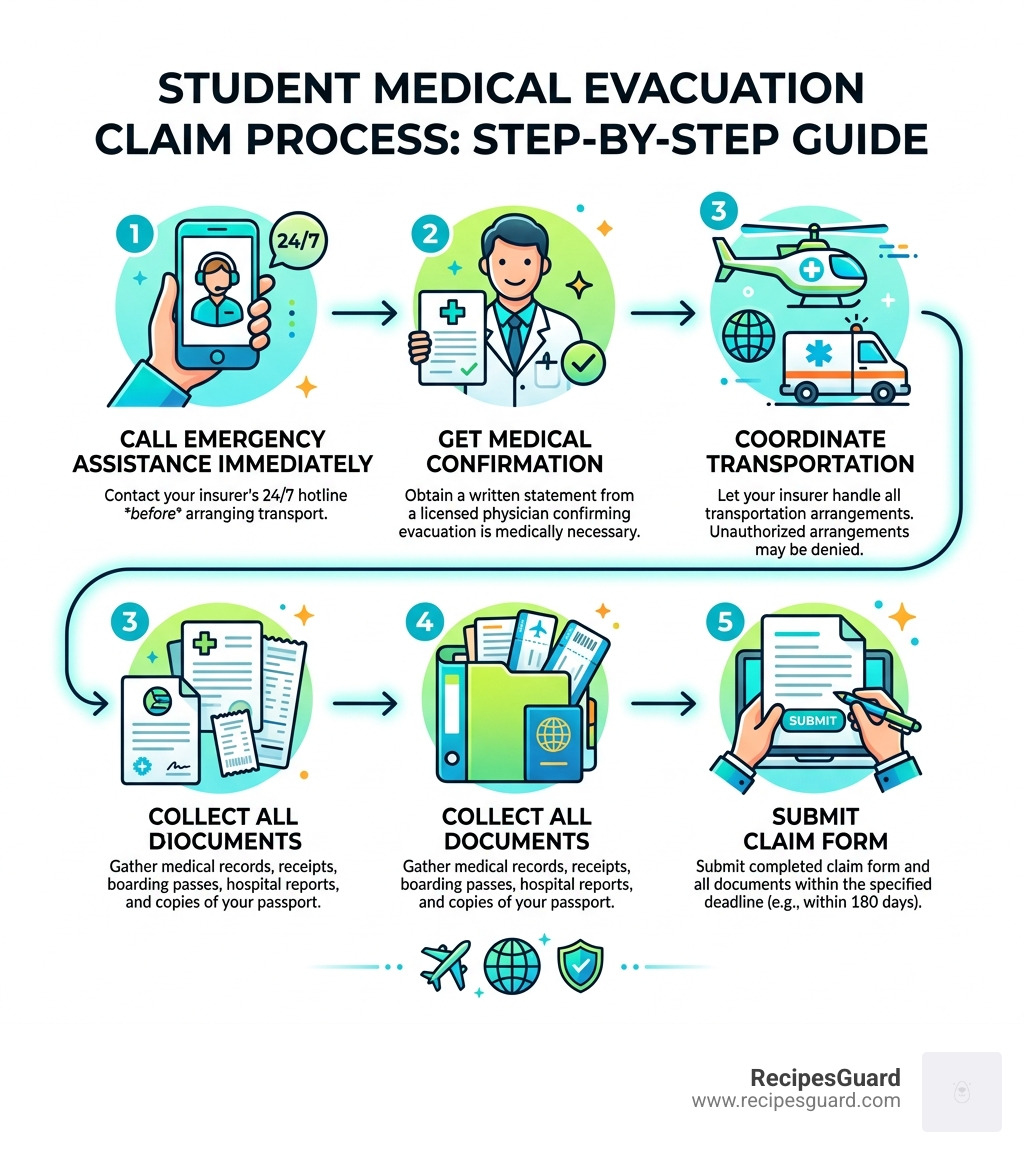
Here’s the quick version of how the process works:
- Call your insurer’s 24/7 emergency assistance line immediately — before arranging any transport
- Get a written statement from a licensed physician confirming evacuation is medically necessary
- Let your insurer coordinate the transportation — unauthorized arrangements are a common reason claims get denied
- Collect every document: medical records, receipts, boarding passes, passport copies, and hospital reports
- Submit your completed claim form within the deadline — typically within 180 days of the event
Studying abroad is one of the most rewarding things you can do. But when a medical emergency strikes in an unfamiliar country, the financial stakes are brutal. An emergency helicopter ride alone averages around $40,000. A full medical evacuation can easily exceed $50,000 — and that’s before you factor in hospital stays or repatriation costs.
Most standard health insurance plans don’t cover any of that.
For international students on J-1 or F-1 visas, specific evacuation and repatriation coverage isn’t just smart — it’s often a legal requirement. And even when you have the right coverage, filing the claim incorrectly can get it denied entirely.
This guide walks you through every step, from the moment an emergency happens to the moment you get reimbursed.
Glossary for student medical evacuation claim guide:
- easy online student claim submission
- student overseas accident claim process
- student travel insurance claim process Australia
Understanding Medical Evacuation and Repatriation for Students
When we talk about medical evacuation in a student medical evacuation claim guide, we aren’t just talking about a quick ambulance ride to the ER. We are talking about high-stakes logistics. Medical evacuation (MedEvac) involves transporting a patient to the nearest “adequate” medical facility when local care isn’t sufficient. Repatriation, on the other hand, involves returning a student to their home country for ongoing recovery or, in tragic circumstances, returning remains.
For international students, this coverage is a lifeline. As of May 2026, the costs of healthcare and emergency transport continue to climb. Without a solid plan, a single accident could end your academic career and leave your family with a debt that takes decades to pay off. This is precisely Why You Need Medical Evacuation Coverage as an International Student. It bridges the gap between basic health insurance and the specialized logistical needs of someone studying thousands of miles from home. For a deeper dive into these concepts, check out The International Student Guide to Emergency Claims and Evacuations.
Student medical evacuation claim guide for J-1 and F-1 holders
If you are studying in the U.S. on a J-1 visa, the Department of State doesn’t treat this coverage as optional. Federal regulations mandate specific minimums to ensure you aren’t a financial burden on the host country and that you are protected.
The current requirements include:
- $50,000 minimum for medical evacuation to your home country.
- $25,000 minimum for repatriation of remains.
- $100,000 per accident or illness for medical expenses.
- Deductibles not exceeding $500 per accident or illness.
- Underwriter Rating: The insurance company must have an A- rating or above from agencies like A.M. Best or Standard & Poor’s.
While F-1 visa holders don’t always have these exact federal mandates, most Australian and U.S. universities require similar levels of Medical Evacuation and Repatriation Insurance as a condition of enrollment. If your plan doesn’t meet these benchmarks, you might find your university health waiver denied.
Coverage limits and family travel benefits
A comprehensive student medical evacuation claim guide should also highlight the “hidden” benefits that many students forget to claim. Beyond the $40,000 helicopter ride, high-tier policies often include:
- Bedside Visit/Emergency Reunion: If you are hospitalized alone for more than a few days (usually 3 to 8 days), many plans pay for a family member to fly to your bedside and cover their accommodation.
- Return of Minor Children: If you are traveling with dependents and become incapacitated, the insurer can arrange for the children to be flown home.
- Non-Medical Evacuation: Some plans even cover evacuations due to political unrest or natural disasters.
Understanding these extras is vital because they are often “service-based” benefits. This means the insurance company arranges the flight rather than just cutting you a check later. You can find more details on these specialized services in this guide on Overseas Emergency Evacuations Explained.
The Student Medical Evacuation Claim Guide: Step-by-Step Process

Filing a claim for an evacuation is vastly different from claiming a $50 prescription. Because the costs are so high, insurers take a “hands-on” approach. You cannot simply book a private jet and expect a refund.
We recommend following these steps to ensure your claim isn’t dead on arrival. For more management tips, see How to Manage the Medical Evacuation Claim Process.
Immediate actions after a medical emergency
The moment an emergency occurs, the clock starts ticking.
- Call the Assistance Provider: Look at your insurance ID card. There will be a “Collect Call” or 24/7 hotline number. Call it immediately. They will coordinate with the treating hospital and their own medical directors to determine if evacuation is necessary.
- Verify Identity: Have your policy number and school name ready. Even if you don’t need immediate transport, notifying them early creates a “paper trail” that makes the later claim much smoother.
- Medical Consultation: The insurer’s medical team will talk to your local doctor. For a successful claim, a licensed physician must certify that the evacuation is “medically warranted” because the local facility cannot provide the life-or-limb-saving care you need.
This initial phase is the most critical. If you want to master this, read Mastering the Emergency Medical Student Claim Process and The Ultimate Survival Guide for Medical Emergencies Abroad.
Preparing your student medical evacuation claim guide paperwork
Once the emergency has stabilized and you are either in a new facility or back home, the “reimbursement” phase begins.
Most insurers give you a 180-day deadline from the date of the event to submit your final paperwork. If you miss this, even a valid claim can be rejected. You will need to fill out a formal claim form—be meticulous here. Any missing signature or blank box can cause a weeks-long delay. Learn more about the nitty-gritty of submission at How to Submit Claim Paperwork and Actually Get Paid.
Essential Documentation for a Successful Claim

If there is one thing we emphasize at RecipesGuard, it’s that documentation is the “bulletproof vest” of your claim. Insurers are looking for any reason to say “no” to a $50,000 payout. Don’t give them one. You need to provide Everything You Need for a Student Medical Evacuation Claim to ensure success.
Proving medical necessity and transport costs
To get paid, you must prove that the evacuation wasn’t just a “preference” but a medical necessity.
- Physician’s Statement: This is the golden ticket. It must be from a legally licensed physician and clearly state the diagnosis and the reason why the current facility was inadequate.
- Medical Records: Full copies of your admission and discharge summaries.
- Invoices and Receipts: If you paid for any part of the transport out-of-pocket (though we recommend avoiding this), you need original, itemized receipts. For pharmacies, ensure they have an official stamp and clear pricing.
For students in Australia or those traveling through the region, Medical assistance overseas – Smartraveller provides excellent context on what the government will and won’t help with (Hint: They won’t pay your bills!). Check out How to Provide Bulletproof Travel Insurance Claim Proof for more.
Travel and identity verification
Insurers need to verify that you were actually on a covered trip when the incident happened.
- Travel Proof: Keep your original boarding passes, flight itineraries, and even passport stamps.
- Visa Status: For J-1 and F-1 students, proof of enrollment and a valid visa are often required to show you were in compliance with the policy’s eligibility rules.
- Distance Requirement: Many policies only kick in if you are more than 100 miles (approx. 160km) from your primary residence. Your travel documents prove this.
For more on navigating these hurdles, see The Ultimate Student Guide to Navigating Insurance Claims.
Avoiding Common Pitfalls and Claim Denials
Even with the best student medical evacuation claim guide, claims can go sideways. Understanding the “why” behind denials can help you avoid them.
| Feature | Standard Health Insurance | Medical Evacuation Insurance |
|---|---|---|
| Primary Goal | Doctor visits, hospital stays, Rx | Emergency transport & repatriation |
| Coordination | You choose the doctor | Insurer must arrange transport |
| Typical Limit | $100,000 – $500,000 | $50,000 – $2,000,000 |
| Repatriation | Rarely included | Standard benefit |
Why claims get rejected
According to industry data, a significant portion of claims are denied due to avoidable errors.
- Unauthorized Transport: This is the #1 killer of evacuation claims. If you call a private ambulance without the insurer’s “Benefit Administrator” approving it first, you will likely pay the full bill yourself.
- Pre-existing Conditions: If your emergency was caused by a condition you were treated for in the months before your trip, the claim might be excluded.
- High-Risk Activities: Were you skydiving, scuba diving, or rock climbing? Many student policies exclude “extreme sports” unless you bought a specific rider.
- Late Notification: Waiting days to call the hotline can be seen as a breach of contract.
For a detailed look at navigating these exclusions, read From Ambulances to Rx: Navigating Emergency Claims Overseas and Preparing for Medical Evacuations Abroad | United Educators.
Special considerations for J-2 dependents and scholars
If you are a J-1 scholar or have J-2 dependents (spouses/children), the rules still apply. In fact, spouses often pay higher rates for the same coverage.
- Continuous Coverage: J-1 regulations require insurance for the entire duration of the program. Any gap in coverage can lead to visa termination and claim denial.
- 28-Day Waiting Period: Some scholars transitioning to university employee health plans face a 28-day gap where they must purchase temporary MedEvac coverage.
- Dependent Age: For many policies, “student” dependents are covered up to age 25 if enrolled full-time.
Don’t let your family be unprotected. Check out The Great Escape: Filing an Emergency Evacuation Claim as a Student for more on family-specific claims.
Frequently Asked Questions about Student Medical Evacuation
How much does medical evacuation insurance cost for students?
Surprisingly, it’s quite affordable. Standalone evacuation and repatriation plans can start as low as $40-$50 for a few months. When bundled into a comprehensive student travel medical plan, the cost typically ranges from $50 to $200 per year. Considering a helicopter ride costs $40,000, the ROI is massive.
Can I use my credit card’s evacuation benefit for a claim?
Sometimes! Premium travel cards often offer up to $50,000 in emergency evacuation benefits. However, be careful: these are almost always secondary coverage. This means they only pay after your primary health insurance has paid its share. Also, you usually must have paid for the trip using that specific card to qualify.
What is the difference between evacuation and repatriation?
Evacuation is about getting you to the nearest place that can save your life. If you’re in a remote village, that might mean a flight to the nearest big city. Repatriation is about getting you home. This includes “Repatriation of Remains” (returning a body) or “Medically Necessary Return Home” once you are stable enough to fly but still need medical supervision.
Conclusion
At RecipesGuard, we’ve seen how a well-managed claim can turn a nightmare scenario into a manageable recovery. Navigating insurance as an international student is tough, but you don’t have to do it alone. By following this student medical evacuation claim guide, keeping your documents organized, and always calling your insurer first, you can protect both your health and your wallet.
We are dedicated to providing the most straightforward, student-focused claim tutorials in the industry. Whether you are studying in Australia or the U.S., our goal is to give you the peace of mind to focus on your studies, not your paperwork.
Ready to secure your journey? Start your claim journey here and let us help you navigate the fine print. Safe travels!

My name is Bianca, and my journey into the world of fermentation and food safety began with a costly mistake. I once lost an entire season’s harvest of chili peppers because I relied on guesswork instead of science. That failure was my turning point.
