
Why Your Travel Insurance Claim Letter Template Can Make or Break Your Payout
A travel insurance claim letter template gives you a ready-made, professional format to request reimbursement from your insurer — fast. Here’s what a strong one covers:
- Your policy number and personal details
- Trip information (dates, destination, purpose)
- A clear incident description (what happened, when, where)
- Itemized expenses you’re claiming
- A list of supporting documents attached (receipts, reports, bills)
- Your requested resolution (exact reimbursement amount)
- Your signature and date
Picture this: you’re studying abroad in Paris, and your luggage never arrives. Or you wake up too sick to board your flight. You paid for travel insurance — but now you’re staring at a blank page, unsure how to actually ask for your money back.
That’s where most students get stuck.
The claim letter isn’t just a formality. According to research from claims processing experts, a disorganized or vague letter is one of the top reasons payouts get delayed or denied. Insurers process huge volumes of claims. A clear, well-structured letter makes yours easier to approve.
The good news? You don’t need to write one from scratch.
Below, you’ll find copy-paste templates, real-world examples, and a step-by-step breakdown of exactly what to include — whether you’re claiming for a medical emergency, trip cancellation, or lost baggage.
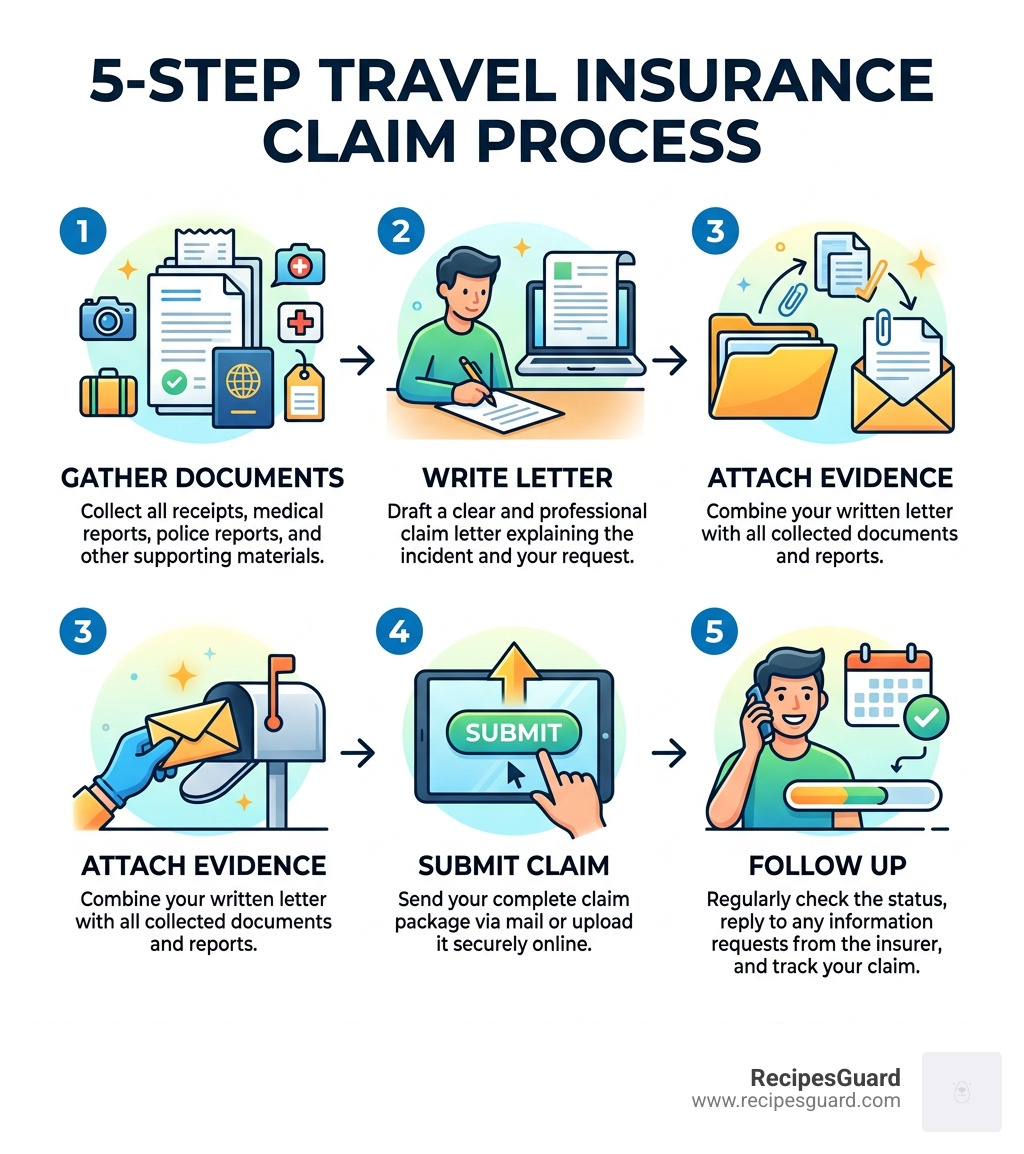
Travel insurance claim letter template vocabulary:
- flight delay compensation claim
- delayed baggage claim process
- visa insurance claim steps
What is a Travel Insurance Claim Letter and When to Use One?
Think of a travel insurance claim letter as the “official handshake” between you and the insurance provider. While many companies now offer digital portals, a well-crafted letter remains the best way to tell your story, organize your evidence, and ensure nothing falls through the cracks. In May 2026, even with AI-driven processing, a human examiner usually reviews the narrative of your claim to see if it matches your policy coverage.
You should use a travel insurance claim letter template whenever you experience a financial loss during your trip that is covered by your policy. This includes:
- Medical Emergencies: If you ended up in a hospital in Tokyo and had to pay upfront.
- Trip Cancellations: When a sudden illness or a family emergency stops you from going.
- Lost or Stolen Baggage: When your suitcase decides to take a solo trip to a different continent.
- Travel Delays: When you’re stuck at the airport and have to pay for a hotel and meals.
Using a formal letter helps you activate your policy benefits by providing a clear paper trail. If you’re a student navigating this for the first time, check out our Mastering The Travel Insurance Claim Tutorial for a deep dive into the technicalities. For those who just want the basics, The Simple Student Tutorial For Filing Any Insurance Claim is a great starting point.
Why a formal letter speeds up your payout
Insurance companies are high-volume businesses. They love “examiner-friendly” documents. When you use a structured travel insurance claim letter template, you are doing the work for them. You are itemizing the costs, linking them to receipts, and explaining the “why” behind the claim.
A professional letter creates an evidence trail that is harder to ignore or “ghost.” In Australia, for instance, while there are no specific laws dictating the exact wording of a claim letter, general contract law applies. Being clear and professional from the start sets a tone of accountability. You can find a Letter to Claim from Travel Insurance – Sample Template to see how these legal expectations are typically met.
Essential Components of a Professional Travel Insurance Claim Letter Template
To ensure your claim isn’t tossed into the “needs more info” pile, your letter needs to be a one-stop shop for the examiner. Here is the professional layout we recommend for all our student travelers.
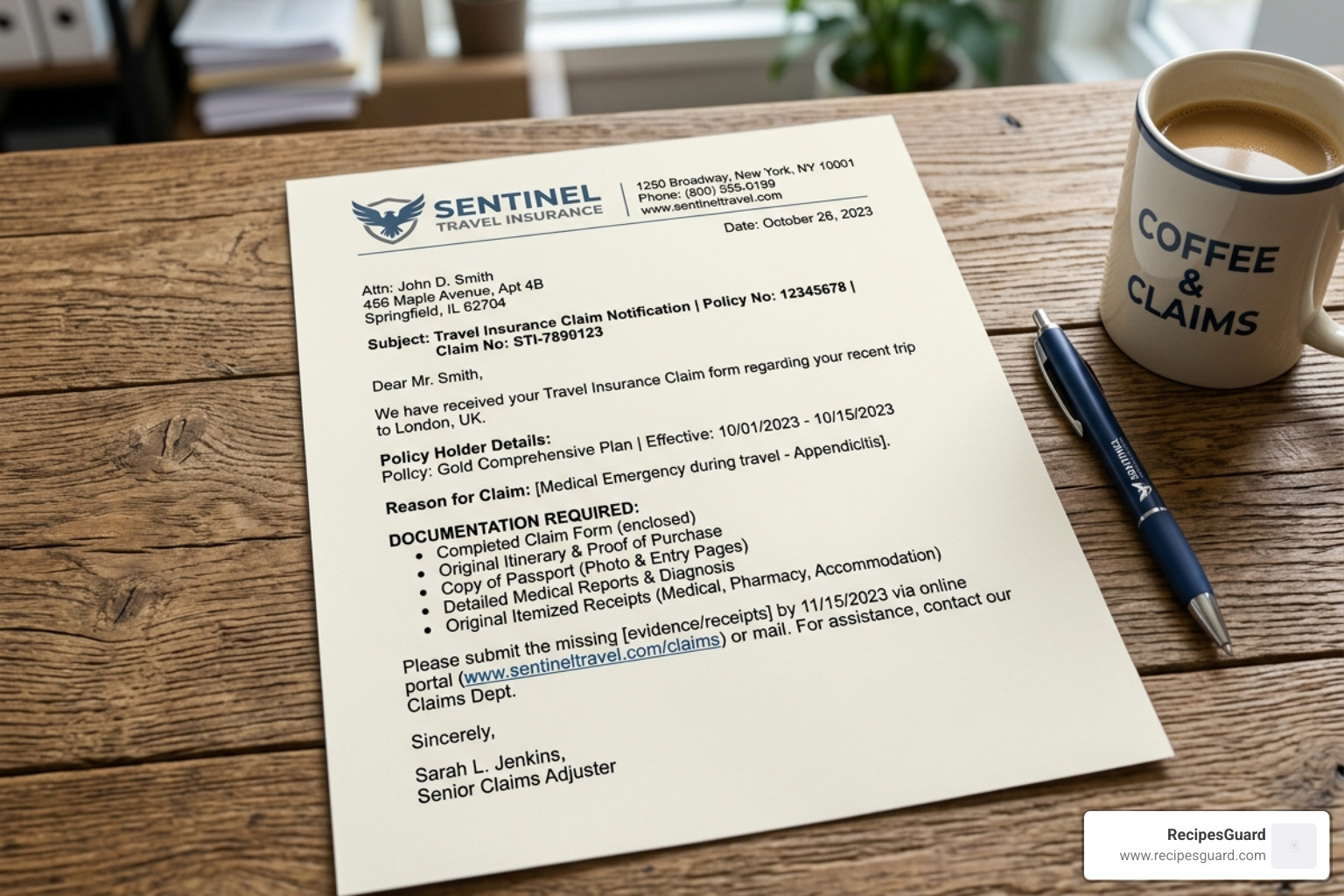
Every effective letter must include:
- Your Contact Information: Name, address, phone number, and student ID (if applicable).
- The Policy Details: Your policy number and the dates the coverage was active.
- The Claim Number: If you’ve already started the claim online, include the reference number.
- Trip Itinerary: Where you were going and when.
- Incident Description: A factual account of what happened.
- Itemized Expenses: A list of every dollar (or AUD) you are asking to be reimbursed.
- Supporting Documents List: A “table of contents” for your attachments.
For a ready-to-use digital version, you can explore this Free Travel Insurance Claim Template to Edit Online.
Structuring your incident description for clarity
The “Incident Description” is where most claims succeed or fail. We suggest using the “5 Ws” approach: Who, What, When, Where, and Why. Avoid emotional language. Instead of saying, “I was terrified and my trip was ruined,” say, “On May 12, 2026, I was diagnosed with acute appendicitis at St. Vincent’s Hospital, which required immediate surgery and prevented my scheduled departure on May 13.”
Be specific about the immediate actions you took. Did you call the police? Did you contact the airline’s help desk? These details prove you tried to mitigate the loss. For a breakdown of these steps, see The Ultimate Student Guide To Insurance Claim Steps.
Customizable Travel Insurance Claim Letter Template for Common Scenarios
Different problems require different approaches. Here are three variations you can adapt. You can also find more detailed versions at this Travel Insurance Claim Letter Sample (Free Template + Step-by-Step Tips) – RequestLetters.
1. The Standard “All-Purpose” Template
Use this for general delays or minor property damage.
“I am writing to formally submit a claim under Policy #[Number]. During my trip to [Destination] from [Date] to [Date], I experienced [Incident]. I have attached the relevant receipts and reports. The total amount I am claiming is $[Amount].”
2. The Medical Emergency Variation
Use this when health issues are involved. Focus on the physician’s advice.
“Due to an unforeseen medical emergency involving [Self/Family Member], I was required to [Cancel Trip/Seek Treatment]. Attached is the Attending Physician’s Statement confirming that I was medically unfit to travel on [Date].”
3. The Lost/Stolen Baggage Format
Focus on the Property Irregularity Report (PIR) and itemized values.
“My baggage was [Lost/Stolen] on [Date] during flight [Number]. I reported the loss immediately to [Airline/Police] and have attached the PIR report #[Number]. Below is an itemized list of the contents and their estimated value.”
Supporting Documentation Checklist for Your Travel Insurance Claim Letter Template
Your letter is the “hook,” but your documents are the “sinker.” Without them, your claim is just a story. In May 2026, insurers are stricter than ever about “proof of loss.”
| Document Type | Medical Claim | Trip Cancellation | Baggage Claim |
|---|---|---|---|
| Proof of Payment | Yes | Yes | Yes |
| Medical Records | Yes | Yes | No |
| Police/PIR Report | No | Optional | Yes |
| Refund Statements | No | Yes | No |
| Receipts for Items | Yes | No | Yes |
For a comprehensive list of what students specifically need, check The Essential List Of Student Travel Insurance Forms.
Specific requirements for trip cancellation and interruption
If you’re cancelling a trip, the insurer wants to know why and if you’ve tried to get your money back elsewhere first. You must include:
- Proof of the reason: A death certificate, a physician’s statement, or a redundancy notice.
- Carrier cancellation proof: A letter from the airline or hotel stating their cancellation policy and confirming that no refund was issued to you.
- Unused tickets: Copies of the original bookings.
We’ve put together a specialized resource for this at The Ultimate Guide To Trip Cancellation And Interruption.
Essential evidence for medical and baggage claims
For medical claims, don’t just send the bill. Send the itemized bill that shows exactly what treatment you received. If you are in Australia, ensure the provider includes their provider number.
For baggage, the most important document is the Property Irregularity Report (PIR) from the airline. If your items were stolen, a police report filed within 24 hours is usually mandatory. Learn more about organizing these papers in How To Submit Claim Paperwork And Actually Get Paid.
Expert Tips to Ensure Your Claim is Processed Quickly
We’ve seen thousands of student claims, and the ones that get paid the fastest follow a specific “pro” playbook.

- Respect the 90-Day Deadline: Most policies require you to submit proof of loss within 90 days. If you miss this window, your claim might be dead on arrival.
- Be “Examiner-Friendly”: Name your digital files clearly. Instead of “IMG482.jpg,” use “MedicalReceipt_May12.jpg.”
- Maintain a Professional Tone: Even if you’re frustrated, stay polite. A cordial, business-like tone is essential for success. As noted in research, assuming a “fail first” policy by the insurer is common, but staying professional helps you navigate these hurdles.
- Itemize Everything: Don’t just give a lump sum. Break it down: “Hotel: $200, Meals: $50, Taxi: $30.”
For more on what happens after you hit send, read The Waiting Room What To Expect During The Travel Insurance Claim Process.
How to follow up effectively without being a nuisance
Don’t just send the letter and hope for the best. Keep a communication log. Write down the date you sent the letter, the name of anyone you speak to on the phone, and your claim reference number.
If you are mailing a physical letter, always use registered post with a signed delivery receipt. This is your legal proof that they received it. If you feel like you’re being ignored, our guide on What To Do When Your Travel Insurance Ghosted Your Claim can help you turn up the heat.
Common Mistakes and Legal Considerations to Avoid
A small mistake can lead to a big denial. Avoid these common pitfalls:
- Missing Signatures: It sounds simple, but many students forget to sign the “Declaration” section.
- Incomplete Forms: If the insurer provides a specific form alongside your letter, fill out every single box. Use “N/A” if it doesn’t apply.
- Fraud Warnings: In Australia, deliberate dishonesty in an insurance claim is a crime under state and territory laws. Never “pad” your claim. If you lost a $500 laptop, don’t claim it was a $2,000 model.
- Disclosing Other Insurance: If you have health insurance or credit card travel insurance, you must disclose it. Failure to do so can be seen as a breach of contract.
If you do face a rejection, don’t panic. Many initial rejections are computer-generated. You can learn How To Successfully Appeal A Denied Insurance Claim to get things back on track.
Navigating claim denials and the appeal process
If your claim is denied, the insurer must provide a reason in writing. Read this carefully. Was it a lack of documentation? Or a policy exclusion? Once you know the reason, you can draft a formal appeal letter. This letter should address the denial reason directly and provide new evidence.
Navigating disputes is an art form. We recommend reading The Art Of The Appeal Navigating Travel Insurance Claim Disputes if you find yourself in this situation.
Frequently Asked Questions about Travel Insurance Claims
How long do I have to submit my claim letter?
Generally, you have a 90-day window from the date of the loss to provide proof. However, you should notify your insurer as soon as the incident happens. Some policies require “immediate” notification for medical emergencies.
Can I submit my claim letter via email or online portal?
Yes! In May 2026, most insurers prefer digital submissions via secure portals. It allows for faster tracking and easier document uploads. Just ensure your files are in PDF or JPEG format and are clearly labeled.
Should I contact the airline or hotel for a refund before filing a claim?
Yes, you should do both in parallel. Insurers expect you to “mitigate your loss.” This means trying to get a refund from the airline first. When you file your insurance claim, you will only be reimbursed for the non-refundable portion of your costs. Always keep proof of any partial refunds or credits you receive.
Conclusion
Writing a travel insurance claim doesn’t have to be a nightmare. By using a travel insurance claim letter template and following the professional steps we’ve outlined, you’re putting yourself in the best position to get your money back.
At RecipesGuard, we specialize in helping students navigate these complex waters. Whether you’re studying in Melbourne, Sydney, or abroad, our step-by-step tutorials are designed to take the stress out of insurance. Don’t let a travel mishap ruin your semester — take control of your claim today.
Start your claim journey with RecipesGuard

My name is Bianca, and my journey into the world of fermentation and food safety began with a costly mistake. I once lost an entire season’s harvest of chili peppers because I relied on guesswork instead of science. That failure was my turning point.
