
Mastering the Travel Insurance Claim Tutorial
What Every Traveler Needs to Know Before Filing a Travel Insurance Claim
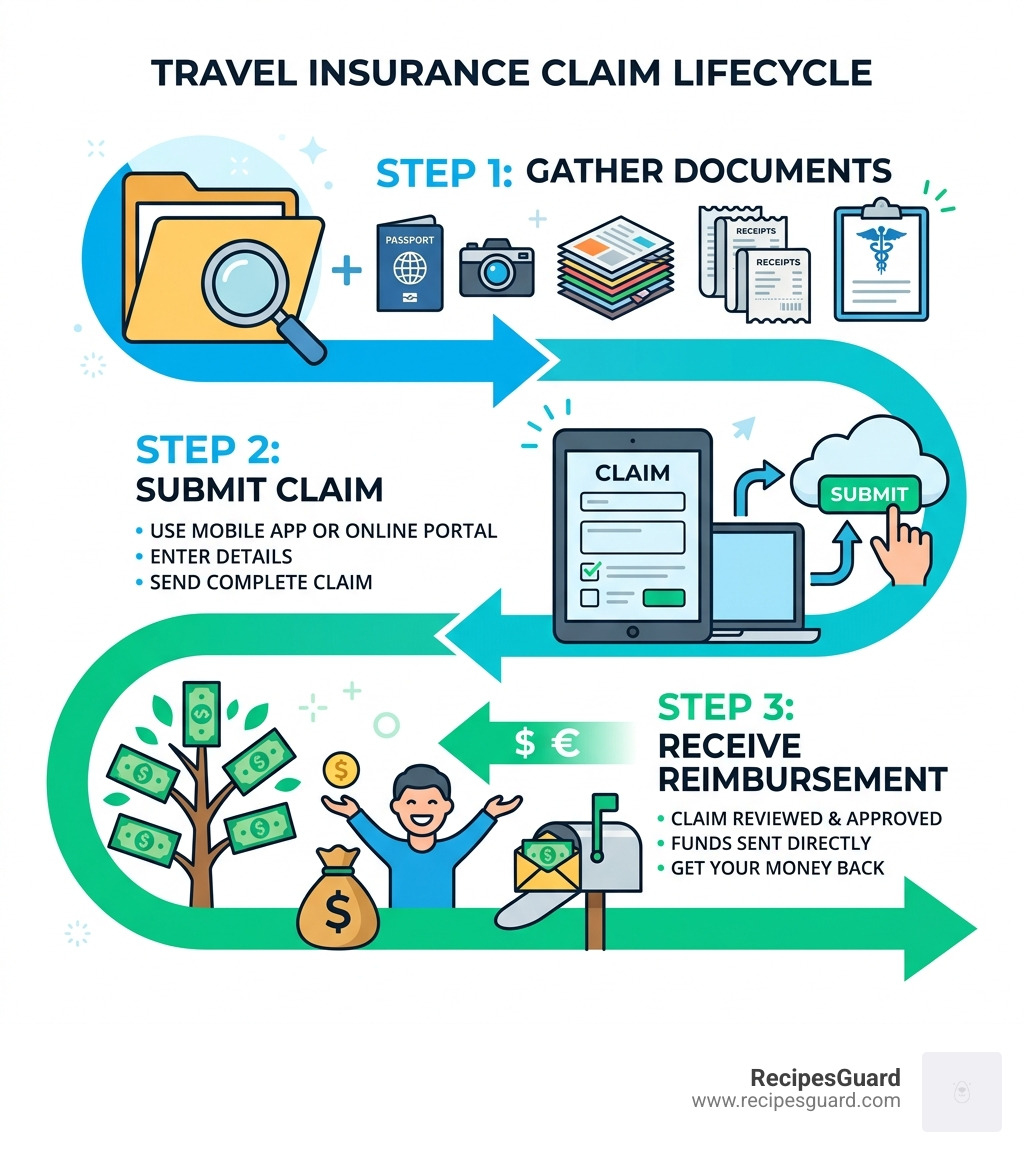
To file a travel insurance claim, follow these key steps:
- Contact your insurer first – Call before submitting anything to confirm required documents and the correct process.
- Gather your documents – Collect receipts, medical records, police reports, airline statements, or any other evidence related to your incident.
- Submit your claim – File online, via a mobile app, by email, or by mail, depending on your insurer.
- Track your claim – Use your insurer’s online portal or app to monitor progress and respond to any requests for more information.
- Appeal if denied – If your claim is rejected, submit additional evidence. About 50% of appeals are successful.
Travel doesn’t always go to plan. A sudden illness abroad, a canceled flight, or a stolen bag can turn an exciting trip into a stressful financial headache — especially if you’ve never dealt with insurance paperwork before.
The good news? According to the U.S. Travel Insurance Association, 90% of travel insurance claims are honored. Most people who file correctly get reimbursed. The 10% that get denied usually come down to one thing: missing or incomplete information.
This guide walks you through exactly how to file a travel insurance claim the right way — from the first phone call to getting money back in your account.
Learn more about file travel insurance claim:
- low cost student health insurance
- student health coverage
- waiving medical coverage
The Step-by-Step Process to File Travel Insurance Claim
Navigating insurance can feel like trying to solve a Rubik’s Cube in the dark. But at RecipesGuard, we believe it should be as simple as ordering a flat white. When you need to file travel insurance claim, the process generally follows a standardized path designed to verify that your “story” matches the coverage you purchased.
The very first thing we recommend is picking up the phone. While it’s tempting to just start uploading files, calling your insurance company first ensures you don’t miss a specific form they might require. They can also confirm if your situation falls under a “covered reason.” Once you have the green light, you can choose your submission method.
How to File Travel Insurance Claim Online or via App
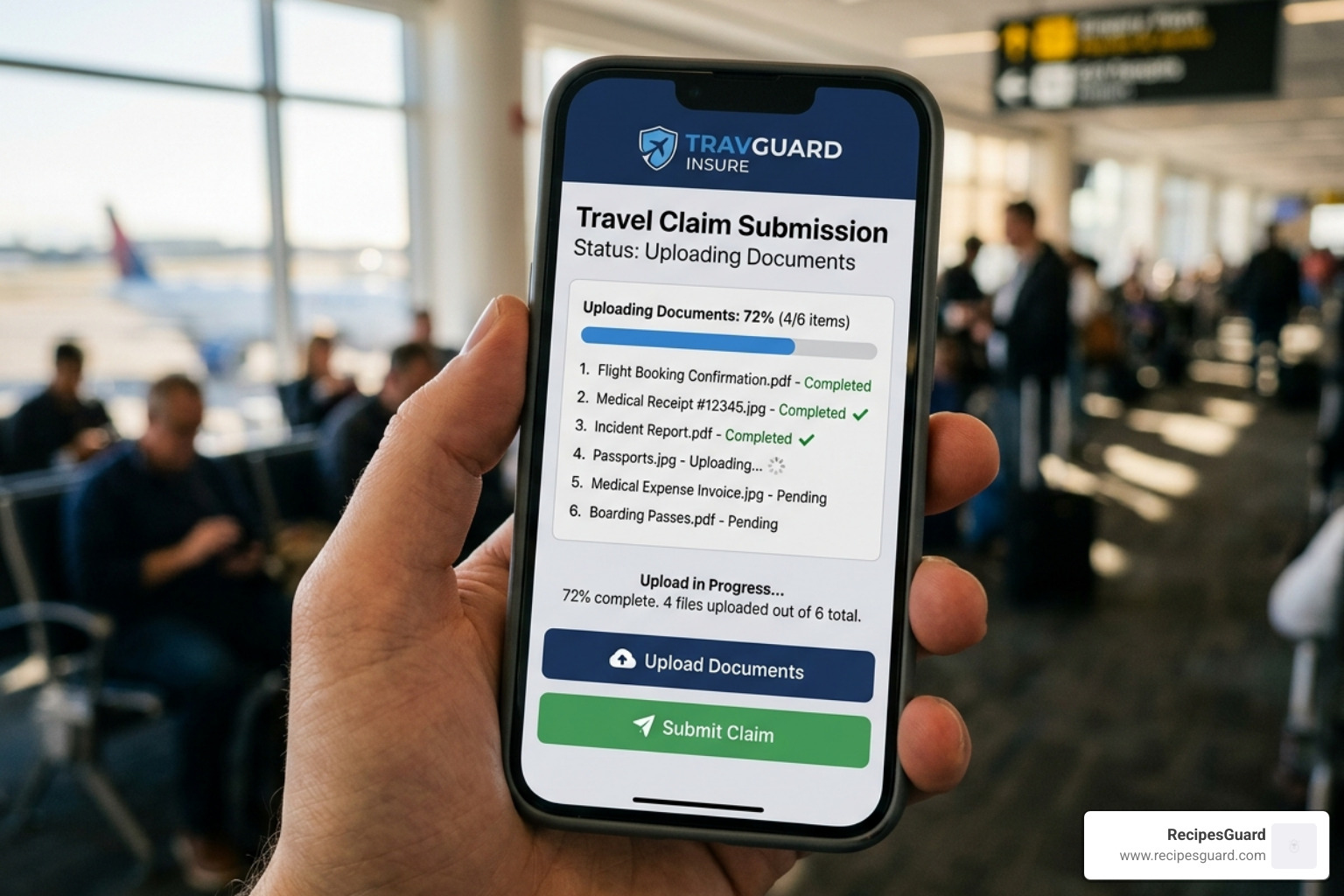
In 2026, digital is the way to go. Most modern insurers offer a secure online portal or a dedicated mobile app. This is often the fastest way to get your claim into the hands of an examiner.
When using a digital portal, keep these pro tips in mind:
- One Session Rule: Many online systems do not allow you to save your progress. We suggest blocking out at least 15 to 20 minutes to complete the application in one go.
- File Size Matters: Most portals have a limit—often around 7MB per file. If your photos are too high-resolution, you might need to resize them before uploading.
- Format Flexibility: Stick to standard formats like PDF, JPG, or PNG. Avoid sending links to cloud drives like Google Docs, as security protocols often prevent claims examiners from opening them.
For more details on navigating these portals, check out our How to File a Travel Insurance Claim Online | RecipesGuard.
Traditional Submission: Mail and Email Options
If you’re more of a “pen and paper” person, or if you’re dealing with a complex case involving hundreds of pages of medical records, traditional mail or email might be better.
If you choose email, ensure your claim number (which you usually get after your initial phone call) is clearly stated in the subject line. For those sending documents by post in Australia, we highly recommend using registered or certified mail. This provides a paper trail and ensures your sensitive documents don’t disappear into a black hole. Be aware that posted claims typically take a few days longer to appear in the system—expect a confirmation within about 5 business days for mail versus 3 days for email.
Essential Documentation for Every Claim Type
Documentation is the heart of your claim. Without it, your claim is just a story; with it, it’s a financial fact. The goal is to provide a clear “paper trail” of what happened, when it happened, and how much it cost you.
| Claim Type | Key Documents Required |
|---|---|
| Baggage Loss | Property irregularity report (from airline), itemized list of items, original receipts, police report (if stolen). |
| Medical Emergency | Physician’s statement, hospital bills, pharmacy receipts, proof of payment. |
| Trip Cancellation | Death certificate or medical note, non-refundable booking receipts, cancellation confirmation from the provider. |
| Trip Delay | Statement from the carrier (airline/train) explaining the delay, receipts for “essential” purchases (meals, hotels). |
Documentation Needed to File Travel Insurance Claim for Medical Emergencies
Medical claims are often the most urgent and the most paperwork-heavy. If you’re a student studying abroad and end up in a hospital, you’ll need more than just a discharge summary.
You will typically need:
- A Medical Certificate: A specific form filled out by the treating physician explaining the diagnosis.
- Itemized Bills: These must show exactly what services were provided (don’t just send a credit card receipt showing a total amount).
- HIPAA Authorization: In many cases, you’ll need to sign a release form allowing the insurance company to speak with your doctors.
- Proof of Student Status: For student-specific policies, have your valid I-20, DS-2019, or a copy of your education visa ready.
For a deeper dive into these requirements, visit our Travel Medical Claims Resource Center | Documentation Guide.
Evidence for Trip Cancellation and Delays
If your trip is cut short or delayed, the insurer wants to see that you actually lost money. If an airline cancels your flight, they might offer a voucher. If you accept that voucher, you cannot file travel insurance claim for the same flight cost—that’s called “double dipping,” and it’s a quick way to get a denial.
For delays, look for the “five-hour rule.” Most policies in Australia require a delay of at least 5 to 6 consecutive hours before benefits kick in. You’ll need a formal letter from the airline explaining the delay (e.g., “Flight 123 delayed due to mechanical failure”). Save every receipt for that airport sandwich or the emergency hotel stay!
To understand how these events are categorized, see our guide on Understanding the Claims Process | RecipesGuard.
Deadlines, Deductibles, and Tracking Your Claim
Time is of the essence. You can’t wait six months to tell your insurer that your laptop was stolen in Melbourne.
Understanding Deductibles and No-Receipt Payments
A deductible is the amount you pay out of your own pocket before the insurance company starts chipping in. For example, if you have a $100 deductible and a $500 medical bill, you pay the first $100, and the insurer pays the remaining $400.
Some modern plans now offer “no-receipts payments” for minor inconveniences. If your flight is delayed by a certain number of hours, some insurers might automatically pay you a fixed amount (like $100 per day) without requiring you to submit every single coffee receipt. This is a huge win for busy students!
How to Track Your Claim Status
Once you hit “submit,” the waiting game begins. Most insurers will provide a claim reference number immediately. Use this to log into their member portal. We recommend checking the status once a week. If the status says “Pending Information,” it means the examiner is waiting on you. Don’t let your claim sit in limbo because an email ended up in your spam folder.
Ready to see where your money is? Submit and track a claim online now.
Navigating Denials and the Appeals Process
Finding out your claim was denied can feel like a punch in the gut. But remember: 90% of claims are honored, and of the 10% that aren’t, 50% of appeals are successful. A denial isn’t always a “No”; sometimes it’s just a “Not yet.”
Common Reasons for Claim Denial
Most denials happen for boring, fixable reasons:
- Missing Details: You forgot to sign a form or didn’t include the airline’s delay letter.
- Policy Exclusions: You tried to claim for an injury sustained while doing an “extreme sport” not covered by your plan.
- Pre-existing Conditions: If you didn’t have a waiver, claims related to ongoing medical issues might be rejected.
- Exaggeration: If you claim your lost bag contained $5,000 worth of designer gear but can’t provide a single receipt, the examiner will likely flag it.
How to Successfully Appeal a Decision
If you believe the denial was unfair, you have the right to appeal. This must be done in writing.
- Read the EOB: Your “Explanation of Benefits” will tell you exactly why the claim was denied.
- Gather New Evidence: Don’t just send the same stuff again. Find the missing document or get a more detailed letter from your doctor.
- Be Professional: State your case clearly and refer to specific sections of your policy.
- Escalate if Necessary: In Australia, if you’re still not getting anywhere, you can take your case to the Australian Financial Complaints Authority (AFCA).
Proactive Tips: Collecting Evidence While Traveling
The best time to prepare for a claim is during the incident, not three weeks later when you’re back at your desk.
Information to Save During Your Trip
We tell all our students: your phone is your best friend.
- Snap everything: Take photos of every receipt, even for small things like bottled water or bus fares during a delay.
- Log the details: Keep a quick note in your phone about times, names of people you spoke to at the airport, and flight numbers.
- Get it in writing: If a hotel manager says they can’t refund you, ask them to send that in an email.
Filing on Behalf of Others and Support Resources
If you are filing a claim for a friend or a minor, you will likely need a HIPAA authorization or a legal Power of Attorney form. For students, ensure you have your DS-2019 or I-20 forms handy, as these prove your eligibility for student-specific coverage. Most insurers offer 24/7 assistance lines—save this number in your phone contacts before you leave Australia!
Frequently Asked Questions about Filing Claims
Should I contact the insurance company before submitting a claim?
Yes! Always call first. They can guide you on the specific steps for your situation, tell you which forms are required, and may even be able to arrange direct payment to a hospital so you don’t have to pay out of pocket.
How long does it usually take for a travel insurance claim to be processed?
It varies, but generally, you can expect a decision within 15 to 30 business days once all documentation is received. Electronic payments (EFT) are much faster than paper checks, often arriving within 24–48 hours of approval.
What are ‘no-receipts payments’ and how do they work?
These are fixed-benefit payments for things like travel delays or baggage delays. If your policy includes this (sometimes called “Smart Benefits”), you might receive a set amount (e.g., $100) just for proving the delay happened, without needing to show receipts for what you spent during that time.
Conclusion
Filing a travel insurance claim doesn’t have to be a nightmare. By staying organized, taking photos of your receipts, and following the steps we’ve outlined, you can join the 90% of travelers who successfully get their money back.
At RecipesGuard, we specialize in helping students navigate these hurdles with ease. Whether you’re studying in Sydney or trekking through the Outback, we’re here to make sure your focus stays on your education and adventure—not on paperwork.
For more tutorials and student-focused insurance advice, visit us at RecipesGuard. Safe travels!

My name is Bianca, and my journey into the world of fermentation and food safety began with a costly mistake. I once lost an entire season’s harvest of chili peppers because I relied on guesswork instead of science. That failure was my turning point.
