
Why Knowing the Best Way to Compare Health Insurance Plans Can Save You Thousands
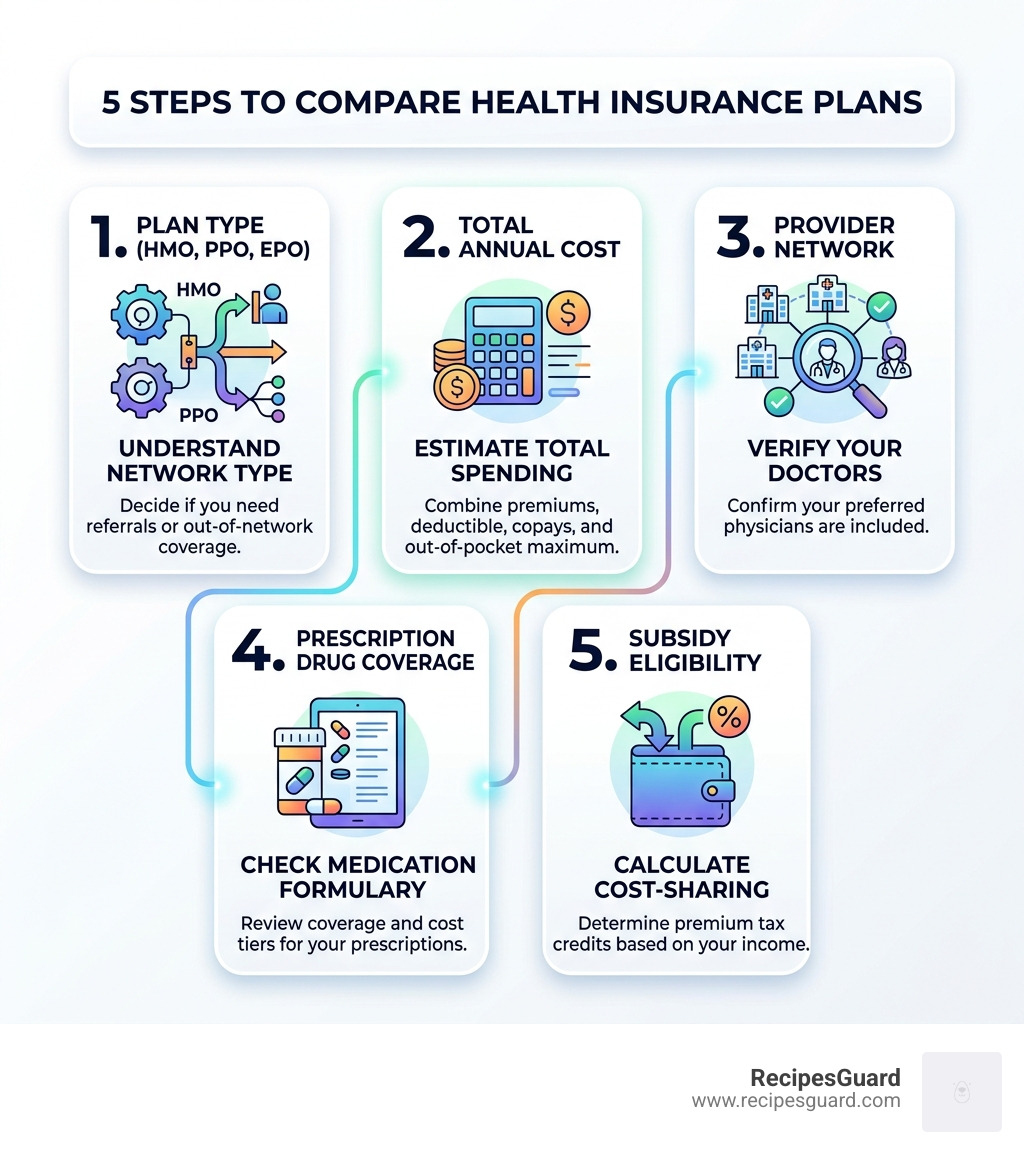
The best way to compare health insurance plans is to look beyond the monthly premium and evaluate five key factors side by side:
- Plan type (HMO, PPO, EPO, or POS) — affects whether you need referrals and how much out-of-network care costs
- Total annual cost — premium x 12, plus your deductible, copays, coinsurance, and out-of-pocket maximum
- Network coverage — confirm your doctors, hospitals, and specialists are actually in-network for that specific plan
- Prescription drug formulary — check that your medications are covered and at what cost tier
- Subsidy eligibility — calculate premium tax credits and cost-sharing reductions based on your income before choosing a metal tier
Health insurance is confusing. There are dozens of plans, layers of jargon, and a narrow window each year to make your choice. One wrong pick can mean paying thousands more than you needed to.
Here’s a striking reality: before subsidies, the average monthly marketplace premium runs about $619 in 2025. After premium tax credits, that drops to roughly $113 — and more than 40% of enrollees paid $10 or less per month. That gap exists because most people don’t know how to compare plans the right way.
For international students especially, this process feels even more overwhelming. You’re navigating a foreign healthcare system, often mid-semester, without a support network to guide you.
This guide breaks it all down into clear, actionable steps — so you can find the most affordable plan that actually covers what you need.
Best way to compare health insurance plans word roundup:
- Overseas Student Health Insurance
- Student Health Insurance Australia
- Student Prescription Claims
Understanding the Best Way to Compare Health Insurance Plans by Type

When we start our search, the alphabet soup of plan types (HMO, PPO, EPO, POS) is usually the first hurdle. These acronyms aren’t just industry jargon; they dictate how you access care and how much you pay when you see a doctor.
- HMO (Health Maintenance Organization): These are often the most affordable options but come with the most “rules.” You generally must stay within a specific network of providers and choose a Primary Care Physician (PCP). If you need to see a specialist, you’ll need a referral from your PCP first.
- PPO (Preferred Provider Organization): This is the gold standard for flexibility. You don’t usually need a PCP or referrals. While it’s cheaper to stay in-network, PPOs allow you to see out-of-network doctors for a higher cost.
- EPO (Exclusive Provider Organization): A middle ground. You don’t need referrals, but—crucially—the plan won’t pay a cent for out-of-network care unless it’s a true emergency.
- POS (Point of Service): These plans combine features of HMOs and PPOs. You’ll likely need a PCP and referrals, but you have the option to seek out-of-network care at a higher price point.
Choosing between these requires a look at your lifestyle. If you have a trusted specialist you’ve seen for years, a PPO might be the best way to compare health insurance plans to ensure you can keep that relationship. For more tips on navigating these choices, check out our guide on How to Navigate Government Health Insurance Marketplaces Like a Pro.
Evaluating Network Flexibility and Provider Access
One of the biggest mistakes we see is assuming a plan’s network stays the same forever. “Provider churn” is a real phenomenon where doctors or hospitals leave an insurance network mid-year. When comparing plans, we recommend looking at the size of the hospital affiliations. A plan that includes major university hospitals often provides a safety net for complex issues.
Furthermore, in May 2026, telehealth has become a standard benefit. If you are a busy student or professional, a plan with robust, $0-copay telehealth services can save you both time and money. Always verify that your “must-have” doctors are in-network before hitting the “enroll” button. You can find more detail on this in the U.S. News Open Enrollment Guide.
Comparing Plan Structures for Different Lifestyles
Are you living in a rural area or a major city? In rural regions, PPOs are often superior because the local “in-network” options might be limited. Conversely, if you live in a city with a massive HMO-affiliated medical group, you might get world-class care for a much lower premium.
For international students, the structure is even more vital. You need to know if your plan covers you if you travel to another state for a holiday or internship. According to NerdWallet’s guide, matching your health usage (how often you actually go to the doctor) to the plan structure is the most effective way to avoid overpaying.
Calculating the Total Cost of Ownership Beyond Premiums
The “sticker price” of a health plan is the monthly premium, but the real cost is the “Total Cost of Ownership.” To find the best way to compare health insurance plans, we use a simple formula: (Monthly Premium x 12) + Expected Out-of-Pocket Costs.
| Feature | Bronze | Silver | Gold | Platinum |
|---|---|---|---|---|
| Monthly Premium | Lowest | Moderate | High | Highest |
| Deductible | Very High | Moderate | Low | Very Low |
| Actuarial Value | 60% | 70% | 80% | 90% |
| Best For… | Rare doctor visits | Average usage | Frequent care | Chronic conditions |
Understanding these terms is vital:
- Deductible: What you pay before the insurance kicks in.
- Copayment: A flat fee (e.g., $30) for a visit.
- Coinsurance: Your percentage of the bill (e.g., 20%) after the deductible is met.
- Out-of-Pocket Maximum: The “worst-case scenario” cap. Once you hit this, the insurer pays 100% of covered costs.
For a deeper dive into these costs, especially for those on a budget, see The Ultimate Guide to Student Health Coverage and Costs and the Calcbee Step-by-Step Guide.
The Best Way to Compare Health Insurance Plans Using Metal Tiers
Metal tiers (Bronze, Silver, Gold, Platinum) do not reflect the quality of medical care; they only reflect how you and the insurer split the costs.
- Bronze plans are great for the healthy and “wealthy” (those with enough savings to cover a high deductible).
- Silver plans are the unique “sweet spot.” They are the only plans eligible for Cost-Sharing Reductions (CSRs). If your income is below 250% of the Federal Poverty Line, a Silver plan might actually behave like a Gold or Platinum plan for a much lower price.
- Gold and Platinum plans are best if you have a chronic condition, take expensive medications, or are planning a major procedure (like surgery) in 2026.
As Vox points out, comparing these tiers is like comparing “apples to oranges to lemons”—they are different financial tools for different needs.
Estimating Annual Expenses for 2026
We suggest categorizing yourself into a “usage tier”:
- Low Usage: You only go for your annual physical.
- Medium Usage: You see a specialist a few times a year and take one or two maintenance meds.
- High Usage: You have a chronic condition, regular therapy, or an upcoming surgery.
A “cash-flow stress test” is also helpful. Can you afford to pay a $3,000 deductible in February if you have an accident? If not, a higher premium plan with a lower deductible might be safer, even if it costs slightly more over the full year. This is particularly important for those Navigating Student Health Insurance in the USA.
Maximizing Savings with Subsidies and HSAs in 2026

Subsidies are the “secret sauce” of affordable health insurance. In 2026, premium tax credits remain the primary way to lower your monthly bill. These are based on your estimated household income compared to the Federal Poverty Line (FPL). For an individual in 2025, an income between $15,650 and $62,600 typically qualifies for these credits.
If you choose a High Deductible Health Plan (HDHP), you may also be eligible for a Health Savings Account (HSA). This is a triple-tax-advantaged account:
- Contributions are tax-deductible (lowering your taxable income).
- Growth is tax-free.
- Withdrawals for medical expenses are tax-free.
For 2026, the HSA contribution limits have increased to $4,300 for individuals and $8,550 for families. If you are in the 24% tax bracket, maxing out an individual HSA can save you over $1,000 in federal taxes alone. For more on these hidden criteria, check out the Penuw 2025/2026 Guide.
The Best Way to Compare Health Insurance Plans for Tax Advantages
When we look at HDHPs, we must check the minimum deductible requirements. For 2025, these were $1,650 for individuals and $3,300 for families. While these plans have higher upfront costs, the tax savings often make them the most cost-effective choice for healthy individuals who want to build a “medical nest egg.”
International students should be careful here; some student visas have specific requirements for insurance that might not align with standard HDHPs. We cover these nuances in our guide on Budgeting for Wellness: The Real Cost of International Student Health Insurance.
Step-by-Step Guide to Shopping During Open Enrollment
The best way to compare health insurance plans is to start early. For most people, Open Enrollment runs from November 1 to January 15. If you miss this window, you can typically only enroll if you have a “Qualifying Life Event,” such as moving, getting married, or losing other coverage.
- Gather your info: You’ll need your ZIP code, estimated 2026 income, and a list of your current doctors and medications.
- Visit the Marketplace: Use HealthCare.gov or your state’s specific exchange.
- Use a Broker or Navigator: These are free services. Brokers are experts paid by insurance companies, while Navigators are government-funded and unbiased.
- Compare at least 3 plans: Don’t just pick the first one you see. Look at a Silver, a Gold, and a Bronze HDHP to see the spread.
For a detailed walkthrough, we highly recommend the BenaVest 2026 Step-by-Step Guide.
Verifying Doctors and Prescription Formularies
Never trust the “Quick Search” on a marketplace home page. The best way to compare health insurance plans for provider accuracy is to go directly to the insurer’s website and use their specific 2026 provider directory.
- Prescription Tiers: Medications are grouped into “tiers” (Tier 1 is usually cheap generics, Tier 4 is expensive specialty drugs). Check where your meds fall.
- Prior Authorization: Some plans require your doctor to “ask permission” before prescribing certain drugs or procedures.
- Continuity of Care: If your doctor leaves the network, some plans allow you to finish a current course of treatment (like pregnancy care) at in-network rates.
Explore more on this topic in our article on The Best Ways to Compare Health Insurance Coverage Today.
Frequently Asked Questions about Comparing Health Plans
When is the 2026 Open Enrollment period?
For most US-based marketplace plans, Open Enrollment begins November 1, 2025, and ends January 15, 2026. To have coverage start on New Year’s Day, you generally must enroll by December 15. If you enroll between December 16 and January 15, your coverage typically starts February 1.
Are the services of an insurance broker or navigator free?
Yes! You should never be charged a fee for help enrolling in a marketplace plan. Brokers receive commissions from the insurance companies, and Navigators are funded by government grants. Both can provide invaluable help in explaining the “fine print” that most consumers miss.
How do I estimate my eligibility for premium tax credits?
Eligibility is primarily based on your Modified Adjusted Gross Income (MAGI) and your household size. The amount of the credit is tied to the cost of the “second-lowest-cost Silver plan” in your specific ZIP code. If that plan costs more than a certain percentage of your income, the tax credit covers the difference.
Conclusion
Finding the right health insurance doesn’t have to be a nightmare. By focusing on the total annual cost, verifying your specific doctors, and maximizing subsidies, you can secure high-quality coverage that fits your 2026 budget.
At RecipesGuard, we know that for students and international travelers, the paperwork is often the hardest part. Whether you are navigating the US Marketplace or looking for advice on student-specific coverage, we are here to help. Our expertise in travel insurance claims for students means we understand the hurdles you face when trying to get your money back for medical expenses.
Before you make your final choice, run through your checklist one last time:
- Did I check my medications on the 2026 formulary?
- Is my primary doctor definitely in-network?
- Have I calculated the “worst-case” out-of-pocket maximum?
For more step-by-step tutorials and advisory guides, visit us at RecipesGuard. We’re dedicated to making insurance simple, so you can focus on your studies and your future.

My name is Bianca, and my journey into the world of fermentation and food safety began with a costly mistake. I once lost an entire season’s harvest of chili peppers because I relied on guesswork instead of science. That failure was my turning point.
