
What You Need to Know About a Theft Claim for Student Travel
Making a theft claim student travel situation requires fast action — here’s the short version if you need it now:
Quick Answer: How to File a Theft Claim While Studying Abroad
- Report the theft to local police within 24 hours and get a written report or reference number
- Contact your insurer immediately — call their emergency helpline and get a case number
- Block any stolen bank cards via your banking app right away
- Notify your study abroad program or university insurance coordinator
- Gather documentation — receipts, boarding passes, photos, and any Property Irregularity Reports (PIR)
- Submit your claim through your insurer’s online portal or mobile app with all supporting documents
Luggage theft and loss makes up nearly half of all travel insurance claims worldwide. Yet most students arrive abroad without knowing their policy limits, their exclusions, or the strict deadlines that can make or break a claim.
Miss the 24-hour police report window? Your claim could be denied outright. Leave your dorm room unlocked when your laptop disappears? Same result.
The good news: with the right steps, most theft claims can be won — even after you’re back home. Whether your insurer is Europæiske ERV, Chubb, CISI, Gallagher, or Zurich, the core process is similar, and this guide walks you through all of it.
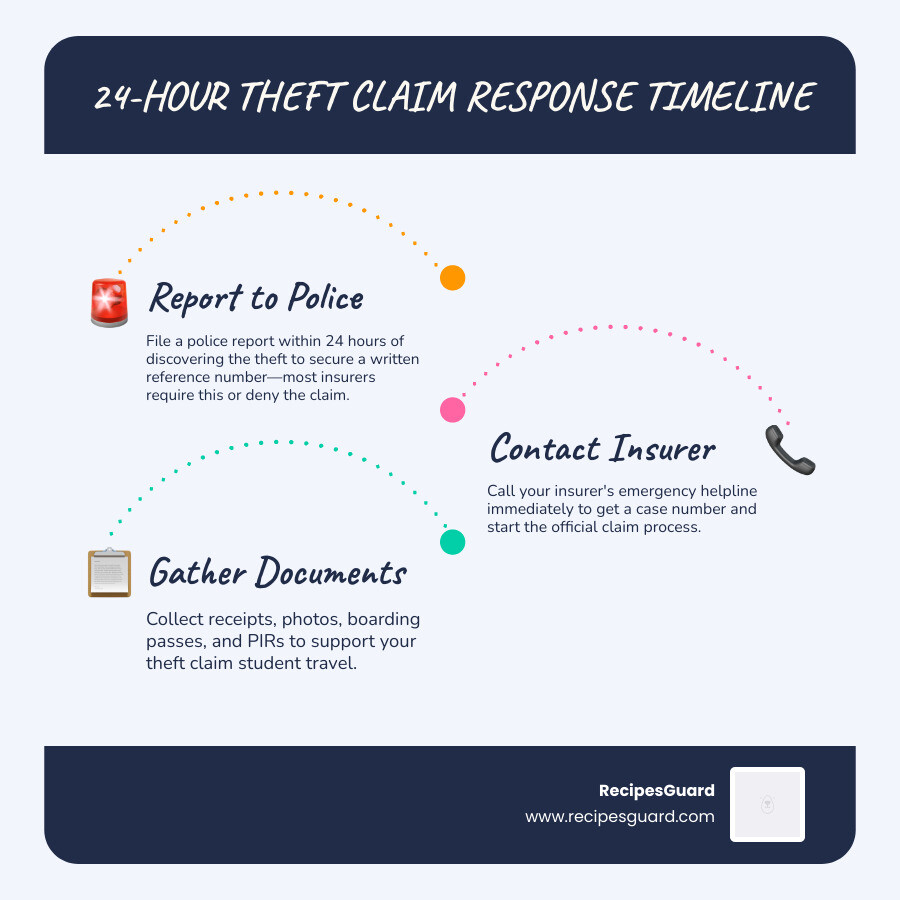
Immediate Steps After a Theft Abroad
When you realize your bag is gone or your phone has been swiped from your pocket in a crowded plaza, your adrenaline will spike. Take a deep breath. We’ve seen many students lose out on hundreds of dollars simply because they panicked and forgot the “Golden Rules” of insurance.
The most critical rule is the 24-hour window. Most major insurers, including Chubb and CISI, require you to report a theft to the local police within 24 hours of discovery. If you wait until you get back to your hostel or, worse, until you return to Australia, your theft claim student travel will likely be rejected.
Here is your immediate checklist:
- Find the nearest police station: Don’t just tell a security guard; you need an official police report. If there is a language barrier, use a translation app or ask your program coordinator for help. You need written proof of the report.
- Call the Emergency Assistance Helpline: Your insurance card (which you should always carry) has a 24/7 number. Call them to open a case. This creates a “timestamp” that proves you acted quickly.
- Block your cards and devices: Use a friend’s phone or a laptop to lock your bank accounts and use “Find My iPhone” or “Find My Device” to lock your tech.
- Notify your program: If you are on a university-sponsored trip, your program director needs to know. They can often provide immediate assistance, such as a loan for essentials or help with a lost luggage student Australia scenario where your textbooks or study materials were taken.

Essential Documentation for a Theft Claim Student Travel
Winning a claim is 90% about the paper trail. Insurers aren’t calling you a liar, but they do need “proof of loss” and “proof of ownership.”
- Proof of Ownership: This is where many students struggle. You need original receipts for the items stolen. If you don’t have the paper receipt, a bank statement or a digital invoice from an online retailer works perfectly.
- Property Irregularity Report (PIR): If your luggage was stolen while in the custody of an airline, you must get a PIR from the baggage desk before you leave the airport. Without this, the insurer will assume the airline is responsible, not them.
- Boarding Passes: Keep your physical or digital boarding passes. These prove you were actually on the trip when the theft occurred.
- Notarized Statements: In rare cases where you don’t have a receipt (perhaps for a gift), a notarized statement or a photo of you with the item before the trip might be accepted by some providers.
For more detailed steps on the administrative side, you can check out this guide on how to make an insurance claim, which outlines the specific forms often required by university-affiliated policies.
Understanding Coverage Limits and Exclusions
Not all “theft” is treated the same. Most student policies have different “buckets” for coverage. For example, your “Baggage” limit is often much lower than your “Contents of Dwelling” limit. If your suitcase is stolen from a bus, you might be capped at $1,000. But if your apartment in Stockholm or Copenhagen is burgled, the “Contents of Dwelling” coverage could go up to $50,000 or more.
| Coverage Type | Typical Limit (Approx. AUD) | Key Requirement |
|---|---|---|
| Stolen Cash | $200 – $500 | Must be on your person or in a locked safe |
| Single Item Limit | $1,000 – $2,500 | Often requires a “high-value” receipt |
| Baggage (Total) | $3,000 – $5,000 | Must not be left unattended |
| Passport Replacement | $250 – $500 | Covers fees and travel to the embassy |
It is also vital to check your theft and loss of luggage guide to see how your specific insurer handles “sets” of items. For example, if your camera, lens, and tripod are stolen together, some insurers treat them as one single item for the purpose of the payout limit.
Common Exclusions in a Theft Claim Student Travel
This is where the “fine print” gets tricky. You can follow every step perfectly, but if your situation falls under an exclusion, the claim is dead on arrival.
- Unattended Items: This is the #1 reason claims are denied. If you leave your bag on a café chair to go to the bathroom, or leave your phone on a table while you look at a map, it is considered “negligence.” You must take “reasonable care.”
- Unlocked Rooms: If your dorm room or Homestay was left unlocked and someone walked in and took your laptop, you aren’t covered. Most policies specifically state that there must be “evidence of forced entry.”
- The Two-Year Rule: Some European-based student insurers have a strict rule regarding the age of property. If an item is older than two years, they may only pay out a fraction of the cost, or in some cases, exclude it from “replacement value” coverage entirely.
- Checked-in Electronics: Never, ever put your laptop, tablet, or expensive jewelry in checked luggage. Almost every policy, including the ones detailed in the ultimate guide to stolen luggage insurance, excludes electronics from checked baggage coverage because they are considered “fragile and high-risk.”
How to File Your Theft Claim Student Travel with Major Insurers
By May 2026, most major insurers have moved entirely to digital filing. Whether you are using a university-sponsored plan like Chubb (UC) or Gallagher, or a private student plan like CISI, the process usually happens through a mobile app.
- Step 1: Open the App. Log in and select “File a Claim.”
- Step 2: Upload the Police Report. Take a clear photo of your report. If it’s in a foreign language, don’t worry — most international insurers have in-house translators.
- Step 3: Itemize Everything. Don’t just say “clothes.” List “3 pairs of jeans, 5 t-shirts, 1 pair of sneakers.”
- Step 4: Attach Receipts. This is where you link your proof of purchase.
- Step 5: Get the Countersignature. For many university-sponsored trips, you may need a staff member from your home campus or the host university to sign off on the claim form to verify you were on a sanctioned trip.
For a deeper dive into the technical side of the process, especially for international students, we recommend this complete guide to student travel insurance claims.

Processing Timelines and Reimbursement
How long until you get your money back? Typically, it takes 2 to 6 weeks for a theft claim student travel to be processed.
One thing that surprises many students is depreciation. Unless you have a “New for Old” policy, the insurer will look at the age of your item and reduce the payout based on wear and tear. A laptop you bought three years ago for $2,000 might only be worth $800 in the eyes of the insurance adjuster.
If you want to understand the math behind these payouts, check out our lost luggage insurance 101 guide, which explains how “actual cash value” differs from “replacement cost.”
Maximizing Your Payout: Pro Tips for Students
We want you to get every cent you deserve. Here are our top “insider” tips for Australian students traveling abroad:
- The “Locker” Rule: If you are staying in a hostel, always use the provided locker. If your items are stolen from a locker that was tampered with, your claim is much stronger than if they were taken from your bed.
- Digital Record Keeping: Before you even leave Australia, take a photo of all your expensive gear and their serial numbers. Upload these to a cloud drive (Google Drive or iCloud). If the physical items are stolen, you still have the “digital proof” ready to go.
- Consider a Rider: If you are carrying a $4,000 MacBook Pro for your film studies, your standard student travel insurance might only cover up to $1,500 for a single item. You may need to buy a “high-value rider” or a separate personal property plan to cover the full cost.
- Reasonable Care: If you are in a high-theft area (like certain parts of Paris or Rome), keep your backpack on your front in crowds. Insurers have been known to deny claims if they feel the student was being “reckless” in a known high-crime zone.
Learning how to handle a gap year theft claim is a great way to prepare for the unexpected. And remember, if you are looking for specific advice for the Australian market, our guide on lost suitcase insurance Australia Protecting Your Precious Cargo is the best place to start.
Frequently Asked Questions about Student Theft Claims
How long does it take to process a theft insurance claim?
Most insurers aim to settle claims within 15 to 30 business days once all documentation is submitted. However, if you are missing a police report or original receipts, it can take months of back-and-forth.
Can I file my claim once I am back in my home country?
Yes! While you must report the theft to the police and your insurer immediately (within 24 hours), you can usually wait until you return home to Australia to submit the final paperwork and receipts. Just make sure you don’t miss the “filing deadline,” which is often 30 to 90 days after the incident.
What if I don’t have the original receipt for my stolen laptop?
Check your email for digital invoices or log into your bank’s app to find the transaction. If the item was a gift, ask the person who bought it for a copy of the receipt. If all else fails, a photo of the item with the serial number visible can sometimes be used as secondary proof.
Conclusion
At RecipesGuard, we know that a theft abroad is more than just a financial loss — it’s a massive disruption to your education and your peace of mind. But remember, insurance is a contract. If you fulfill your end of the deal (reporting within 24 hours, taking reasonable care, and providing documentation), the insurer is legally bound to fulfill theirs.
We are here to provide the insurance advisory and step-by-step tutorials you need to navigate these tricky waters. Don’t let a pickpocket ruin your semester. Take the right steps, document everything, and start your claim recovery today to get back on track. Safe travels!

My name is Bianca, and my journey into the world of fermentation and food safety began with a costly mistake. I once lost an entire season’s harvest of chili peppers because I relied on guesswork instead of science. That failure was my turning point.
