
Filing Your Flight Claim One Step at a Time
Why Step by Step Filing Matters When Your Flight Goes Wrong
Step by step filing is the structured process of submitting an insurance claim — or any formal financial document — by following a clear, ordered sequence of actions to get your money back.
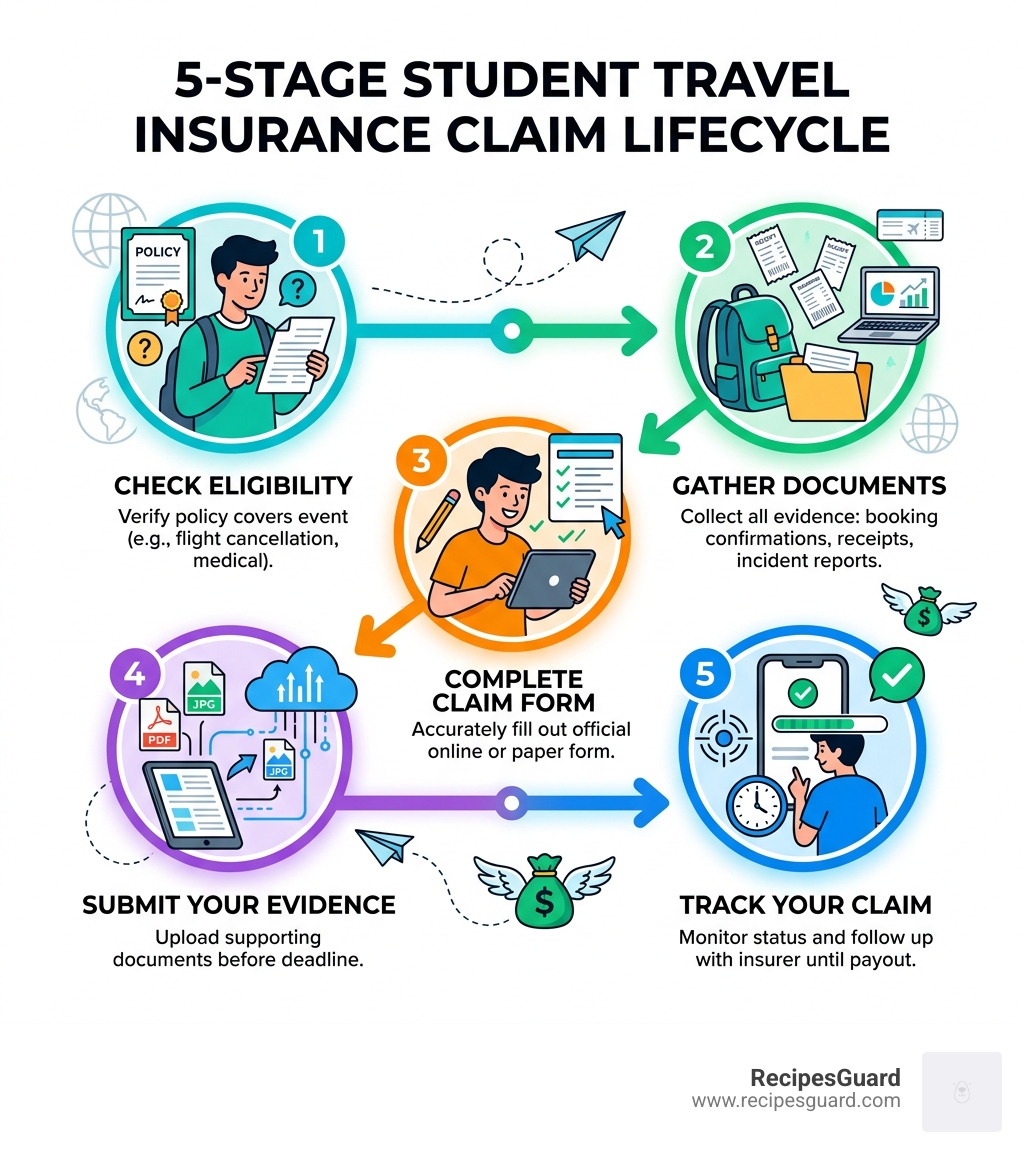
If you just need the quick version, here’s how the process works:
- Check eligibility — Confirm your policy covers the disruption (flight cancellation, medical emergency, etc.)
- Gather documents — Collect receipts, booking confirmations, incident reports, and your policy number
- Complete the claim form — Fill out your insurer’s official form accurately and completely
- Submit your evidence — Upload or mail supporting documents before the deadline
- Track your claim — Follow up with your insurer and monitor the status of your payout
That’s the core of it. But the details matter — a lot.
Picture this: your flight is cancelled the night before your final exams. You’re stranded, out of pocket for a hotel, meals, and a last-minute rebooking fee. You have travel insurance. But you’ve never filed a claim before, and the process looks overwhelming.
This is exactly where most international students get stuck. Not because the system is impossible — but because nobody walked them through it clearly.
The good news? Filing a travel insurance claim follows a logical sequence, much like filing a tax return or any other formal financial submission. Once you understand the steps, the process becomes far less intimidating.
Step by step filing word list:
- how cancel trip claim
- student abroad claim process
- student travel claim process
Preparing for Your Step by Step Filing

Before you even log into a portal or pick up a pen, the secret to a successful claim lies in the preparation. Think of it like a chef prepping their “mise en place” before cooking. If you have everything chopped and ready, the actual cooking is a breeze. If you’re hunting for the onions while the garlic is burning, you’re in trouble.
In finance and insurance, your “mise en place” consists of your documentation. Whether you are following the IRS guide to filing taxes or preparing a flight delay claim, the first step is always the same: gather your papers.
We recommend creating a “Claims Folder” on your phone or laptop the moment you start your journey. This should include:
- Proof of Purchase: Your original flight itinerary and the receipt showing how much you paid.
- Incident Reports: If your flight was delayed or cancelled, ask the airline for a written statement explaining why. This is your “evidence” that the event actually happened.
- Expense Tracking: Keep every single receipt for “out-of-pocket” expenses. Did you buy a sandwich because you were stuck for six hours? Keep the receipt. Did you have to take an Uber to a hotel? Keep the receipt.
As we discuss in our guide on how to file claims without losing your mind, organization is the antidote to stress. When you have a digital trail of every cent spent, the insurer has very little room to argue.
Determining Your Eligibility and Status
Not every “bad day” at the airport is a valid insurance claim. Just as a taxpayer must determine their filing status (Single, Married Filing Jointly, etc.) before submitting a return, a student traveler must determine their “claim status.”
If you are an international student in Australia, your eligibility might depend on your visa status and the specific requirements of your Overseas Student Health Cover (OSHC) or additional travel insurance. According to the Australian Taxation Office, residency status is a major factor in how you interact with government systems, and the same logic applies to insurance.
Ask yourself:
- Is this a “Qualifying Event”? Most policies cover cancellations due to illness, severe weather, or airline strikes. They rarely cover “I decided I didn’t want to go anymore.”
- Am I a Nonresident? If you are studying in Australia on a Student Visa (subclass 500), ensure your policy specifically covers international students. The steps for an Australia tax return often highlight how nonresidents have different obligations—your insurance is no different.
Mastering the Step by Step Filing of Evidence
In May 2026, the digital world is more advanced than ever, yet many claims are still rejected because of “insufficient evidence.” To master step by step filing, you need to treat your evidence like a legal brief.
- Digital Uploads: Most modern insurers prefer high-resolution PDFs or JPEGs. Avoid blurry photos taken in a dark airport lounge. Use a scanning app to ensure the edges are crisp and the text is readable.
- Signature Requirements: Some forms require a “wet signature” (pen on paper), while others accept digital signatures like DocuSign. Check the policy fine print early so you don’t have to scramble for a printer at the last minute.
- Timestamps: When an incident occurs, take a screenshot of the airline’s app notification or the departure board. This provides an undisputed timestamp of when your “qualifying event” began.
Following a simple student tutorial for filing insurance claims can help you avoid the common pitfall of submitting incomplete data, which is the number one reason for payout delays.
The Core Process of Insurance Submission

Now we reach the “meat” of the process. This is the actual submission. In 2026, the IRS reports that more than 9 out of 10 refunds are issued in less than 21 days when taxpayers e-file and choose direct deposit. We see the exact same trend in the insurance industry.
E-filing vs. Paper Filing: Just as the IRS Free File program (available for those with an AGI of $89,000 or less) makes tax season easier, most travel insurers now offer dedicated mobile apps. Using these apps is almost always faster than mailing a thick envelope of receipts to a claims center in Sydney or Melbourne.
Refund and Payout Tracking: Once you hit “submit,” the waiting game begins. Most insurance companies will provide a “Claim ID.” Keep this number safe! It is your ticket to tracking your money. Much like the “Where’s My Refund?” tool for taxes, insurance portals allow you to see if your claim is “Received,” “Under Review,” or “Approved.”
| Feature | Tax Filing (2025/2026) | Bankruptcy Petition (Ch. 7) | Insurance Claim |
|---|---|---|---|
| Primary Goal | Compliance & Refund | Debt Discharge | Financial Reimbursement |
| Key Deadline | April 15, 2026 | Within 180 days of credit counseling | Usually 30-90 days post-incident |
| Filing Fee | Often Free (IRS Free File) | $338 | Included in Policy Premium |
| Wait Time | ~21 Days (E-file) | 4-5 Months | 15-45 Days |
For a deep dive into the nuances of this stage, check out our mastering the travel insurance claim tutorial.
Navigating the Step by Step Filing Deadlines
Time is your greatest enemy in step by step filing. In the tax world, the deadline for 2025 returns is April 15, 2026. If you miss it, you face penalties unless you request an extension (Form 4868) which gives you until October 15.
Insurance claims have their own “statutes of limitations.” Most policies require you to notify the insurer of an incident within 24 to 48 hours and submit the full claim within 30 days.
If you need more time—perhaps because you are still waiting for a final bill from a hospital or a statement from an airline—you must request an “extension” from your claims adjuster. Don’t just wait and hope they understand; be proactive. As noted in the guide for Chapter 7 bankruptcy, missing a strict deadline (like the 14-day window for “skeleton filings”) can lead to your entire case being dismissed. Don’t let your claim suffer the same fate.
Choosing Between Standard and Itemized Submissions
When filing a claim, you often have a choice: do you take the “fixed benefit” or do you “itemize”?
- Standard Allowances: Some policies offer a flat rate. For example, “If your flight is delayed more than 6 hours, we pay a flat $200.” This is the “Standard Deduction” of the insurance world. It’s easy, requires less paperwork, and is usually paid out quickly.
- Itemized Expenses: If your actual costs were much higher (e.g., you spent $450 on a hotel and meals), you should choose to itemize. This requires a receipt for every single cent.
Just as taxpayers must decide if their itemized deductions exceed the standard deduction amount, you should calculate if the extra paperwork of itemizing is worth the higher payout. Our guide on submitting medical expense claims explains how to navigate these choices without getting a headache.
Overcoming Hurdles in Professional Filings
Sometimes, despite your best efforts at step by step filing, things get complicated. Maybe the airline is being difficult, or the insurer is using legal jargon you don’t understand.
In the tax world, there are programs like VITA (Volunteer Income Tax Assistance) which help people earning $69,000 or less, seniors, and those with disabilities. In the insurance world, you have similar resources. Many universities in Australia offer free legal or student advisory services that can help you review your insurance policy.
If you are filing “pro se” (without a lawyer), you are in the same boat as many people filing for bankruptcy. A Pro Se Bankruptcy Guide highlights that while filing alone saves money (avoiding attorney fees of $1,000–$3,500), it requires extreme attention to detail. The same applies to your insurance. You don’t necessarily need a lawyer to get a $500 flight refund, but you do need to be your own best advocate.
Handling Rejections and Appeals
A “No” from an insurance company isn’t always the final answer. It might just mean “Not yet.”
Common reasons for rejection include:
- Missing Documentation: You forgot to include the airline’s cancellation notice.
- Late Filing: You submitted the claim after the policy’s deadline.
- Excluded Events: The event wasn’t covered (e.g., you missed your flight because you overslept).
If your claim is rejected, you have the right to appeal. This is similar to a “dispute resolution” process in a injury claim guide. You will need to provide new evidence or a clearer explanation of why the initial decision was incorrect. Always remain polite but firm.
Special Group Considerations for Seniors and Students
Different groups have different needs when it comes to step by step filing.
- Nonresident Students: If you’re an international student in Australia, your OSHC is mandatory, but it usually only covers medical. For flight claims, you need a separate travel policy. Be sure to check how your residency status affects your “taxable” insurance benefits.
- Seniors: Older travelers may have higher premiums but often have access to “Senior Credits” or more comprehensive coverage for pre-existing medical conditions.
- Disability Accommodations: If a flight delay is made worse because of a disability (e.g., you need specific medical equipment or accessible transport), these extra costs are often reimbursable.
The Australian Taxation Office provides specific pathways for different demographics, and your insurance company should do the same. If you need language support, many Australian insurers offer translation services—don’t be afraid to ask!
Frequently Asked Questions about Filing Procedures
When is the deadline for filing and can I get an extension?
For the 2025 tax year, the deadline is April 15, 2026. For insurance, the “notice” deadline is usually within 48 hours of the flight disruption, while the “submission” deadline is typically 30 days. Just as you can use Form 4868 to get a tax extension to October 15, you can often negotiate a deadline extension with your insurance company if you have a valid reason (like being hospitalized).
What free options are available for filing help?
If your income is $89,000 or less, you can use IRS Free File for your taxes. For students in Australia, your university’s Student Union or International Student Office often provides free advisory services for insurance and financial claims. Additionally, VITA volunteers provide free tax prep for those earning $69,000 or less.
How do I track my refund or claim status?
Most e-filed tax refunds arrive within 21 days and can be tracked via “Where’s My Refund?”. Insurance claims follow a similar timeline. If you choose direct deposit, you can receive your funds significantly faster than a paper check. Always record your “Claim ID” and “Adjuster’s Name” for future reference.
Conclusion
At RecipesGuard, we believe that being a student traveler should be about exploring the world, not drowning in paperwork. Whether you are navigating the complexities of an Australian tax return or trying to get a refund for a cancelled flight to Sydney, step by step filing is your roadmap to success.
By gathering your evidence early, understanding your eligibility, and staying on top of deadlines, you turn a stressful situation into a manageable task. The average American tax refund in 2024 was $3,453—that’s a lot of money to leave on the table. The same goes for your insurance claims. Don’t let a “complicated” form stand between you and the money you are owed.
For more student-focused tutorials, check out our step by step guide to trip cancellation refunds and take control of your financial journey today!

My name is Bianca, and my journey into the world of fermentation and food safety began with a costly mistake. I once lost an entire season’s harvest of chili peppers because I relied on guesswork instead of science. That failure was my turning point.
