
When a Tooth Breaks on Your Gap Year: What You Need to Know
Emergency dental claim travel insurance can be the difference between a manageable setback and a financial crisis when something goes wrong with your teeth abroad.
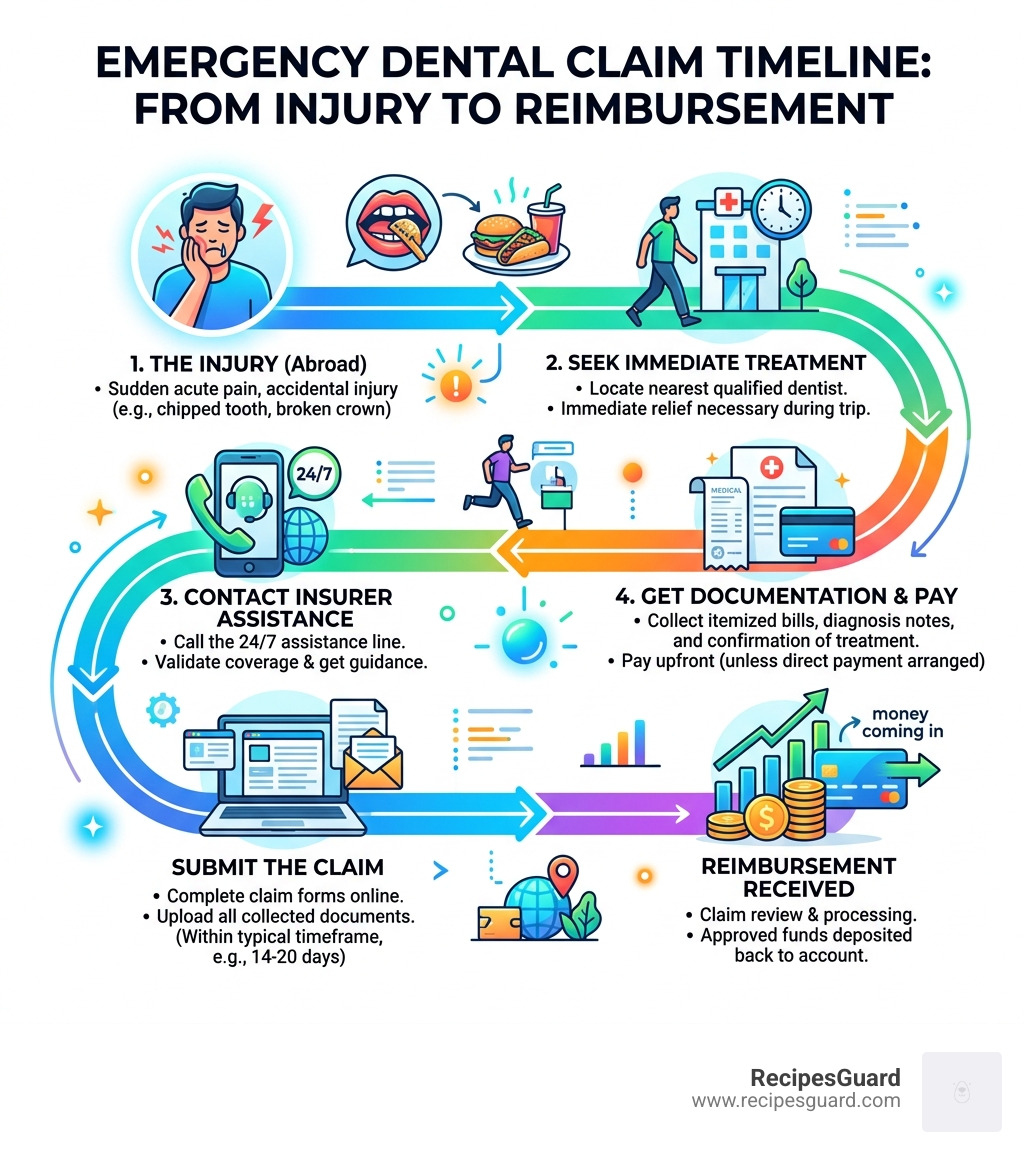
Here’s the quick answer on how to file an emergency dental claim:
- Seek treatment immediately – only care received during your trip is eligible
- Contact your insurer’s 24/7 assistance line before or right after seeing a dentist
- Collect all documentation – itemized bills, diagnosis notes, and written confirmation from the treating dentist
- Pay upfront (most plans reimburse you later, though some can arrange direct payment)
- Submit your claim online through your insurer’s portal, typically within 14-20 days of the incident
Picture this: you’re halfway through your gap year, biting into street food in a busy night market, when you feel that horrible crack. Suddenly you’re in a foreign country, in pain, with no idea what your insurance actually covers or how to use it.
It happens more often than you’d think.
Most travel insurance plans do include emergency dental coverage — but it’s almost always buried inside the broader emergency medical benefit, with its own sublimits, rules, and exclusions. Coverage limits for dental care typically range from $500 to $1,000 on standard plans, while more comprehensive plans can bundle dental within much larger medical maximums of $50,000 to $250,000.
The catch? The rules around what qualifies, what documentation you need, and how quickly you must act are strict. Miss a step and your claim could be denied.
This guide walks you through everything — from understanding what’s covered to filing a successful claim without the stress.
Understanding Your Emergency Dental Claim Travel Insurance Coverage

When we talk about emergency dental claim travel insurance, the word “emergency” is doing a lot of heavy lifting. In insurance, an emergency isn’t just “my tooth feels a bit weird”; it is generally defined as the relief of sudden and acute pain or the treatment of an injury to sound natural teeth.
Most policies available to Australian travelers treat dental as a sub-limit of your Overseas Medical Expenses. This means that while you might have “unlimited” medical cover, the specific amount you can claim for a toothache or a broken molar is capped. For example, some popular Australian plans might offer up to $50,000 for emergency medical but restrict dental care to a $750 or $1,000 sub-limit.
To ensure your claim is successful, you need to understand the concept of “sound natural teeth.” Most insurers will only pay for repairs to teeth that were healthy and whole before the accident. If you have a pre-existing crown that falls out because of underlying decay, your insurer might argue the tooth wasn’t “sound.”
For a deeper dive into how these definitions affect your specific situation, check out our guide on how to Brace Yourself for Your Overseas Dental Claim.
Covered Scenarios for an Emergency Dental Claim Travel Insurance
What actually counts as a claimable event? Based on our experience helping students navigate these murky waters, the following scenarios are typically covered:
- Accidental Impact: You’re playing beach volleyball and take a ball to the face, chipping a front tooth.
- Sudden Infection: An abscess or infection develops out of nowhere, causing fever and intense pain that requires immediate antibiotics or a drainage procedure.
- Broken Molars: You bite down on an olive pit in Greece or a hidden bone in a meat dish, cracking a tooth.
- Lost Fillings/Crowns: If a filling or crown falls out and causes acute pain, most insurers will cover the cost of a temporary replacement to get you through the trip.
| Feature | Standard Plan (Average) | Premium Plan (Average) |
|---|---|---|
| Dental Sub-limit | $500 – $700 | $1,000 – $2,000 |
| Medical Maximum | $50,000 – $100,000 | $250,000 – Unlimited |
| Deductible/Excess | $100 – $250 | $0 – $100 |
Common Exclusions and Limitations
It’s just as important to know what we can’t claim for. Travel insurance is designed for “unforeseen” events, not routine maintenance.
- Routine Care: You cannot claim for a check-up, a cleaning, or a scale-and-polish just because you’re near a cheap dentist in Bali.
- Cosmetic Procedures: Teeth whitening, veneers, or elective orthodontic work are strictly off the table.
- Pre-existing Conditions: If you knew you needed a root canal before you left Australia, you can’t wait until you’re overseas and try to claim it as an “emergency.”
- Dental Tourism: This is a big one. If the primary purpose of your trip is to get cheaper dental work (like implants or major bridgework), your travel insurance will not cover any complications arising from those procedures.
- Dentures and Braces: Damage to false teeth, bridges, or orthodontic braces is a common exclusion in many standard policies.
Understanding what travel insurance covers regarding dental health is the first step to avoiding a rejected claim. Always read your specific PDS (Product Disclosure Statement) to see if your “Already Overseas” policy has a waiting period—often 72 hours—before coverage kicks in.
Immediate Steps After a Dental Emergency Abroad

When pain strikes, your first instinct might be to panic. Don’t. We recommend a systematic approach to ensure both your health and your emergency dental claim travel insurance are protected.
First, contact your insurer’s 24/7 assistance team. This is crucial. They can often direct you to pre-screened, English-speaking dentists in their network. In some severe cases, they may even be able to arrange an “advance payment” or a “letter of guarantee,” meaning you don’t have to front the cash yourself.
If you’ve knocked out a tooth, time is of the essence. Clinical data shows a 30-40 minute window for successful re-implantation. While you’re rushing to the clinic, store the tooth in a small container of milk or inside your cheek (if you’re old enough not to swallow it!) to keep the root cells alive. For more information on managing dental trauma, you can refer to the Australian Dental Association’s emergency guide.
For more student-specific tips on handling these high-stress moments, see our article A Pain in the Tooth: Navigating Student Health and Travel Claims.
Treatment Timing and Eligibility
Timing is everything. To be eligible for an emergency dental claim travel insurance payout, the treatment must occur during your trip. You cannot wait until you return home to Australia to see your local dentist and then try to claim it on your travel insurance.
Insurers look for “acute” symptoms. If you have a mild toothache and wait three weeks to see a dentist, the insurer might argue it wasn’t a true emergency. Seek care as soon as the pain becomes unmanageable or the injury occurs.
For a full breakdown of how to handle medical crises on the road, read The Ultimate Survival Guide for Medical Emergencies Abroad.
How to File an Emergency Dental Claim Travel Insurance Successfully
Most dental claims operate on a “reimbursement model.” This means you pay the dentist out of your own pocket and then ask the insurance company to pay you back.
To make this process as smooth as possible, we suggest using the insurer’s eClaims portal. These digital platforms allow you to upload photos of your receipts and documents directly from your phone, which is much faster than traditional paper forms.
Need a step-by-step walkthrough? Check out A Student’s Guide to Dental and Prescription Claims.
Documentation Needed for Your Emergency Dental Claim Travel Insurance
This is where most claims live or die. If you don’t have the right paperwork, the insurer will likely reject the claim. Before you leave the dental office, ensure you have:
- A Written Certification: The dentist must state in writing that the treatment was for “the relief of sudden and acute pain” or due to an “accidental injury to sound natural teeth.”
- Itemized Billing: A receipt that shows exactly what you were charged for (e.g., X-rays, local anesthetic, temporary filling).
- Diagnosis Report: A brief note from the dentist explaining what was wrong (e.g., “fractured upper left molar”).
- Proof of Payment: An official receipt showing the balance was paid in full.
- Travel Itinerary: To prove the incident happened while you were actively traveling.
We’ve simplified this entire process in our tutorial: Filing Your Student Emergency Dental Claim Without the Headache.
Primary vs. Secondary Coverage Mechanics
In Australia, travel insurance is often “secondary” if you have other forms of insurance. However, for overseas dental work, it usually acts as your primary cover because Medicare does not operate outside of Australia (except for very limited reciprocal health care agreements that rarely cover dental).
You will likely have to pay an “excess” or “deductible.” This is a pre-agreed amount (usually between $50 and $250) that you contribute toward the claim. If your dental bill is $600 and your excess is $100, the insurer will reimburse you $500.
For more on how these mechanics work for students, read Mastering the Emergency Medical Student Claim Process.
Preparing Your Gap Year Dental Kit
Prevention is better than a claim. Before you head off on your gap year, we highly recommend getting a full dental check-up in Australia. This establishes a record of your “sound natural teeth” and can prevent a surprise infection mid-trip.
We also suggest packing a small “Dental First Aid Kit” containing:
- Temporary Dental Cement: Available at most Australian pharmacies, this can hold a crown or filling in place for up to 48 hours.
- Clove Oil or Numbing Gel: For immediate pain relief while you find a dentist.
- Interdental Brushes and Floss: To keep things clean and prevent “food traps” that lead to infections.
Maintaining these hygiene habits is your best defense. For more tips on keeping your smile bright while on a budget, see Dental Insurance for Students: Keeping Your Pearly Whites Protected.
Frequently Asked Questions about Gap Year Dental Claims
Does travel insurance cover dental tourism or planned work?
No. Standard travel insurance is strictly for unexpected emergencies. If you plan to get veneers in Thailand or implants in Vietnam, the costs of the procedure and any complications arising from it are your responsibility. Travel insurance will not cover “medical tourism.”
Can I claim for follow-up treatment after I return home?
Generally, no. Travel insurance covers the immediate relief of pain while you are overseas. If you get a temporary filling in London, the cost of getting a permanent crown once you return to Australia is usually not covered. Coverage ends the moment you clear customs back in your home country.
What happens if my injury was caused by a high-risk sport?
This depends on your policy. If you were injured while boxing, mountain biking, or bungee jumping, you might only be covered if you paid an extra premium for “adventure sports” coverage. Always check the “Excluded Activities” list in your PDS. Injuries resulting from being under the influence of alcohol or drugs are also standard exclusions.
Conclusion
Navigating an emergency dental claim travel insurance doesn’t have to be a nightmare. By understanding your limits, acting quickly, and gathering the right documentation, you can get back to enjoying your gap year without a massive hole in your savings.
At RecipesGuard, we specialize in student-focused advocacy. We know that as a gap year traveler, your budget is tight and your stress levels are high when things go wrong. That’s why we provide step-by-step claim filing tutorials and insurance advisory services specifically tailored for the young Australian explorer.
Don’t let a toothache end your adventure. Start your claim journey today and let us help you get your pearly whites—and your finances—back on track.

My name is Bianca, and my journey into the world of fermentation and food safety began with a costly mistake. I once lost an entire season’s harvest of chili peppers because I relied on guesswork instead of science. That failure was my turning point.
