
How to find the best travel insurance for cancer patients Australia
Why Finding the Best Travel Insurance for Cancer Patients Australia Matters
The best travel insurance for cancer patients australia can be hard to find — but it exists, and more options are available than most people realise.
Here is a quick summary of what you need to know:
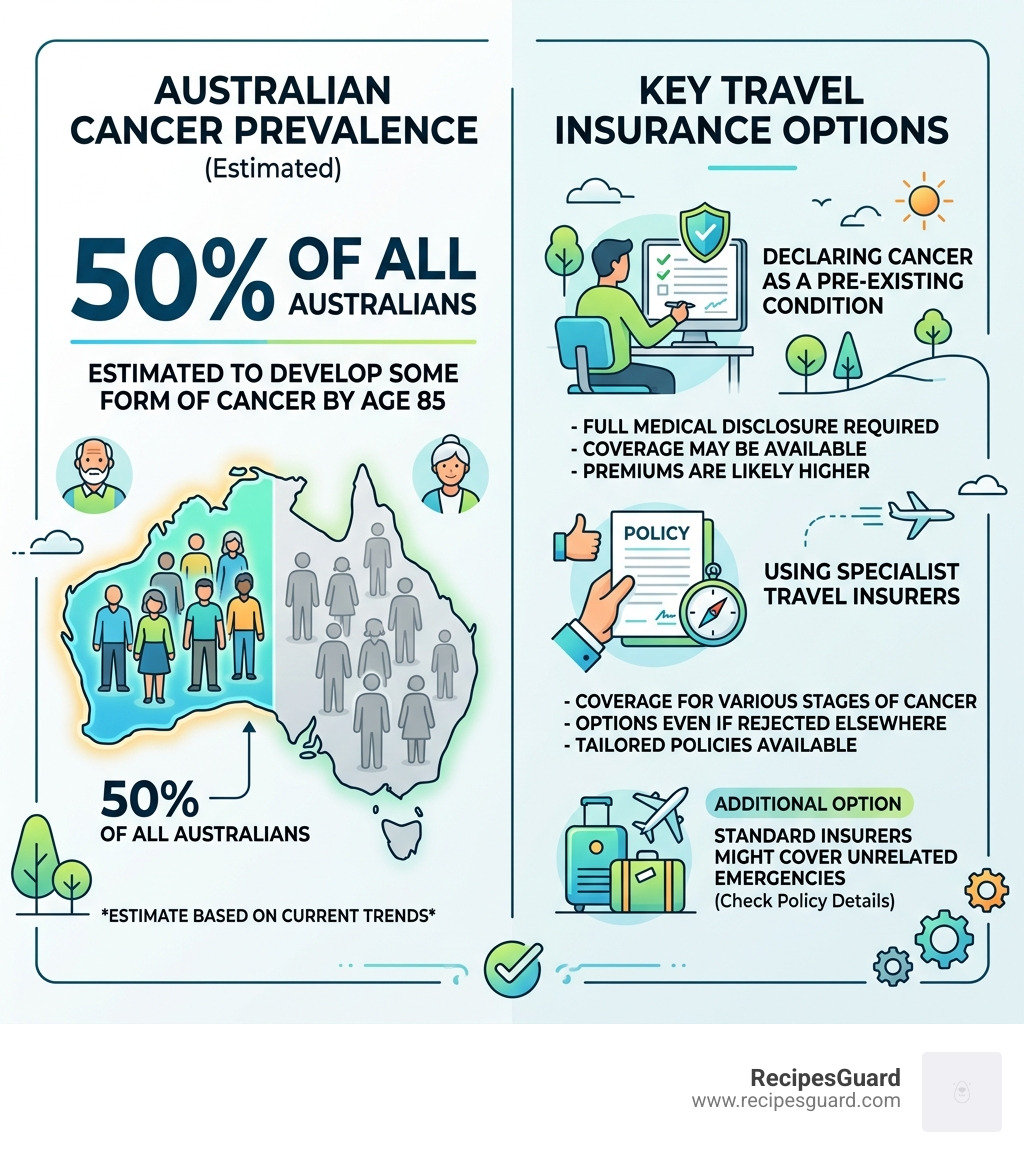
- Yes, cancer patients can get travel insurance in Australia — even with an active diagnosis or a history of cancer
- You must declare cancer as a pre-existing condition when applying, or risk having claims denied
- Specialist insurers can cover all stages of cancer, including cases that standard insurers reject
- Standard insurers may still cover you for unrelated emergencies (broken bones, food poisoning, lost luggage) even if cancer itself is excluded
- Terminal illness cover is possible in some cases, provided a doctor confirms you are fit to travel and your prognosis meets the insurer’s minimum timeframe
- Premiums will likely be higher, but the financial protection overseas is worth comparing
Around half of all Australian men and women are estimated to develop some form of cancer by their 85th birthday — making this one of the most common pre-existing conditions travellers need to navigate.
If you have cancer — whether in remission, actively being treated, or newly diagnosed — travel is still possible. The key is finding the right policy before you book, not after.
Explore more about best travel insurance for cancer patients australia:
- buy travel insurance online australia
- best insurance for working holiday visa australia
- corporate travel insurance australia
Eligibility: Can You Get Travel Insurance with Cancer?

One of the most frequent questions we hear at RecipesGuard is: “Is it even possible to get covered?” The answer is a resounding yes, though the “how” depends heavily on your current health status. In Australia, travel insurance providers generally categorise cancer as a pre-existing medical condition. This applies whether you are currently undergoing treatment, are in remission, or have had a diagnosis in the distant past.
To be eligible for the best travel insurance for cancer patients australia, you usually need to meet a few baseline criteria:
- Remission Status: If you have been in remission for a specific period (often 6 to 12 months), many standard insurers may offer cover, sometimes even without a significant premium hike.
- Active Treatment: If you are currently undergoing chemotherapy or radiotherapy, your options narrow to specialist providers who focus on medical risks.
- Fitness to Travel: Regardless of the insurer, you must be declared “fit to travel” by your treating physician. If a doctor advises against travel, no policy will be valid.
- Medical Clearance: You may need a formal letter from your oncologist detailing your stability and any medications you are taking.
Understanding Healthcare That Covers Pre Existing Conditions What You Need To Know is vital because it explains that while insurers can’t always cover the cancer itself, they can provide a safety net for everything else.
Understanding Terminal Illness Coverage
For those with a terminal diagnosis, the search for insurance is more sensitive but not impossible. Specialist providers often assess these cases on a manual, case-by-case basis. Generally, to secure cover for a terminal illness, your prognosis must typically be at least six months from the date of your scheduled return to Australia. This ensures that the insurance covers “unforeseen” complications rather than expected end-of-life care.
Coverage for Different Cancer Stages
The best travel insurance for cancer patients australia isn’t a one-size-fits-all product. Coverage varies significantly based on the type and stage of the disease:
- Breast and Prostate Cancer: Often easier to cover if the condition is stable or in remission.
- Lymphoma and Bowel Cancer: Frequently covered by specialist insurers, provided there are no secondary complications.
- Stage 4/Metastatic Cancer: Requires specialist medical screening. While standard insurers might refuse cover for cancer-related claims, specialists may offer “unlimited” medical emergency cover for an additional premium.
- Undiagnosed Conditions: If you are currently “in the middle” of a diagnosis (waiting for biopsy results, for example), almost all insurers will refuse cover until a formal diagnosis is reached.
How to Choose the Best Travel Insurance for Cancer Patients Australia
Choosing the right policy requires looking beyond the price tag. You are essentially buying a promise of help when things go wrong. For cancer patients, the “risk assessment” performed by the insurer is based on actuarial data—essentially, the statistical likelihood of you needing medical care while abroad.
When evaluating policies, consider “premium loading.” This is the extra cost added to your base premium to account for your medical history. While it might feel unfair, it’s how insurers manage the high cost of overseas hospitalisation, which can easily exceed $50,000 for a single event in places like the USA or Europe.
To help you decide, we recommend reading Dont Let Old Aches Break Your Travel Bank to understand how older or chronic conditions impact your wallet.
Comparing Specialist vs. Non-Specialist for the Best Travel Insurance for Cancer Patients Australia
There is a massive difference between a standard “big bank” travel insurance policy and a specialist medical provider.
| Feature | Standard Insurer | Specialist Medical Insurer |
|---|---|---|
| Cancer Cover | Often excluded or very limited | Usually available for all stages |
| Medical Screening | Basic online questionnaire | Detailed medical assessment |
| Age Limits | Often capped at 75-80 years | Often no upper age limit |
| Terminal Illness | Standard exclusion | Case-by-case assessment |
| Unrelated Claims | Covered (e.g., broken legs) | Covered |

Specialist insurers are designed for this specific purpose. They often offer “unlimited” medical emergency and repatriation costs, which is crucial if you need to be flown back to Australia with medical supervision. Standard insurers are excellent for healthy travellers or those with very stable, long-term remission, but they may have stricter exclusion clauses for active cancer.
The Application Process and Disclosure Requirements
Honesty is not just the best policy; it’s the only policy that works. Under Australian law, you have a “duty of disclosure.” If you fail to mention a cancer diagnosis—even one from ten years ago—the insurer can legally refuse any claim you make, even if the claim is for something completely unrelated like a stolen camera or a cancelled flight due to a strike.
When you apply for the best travel insurance for cancer patients australia, you will go through a process called “medical screening.” This is usually an online or phone-based questionnaire that asks about:
- The date of your original diagnosis.
- Whether the cancer has spread (secondary cancer).
- Your current treatment status (chemo, radiation, surgery).
- Any medications you are currently taking.
If you are a student or a young traveller, navigating these forms can be daunting. Check out The Ultimate Guide To Buying Travel Insurance For Australia Online for a step-by-step look at the digital application process.
What to Declare During Assessment
To make the process smoother, have these documents and details ready:
- Treatment History: Dates of your last surgery or chemotherapy session.
- Medication List: Exact names and dosages of all current prescriptions.
- Remission Duration: The exact date your doctor gave you the “all clear.”
- Secondary Diagnosis: If you were diagnosed with a new form of cancer after a previous one was treated, this must be disclosed.
- Future Appointments: Any scheduled check-ups or scans planned for after your return.
If you are diagnosed with a secondary cancer after purchasing your policy but before you fly, you must notify your insurer immediately. They may require a new assessment and a small additional premium, but this ensures you remain covered for cancellation costs.
Legal Rights and Support Resources
It is a common misconception that insurers can simply refuse cover because they feel like it. In Australia, the Disability Discrimination Act 1992 protects you. While insurers are allowed to refuse cover or charge more for cancer, they can only do so if they have “actuarial or statistical data” to back up the decision. If an insurer refuses you without a valid reason, or refuses to even screen you, they may be acting unlawfully.
If you feel you’ve been treated unfairly, you have several avenues for help:
- Internal Dispute Resolution: Every insurer must have a process to review your case if you complain.
- AFCA (Australian Financial Complaints Authority): If the insurer’s response isn’t satisfactory, AFCA provides a free, independent dispute resolution service.
- Cancer Council: They offer excellent fact sheets and can sometimes point you toward “cancer-friendly” brokers.
- Human Rights Commission: For cases where you believe the discrimination was not based on actual risk data.
For more on your rights regarding pre-existing conditions, see our guide on Healthcare That Covers Pre Existing Conditions What You Need To Know. You can also read the official overview of the Disability Discrimination Act 1992 for broader legal context.
Frequently Asked Questions about Best Travel Insurance for Cancer Patients Australia
Can I get cover if I am currently undergoing chemotherapy?
Yes, but it is more difficult. Standard insurers will almost certainly exclude any medical costs related to your cancer while you are in active treatment. However, specialist medical insurers can often provide full cover, including for complications arising from chemotherapy, provided your doctor confirms you are stable enough to fly. You should expect a higher premium and a more rigorous screening process.
What happens if I am diagnosed after buying my policy?
If you bought your policy and then received a cancer diagnosis (and you had no symptoms or pending tests at the time of purchase), you are usually in a strong position. Most comprehensive policies will allow you to claim for “unforeseen” cancellation costs if your doctor says you can no longer travel. If you still want to travel, you must inform the insurer of the change in health so they can update your policy.
Does travel insurance cover routine cancer check-ups abroad?
No. Travel insurance is designed for unforeseen medical emergencies. It does not cover “medical tourism” or routine maintenance of a chronic condition. If you need a blood test or a scan that was already scheduled before you left Australia, you will have to pay for that out of pocket. Insurance is there for the “what ifs”—like an unexpected infection or a sudden complication that requires hospitalisation.
Tips for Travelling with Cancer
Travelling is often “just what the doctor ordered” for mental well-being, but it requires extra logistics.
- Medication: Always carry your meds in your carry-on luggage, not checked baggage. Bring a copy of your prescription and a letter from your doctor.
- Sun Safety: Many cancer treatments (like radiation and certain chemos) make your skin much more sensitive to UV rays. Pack high-SPF sunscreen and protective clothing.
- Pace Yourself: Fatigue is a real factor. Don’t over-schedule your itinerary. If you’re heading on the water, make sure you have Sailing Smoothly With The Best Cruise Insurance In Australia to cover onboard medical expenses.
- Reciprocal Health Care Agreements (RHCA): Australia has agreements with countries like the UK, New Zealand, and parts of Europe. This can provide some free “essential” care, but it is never a substitute for the best travel insurance for cancer patients australia, as it doesn’t cover ambulance costs or repatriation.
Conclusion
At RecipesGuard, we know that a cancer diagnosis changes many things—but it shouldn’t have to change your dream of seeing the world. Whether you are a student planning your first big overseas trip or a senior embarking on a well-earned cruise, finding the best travel insurance for cancer patients australia is about due diligence and disclosure.
Remember:
- Declare everything to ensure your policy is valid.
- Compare specialist insurers if standard ones say no.
- Check the PDS (Product Disclosure Statement) for specific cancer exclusions.
If you are a student heading to Australia or an Australian student heading abroad, we specialise in making the insurance claim process simple. From step-by-step tutorials on filing medical claims to finding the right advisory for your specific health needs, we are here to help you navigate the fine print.
For more information, check out our Ultimate Guide To Buying Travel Insurance For Australia Online or learn about How To Pick The Best Insurance For Your Aussie Working Holiday. Safe travels!

My name is Bianca, and my journey into the world of fermentation and food safety began with a costly mistake. I once lost an entire season’s harvest of chili peppers because I relied on guesswork instead of science. That failure was my turning point.
