
The Student Guide to Hospital Bill Reimbursement
Why Filing a Dental Claim on Student Insurance Is Harder Than It Should Be
If you’ve ever tried to figure out dental claim student insurance, you already know the frustration. You go to the dentist, get a bill, and then stare at a pile of forms wondering what to do next.
Here’s the quick answer most students need:
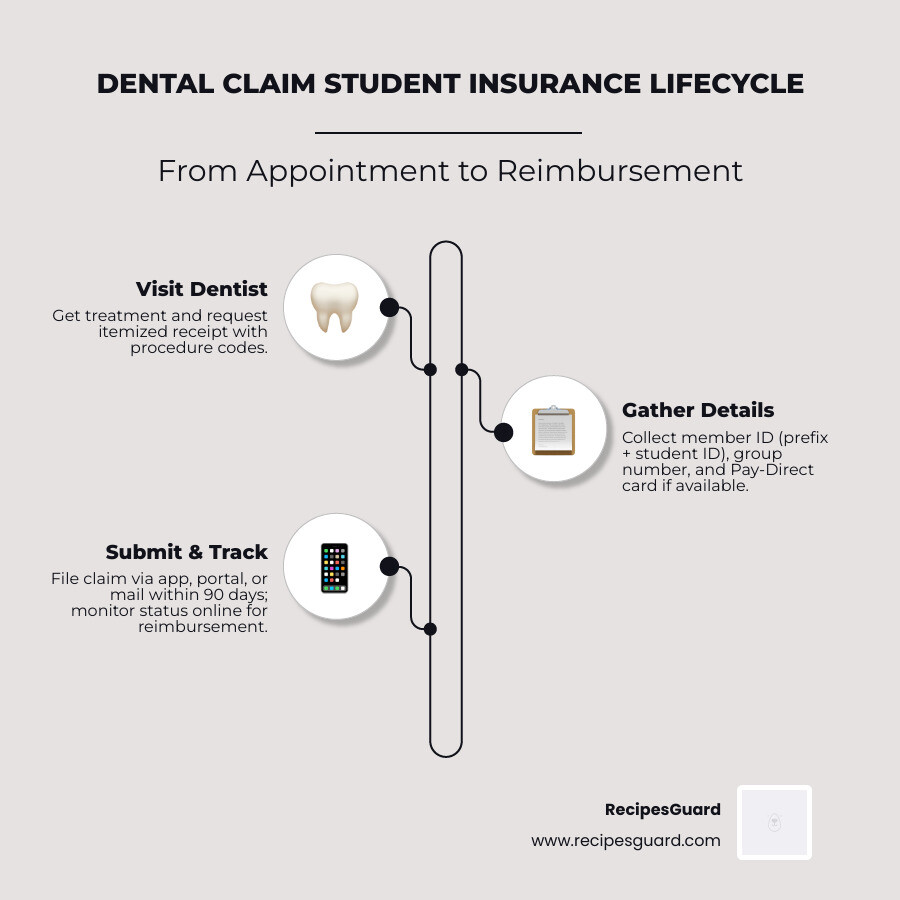
How to file a dental claim on student insurance (fast summary):
- Get your Member ID — usually a prefix (like “AMS” or “UWD”) plus your student ID number
- Collect your receipt from the dentist, including procedure codes
- Choose your submission method — Pay-Direct card, mobile app, online portal, or mail-in form
- Submit within the deadline — typically 90 days after your policy year ends
- Track your claim through your insurer’s online portal or app
Now, here’s why this matters more than most students realize.
Dental work is expensive. A single root canal can run into hundreds — sometimes thousands — of dollars without coverage. For international students studying abroad, the stakes are even higher: you may be navigating an unfamiliar insurance system, in a second language, under stress, while trying to keep up with coursework.
The good news? Most student dental plans are actually designed to be used. They cover preventive care, basic procedures, and sometimes orthodontics. The hard part is knowing how to activate those benefits before the clock runs out.
This guide walks you through everything — from understanding what your plan covers, to submitting your first claim without losing money to missed deadlines or paperwork errors.
Related content about dental claim student insurance:
- hospital stay claim process
- medical bill dispute guide
- student accident medical claim
Understanding Your Dental Claim Student Insurance Options

When we talk about dental claim student insurance, we aren’t just talking about one single plan. Depending on your age, your degree, and even your employment status at the university, you might be covered by several different safety nets.
For many undergraduate students, the first line of defense is often parental coverage. In many jurisdictions, you can remain on your parents’ dental insurance until the end of the year you turn 26. This is a fantastic “set it and forget it” option, but it has its limits—especially if you move to a different state or country for school and your parents’ network doesn’t have local providers.
If you aren’t on a parental plan, you likely have access to a school-sponsored student health and dental plan. These are often bundled into your tuition fees. For those pursuing high-level degrees, such as dental students, there are even more specialized options. Professional association insurance, like those sponsored by the ADA, often provides unique protections. For instance, dental students might be eligible for a $50,000 ADA Student Term Life Insurance benefit that automatically doubles to $100,000 on July 1 of their graduation year.
Furthermore, disability coverage for dental students can provide up to $2,000 per month for up to 7 years if an injury prevents you from completing your studies. Protecting your “career investment” is just as important as protecting your teeth. For more on this, check out Dental Insurance For Students Keeping Your Pearly Whites Protected.
Understanding Your Dental Claim Student Insurance Benefits
What does your money actually buy you? Most student plans are heavily weighted toward preventative care. It’s much cheaper for an insurer to pay for a cleaning than a crown! Many high-quality student plans, such as the Anthem BCBS plans used by major universities, offer three cleanings per plan year.
Typical coverage levels include:
- Preventative Care: Often 100% covered (cleanings, X-rays, exams).
- Basic Services: Usually 80% coverage for fillings, root canals, and extractions.
- Deductibles: Many in-network student plans offer a $0 deductible, meaning you don’t have to pay anything out of pocket before the insurance kicks in.
Understanding these tiers is vital before you sit in the chair. You can find more details in A Students Guide To Dental And Prescription Claims.
Enrollment and Opt-Out Procedures
Most universities operate on an “automatic enrollment” basis. If you are a full-time student, the premium is likely already tucked into your tuition bill. However, graduate students—particularly those with PhD stipends or teaching assistantships (TA/RA)—might have different rules. In some cases, enrollment is triggered only after a tuition waiver is processed by the university’s campus system.
If you already have private coverage (perhaps through a spouse or employer), you can usually “opt-out” or waive the school plan to save money. Be careful, though! Waiver deadlines are strict—usually occurring within the first few weeks of the semester. If you miss the “change-of-coverage” period, you’re stuck paying for the plan for the full academic year.
The Step-by-Step Guide to Filing a Dental Claim Student Insurance

Filing a dental claim student insurance doesn’t have to be a headache if you follow a system. The modern way to do this is through “Pay-Direct” cards. These are digital or physical cards you present at the dentist’s office. If the dentist is in the network, they can process the claim immediately. You only pay the “co-pay” (the portion not covered by insurance), and the insurance company pays the dentist directly.
If you have to pay upfront and seek reimbursement, here is the step-by-step:
- Identify your Member ID: This isn’t just your student number. It usually requires a prefix. For example, some plans use “UWD” for dental and “UWH” for health, followed by your student ID.
- Use the Portal or App: Most providers (like Studentcare or Aetna) have mobile apps. You can literally take a photo of your receipt and upload it.
- Check for Dependent Codes: If you are filing for a spouse or child, you’ll need a suffix (like -01 for a spouse or -02 for a child).
For a deeper dive into avoiding the paperwork blues, see Filing Your Student Emergency Dental Claim Without The Headache.
Common Deadlines for Dental Claim Student Insurance
Insurance companies love deadlines. If you miss them, they don’t have to pay. Most student dental plans operate on the academic calendar, meaning the “policy year” often ends on August 31.
You typically have a 90-day submission window after the policy year ends or after your coverage terminates to get your claims in. This means if you had a cavity filled in May 2026, you generally need to have that claim submitted by late November 2026.
Pro Tip: Keep your receipts for at least 12 months! Insurers have a “12-month audit period” where they can ask to see the original physical or digital receipt even after they’ve paid you. You can find more on timing in A Students Guide To Dental And Prescription Claims.
Navigating Blackout Periods and Processing Delays
At the start of every semester (September and January), insurance companies experience what we call a “Blackout Period.” This is a window of a few weeks where the university is still sending enrollment lists to the insurance provider.
During this time, your Pay-Direct card might be “denied” at the dentist even though you are covered. Don’t panic! You just have to pay the full amount upfront and submit a manual reimbursement claim once the blackout period ends. You can track the status of these claims through your provider’s online portal. For more on navigating these “pains in the tooth,” check out A Pain In The Tooth Navigating Student Health And Travel Claims.
Maximizing Provider Networks and Cost Savings
Choosing the right dentist is the difference between a $0 bill and a $200 bill. Most student plans use a Preferred Provider Organization (PPO) model.
| Feature | In-Network Dentist | Out-of-Network Dentist |
|---|---|---|
| Deductible | Often $0 | Often $50+ |
| Coverage Level | 80% – 100% | 50% – 60% |
| Paperwork | Dentist handles it (Pay-Direct) | You must file manually |
| Pricing | Pre-negotiated lower rates | “Reasonable and Customary” limits |
With networks like Aetna boasting over 262,000 dental practices, finding an in-network provider is usually easy. Using these networks ensures you aren’t surprised by “balance billing,” where a dentist charges more than what the insurance company considers “reasonable.” Learn more at Dental Insurance For Students Keeping Your Pearly Whites Protected.
Coordination of Benefits and Secondary Coverage
If you are lucky enough to have two plans—say, your university plan and a plan through your parents or a spouse—you can “coordinate benefits.” This allows you to claim the remaining balance from your secondary insurance after the primary insurance has paid its share.
When doing this, you’ll need to use specific dependent codes (-00 for the primary member, -01 for a spouse). Always submit to your own school plan first (as the primary) before sending the remainder to a secondary plan. This is explained further in Filing Your Student Emergency Dental Claim Without The Headache.
Orthodontics and Special Dental Needs
Thinking about getting braces or Invisalign? Be careful. Most student plans treat Invisalign as an “upgrade.” They might cover the cost of conventional metal braces (at maybe 50%), but you will be responsible for the “upgrade charge”—the price difference between the two.
For emergency dental work (like a tooth knocked out during sports), always contact your provider or Studentcare network before treatment if possible. This ensures you meet the “pre-approval” requirements for accidental dental coverage. See Brace Yourself For Your Overseas Dental Claim for more.
International Student Requirements and Post-Graduation Transitions
For international students in Australia, dental is often not included in the standard Overseas Student Health Cover (OSHC). OSHC is designed for hospital and medical “essentials.” To get dental coverage, you usually need to purchase “Extras” or “General Treatment” cover.
We always recommend checking if your university’s student union has a separate dental plan that international students can join. Keeping your OSHC and dental coverage compliant is a requirement of your visa, so don’t let it lapse!
Transitioning to Professional Coverage After Graduation
What happens when you throw the cap and gown? Most student coverage ends on August 31 of your graduation year. However, many professional plans (especially for dental students) offer a “Graduate Offer.” This allows you to convert your student policy into a professional one with no medical exams or underwriting.
As mentioned earlier, some life insurance components of student plans automatically double on July 1 of your graduation year, providing a $100,000 safety net as you enter the workforce. It’s a smooth transition that ensures you aren’t left unprotected during your first few months on the job.
Frequently Asked Questions about Student Dental Claims
What is a Pay-Direct card and how does it work?
A Pay-Direct card is a digital or physical ID that allows your dentist to bill your insurance provider directly. Instead of paying $200 for a cleaning and waiting for a check in the mail, you present the card, and the insurer pays their portion (e.g., $160) immediately. You only pay the remaining $40 at the front desk.
Can I stay on my parents’ dental insurance after I turn 26?
Generally, no. Most plans in major regions have a hard cutoff on December 31 of the year you turn 26. At that point, you’ll need to enroll in your university plan or a Marketplace plan. Turning 26 is considered a “Qualifying Life Event,” allowing you to enroll even outside of the standard open enrollment period.
What should I do if my dental claim is delayed during the blackout period?
If you are in the blackout period (usually the first 4-6 weeks of the semester), the best move is to pay the bill yourself and keep the detailed receipt. Once the university confirms your enrollment with the insurer (usually by mid-October), you can submit the claim via the mobile app for a full reimbursement.
Conclusion
At RecipesGuard, we believe that being a student is hard enough without having to worry about the cost of a toothache. Our goal is to provide student-focused claim tutorials that take the mystery out of the insurance industry. By understanding your dental claim student insurance, maximizing your in-network benefits, and keeping a close eye on those 90-day deadlines, you can protect both your financial wellness and your smile.
Don’t let your benefits go to waste. Start your claim journey today and make sure you’re getting every dollar of coverage you’re entitled to.

My name is Bianca, and my journey into the world of fermentation and food safety began with a costly mistake. I once lost an entire season’s harvest of chili peppers because I relied on guesswork instead of science. That failure was my turning point.
