
Cancer Travel Insurance Australia: Your Ticket to Peace of Mind
Cancer Travel Insurance Australia: What You Need to Know Before You Go
Cancer travel insurance Australia is something every Australian traveller with a cancer history — past or present — needs to understand before booking a trip. The good news? Having cancer does not automatically lock you out of travel insurance.
Here is a quick overview of your options:
| Your Situation | Can You Get Cover? |
|---|---|
| Cancer in remission | Yes — declare it, and you can likely get cover |
| Active cancer, stable condition | Possibly — requires medical screening |
| Currently undergoing treatment | Limited — may only get non-medical cover |
| Terminal diagnosis | Case-by-case — specialist insurers may help |
| Undiagnosed / awaiting results | No — must wait for confirmed diagnosis |
A few things stand out immediately:
- You must declare past and present cancer — even if you finished treatment years ago
- Specialist insurers in the Australian market cover a wide range of medical conditions, including cancer at all stages
- If cancer is excluded from your policy, you can still get cover for lost luggage, trip cancellation, and unrelated medical emergencies
- Around half of all Australians are estimated to develop some form of cancer by age 85 — making this one of the most common pre-existing conditions in the travel insurance market. For more information on cancer support and resources, visit Cancer Council Australia.
The challenge is knowing which policies actually protect you — and which leave you exposed.
Explore more about cancer travel insurance australia:
- australia cruise insurance
- best insurance for working holiday visa australia
- schengen visa insurance australia
Understanding Cancer Travel Insurance in Australia

When we talk about cancer travel insurance Australia, we are navigating a landscape built on risk assessment. In the eyes of an insurer, cancer is a “pre-existing medical condition.” This doesn’t mean they want to stop you from seeing the world; it means they need to understand the likelihood of you requiring medical care while you’re away.
In Australia, the relationship between you and your insurer is governed by a few key rules. First is the Duty of Disclosure. This is your legal obligation to tell the insurer anything that might influence their decision to cover you. If you’ve had cancer, you must mention it.
Second, the Disability Discrimination Act 1992 actually offers some protection. While insurers can refuse cover or charge higher premiums for cancer, they can only do so if they have actuarial data or statistical evidence to back up that decision. They can’t just say “no” because they feel like it. Many advocacy groups, such as Cancer Council Victoria, have fought for the “dignity of risk,” ensuring that travellers can still get cover for things like lost luggage or theft even if their cancer itself is excluded from medical coverage.
Defining Cancer as a Pre-existing Condition
What exactly counts as a pre-existing condition? In the Australian insurance market as of May 2026, a condition is generally defined by the presence of signs and symptoms, not just a formal name on a file.
Most insurers use a 6-month look-back period. If you’ve had symptoms, sought medical advice, or taken medication for cancer within the last six months (or sometimes longer, depending on the policy), it is pre-existing. Even if you are in remission, the history of the illness remains part of your medical record and must be disclosed to ensure the policy remains valid.
Why Disclosure is Mandatory in 2026
We cannot stress this enough: honesty is the only policy. Failing to disclose a past or current cancer diagnosis is a recipe for disaster. If you fall ill overseas and the insurer discovers an undeclared history during the claims process, they can deny your claim entirely. This doesn’t just apply to cancer-related claims; in some cases, non-disclosure can void the entire policy, leaving you unprotected for things like stolen luggage or flight cancellations.
Navigating the Medical Assessment Process
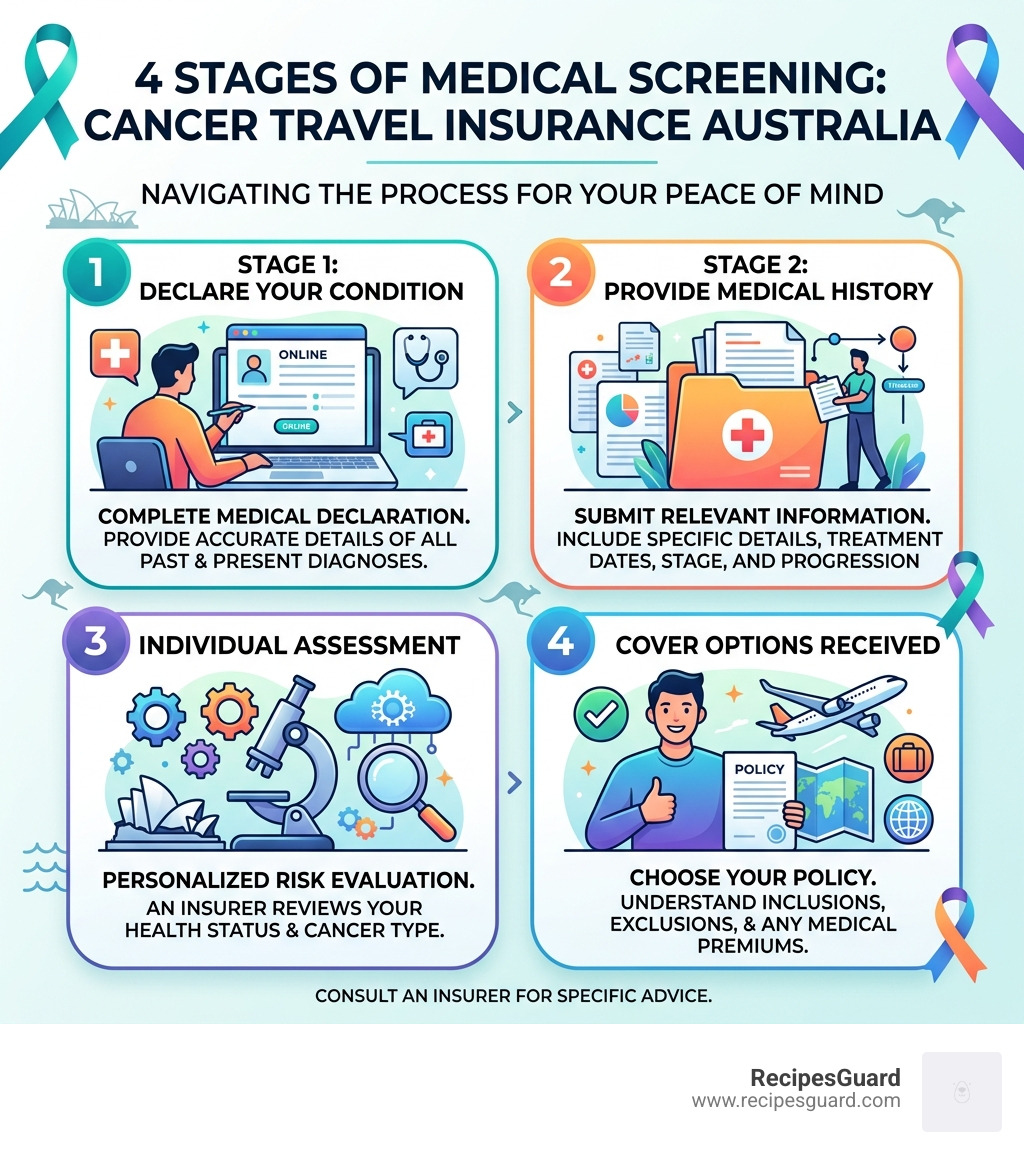
Getting a quote for cancer travel insurance Australia usually involves a medical screening. In 2026, most Australian insurers offer a streamlined online questionnaire. You’ll be asked about the type of cancer, the stage, your treatment history, and your current health status.
Outcomes of a Cancer Travel Insurance Australia Assessment
Once you complete the screening, there are typically four possible outcomes:
- Automatic Cover: Your condition is deemed low risk, and you are covered at no extra cost.
- Premium Loading: The insurer agrees to cover your cancer, but you must pay an additional fee (a “loading”) because the risk is higher.
- Specific Exclusion: The insurer provides a policy but explicitly states they will not pay for any claims related to your cancer. You are still covered for everything else (like a broken leg or lost bags).
- Full Refusal: The insurer decides the risk is too high and declines to offer any cover at all.
| Assessment Outcome | Coverage for Cancer | Coverage for Other Risks | Cost Impact |
|---|---|---|---|
| Automatic Cover | Yes | Yes | Standard Premium |
| Premium Loading | Yes | Yes | Higher Premium |
| Exclusion | No | Yes | Standard Premium |
| Refusal | No | No | N/A |
Handling a Secondary Cancer Diagnosis
If you are diagnosed with a secondary cancer or your condition changes after you’ve bought your policy but before you fly, you must notify the insurer immediately. This is a critical step. They will likely require a re-screening. While this might result in an extra premium, it ensures that your claim for hotel cancellation or medical costs will actually be honored if you can no longer travel.
What is Covered Under Cancer Travel Insurance Australia?

When you secure a policy that includes cancer cover, you aren’t just buying a piece of paper; you’re buying a safety net that can save you hundreds of thousands of dollars.
Emergency Medical Expenses
This is the core of any medical travel policy. If you require emergency surgery, hospitalisation, or medication while overseas due to your condition, the insurer covers the costs. Considering that a single night in a US hospital can cost upwards of $15,000, this is vital.
Medical Evacuation and Repatriation
If you become seriously ill and need to be flown back to Australia with medical supervision, the costs are astronomical. A specialized policy for cancer travel insurance Australia includes repatriation, ensuring you are brought home safely to the Australian healthcare system.
Cancellation and Trip Interruption
Cancer treatment is unpredictable. If a sudden change in your health means you have to cancel your trip, a policy with “Cancellation Cover” can reimburse your non-refundable flights and accommodation. This often extends to your travel companions as well, provided they are on the same policy. For those worried about their gear, you can also look into luggage insurance to protect your belongings during these interruptions.
Coverage for Non-Cancer Related Emergencies
Even if an insurer excludes your cancer, travel insurance is still worth it. You can still be covered for:
- Unrelated Medical Issues: Food poisoning, a broken wrist, or a sudden toothache.
- Theft and Loss: If your passport is stolen or your bag goes missing, the insurance helps you recover the costs.
Essential Exclusions and Limitations
No insurance policy covers everything. Understanding the “fine print” is how we stay protected.
Undiagnosed Conditions
Insurers in Australia will not cover you if you are currently “under investigation.” If you have found a lump or are waiting for biopsy results, you cannot get cover for that condition until a formal diagnosis is made. This is because insurance is designed for “unforeseen” events, and a pending diagnosis is considered a known risk.
Routine Treatment and Terminal Prognosis
Travel insurance is for emergencies, not routine care. You cannot claim for scheduled chemotherapy or radiotherapy sessions while on holiday. Furthermore, many standard insurers will not provide medical cover for those with a terminal prognosis, though specialist providers may consider these on a case-by-case basis via phone assessment.
Geographic and Age Restrictions
Some policies have strict limits. For instance, travellers aged 80 or over might be limited to a maximum trip duration of 90 days. Additionally, if the Australian Government issues a “Do Not Travel” warning for a destination, your insurance will likely be void if you choose to go there anyway.
Reciprocal Health Care Agreements (RHCA)
Australia has reciprocal agreements with 11 countries, including the UK, New Zealand, Italy, and the Netherlands. These agreements allow Australians to access the local public health system for essential treatment. While this is a fantastic safety net, it is not a replacement for travel insurance. An RHCA won’t pay for your cancelled flights, stolen bags, or medical evacuation back to Australia.
Frequently Asked Questions about Cancer Travel Insurance Australia
Can I get travel insurance if I am in remission?
Yes, absolutely. In fact, many Australians in remission find it quite easy to get cover. However, you still have a legal duty to disclose your history. Insurers often look for a “stability period”—usually 6 to 12 months without treatment—before they offer standard rates.
What happens if I need medical assistance overseas?
If you fall ill, the first step is to contact your insurer’s 24-hour emergency assistance team. They can coordinate with the hospital, guarantee payments, and even arrange for a medical escort if you need to return home. Always keep your receipts for every expense, no matter how small, to make the claim process smoother.
Is domestic travel insurance necessary for cancer patients?
While Medicare covers your medical costs within Australia, domestic travel insurance is still highly recommended. It covers the “non-medical” financial risks, such as expensive cancellation fees for flights and hotels, or lost luggage. If a flare-up happens at home and you can’t go on your Kimberley cruise, domestic insurance is what gets your money back.
Conclusion
At RecipesGuard, we believe that a cancer diagnosis shouldn’t be the end of your travel dreams. Whether you are a student heading off on a gap year or a retiree finally taking that bucket-list trip, navigating cancer travel insurance Australia is about being informed and prepared. By disclosing your history, choosing the right specialist provider, and understanding your policy’s limits, you can fly with confidence.
We specialize in helping travellers navigate the often-confusing world of insurance. From understanding how to file a claim to ensuring overseas student claims are handled correctly, we are here to support your journey every step of the way.
CTA: Get Protected with our Student Travel Insurance Guide

My name is Bianca, and my journey into the world of fermentation and food safety began with a costly mistake. I once lost an entire season’s harvest of chili peppers because I relied on guesswork instead of science. That failure was my turning point.
