
The Essential Guide to Managing Your OSHC Claims
Why Managing Your Overseas Students Health Cover Claims Matters
Overseas students health cover (OSHC) is mandatory health insurance for international students studying in Australia. It protects you from the high cost of medical care while you’re away from home.
Here’s what you need to know at a glance:
- What it covers: GP visits, hospital treatment, prescription medicines, and emergency ambulance services
- Who needs it: All international students on an Australian student visa
- When to use it: From the moment you arrive in Australia until your visa expires
- How to claim: Through your provider’s app, online portal, or by submitting receipts directly
Getting sick in a new country is stressful enough. Not knowing how to use your insurance makes it worse.
Many international students pay out of pocket for medical care — not because their policy doesn’t cover it, but because they don’t know how to file a claim. Others get claims rejected due to missing documents or misunderstood policy terms.
This guide walks you through the entire OSHC claims process, step by step, so you can get reimbursed quickly and confidently.
Simple overseas students health cover word guide:
Understanding Your Overseas Students Health Cover Benefits
Before you can master the art of the claim, you need to know what you are actually entitled to. In Australia, the Department of Home Affairs requires almost every international student to maintain overseas students health cover for the entire duration of their stay. This isn’t just a bureaucratic hurdle; it’s your safety net in a healthcare system that can otherwise be very expensive for non-residents.
According to the latest industry data, specifically the APRA Operations of Private Health Insurers Annual Report published in December 2025, the OSHC market is growing rapidly. Providers like Medibank and ahm have emerged as the largest and fastest-growing insurers in this space. This growth means more resources for students, but it also means policies are becoming more specialized.
Standard benefits across all OSHC providers generally include:
- General Practitioner (GP) Visits: Your first point of contact for non-emergency issues like the flu, minor infections, or mental health concerns.
- Hospital Treatment: Coverage for accommodation and medical services if you are admitted to a hospital.
- Prescription Medicines: Limited reimbursement for medicines listed under the Pharmaceutical Benefits Scheme (PBS).
- Ambulance Services: Most policies include unlimited emergency ambulance transport, which is vital since a single ambulance ride in Australia can cost over $1,000 out of pocket.
For a deeper dive into these basics, check out Everything You Need To Know About Overseas Student Health Insurance Cover. It is important to remember that OSHC is designed for “medical necessity.” This means it covers treatments required to keep you healthy and safe, rather than elective procedures. You can find more official details on the Overseas Student Health Cover – PrivateHealth.gov.au website.
Basic vs. Comprehensive Overseas Students Health Cover
Not all overseas students health cover plans are created equal. While every plan must meet the minimum standards set by the Australian government, many providers offer “Comprehensive” versions that provide a much wider safety net.
- Basic Plans (Essentials): These usually cover the bare minimum: GP visits, public hospital shared wards, and emergency ambulance. They are great for the budget-conscious but might leave you with higher out-of-pocket costs for specialist care.
- Comprehensive Plans: These often include “Extras” or higher benefit limits. For example, Medibank’s Comprehensive OSHC offers access to a 24/7 Student Health and Support Line and higher limits for prescription medicines.
One of the biggest differences involves waiting periods. A waiting period is the time you must hold your insurance before you can claim for certain conditions. Most OSHC policies have a 12-month waiting period for pre-existing conditions and pregnancy-related services. However, some providers like nib may recognize waiting periods served on equivalent prior covers if you switch.
For more on what’s included, see The Ultimate Guide To Oshc Whats In And Whats Out. Understanding these nuances—especially around mental health and maternity—can save you thousands of dollars later.
Managing Digital Claims for Overseas Students Health Cover
In May 2026, the days of mailing paper forms are largely behind us. Managing your overseas students health cover has gone almost entirely digital. Most major Australian providers (like ahm, Medibank, Bupa, and nib) offer dedicated mobile apps designed specifically for international students.
These apps allow you to:
- View your Digital Card: No need to wait for a plastic card in the mail; you can show your digital certificate on your phone at the clinic.
- Submit Claims Instantly: Take a photo of your receipt and upload it through the app. Some providers offer “instant reimbursement” for simple GP claims, putting money back in your account within 24 to 48 hours.
- Access Telehealth: Many plans now include 24/7 online doctor consultations (like Bupa’s Blua platform), allowing you to get a prescription or medical advice without leaving your room.
Using these tools is the smartest way to stay on top of your health. For more tips on digital management, read The Essential Guide To Oshc Coverage And Extras.
Step-by-Step Guide to Filing a Claim
Filing a claim shouldn’t feel like a math exam. We’ve broken it down into a simple process that we recommend to all our students at RecipesGuard.

There are generally two ways your medical bill gets paid:
- Direct Billing: This is the “gold standard.” You visit a doctor who belongs to your provider’s network. You show your OSHC card, and the clinic bills the insurer directly. You might only pay a small “gap fee” (the difference between what the doctor charges and what the insurance covers), or nothing at all.
- Pay and Claim: If the clinic doesn’t offer direct billing, you pay the full amount upfront, get a receipt, and then ask your insurer for the money back.
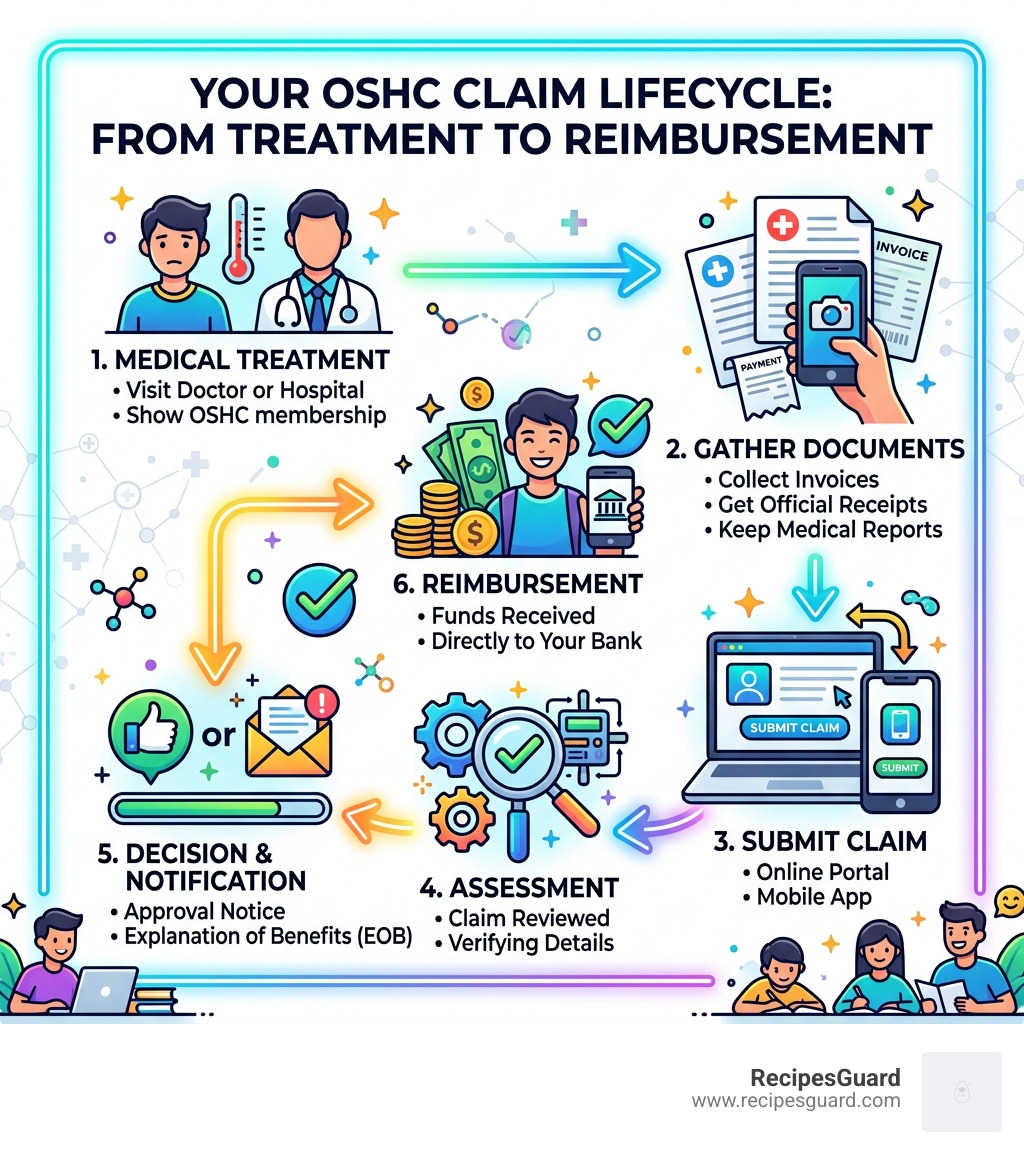
The RecipesGuard Step-by-Step Claim Process:
- Step 1: Check the Provider Network. Before you book, use your provider’s app to “find a doctor.” Choosing a network provider reduces your out-of-pocket expenses.
- Step 2: Get an Itemized Receipt. Ensure the receipt shows the “MBS Item Code” (a number that tells the insurer exactly what treatment you received), the date, and the doctor’s provider number.
- Step 3: Upload via App or Portal. Open your OSHC app, enter the amount paid, and scan the receipt.
- Step 4: Keep the Original. Don’t throw the paper receipt away! Keep it for at least 6 months in case the insurer asks for a manual verification.
If you find the process overwhelming, our guide on How To Master Oshc Insurance Australia Without Losing Your Mind offers more practical “sanity-saving” tips.
Documentation Required for Successful Claims
The number one reason claims are rejected is missing paperwork. To ensure your overseas students health cover provider pays out, you need a “claim-ready” folder (digital or physical).
Required documents usually include:
- Itemized Invoices: Showing the cost of each service separately.
- Medical Certificates: Especially if you are claiming for a condition that required you to miss class.
- Referral Letters: In Australia, you usually need a GP to write a referral before you see a specialist (like a dermatologist or cardiologist). Without this letter, your claim for the specialist visit might be denied.
- Proof of Payment: A credit card slip or a receipt marked “Paid in Full.”
- Visa Verification: Occasionally, providers may ask for a copy of your visa to confirm you are still eligible for OSHC.
For more details on costs and documentation, see The Ultimate Guide To Student Health Coverage And Costs.
Navigating Medical Services and Specialist Referrals
Understanding where to go when you’re sick is just as important as knowing how to claim. The Australian healthcare system relies heavily on General Practitioners (GPs).
| Feature | GP Clinic (General Practitioner) | Hospital Emergency Department |
|---|---|---|
| When to go | Minor illness, flu, scripts, mental health | Chest pain, severe bleeding, difficulty breathing |
| Cost | Usually low ($0-$40 gap fee) | High (but covered for emergencies) |
| Wait time | Usually requires an appointment | Based on urgency (can be several hours) |
| Referrals | Can provide referrals to specialists | Focuses on immediate stabilization |
If you have a non-life-threatening issue, always start with a GP. As noted by Study Australia, OSHC helps you access a vast network of providers. Some insurers, like Bupa, even provide a 24/7 Student Advice Line that supports 150 languages, which is incredibly helpful if English isn’t your first language and you’re trying to explain symptoms.
If you need a specialist, you must see a GP first to get a referral. This is a standard requirement for overseas students health cover reimbursement.
Frequently Asked Questions about OSHC Claims
How long do I have to submit a claim after treatment?
Most Australian OSHC providers allow you to submit a claim up to two years after the date of service. However, we recommend doing it immediately. It’s much easier to find a receipt today than it is 24 months from now! Plus, getting your money back sooner helps with your student budget.
What are the common reasons for claim rejection?
The most common reasons include:
- Waiting Periods: Trying to claim for a pre-existing condition or pregnancy within the first 12 months of cover.
- Exclusions: Claiming for services not covered by OSHC, such as cosmetic surgery, dental, or physiotherapy (unless you have “Extras” cover).
- Missing Info: Receipts that don’t have the doctor’s provider number or the correct MBS item codes.
- Expired Visa: Attempting to claim for services that occurred after your visa (and thus your cover) ended.
Can I switch providers if my claims are not being processed?
Yes! You have the right to switch your overseas students health cover provider at any time. If you find your current insurer is slow to process claims or has a confusing app, you can move to a new one. The new provider will usually honor the waiting periods you have already served, provided there is no gap in your cover. You will simply need to request a “refund” for the unused portion of your premium from your old provider.
Conclusion
At RecipesGuard, we believe that being an international student should be about exploring new cultures and excelling in your studies—not stressing over medical bills. Managing your overseas students health cover claims effectively is the key to maintaining your financial and physical well-being.
By choosing the right plan, utilizing digital tools, and keeping your documentation organized, you can ensure that you are always protected. If you’re looking for more step-by-step tutorials on navigating student insurance, we have plenty of resources to help.
Explore our other guides for more insights:
- Everything You Need To Know About Student Insurance Cover
- The International Student Guide To Staying Covered In Australia
Ready to take control of your health cover? Start Managing Your Claims Today and enjoy the peace of mind you deserve while studying in Australia.

My name is Bianca, and my journey into the world of fermentation and food safety began with a costly mistake. I once lost an entire season’s harvest of chili peppers because I relied on guesswork instead of science. That failure was my turning point.
