
Don’t Let a Trip Trip You Up: Australian College Claim Guide
Why Australia Uni Insurance Claims Catch Students Off Guard
Australia uni insurance claims are more common than most students expect — and the process can feel overwhelming when you’re already dealing with a medical emergency, a cancelled flight, or lost luggage overseas.
Here’s a quick overview of how to navigate a university insurance claim in Australia:
- Identify your policy type — OSHC (health), corporate travel, or personal accident
- Notify your insurer or university within 30 days of the incident (sooner is always better)
- Gather supporting documents — receipts, medical reports, police statements, proof of enrollment
- Submit your claim via your university’s online portal or by emailing the claims form
- Pay any applicable excess — this varies by university and claim type
- Follow up for SMS or email confirmation of your claim status
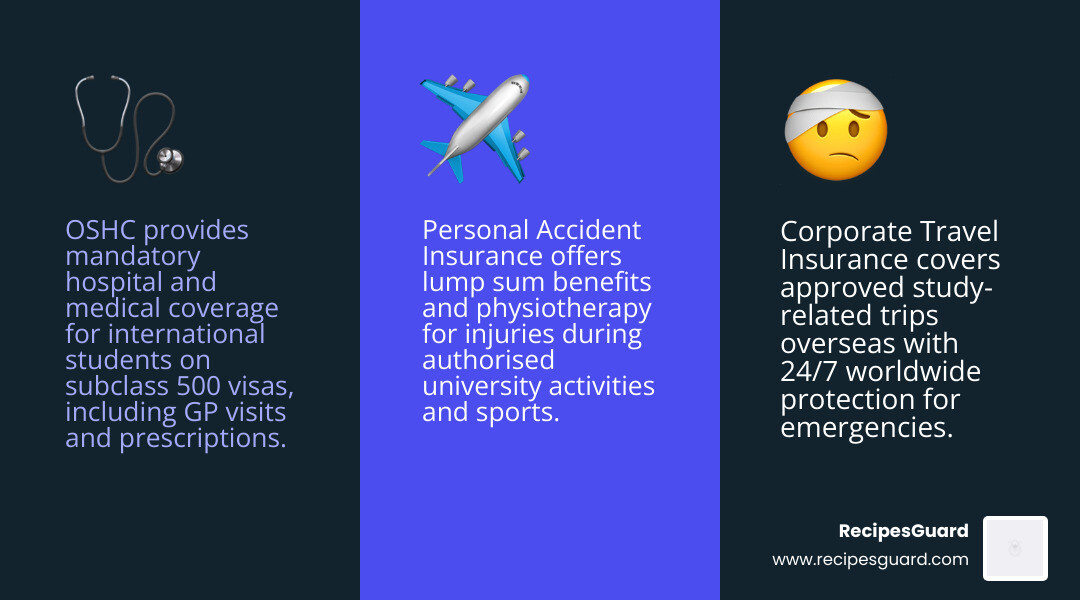
Australian universities typically provide students with three layers of insurance protection:
- OSHC — mandatory health cover for international students on a student visa (subclass 500)
- Corporate Travel Insurance — for approved, curriculum-related travel overseas
- Personal Accident Insurance — for injuries during authorised university activities, including sports clubs
Each policy has different rules, exclusions, and claim processes. What’s covered under one may not be covered under another. And if you miss a deadline or submit the wrong documents, your claim can be denied entirely.
This guide walks you through everything — clearly and step by step.
Understanding the Landscape of Australia Uni Insurance Claims
Navigating university insurance in Australia can feel like trying to find a specific book in a library with no signs. We are here to help you map it out. As of April 2026, most Australian institutions operate under a structured insurance framework designed to protect you, but only if you are engaged in “approved activities.”
The scope of coverage generally falls into three buckets: Overseas Student Health Cover (OSHC), Corporate Travel, and Personal Accident insurance. While OSHC is a government mandate for international students, the other two are often provided by the university itself to cover you during your studies.
It is vital to understand that “coverage” isn’t a blanket that follows you everywhere. Most australia uni insurance claims are tied to study-related travel or university-sanctioned events. For example, if you are attending a lecture, participating in an official internship, or representing your uni at a sports competition, you are likely covered. However, if you’re just heading to the beach for a weekend that isn’t part of a club trip, you might be on your own.
For specific details on how these policies interact, you can check the Insurance FAQs provided by major institutions. These documents clarify that while some policies offer worldwide 24/7 cover, they usually require the incident to be linked back to your status as a student or a staff member.

Mandatory OSHC vs. Australia Uni Insurance Claims
If you are in Australia on a Subclass 500 Student Visa, OSHC isn’t optional—it’s a requirement. This insurance is your primary shield for health-related issues. It covers GP visits, hospital stays, and some prescription medications.
However, OSHC and university-provided travel or accident insurance are different beasts. OSHC is for your general health while living in Australia. In contrast, australia uni insurance claims for travel or accidents often kick in for events that OSHC doesn’t touch, like emergency evacuations or non-Medicare medical expenses.
When switching providers, waiting periods from previous funds are usually recognized if you transfer within 30 days. This is a common point of confusion for students trying to manage their Personal accident insurance alongside their health cover. Always keep your transfer certificates handy!
Personal Accident and Sports Coverage in Australia Uni Insurance Claims
Injured during a heated match for your uni sports club? This is where Personal Accident insurance shines. This policy covers the university and affiliated bodies, including members of sports clubs like MU Sport.
The scope of cover is often worldwide and 24/7, provided you are on university business or traveling directly to or from an activity. One unique insight we’ve gathered is that you usually have to pay medical accounts upfront and then seek reimbursement. This policy specifically targets non-Medicare expenses—things like physiotherapy that don’t have a Medicare Benefits Schedule (MBS) item number.
For instance, the Personal Accident Details for many unis highlight that lump-sum benefits are available for permanent disabilities, and some even offer weekly income benefits if you can’t work due to your injury. If you’re active in campus life, check out the Insurance | Melbourne University Sport page to see how your specific club membership protects you.
Eligibility and Common Policy Exclusions
Who gets to claim? Generally, enrolled full-time and part-time students are eligible. But there are “red lines” you need to be aware of. The most significant exclusion involves the Department of Foreign Affairs and Trade (DFAT) travel advisories. If you travel to a country listed as Level 4 (“Do Not Travel”), your insurance is effectively void.

Common exclusions in australia uni insurance claims include:
- Pre-existing conditions: Most policies have a 12-month “lookback” period. If you received treatment or advice for a condition in the year before your trip, it likely won’t be covered unless specifically disclosed and accepted.
- High-risk sports: Thinking of skydiving? Check your PDS (Product Disclosure Statement) first. Professional sports and certain “aerial” activities are often excluded.
- Post-graduation: Once you graduate, the safety net disappears. Coverage is for current students only.
- Personal Travel: If your “study trip” is 90% vacation and 10% study, the insurer might only cover the study portion.
The ANU Policy Library – Procedure – Insurance emphasizes that failure to declare your travel or activity prior to departure can lead to an automatic exclusion. Always get your university’s written approval before you pack your bags.
Navigating COVID-19 and Travel Restrictions
In April 2026, COVID-19 is considered a “known event.” This means insurers are very specific about what they will and won’t cover.
- What’s covered: If you contract COVID-19 while overseas, most policies (like those from Chubb or Deakin) will cover your medical treatment and repatriation costs. If you catch it before you leave and have to cancel, you’re usually covered for out-of-pocket cancellation expenses.
- What’s NOT covered: Border closures, government directives to return home, or simply “feeling nervous” about traveling. Because these are now seen as foreseeable risks, insurers won’t foot the bill for flights cancelled due to government-mandated lockdowns.
Always engage with your airline first for recoupment before filing a claim.
Step-by-Step Guide to Filing Australia Uni Insurance Claims
If the unthinkable happens, don’t panic. Follow this sequence to ensure your claim isn’t rejected on a technicality.
- Notify immediately: Most universities require notification within 30 days of the incident. Some, like the University of Adelaide, are very strict about this window.
- Seek Authorization: Before the insurer pays out, your university’s insurance office usually needs to “authorize” that you were indeed on an approved activity.
- Use the Online Portal: Most providers, including Chubb, offer a self-service portal. This is the fastest way to get your claim into the system.
- Provide Payee Info: Make sure your bank details are correct. Intended payee information is a common cause of payment delays.
For a deep dive into the internal mechanics of this, the Insurance Coverage and Management of Claims Procedure at UQ provides a great example of the “chain of command” for claims.
Essential Documentation for a Successful Claim
The secret to a fast payout is the “Paper Trail.” You will need:
- Medical Reports: A written statement from a doctor confirming the illness or injury.
- Police Statements: Mandatory for any theft or loss of personal property.
- Itemized Receipts: Not just the credit card slip—the actual invoice showing what you paid for.
- Proof of Enrollment/Itinerary: To prove you were where you were supposed to be for your studies.
- Baggage Loss Acknowledgment: If an airline loses your bags, you need their written report (PIR) before the insurance will step in.
Managing Costs: Excesses, Deductibles, and Reimbursements
An “excess” is the amount you pay out of your own pocket before the insurance covers the rest. In australia uni insurance claims, these amounts can vary wildly.
| Claim Type | Typical Excess Amount | Who Pays? |
|---|---|---|
| Overseas Medical | $0 (Usually) | Insurer covers 100% |
| Non-Medical Travel | $100 – $3,000 | Student or Faculty |
| Personal Accident | $50 | Student |
| Equipment/Baggage | $100 – $250 | Student |
For example, Deakin University offers a $0 excess for medical claims but $100 for everything else. Meanwhile, the University of Sydney has a corporate excess of $3,000 for non-medical claims, though this is often charged to the faculty rather than the student.
Interestingly, while the industry average premium increase was 4.41% this year, some providers like Australian Unity kept theirs lower at 3.98%. This matters because higher premiums for the university can sometimes lead to higher excesses for the students.
Emergency Assistance and Real-World Scenarios
When you’re in a bind, you need a human on the other end of the phone. Most Australian universities partner with 24/7 assistance providers like International SOS or Chubb Assistance.
Real-World Scenario: The Luggage Limbo
If your luggage is delayed by more than 12 hours, most university policies allow you to claim for “essential emergency clothing and toiletries.” If the delay stretches past 36 hours, that limit usually increases. We recommend keeping every single receipt for that emergency toothbrush and change of clothes!
Real-World Scenario: The Flight Delay
Flight delayed by 6 hours? You might be eligible for additional accommodation expenses. If the delay hits the 30-hour mark, the benefit amount typically jumps up.
For political risks or emergency evacuations, these assistance teams coordinate directly with the university and the insurer so you don’t have to worry about the logistics while in a crisis.
Frequently Asked Questions about Uni Insurance
Can I claim for personal travel days?
Most university travel policies are generous but have limits. For example, Deakin allows up to 10 days of “incidental” leisure travel. If your holiday is longer than that, or if it isn’t “attached” to your study dates, you must purchase private travel insurance for those extra days. You are also usually covered for weekend travel within the same “Country of Assignment” where you are studying.
What happens if my claim is rejected?
Claims are usually rejected for three reasons:
- Foreseen risks: Like booking a flight with a 45-minute connection during storm season.
- Missing documentation: No police report for a stolen phone? No claim.
- Admission of liability: If you’re in a car accident and tell the other person “It’s my fault,” you might void your cover. Never admit liability; let the insurer handle it. If rejected, you can appeal the decision by providing new evidence or a written explanation to the university’s insurance office.
Does university insurance cover my laptop?
Yes, but with caveats. It falls under “personal effects.” You’ll need a theft report, and the insurer will likely pay the “depreciated value” (what it’s worth now, not what you paid three years ago). Items on loan or hired are almost always excluded. For high-value items, we suggest checking if your home and contents insurance covers them worldwide.
Conclusion
At RecipesGuard, we know that a single mishap shouldn’t derail your education. Navigating australia uni insurance claims is all about being prepared before you leave and being meticulous with your paperwork if things go wrong.
Before your next trip or sports season, do two things:
- Download your policy’s PDS and Target Market Determination.
- Ensure your travel is registered and approved in writing by your faculty.
Ready to secure your peace of mind? Start your claim journey with our detailed tutorials and ensure you’re never left out of pocket. Safe travels!

My name is Bianca, and my journey into the world of fermentation and food safety began with a costly mistake. I once lost an entire season’s harvest of chili peppers because I relied on guesswork instead of science. That failure was my turning point.
