
Gap Year Insurance: Protecting Your Education and Your Wallet
Why Every Student Traveler Needs Travel Insurance Before They Leave
Travel insurance for students is a type of policy designed to protect you financially and medically while studying or traveling abroad — covering things like emergency medical care, trip cancellations, lost baggage, and evacuation.
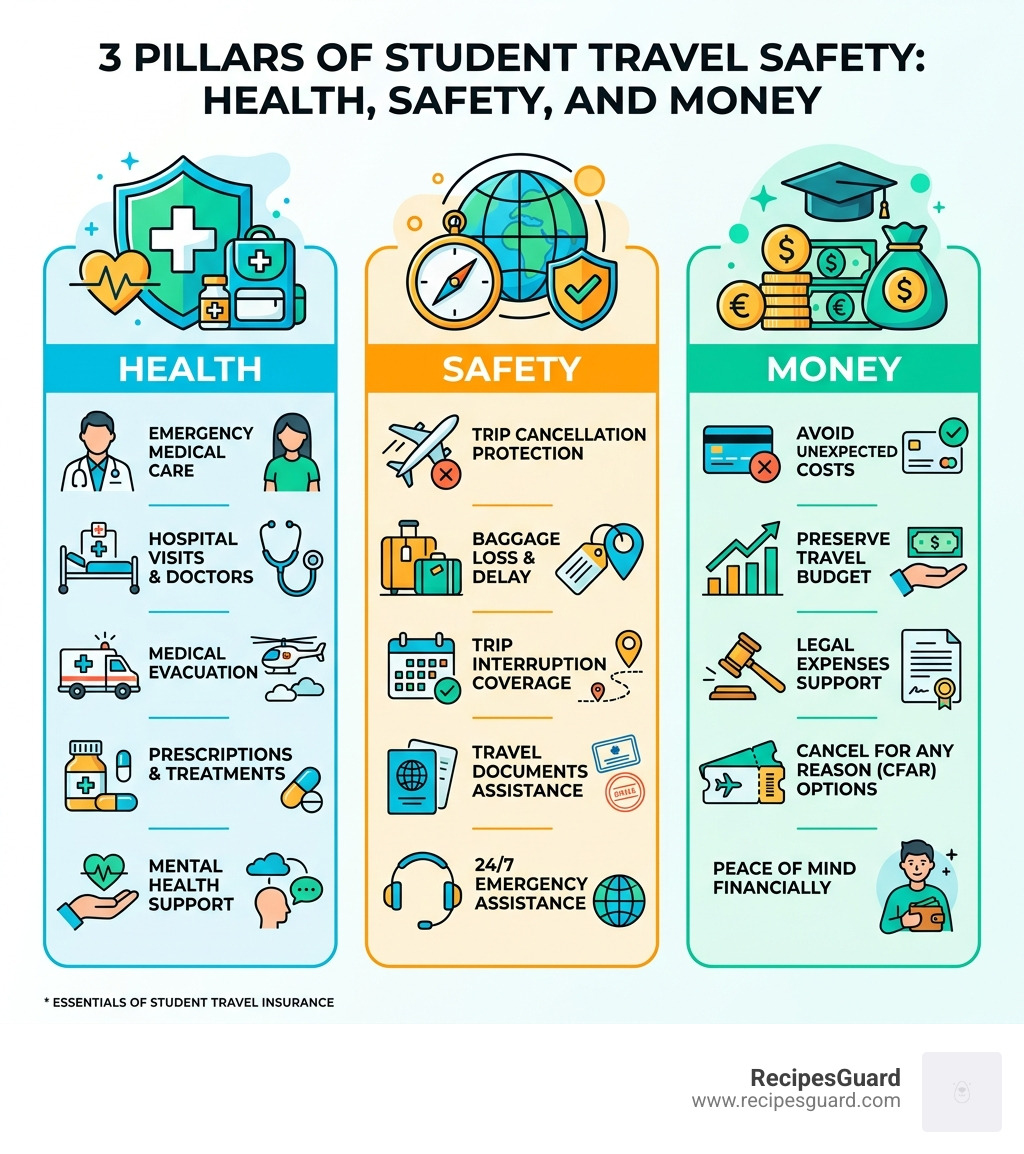
Here’s a quick snapshot of what it typically covers:
- Emergency medical expenses — hospital stays, doctor visits, surgery
- Medical evacuation — transport to a better facility or back home
- Trip cancellation or interruption — reimbursement for non-refundable costs
- Baggage delay or loss — replacing essentials when your luggage doesn’t arrive
- 24/7 emergency assistance — help with lost documents, legal referrals, and more
- Mental health support — counseling and crisis services in many plans
Plans generally cost 5–7% of your total trip cost, and some student-specific plans start as low as $29/month.
Your passport is stamped. Your classes are scheduled. Your bags are packed.
But what happens if your luggage doesn’t show up? Or you end up in a hospital in a country where you don’t speak the language?
These aren’t just worst-case scenarios — they’re situations real students face every year. And without the right coverage, a single medical emergency abroad can wipe out your entire travel budget and then some.
The tricky part is that most domestic health insurance plans offer little to no protection once you cross the border. That gap leaves students exposed at exactly the moment they’re most vulnerable — far from home, navigating unfamiliar systems, often for the first time.
Student travel insurance exists to close that gap. It’s built around three core pillars that matter most when you’re studying or traveling internationally.
Glossary for travel insurance for students:
- student trip insurance process
- student travel claim process
- trip cancellation insurance for any reason
What is Travel Insurance for Students and Why is it Essential?

When we talk about travel insurance for students, we aren’t just talking about a standard holiday policy that covers a lost camera or a delayed flight. For students, “traveling” often means living in a foreign country for months, attending lectures, and navigating a “campus-based lifestyle” far from their usual support networks.
Standard insurance is designed for the two-week tourist. Student insurance is designed for the academic adventurer. It addresses the unique risks of long-term educational stays, such as needing to return home for a family emergency or requiring medical care that allows you to continue your studies rather than just “patching you up” to fly home.
Whether you are heading off for a semester abroad, a full degree, or a gap year, Everything You Need To Know About Student Insurance Cover starts with understanding that you are protecting more than just your suitcase; you are protecting your education and your future financial stability.
Key Benefits of Travel Insurance for Students
The best plans act as a comprehensive safety net. Here is what we look for when evaluating the best student insurance for your semester abroad:
- Emergency Medical Evacuation: If you are in a remote area or a country where local facilities cannot treat your condition, this benefit covers the cost of transporting you to a facility that can—sometimes via a specialized aeromedical escort.
- Repatriation of Remains: A somber but necessary inclusion that ensures your family isn’t burdened with astronomical costs in the worst-case scenario.
- 24/7 Assistance: Imagine losing your passport in a city where you don’t speak the language. These services provide a lifeline for non-medical issues, including legal referrals and translation help.
- Mental Health Support: Moving abroad is stressful. Modern student plans often include coverage for outpatient mental health services, ensuring you can speak to a counselor if the “culture shock” becomes overwhelming.
- Dental Emergencies: This isn’t for your routine cleaning. It’s for that moment you chip a tooth playing intramural basketball or develop an agonizing infection.
- Prescription Drugs: Many plans cover a percentage of outpatient medication costs, which is vital if you require ongoing treatment for an illness contracted abroad.
How Student Plans Differ from Standard Policies
One of the biggest differences is the duration of stay. While standard policies often cap a single trip at 30 or 60 days, student policies are built for the long haul—often covering up to 365 days or even longer if renewable.
Furthermore, student plans focus on the academic context. This includes benefits like Tuition Reimbursement, which can help recoup lost fees if you are forced to withdraw from your semester due to a covered illness or injury. They are also designed to meet specific visa requirements, something a generic travel policy might fail to do. Everything You Need To Know About Student Study Abroad Insurance highlights how these plans integrate with your life as a student, rather than just as a visitor.
Navigating Visa Requirements and University Mandates
If you are heading to countries like the USA, insurance isn’t just a “good idea”—it’s a legal requirement. To obtain a J-1 or F-1 visa, you must provide proof that your insurance meets very specific standards.
Finding Your Guide To Finding Affordable International Student Insurance USA is often the first step in the visa application process. Without a “Visa Letter” or proof of coverage, your application could be stalled or denied.
Meeting J-1 and F-1 Insurance Standards
The U.S. Department of State has strict minimum limits for J-visa holders. These typically include:
- Medical benefits of at least $100,000 per accident or illness.
- Repatriation of remains in the amount of $25,000.
- Medical evacuation coverage of $50,000.
- A deductible not to exceed $500 per accident or illness.
Many students find that their university offers a plan, but it might be incredibly expensive. In many cases, you can use a private plan to “waive” the university’s insurance, provided your private plan meets or exceeds the school’s requirements. Learning How To Successfully Waive Your University Health Insurance can save you thousands of dollars over the course of your degree.
University-Sponsored vs. Private Travel Insurance for Students
Some universities provide free coverage for students traveling on “official university business,” such as field research or supervised academic trips. For example, some programs cover students traveling more than 100 miles from their home campus.
However, these plans often have limits. They might cover you for the academic portion of your trip but exclude “personal deviation”—those 14 days you spent backpacking after your research ended. When Navigating Your University Sponsored Health Insurance Plan, always check if you need to register your travel in a system to activate the coverage. If the university plan is too restrictive, a private travel insurance for students policy is the best way to ensure 24/7 protection.
Understanding Costs, Exclusions, and Plan Selection
How much should you pay? On average, expect to spend about 5% to 7% of your total trip cost. If your semester costs $10,000, $500–$700 for peace of mind is a sensible investment.

When choosing a plan, you’ll often see tiers like “Budget” versus “Elite.”
| Feature | Budget Plan | Elite Plan |
|---|---|---|
| Overall Maximum | Up to $500,000 | Up to $5,000,000 |
| Deductible | Often $0 – $100 | $0 |
| Maternity | Limited or None | Included (if pregnancy starts after effective date) |
| Mental Health | Basic Outpatient | Comprehensive Inpatient/Outpatient |
| Sports Coverage | Leisure only | Organized/Intercollegiate included |
Factors that affect your premium include your age (under 45 is usually the cheapest bracket), your destination (the USA is typically more expensive due to healthcare costs), and the length of your stay. For more details, see The Ultimate Guide To Student Health Coverage And Costs.
Common Exclusions to Watch For
No insurance covers everything. We’ve seen many students get caught out by “the fine print.” Common exclusions include:
- Pre-existing Conditions: Unless you buy your policy within a specific window (usually 14–21 days) of your first trip payment, conditions you already have may not be covered.
- Alcohol and Drugs: If an accident happens while you are under the influence, most insurers will deny the claim.
- Routine Care: Travel insurance is for emergencies. It won’t cover your annual check-up or routine vaccinations.
- High-Risk Activities: Standard plans often exclude skydiving, bungee jumping, or technical mountain climbing.
For our Australian readers, A Student Guide To Australian Insurance Claims And Visa Medicals provides a deep dive into how these exclusions work in the local context.
Coverage for Adventure Sports and Extra Activities
If your gap year involves more adrenaline than a library can provide, you’ll need “riders” or add-ons.
- Moped/Motorcycle Riding: In places like Southeast Asia, this is common. However, most insurers only cover you if you wear a helmet, hold a valid license in your home country, and the engine is under a certain capacity (often 250cc).
- Snow Sports: Skiing and snowboarding usually require an extra premium.
- Adventure Riders: If you’re planning on scuba diving or trekking at high altitudes, check your policy’s altitude limits.
Don’t guess—How To Pick The Best Insurance For Your Aussie Working Holiday can help you match your activities to the right level of cover.
How to Handle Emergencies and File Claims Abroad
In a medical emergency, your first call shouldn’t be to your parents—it should be to your insurance provider’s 24/7 hotline. Why? Because they can monitor your care, speak to doctors in their native language, and assess whether you need to be moved to a better hospital.
If you are hospitalized, the insurance company often issues a “Letter of Guarantee” to the hospital, which means you won’t have to pay thousands of dollars upfront. How To Secure Student Trip Insurance Without The Headache emphasizes the importance of having your policy number and the emergency contact saved in your phone before you even board the plane.
Step-by-Step Guide to Filing a Claim
At RecipesGuard, our specialty is making the claim process less of a nightmare. If you need to file a claim for baggage loss or a smaller medical bill you paid out of pocket, follow these steps:
- Gather Documentation: You need proof. This means medical reports, itemised receipts, and—in the case of theft—a police report filed within 24 hours.
- Use the Online Portal: Most modern insurers allow you to upload photos of your documents directly through an app or website.
- Keep Originals: Don’t throw away those paper receipts until the money is in your bank account!
- Follow Up: If you haven’t heard back in a few weeks, don’t be afraid to call.
For a more detailed breakdown, check out The International Student Guide To Not Going Broke Abroad.
Frequently Asked Questions about Travel Insurance for Students
Can I buy insurance if I have already departed?
In most cases, no. Most providers require you to purchase the policy before you leave your home country. However, some specialized plans allow for “already traveling” coverage, though these often have a waiting period before they become active.
Does student insurance cover my laptop and textbooks?
Most comprehensive plans include baggage and personal effects coverage, but there are “per-item” limits (often $500–$1,000). If you are carrying a high-end MacBook and expensive textbooks, you might need to list them as “specified items” and pay an extra premium to cover their full value.
Are mental health services included in most plans?
While not universal, many student-specific plans now recognize the importance of mental health. Look for plans that offer outpatient counseling. Pre-existing mental health conditions are often excluded unless the policy has a specific waiver.
Conclusion
Studying abroad or taking a gap year is a life-changing experience. It’s about growth, independence, and exploration. But true independence means being prepared for the unexpected. By securing the right travel insurance for students, you aren’t just buying a piece of paper; you’re buying the freedom to focus on your exams and your adventures without the constant fear of a financial catastrophe.
Whether you’re navigating the complexities of The International Student Guide To Staying Covered In Australia or heading to the cobblestone streets of Europe, keep your health and your wallet protected.
For more expert advice and step-by-step tutorials on navigating insurance, visit RecipesGuard. Safe travels!

My name is Bianca, and my journey into the world of fermentation and food safety began with a costly mistake. I once lost an entire season’s harvest of chili peppers because I relied on guesswork instead of science. That failure was my turning point.
