
Navigating Your University Sponsored Health Insurance Plan
What You Need to Know About University Insurance Coverage
University insurance coverage refers to the range of insurance protections that colleges and universities provide for their students, faculty, staff, and institutional assets.
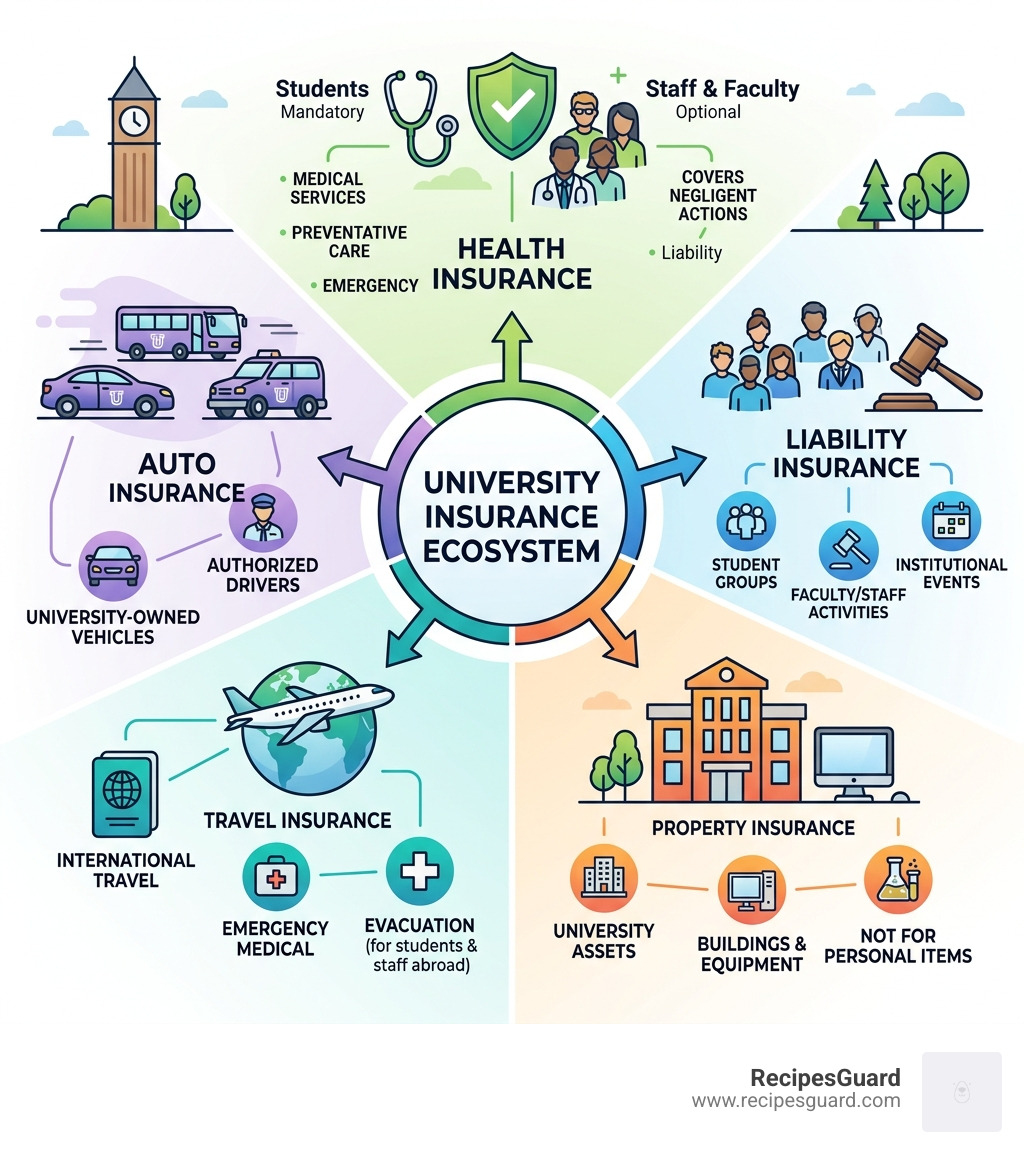
Here is a quick overview of what is typically covered:
| Coverage Type | Who It Protects | Key Details |
|---|---|---|
| Student Health Insurance | Students | Mandatory for most; international students usually cannot opt out |
| General Liability | Students, staff, faculty | Covers negligence during official university activities |
| Property Insurance | University-owned assets | Buildings, equipment, computers; personal property is usually excluded |
| Automobile Insurance | Authorized drivers | Covers university-owned vehicles; personal vehicles get excess coverage only |
| International Travel Insurance | Students and staff traveling abroad | Emergency medical, evacuation, trip cancellation |
| Professional Liability | Faculty and healthcare students | Errors, omissions, and malpractice |
If you are an international student studying abroad, the most important thing to know right now is this: your university’s insurance likely does not cover your personal belongings, and you may be required to enroll in a specific health plan with no opt-out option.
Starting college or arriving in a new country is already overwhelming. Add a medical emergency, a stolen laptop, or a cancelled flight — and suddenly you are trying to decode insurance documents in a system you have never used before.
University insurance programs are complex. They cover a lot — general liability, property, vehicles, travel, and professional errors — but they also leave significant gaps, especially for international students.
For example, at the University of Miami, the 2025-2026 student health plan costs $4,230 per year, with a $300 in-network deductible and an out-of-pocket maximum of $5,500. That is real money. And if you do not understand what is covered before something goes wrong, you could end up paying far more than you expected.
This guide breaks down every major type of university insurance coverage — what it includes, what it does not, and what you need to do to protect yourself.
Key terms for university insurance coverage:
- low cost student health insurance
- student dental coverage
- waiving medical coverage
Understanding the Scope of University Insurance Coverage

When we talk about university insurance coverage, we are looking at a massive safety net designed primarily to protect the institution’s mission and assets. In April 2026, these policies are more robust than ever, but they are still largely focused on institutional risk rather than individual convenience.
Most universities operate a “Risk Management Office” that manages a portfolio of insurance types. These include fiduciary liability (protecting those who manage university funds), general liability, and property protection. For faculty and staff, this often extends to errors and omissions insurance, which provides legal counsel if they are sued for actions taken in the good faith performance of their duties.
As we see in the UD Policies | University Insurance Coverage | University of Delaware, the university acts as a central hub for purchasing these policies. Individual departments aren’t allowed to go rogue and buy their own insurance; everything is centralized to keep costs down and ensure the school isn’t left vulnerable. Similarly, General University Insurance Protection | Risk Management | The University of Vermont highlights that while the university protects its employees against civil actions related to their jobs, this protection stops the moment you step outside your official duties.
Liability and Property Protections for Students
As a student, you are generally protected by the university’s general liability insurance when you are participating in official university business or authorized educational programs. This means if you accidentally damage a lab or cause an injury while performing a required task, the university’s policy may cover the legal and medical costs.
However, there is a massive “but” here. The Policy | Property and Liability Insurance from the University of Minnesota makes it clear: the university’s property insurance covers university-owned buildings and equipment—not your stuff. If a pipe bursts in your dorm and ruins your $2,000 gaming laptop, the university’s insurance will likely pay to fix the floor and the walls, but you’ll be on the hook for the computer.
University Insurance Coverage for Vehicles and Travel
Driving for university business—whether you’re a student leader heading to a conference or a grad student doing field research—comes with specific rules. If you are driving a university-owned vehicle, you are typically covered by the school’s auto liability policy. At the University of Delaware, for instance, there is a $500 deductible for physical damage to university vehicles, which is usually charged back to the responsible department.
When it comes to using your personal vehicle, things get tricky. The UVA Policy explains that your personal insurance is always “primary.” This means if you get into an accident while driving your own car for a university errand, your own insurance pays first. The university’s insurance only kicks in as “excess coverage” after your personal limits are completely exhausted. Furthermore, the university will almost never pay for physical damage to your own car.
Deep Dive into Student Health Insurance Plans

For most of us, the most visible part of university insurance coverage is the Student Health Insurance Plan (SHIP). By April 2026, nearly every major institution requires students to have “adequate coverage.”
The enrollment process is usually “passive,” meaning you are automatically enrolled and billed for the plan unless you proactively submit a waiver. To successfully waive the plan, you must prove that your existing insurance meets the university’s strict criteria. As noted in the Student Insurance < The University of Texas at Austin, the university plan often pays 100% for services at on-campus health centers, which is a huge perk for students living on campus.
Costs, Deductibles, and Out-of-Pocket Maximums
Understanding the math behind your health plan is the best way to avoid “sticker shock” at the doctor’s office. Using the University of Miami’s 2025-2026 data as a benchmark, we can see the typical financial structure of these plans.
| Feature | In-Network Cost (2025-2026) | Out-of-Network Cost (2025-2026) |
|---|---|---|
| Annual Premium | $4,230 | $4,230 |
| Annual Deductible | $300 | $750 |
| Out-of-Pocket Max | $5,500 | $6,000 |
| Primary Care Copay | $40 | Co-insurance applies |
| Emergency Room Copay | $200 | $200 |

A “deductible” is the amount you pay out of your own pocket before the insurance company starts chipping in. The “out-of-pocket maximum” is your safety net; once you’ve spent that amount in a year, the insurance company pays 100% of your covered medical bills.
Domestic vs. International University Insurance Coverage Requirements
If you are a domestic student, you usually have the flexibility to stay on your parents’ plan until you are 26. However, if you are an international student, your options are much narrower.
Most universities mandate that international students enroll in the school-sponsored plan. This isn’t just a university rule; it’s often tied to visa requirements. In Australia, this is known as Overseas Student Health Cover (OSHC). According to Overseas Student Health Cover (OSHC) – Study Australia, having this coverage is a condition of your student visa. You can compare different providers at Compare Overseas Student Health Cover (OSHC) – Study in Australia or look into specific providers like Overseas Student Health Cover | Allianz Care Australia.
Specialized Coverage: International Travel and Study Abroad
One of the best parts of the university experience is the chance to see the world. But traveling as a student requires more than just a passport; it requires specialized university insurance coverage.
Many universities, like Purdue, offer international travel insurance for students and volunteers starting as low as $32.00 for short trips. This isn’t just standard health insurance; it includes critical services like emergency medical evacuation (which can cost $100,000+ without insurance) and trip interruption coverage. The Office of Risk Management at Purdue emphasizes that students must often register their travel in advance to be covered by these policies.
Managing Risks During University-Sanctioned Events
Whether it’s a fireworks display for homecoming or a weekend field trip to a national park, special events carry unique risks. Universities often require a 45-day notice to arrange “Special Event Coverage” for activities that fall outside of normal classroom learning.
This coverage is vital for student organizations. If your club hosts a concert and someone gets hurt, the university’s general liability policy might not automatically cover the club unless specific event insurance was secured. This also extends to intercollegiate sports, where specialized accident insurance covers student-athletes for injuries sustained during games or practices.
How to Report Losses and File Insurance Claims
When something goes wrong, the clock starts ticking immediately. Most universities have a “24-hour reporting rule.” This means if you are involved in an accident or discover property damage, you must notify the Risk Management Office within one business day.
At RecipesGuard, we have seen many students lose out on reimbursements simply because they waited too long to file. To keep your claim on track, follow this checklist:
- Report to Authorities: If it’s a crime (theft) or a car accident on a public road, call the police first.
- Notify the University: Contact your department head and the Risk Management Office.
- Document Everything: Take photos of the damage, keep receipts for any emergency repairs, and save all medical bills.
- Complete the Forms: Most schools have specific forms (like the RM30 for general liability or the Automobile Loss Notice).
Navigating the Claims Process for Personal Property
Since universities generally do not cover personal property, you will likely be filing a claim through your own renters or homeowners insurance. However, if the loss happened on campus, the university will still want a report.
For theft claims, the university and your private insurer will require a police report. If you are claiming a lost item, having “proof of purchase” is essential. We recommend keeping a digital folder with receipts or photos of serial numbers for high-value items like laptops, cameras, and tablets. If an item is “uninventoried” (meaning the university doesn’t have a record of it), your personal proof of purchase is the only way to prove you owned it.
Frequently Asked Questions about University Insurance
Can I waive the university health plan if I have my own insurance?
Yes, domestic students can typically waive the plan if their current insurance provides “comparable coverage.” This usually means your plan must have a local network of doctors near the campus and meet the minimum benefit requirements of the Affordable Care Act. Be sure to check your university’s April 2026 deadlines, as missing the waiver window means you’ll be stuck paying the premium for the full semester.
Does the university cover my laptop if it is stolen from my dorm?
Almost certainly not. As we’ve seen in the policies of UVA, Delaware, and Vermont, the university assumes no responsibility for personal property. Your laptop, clothes, and bike are your responsibility. We strongly recommend students look into renters insurance, which is often very affordable and provides the protection the university doesn’t.
What is the difference between self-insurance and commercial plans?
Self-insurance means the university (or the state) sets aside its own money to pay for claims instead of buying a policy from a private company. This is common for large institutions like the University of Virginia. Commercial plans are traditional policies bought from companies like Aetna or UnitedHealthcare. For you, the main difference is often the deductible structure—self-insured programs may have specific “departmental deductibles” that could affect how quickly a claim is processed.
Conclusion
Navigating university insurance coverage doesn’t have to be a headache. While the system is designed to protect the university first, understanding how to work within that system can save you thousands of dollars and a lot of stress.
Remember the golden rules:
- Check the gaps: Assume your personal property isn’t covered.
- Watch the clock: Report every incident within 24 hours.
- Keep the receipts: Documentation is the lifeblood of a successful claim.
At RecipesGuard, we are dedicated to helping students navigate these complex waters. If you are preparing for a semester abroad or just trying to make sense of your campus health plan, our step-by-step claim filing tutorials are here to guide you. Don’t let a paperwork error ruin your academic journey.
Secure your student travel future and stay protected!

My name is Bianca, and my journey into the world of fermentation and food safety began with a costly mistake. I once lost an entire season’s harvest of chili peppers because I relied on guesswork instead of science. That failure was my turning point.
