
Why Holiday Cancellation Protection Can Save Your Trip Investment
Holiday cancellation protection is travel insurance coverage that reimburses your prepaid, non-refundable trip costs if you need to cancel before you depart.
Here’s a quick overview of your main options:
| Coverage Type | Reimburses | Covered Reasons | Typical Cost |
|---|---|---|---|
| Standard Trip Cancellation | Up to 100% | Specific reasons only (illness, death, disaster) | 5%–10% of trip cost |
| Cancel for Any Reason (CFAR) | 50%–75% | Any reason at all | Adds ~40%–50% to base premium |
| Enhanced Cancellation | Up to 80% | Almost any unforeseeable reason | Varies by plan |
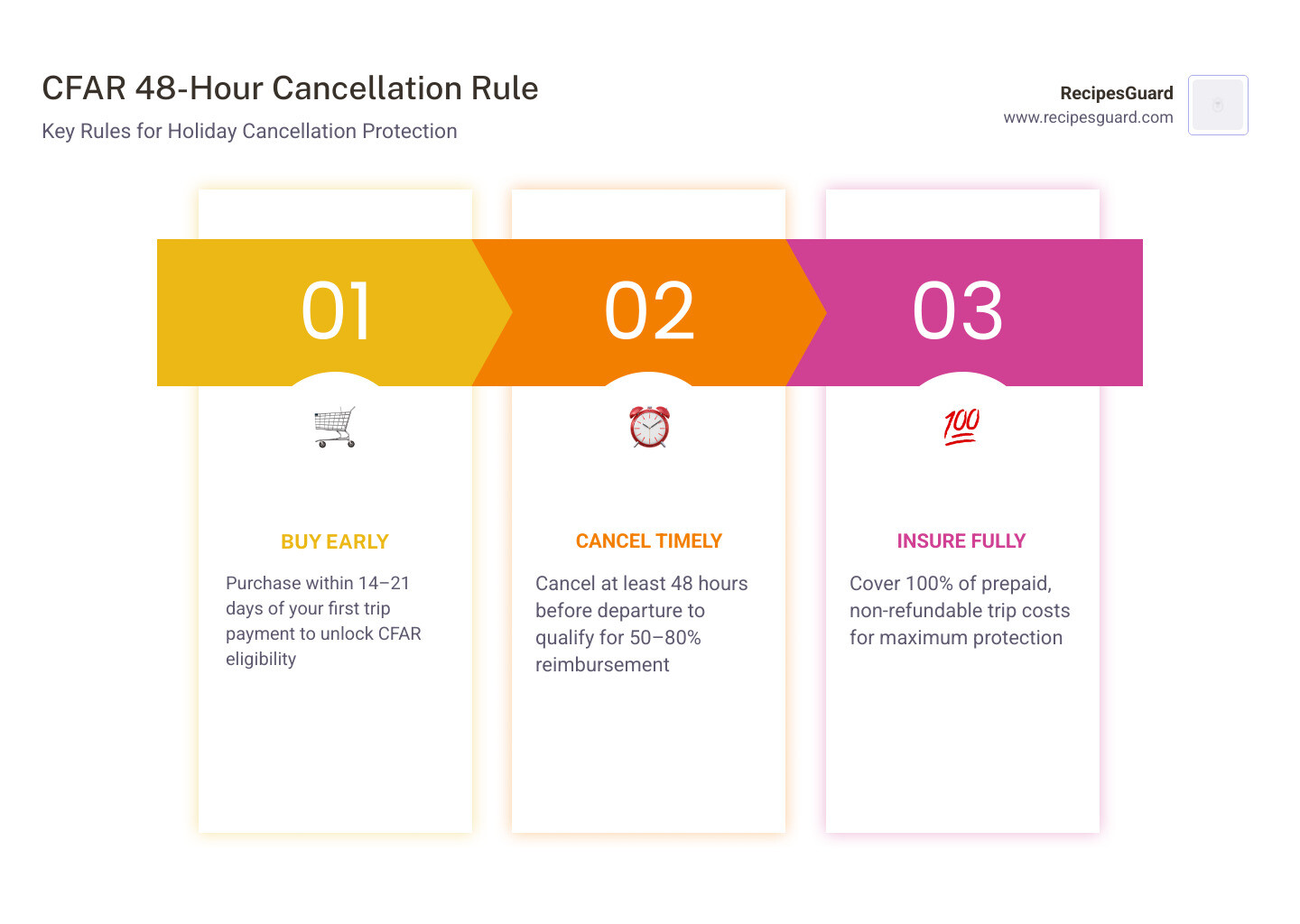
Key rules to know upfront:
- Buy within 14–21 days of your first trip payment to unlock CFAR
- Cancel at least 48 hours before departure to qualify for a CFAR payout
- Insure 100% of your prepaid, non-refundable costs to be eligible
You’ve saved up, paid a deposit, and booked everything. Then life happens.
Maybe a family emergency comes up. Maybe your travel companion can’t make it. Maybe you’re an international student who just got hit with a rescheduled exam right before your flight.
Whatever the reason, if you’ve already paid non-refundable deposits, you could lose hundreds — or thousands — of dollars without the right protection in place.
About 11% of travel insurance plans now include Cancel for Any Reason coverage, according to industry data. That means most travelers are still exposed. And comprehensive travel insurance typically costs just 5% to 10% of your total trip cost — a small price compared to losing your entire holiday budget. According to the Australian Government’s Smartraveller website, travel insurance is as essential as a passport.
The good news: getting protected is straightforward, if you act early enough.
Holiday cancellation protection helpful reading:
Understanding the Basics of Holiday Cancellation Protection
When we talk about holiday cancellation protection, we are looking at the financial safety net that catches you if your trip falls through before you even leave home. It’s the difference between losing your shirt on a non-refundable booking and getting most of your money back to try again later.

In Australia, we often book our big overseas holidays or domestic getaways months in advance. Whether it’s a beach house in Queensland or a flight to Europe, those prepaid expenses add up fast. Most of these bookings come with “non-refundable” clauses in fine print.
Standard holiday cancellation protection typically kicks in for specific “covered reasons.” These usually include things like:
- You or a family member getting seriously ill or injured.
- A natural disaster making your destination uninhabitable.
- Being called for jury duty or being made redundant from work.
However, many travelers find these reasons too restrictive. That is why understanding How Trip Cancellation Interruption Saves Your Vacation is vital. It’s not just about the “big” disasters; it’s about protecting every dollar you’ve invested in your peace of mind.
CFAR vs. Standard Coverage: Choosing Your Safety Net
If you want the ultimate level of flexibility, you need to look at “Cancel for Any Reason” (CFAR). While standard coverage is great for medical emergencies, CFAR is for everything else—including just changing your mind.
Standard trip cancellation usually reimburses 100% of your costs, but only for those listed “covered reasons.” CFAR, on the other hand, usually reimburses between 50% and 75% of your non-refundable costs, but it lets you walk away from a trip for reasons like:
- You and your travel companion had a massive falling out.
- You’re worried about political unrest or a predicted storm that hasn’t hit yet.
- You simply don’t feel like going anymore.
| Feature | Standard Cancellation | Cancel for Any Reason (CFAR) |
|---|---|---|
| Reimbursement | Up to 100% | 50% to 75% (typically) |
| Covered Reasons | Specific (illness, death, etc.) | Literally any reason |
| Purchase Window | Up to the day before travel | 14–21 days after first deposit |
| Cancellation Deadline | Up to departure | 48–72 hours before departure |
Choosing between the two depends on your risk tolerance. If you are booking a high-value cruise or a complex itinerary, the CFAR upgrade is often the smartest move. For more on this, check out our guide on Cfar Travel Insurance Because Life Happens And Plans Change.
Why Students Need Holiday Cancellation Protection
At RecipesGuard, we focus heavily on the student experience because we know your travel needs are unique. Students often travel on tight budgets where losing a $1,500 flight deposit isn’t just a bummer—it’s a financial catastrophe.
Holiday cancellation protection is essential for students for several reasons:
- Exam Rescheduling: You book a trip for the end of the semester, but a professor moves a final exam or you’re required to sit a supplementary test. Standard policies won’t cover this, but a CFAR policy or a student-specific plan might.
- Study Abroad Changes: If your university cancels a study abroad program at the last minute, you need a way to recover your flight and housing costs.
- Budget Constraints: Students can’t afford to “self-insure.” Paying a small premium upfront is much safer than risking the entire cost of the holiday.
We recommend checking out The Student Guide To Getting Your Money Back After A Cancelled Trip for tailored advice on navigating these academic hurdles.
Maximizing Your Holiday Cancellation Protection Benefits
To get the most out of your policy, you have to play by the rules. The most common reason claims are denied isn’t because the reason wasn’t valid—it’s because the paperwork was missing or the notification was late.
To maximize your benefits:
- Keep every receipt: From the initial deposit to the final payment for that niche walking tour.
- Notify suppliers immediately: As soon as you know you can’t go, tell the airline, the hotel, and the tour operator. You need proof that you attempted to get a refund from them first.
- Document everything: If you’re canceling for a medical reason, get a doctor’s note that specifically states you are “unfit to travel.”
Following a Step By Step Guide How To Successfully Claim Your Trip Cancellation Refund can ensure you don’t miss a single detail that could jeopardize your payout.
The Critical Timeline: When to Buy and When to Cancel
Timing is everything when it comes to holiday cancellation protection. You can’t wait until you’re worried about a situation to buy the insurance; by then, it’s usually too late.

- The 14–21 Day Rule: For CFAR and many pre-existing condition waivers, you must purchase your policy within 14 to 21 days of making your very first trip payment (even if it was just a small deposit).
- The 48-Hour Rule: Most CFAR policies require you to cancel your trip at least 48 to 72 hours before your scheduled departure. If you try to cancel the morning of your flight because you have a “bad feeling,” you likely won’t be covered under CFAR.
- The 30-Day Rule for Upgrades: Some premium plans require the trip to be at least 30 days away at the time of purchase to include certain enhanced cancellation upgrades.
Waiting too long is the fastest way to find yourself in a Non Refundable Nightmare.
Step-by-Step: Filing a Claim Without the Stress
Filing a claim shouldn’t feel like a second job. At RecipesGuard, we specialize in making this process as smooth as possible for students and travelers across Australia.
Step 1: Cancel with your providers. Contact your airline, hotel, or tour operator. Ask for a written confirmation of the cancellation and a statement showing any “unused, non-refundable” amounts.
Step 2: Gather your “Proof of Payment.” The insurance company needs to see that you actually paid the money you’re claiming. Bank statements or credit card receipts are usually required.
Step 3: Complete the Claim Form. Be honest and detailed. If you’re using holiday cancellation protection for a hotel, see our specific guide on how to Claim For Hotel Cancellation And Get Your Deposit Back.
Step 4: Submit and Follow Up. Most providers in 2026 offer online portals. Use them! It’s faster and creates a digital paper trail. If you’re worried about the specific nuances of hotel bookings, read up on How To Not Lose Your Deposit With Hotel Cancelation Insurance.
Cost-Benefit Analysis: Is the Upgrade Worth the Premium?
Is CFAR worth the extra cash? Let’s look at the numbers.
A standard comprehensive policy usually costs 5% to 10% of your trip. Adding CFAR typically increases that base premium by 40% to 50%.
For example, if you have a $5,000 trip:
- Base Premium: $350
- CFAR Upgrade: +$150
- Total Cost: $500
If you cancel for a non-covered reason with a 75% CFAR benefit, you get back $3,750. Without it, you get back $0. For most people, spending an extra $150 to protect $3,750 is a no-brainer, especially for once-in-a-lifetime trips like a luxury cruise or an overseas graduation tour.
However, if your trip is mostly refundable (e.g., you booked “Free Cancellation” hotel rooms and used points for flights), the upgrade might not be necessary. Always weigh the “non-refundable” portion of your trip against the premium cost. For medical-specific concerns, refer to A Travelers Guide To Canceling Trips For Medical Reasons.
Frequently Asked Questions about Holiday Cancellation
Can I add CFAR to my policy after I have already paid for my trip?
Generally, no. CFAR is a time-sensitive benefit. Most providers require you to add it within 14 to 21 days of your initial deposit. If you’ve already paid off your entire trip and months have passed, you likely won’t be able to add “Cancel for Any Reason” coverage, though you can still buy standard trip cancellation.
Does holiday cancellation protection cover flights booked with frequent flyer points?
This is a tricky one. Standard policies usually do not reimburse the “value” of the points. They may, however, reimburse the cash fees and taxes you paid, or the “redeposit fee” charged by the airline to put the points back into your account. Always check the specific wording regarding “Frequent Traveler Awards.”
What is the difference between trip interruption and trip cancellation?
- Trip Cancellation happens before you leave. It covers you if you never make it to the airport.
- Trip Interruption happens during your trip. It covers you if you have to come home early or if you miss part of your holiday due to a covered event.
Conclusion
Navigating holiday cancellation protection doesn’t have to be overwhelming. Whether you are a student heading off on a gap year or a family planning a long-awaited getaway, the key is to act fast.
At RecipesGuard, we are dedicated to helping you protect your travel investments with student-focused advice and step-by-step claim tutorials. We believe that every traveler deserves a safety net that actually works when they need it most.
Don’t let a change of plans turn into a financial disaster. Secure your protection today, and then get back to the fun part—planning your next adventure!
For more expert advice and claim filing guides, visit us at https://www.recipesguard.com/.

My name is Bianca, and my journey into the world of fermentation and food safety began with a costly mistake. I once lost an entire season’s harvest of chili peppers because I relied on guesswork instead of science. That failure was my turning point.
