
The easiest visa student claim tutorial you will ever read
Why Every International Student Needs an Insurance Claim Tutorial
Insurance claim tutorial students is one of the most searched phrases by international students facing a medical bill, stolen laptop, or cancelled flight — and not knowing what to do next.
Here is a quick answer if you need it right now:
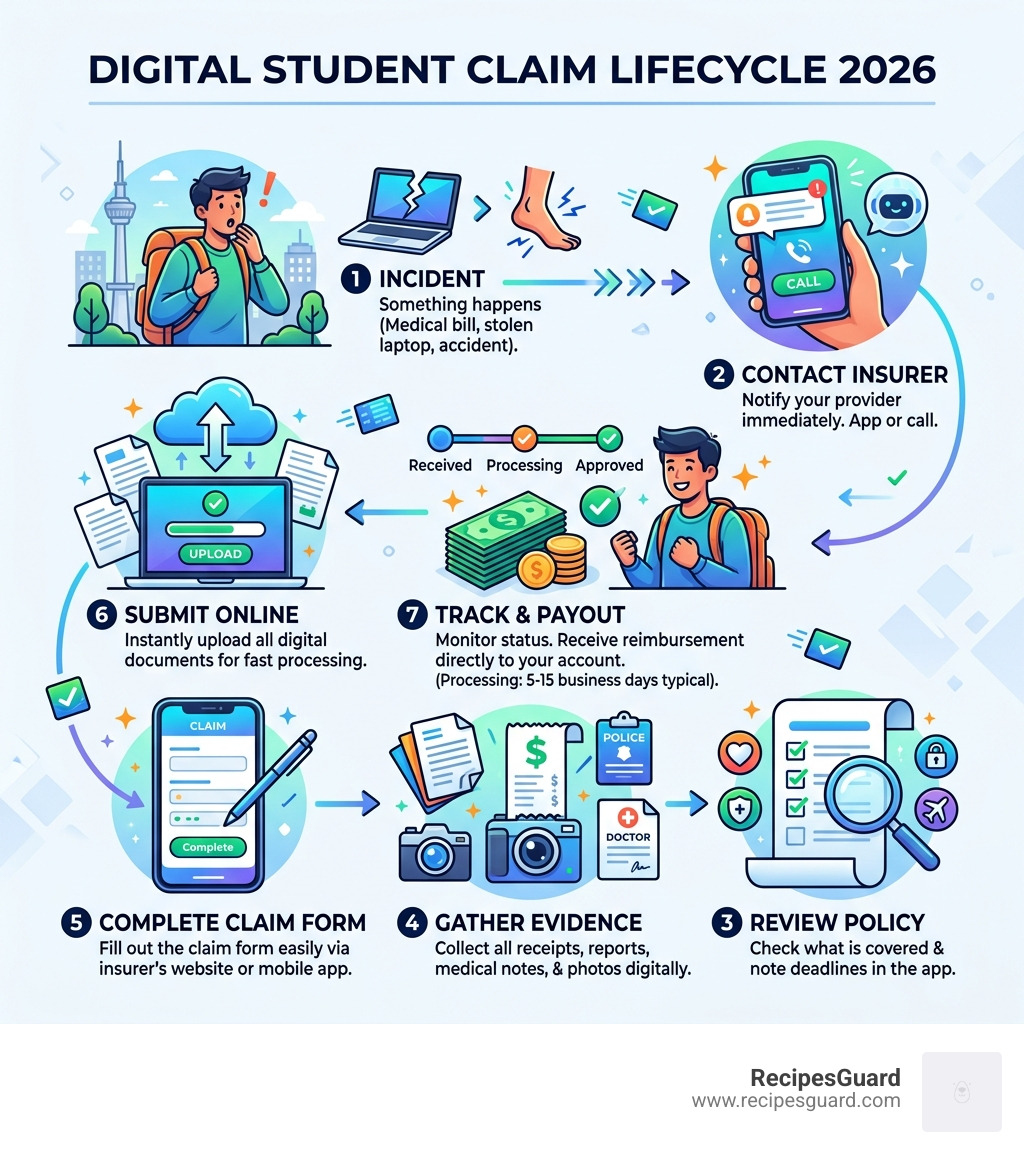
How to file an insurance claim as a student (online) — fast overview:
- Review your policy — check what is covered and note any deadlines
- Contact your insurer immediately — most require notification within 24 hours
- Gather your documents — receipts, medical notes, police reports, photos
- Complete the claim form — available on your insurer’s app or website
- Submit online — upload documents via portal or app for fastest processing
- Track your claim — use your reference number to follow up
Most student claims are processed within 5–15 business days when all documents are correct.
Being far from home when something goes wrong is stressful enough. Add an unfamiliar insurance system on top of that, and it can feel overwhelming fast.
The good news? Filing a claim is a learnable process. Insurance exists for exactly this reason — to spread financial risk so that one bad event does not wipe out your savings. As a student, your policy is your financial safety net abroad.
But the system only works if you know how to use it.
Many students miss out on money they are owed simply because they submitted the wrong document, missed a deadline, or did not know they could appeal a denial. This guide fixes that.
Understanding the Basics: An Insurance Claim Tutorial for Students
Before we dive into the “how-to,” we need to understand the “what.” At its simplest, an insurance claim is a formal request you make to your insurance provider to pay for a covered loss or event. Whether it is a doctor’s visit in Sydney or a stolen backpack in Melbourne, the claim is the bridge between the incident and your reimbursement.
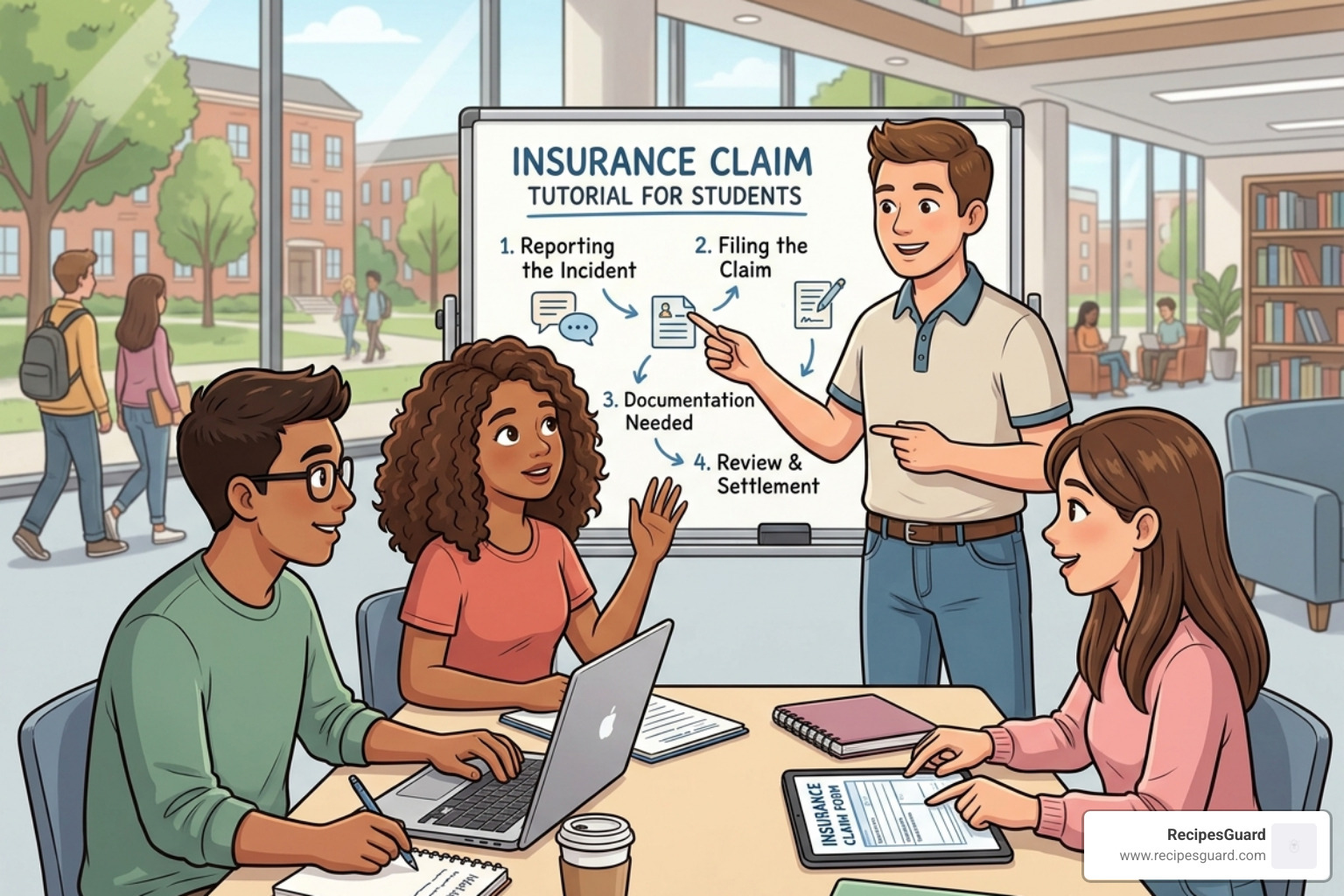
To navigate this process without a headache, you need to speak the language. If you have ever looked at a policy document and felt like you were reading ancient hieroglyphics, you are not alone. Let’s break down the big four terms you will encounter in any insurance claim tutorial students might read:
- Peril: This is the cause of the loss. Was it a fire? A theft? A storm? In insurance-speak, these are “perils.” Your policy will list which perils are covered and which are not.
- Deductible (or Excess): This is the amount of money you have to pay out of your own pocket before the insurance company starts paying. For example, if you have a $500 claim and a $100 deductible, the insurance company pays $400.
- Indemnify: This is a fancy word for “making you whole again.” The goal of insurance is to return you to the financial position you were in before the accident — not to help you make a profit.
- Claims Adjuster: This is the person assigned by the insurance company to investigate your claim and determine how much the company should pay.
When you are filing, it is also vital to know the difference between Actual Cash Value (ACV) and Replacement Cost. ACV pays you what the item was worth at the time of the loss (accounting for age and wear), while Replacement Cost pays for a brand-new version of the item. As a student, knowing which one your policy uses can prevent a lot of disappointment when the check arrives.
If you are looking for a broader overview of the basics, check out The Simple Student Tutorial For Filing Any Insurance Claim.
Key Vocabulary for Policyholders
Beyond the basics, there are a few more terms that will help you master this insurance claim tutorial students guide.
Coverage Limits are the maximum amount your insurer will pay for a specific type of claim. For instance, your renter’s insurance might cover up to $2,000 for “portable electronics.” If your $3,000 laptop is stolen, you’re still only getting $2,000.
You should also be aware of Depreciation Holdbacks. Sometimes, an insurer will pay you the Actual Cash Value first and then send a second check for the remaining balance once you provide a receipt showing you actually replaced the item.
Finally, there is Third-Party Liability. This is crucial if you accidentally damage someone else’s property or if someone gets hurt in your student apartment. Your insurance doesn’t just protect your stuff; it protects your bank account from being sued by others.
Main Types of Student Insurance Claims
In Australia, international students typically deal with four main categories of claims. Understanding which bucket your claim falls into will determine what paperwork you need.
| Claim Type | Common Examples | Key Document Needed |
|---|---|---|
| Health (OSHC) | GP visits, hospital stays, prescriptions | Itemised invoice & ICD codes |
| Property | Stolen laptop, fire damage to dorm | Police report & proof of purchase |
| Travel | Cancelled flights, lost luggage | Carrier report or medical note |
| Auto | Car accidents, theft of vehicle | FIR (Police report) & Driver’s License |
The Step-by-Step Guide to Filing Your Claim Online
In 2026, the days of mailing in paper forms are mostly gone. Most Australian insurers, especially Overseas Student Health Cover (OSHC) providers, use mobile apps and online portals to speed things up.
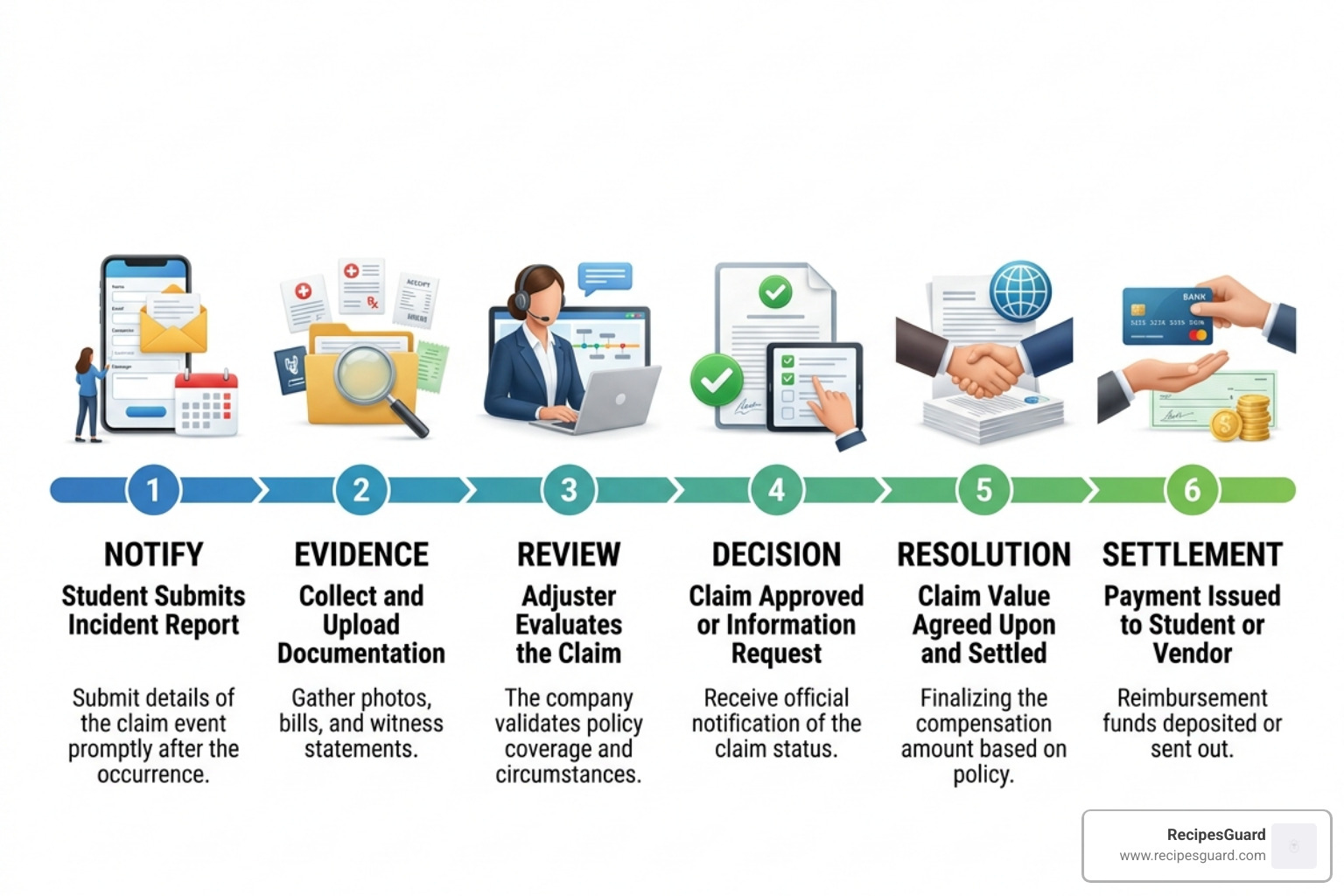
Step 1: Immediate Notification
As soon as the incident happens — whether it’s a car bump or a medical emergency — contact your insurer. Many policies have a 24-hour notification window. Even if you don’t have all the paperwork yet, letting them know “something happened” starts the clock and protects your right to claim.
Step 2: Evidence Collection
Be a detective. Take photos of the damage from multiple angles. If you were in a car accident, photograph the road, the other car, and the license plate. If you are sick, keep every single piece of paper the doctor gives you.
For more detailed help on medical-specific steps, see Mastering The Student Medical Claim Process In 5 Easy Steps.
Step 3: Formal Incident Reports
If something was stolen or you were in a major accident, you must file a police report. In Australia, this is often a legal requirement for your claim to be valid. Keep the “Event Number” or the physical copy of the report.
Step 4: Submission
Log into your provider’s portal. Fill out the claim form carefully. Most rejections happen because of simple typos or missing information. Before you hit “submit,” double-check your bank details — you want that money going to the right place!
For those traveling between semesters, don’t forget to use The Essential Student Travel Insurance Claim Checklist.
Essential Documentation for an Insurance Claim Tutorial for Students
Documentation is the fuel that makes the claims engine run. Without it, you’re going nowhere. For students in Australia, there is one specific thing that often trips people up: ICD Diagnosis Codes.
When you visit a doctor, the invoice must show a code that tells the insurer exactly what was wrong (e.g., “J06.9” for an upper respiratory infection). Without this code, the insurer might reject the claim because they don’t know if the treatment was for a covered illness or something excluded, like cosmetic surgery.
Other essential documents include:
- Medical Receipts: These must be itemised. A total-sum receipt is usually not enough.
- Proof of Ownership: For property claims, keep digital copies of your receipts or even photos of the item’s serial number.
- Bank Statements: Sometimes used to prove you paid for a service upfront.
If you are struggling with medical paperwork, our guide on Mastering Your Medical Receipt Claims As An International Student is a lifesaver.
Timelines and Submission Deadlines
Time is of the essence. While you should notify the company within 24 hours, you generally have a 30 to 90-day limit to submit the full documentation. If you wait until the end of the semester to file all your medical claims from February, you might find yourself out of luck.
Once submitted, Australian OSHC reimbursements typically take 5 to 10 working days. Property or car claims can take longer, usually between 2 to 6 weeks, depending on the complexity and whether an adjuster needs to visit.
To speed things up, check out The Fast Track To Easy Online Student Claim Submission.
Navigating the Evaluation: Adjusters, Fraud, and Settlements
Once you hit submit, your claim enters the “Evaluation Phase.” This is where the insurance company decides if your claim is valid and how much it’s worth.
The Role of the Claims Adjuster
For smaller health claims, the process is automated by AI. But for larger claims — like a car accident or a flooded apartment — a claims adjuster will be assigned. Their job is to:
- Investigate: Verify that the event actually happened as described.
- Assess: Use specialised software to calculate the cost of repairs or replacement.
- Detect Fraud: Look for patterns that suggest the claim might be exaggerated.
When interacting with an adjuster, be polite and factual. You don’t need to be an expert; you just need to provide the information they ask for. They handle hundreds of claims; being organized makes their job easier and your payout faster.
If the stress is getting to you, read How To File Claims Without Losing Your Mind.
Claims Resolution and Payment Calculation
After the evaluation, you will receive a Settlement Offer. This is the final amount the company agrees to pay.
The Math:
- Total Loss/Repair Cost – Your Deductible – Depreciation = Your Payout.
If you still owe money on the item (like a car loan), the check might be made out to both you and the lender. This ensures the money is actually used to fix the asset.
Sometimes, you might find more damage after the claim is closed. Don’t panic! Claims can often be reopened if you discover hidden damage, provided you act quickly and have a professional (like a mechanic or contractor) document the new findings.
To understand the nitty-gritty details of these steps, visit Understanding The Student Insurance Claim Evaluation Process and The Ultimate Student Guide To Insurance Claim Steps.
Troubleshooting Denials and Avoiding Common Pitfalls
It is the email every student dreads: “Your claim has been denied.” Before you spiral, understand that a denial isn’t always the final word.
Common reasons for denial include:
- Missing Deadlines: Filing too late.
- Exclusions: Trying to claim for something the policy specifically says it won’t cover (like pre-existing conditions or “high-risk” sports).
- Incomplete Documentation: Forgetting that all-important ICD code.
Avoiding Pitfalls in Your Insurance Claim Tutorial for Students
One of the biggest mistakes students make is authorizing repairs before the claim is approved. If you get your car fixed at your cousin’s shop before the adjuster sees it, the insurance company may refuse to pay because they couldn’t verify the damage themselves.
Another pitfall is “soft fraud” — slightly exaggerating the value of a stolen item. In 2026, insurers use advanced data analytics to spot these inconsistencies. It isn’t worth the risk!
For more tips on avoiding these traps, see The Ultimate Student Guide To Navigating Insurance Claims and Mastering The Travel Insurance Claim Tutorial.
Improving Claims Handling with Technology
The good news is that technology is making things better. AI-driven assessment means that simple medical claims can be approved in minutes. Many Australian providers now offer 24/7 customer service via chat, which is perfect for students who might be in a different time zone while traveling.
Frequently Asked Questions about Student Claims
How does filing a claim affect my future insurance premiums?
Insurers use your claim history to assess how “risky” you are. If you file multiple claims in a short period, your premiums (the cost of the policy) will likely go up. However, many Australian car insurers offer “Accident Forgiveness” for your first “not-at-fault” claim.
When should I choose to pay out-of-pocket instead of filing?
If the damage is only slightly more than your deductible, it might be smarter to pay yourself. For example, if you have a $500 deductible and the repair costs $600, filing a claim to get $100 back might not be worth the potential increase in your future premium rates. Always do a cost-benefit analysis first.
What are the consequences of insurance fraud for international students?
This is serious. In Australia, insurance fraud can lead to:
- Immediate Policy Cancellation: You lose your coverage.
- University Enrollment Termination: Most student visas require valid insurance. If your policy is cancelled for fraud, your university may be legally required to cancel your enrollment.
- Legal Action: Fraud is a criminal offense.
Hard fraud (staging an accident) and soft fraud (inflating a claim) are both treated with zero tolerance.
Conclusion
Navigating insurance doesn’t have to be a nightmare. By following this insurance claim tutorial students guide, you are already ahead of the curve. The goal of insurance is your peace of mind and financial safety.
At RecipesGuard, we are dedicated to providing student-focused advice that simplifies the complex. Whether you are studying in Sydney, Melbourne, or anywhere in between, we are here to ensure your journey is protected.
Stay safe, keep your receipts, and don’t be afraid to ask for help!
Visit RecipesGuard for more student claim guides

My name is Bianca, and my journey into the world of fermentation and food safety began with a costly mistake. I once lost an entire season’s harvest of chili peppers because I relied on guesswork instead of science. That failure was my turning point.
