
Why Health Insurance Plans for Pre-Existing Conditions Matter More Than Ever in 2026
Health insurance plans for pre existing conditions are fully protected under federal law — and in 2026, you have more coverage options than ever before.
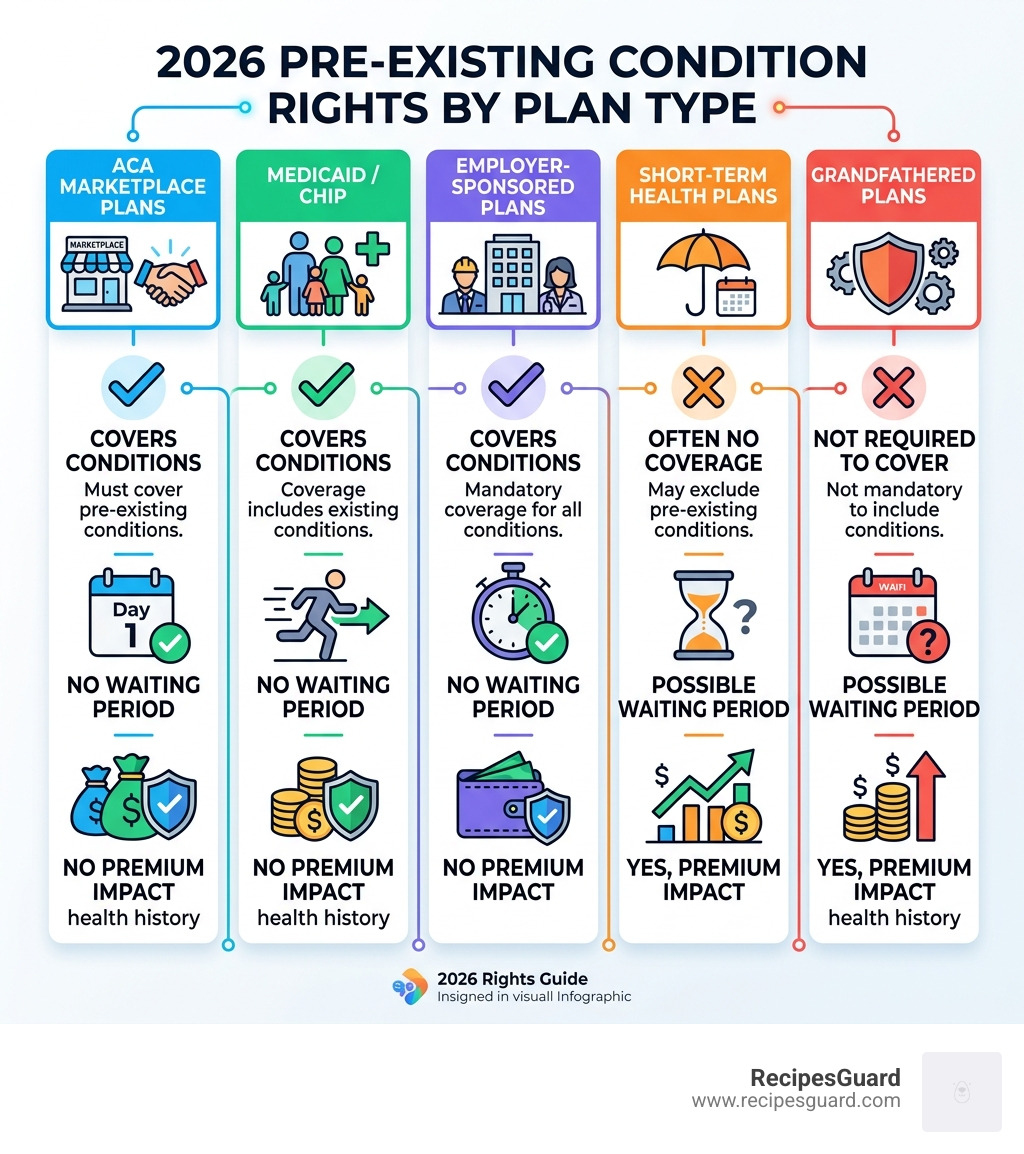
Here’s a quick answer if you need it fast:
| Plan Type | Covers Pre-Existing Conditions? | Waiting Period? | Premium Impact? |
|---|---|---|---|
| ACA Marketplace Plan | Yes | None | No |
| Medicaid / CHIP | Yes | None | No |
| Employer-Sponsored Plan | Yes | None | No |
| Short-Term Health Plan | Often No | Possible | Yes |
| Grandfathered Plan | Not Required | Possible | Yes |
The bottom line: Any ACA-compliant plan — whether through the Marketplace, an employer, or Medicaid — must cover your pre-existing conditions from day one, with no higher premiums and no exclusions.
If you have a chronic illness, a past diagnosis, or even an ongoing condition like diabetes or asthma, finding the right health plan can feel overwhelming. You might worry about being denied, paying more, or having your condition simply… ignored by your insurer.
Those fears made sense before 2010. They don’t anymore — at least not for most plans.
According to federal health data, roughly 54 million non-elderly U.S. adults — about 27% of the population under 65 — have a health condition that would have led to denial or inflated premiums under the old rules. That’s more than one in four people.
The Affordable Care Act changed that. But not every plan on the market plays by those rules. Short-term plans and grandfathered plans are still exceptions — and that gap can cost you if you’re not careful.
This guide compares your real options so you can choose with confidence.
Health insurance plans for pre existing conditions word guide:
- Disability Insurance for Pre-Existing Conditions
- Family Health Insurance for Pre-Existing Conditions
- Medical Aid Covering Pre-Existing Conditions
Understanding Pre-Existing Conditions in 2026

What exactly counts as a pre-existing condition? In the simplest terms, it is any health problem, illness, or injury you had before the date your new health coverage begins. It doesn’t matter if it’s a major chronic illness or a relatively minor issue; if it was there before the “start” button was pressed on your policy, it fits the definition.
Common examples we see every day include:
- Chronic illnesses: Diabetes, cancer, COPD, lupus, epilepsy, and sleep apnea.
- Common ailments: Asthma, high blood pressure, and even severe acne or anxiety.
- Ongoing situations: Pregnancy is a major one. Under the law, if you are pregnant when you apply for a plan, it is treated as a pre-existing condition, but you cannot be denied coverage or charged more for it.
In 2026, the data remains striking: nearly half of all Americans are living with at least one chronic health issue. Historically, insurers used medical underwriting to look back through your records, prescriptions, and doctor visits to determine your risk. Before the Affordable Care Act (ACA), this often meant being “blacklisted” from coverage or being forced to pay “premium loading” — a fancy term for much higher prices.
Today, Marketplace health plans cover pre-existing conditions by law. This means insurers can no longer refuse to cover you or charge you more just because of your medical history. Whether your condition is physical or mental, diagnosed or even undiagnosed (but previously treated), you are protected. It is vital to remember that Don’t Let Your Medical History Stop Your Future Disability Coverage is a philosophy that now extends deep into the health insurance market.
Comparing Health Insurance Plans for Pre Existing Conditions
When shopping for health insurance plans for pre existing conditions, it’s important to know that not all “insurance” is created equal. The protections you enjoy depend heavily on the type of plan you choose.
| Plan Category | ACA-Compliant? | Pre-Existing Coverage | Best For… |
|---|---|---|---|
| Marketplace (Exchange) | Yes | Full (Day 1) | Individuals & Families |
| Employer-Sponsored | Mostly | Full (Day 1) | Employees |
| Medicaid / CHIP | Yes | Full (Day 1) | Low-income individuals |
| Short-Term Plans | No | Often Excluded | Temporary gaps only |
| Grandfathered Plans | No | May exclude | Those keeping old plans |
The gold standard for protection is the ACA Marketplace. All plans sold here must cover treatment for pre-existing medical conditions. They cannot reject you, charge you more, or refuse to cover “essential health benefits” related to your condition. Similarly, Medicaid and CHIP are prohibited from discriminating based on your health history.
However, we must be cautious of “non-ACA” plans. Short-term health plans, for instance, are designed for temporary gaps and often use medical underwriting. They may refuse to cover your asthma or diabetes entirely. Grandfathered plans — those that existed before March 23, 2010, and haven’t changed significantly — also don’t have to follow the same rules. If you’re on one of these, you might find that your Healthcare That Covers Pre Existing Conditions What You Need To Know guide is your most valuable resource for switching to a better option.
Historically, the government even funded a Pre-Existing Condition Insurance Plan (PCIP) as a bridge until the Marketplace was fully functional. While PCIP ended in 2014, its legacy is the robust Marketplace we use today, where the $5 billion once used for high-risk pools has been replaced by universal protections.
Essential Benefits in Health Insurance Plans for Pre Existing Conditions
One of the biggest wins for patients in 2026 is the “Essential Health Benefits” requirement. It’s not enough for a plan to just “accept” you; they have to actually cover the things that keep you healthy.
For those with pre-existing conditions, this includes:
- Mental Health and Substance Use Disorder Services: Thanks to parity laws, these must be covered at the same level as medical and surgical care.
- Prescription Drugs: Essential for managing chronic conditions like diabetes or heart disease.
- Chronic Disease Management: Plans must offer programs to help you manage long-term issues.
- Rehabilitative Services: Crucial if your pre-existing condition involves past injuries or surgeries.
If you are currently in a situation where your doctor is still running tests, don’t panic. You can still find How To Get Health Insurance When Your Doctor Is Still Guessing to ensure you have a safety net while seeking a diagnosis.
How to Audit Health Insurance Plans for Pre Existing Conditions

Choosing the “best” plan isn’t just about finding one that covers you — they all should (if they are ACA-compliant). It’s about finding the one that minimizes your total costs. We recommend performing a “Health Audit” before Open Enrollment:
- Review your last 12 months: Total up your doctor visits, specialist consultations, and every single prescription.
- Check the Provider Network: If you have a specialist you’ve seen for 10 years for a rare condition, verify they are “In-Network” for the new plan. Seeing an out-of-network specialist can be devastatingly expensive.
- HMO vs. PPO: For chronic conditions, a PPO (Preferred Provider Organization) is often better. While premiums are higher, you usually don’t need a referral to see a specialist, giving you more freedom to manage complex care.
- Analyze the Specialty Pharmacy: If you take high-cost “specialty” drugs, check the plan’s formulary. Some plans have much better rates for specific Tier 4 or Tier 5 medications.
- Deductible Strategy: If you know you will hit your out-of-pocket maximum every year due to a chronic condition, it often makes sense to choose a “Gold” or “Platinum” plan. You’ll pay higher monthly premiums, but your deductible will be lower, and the insurance company will start picking up the 100% of the tab much sooner.
Enrollment Windows and Legal Protections
Timing is everything. Generally, you can only sign up for health insurance plans for pre existing conditions during the annual Open Enrollment Period (typically November 1 to January 15).
However, life happens. If you miss that window, you might qualify for a Special Enrollment Period (SEP). Common qualifying events include:
- Losing existing health coverage (e.g., leaving a job).
- Getting married or divorced.
- Having a baby or adopting a child (this triggers a 60-day window to add the child, and coverage is often retroactive).
- Moving to a new zip code.
A common question we hear at RecipesGuard is: “Is there a waiting period?” For ACA-compliant medical plans, the answer is a resounding no. There are no waiting periods for pre-existing conditions. Your coverage for that “old ache” starts the same day your policy goes live. This is a huge relief for students and travelers who might worry that Don’t Let Old Aches Break Your Travel Bank when they move or study abroad.
If you are currently on a grandfathered plan, you aren’t stuck. You can switch to a Marketplace plan during Open Enrollment to get better protections. You can also find more details on how to Pre-Existing Condition Coverage, How to Apply & Qualify to ensure you don’t miss these critical windows.
Navigating Coverage for Chronic and Rare Diseases
For those managing rare diseases like Gaucher disease or complex chronic conditions like lupus or epilepsy, insurance isn’t just a safety net — it’s a lifeline.
Care management is key here. Many top-tier health insurance plans for pre existing conditions now offer dedicated case managers. These professionals help coordinate between your various specialists, ensure your specialty drugs are refilled on time, and help you navigate the appeals process if a specific treatment is initially denied.
If you are between jobs and worried about a lapse in treatment, COBRA can act as a vital bridge. While expensive (usually 102% of the total premium), it allows you to keep your exact same doctors and prescriptions without a single day of interruption. For someone with a rare disease, a “ripple effect” from missing even one month of specialized treatment can cause irreversible damage.
For those who are still in the diagnostic phase, we’ve put together The Ultimate Guide To Holiday Insurance For People Without A Diagnosis Yet to help you stay protected while the medical team searches for answers.
Frequently Asked Questions about Pre-Existing Coverage
Can I be denied coverage or charged more for a pre-existing condition?
In 2026, if you are applying for an ACA-compliant plan (Marketplace, employer-sponsored, or Medicaid), the answer is no. It is illegal for these insurers to deny you or hike your rates based on your medical history. However, be wary of “short-term” or “limited benefit” plans, which do not have to follow these rules.
Is pregnancy considered a pre-existing condition under current law?
Yes, technically it is a condition that exists before your plan starts. However, the law explicitly protects pregnant individuals. You cannot be denied coverage, and your prenatal care, labor, and delivery must be covered from day one of your enrollment.
Do all health plans have to cover my medical history immediately?
Most do, but there are two main exceptions: grandfathered plans (those in effect before March 2010) and short-term health insurance. These plans may still have waiting periods or exclude pre-existing conditions entirely. Always check the Summary of Benefits and Coverage (SBC) before signing up.
Conclusion
At RecipesGuard, we believe that your medical history should be a footnote, not a barrier. As a student-focused advisory, we’ve seen how complex claims and coverage can be. Whether you are filing a claim for the first time or trying to find a plan that won’t punish you for a past diagnosis, we are here to provide step-by-step guidance.
Don’t let the paperwork intimidate you. The laws in 2026 are on your side, and with a little bit of auditing and the right enrollment timing, you can secure a plan that provides both physical and financial health.
Learn more about our mission at RecipesGuard and let us help you navigate your insurance journey with confidence.

My name is Bianca, and my journey into the world of fermentation and food safety began with a costly mistake. I once lost an entire season’s harvest of chili peppers because I relied on guesswork instead of science. That failure was my turning point.
