
Why You Need to 485 Health Insurance Compare Before Applying
485 health insurance compare is essential for any international graduate planning to stay in Australia – and the table below gives you a fast answer on the top options available in May 2026.
| Cover Type | Starting Monthly Cost | Typical Excess | Meets Condition 8501 |
|---|---|---|---|
| Basic OVHC | From $59.35 | Up to $750 | Yes |
| Mid-range OVHC | From $64.57 | Around $500 | Yes |
| Higher-cover OVHC | From $67.90 | $250 – $500 | Yes |
Prices are indicative for a single adult. Always confirm current pricing directly with the insurer.
If you’ve just finished your studies in Australia and you’re applying for a Subclass 485 Temporary Graduate Visa, health insurance isn’t optional – it’s a legal requirement. Under Visa Condition 8501, you must hold adequate health cover for your entire stay.
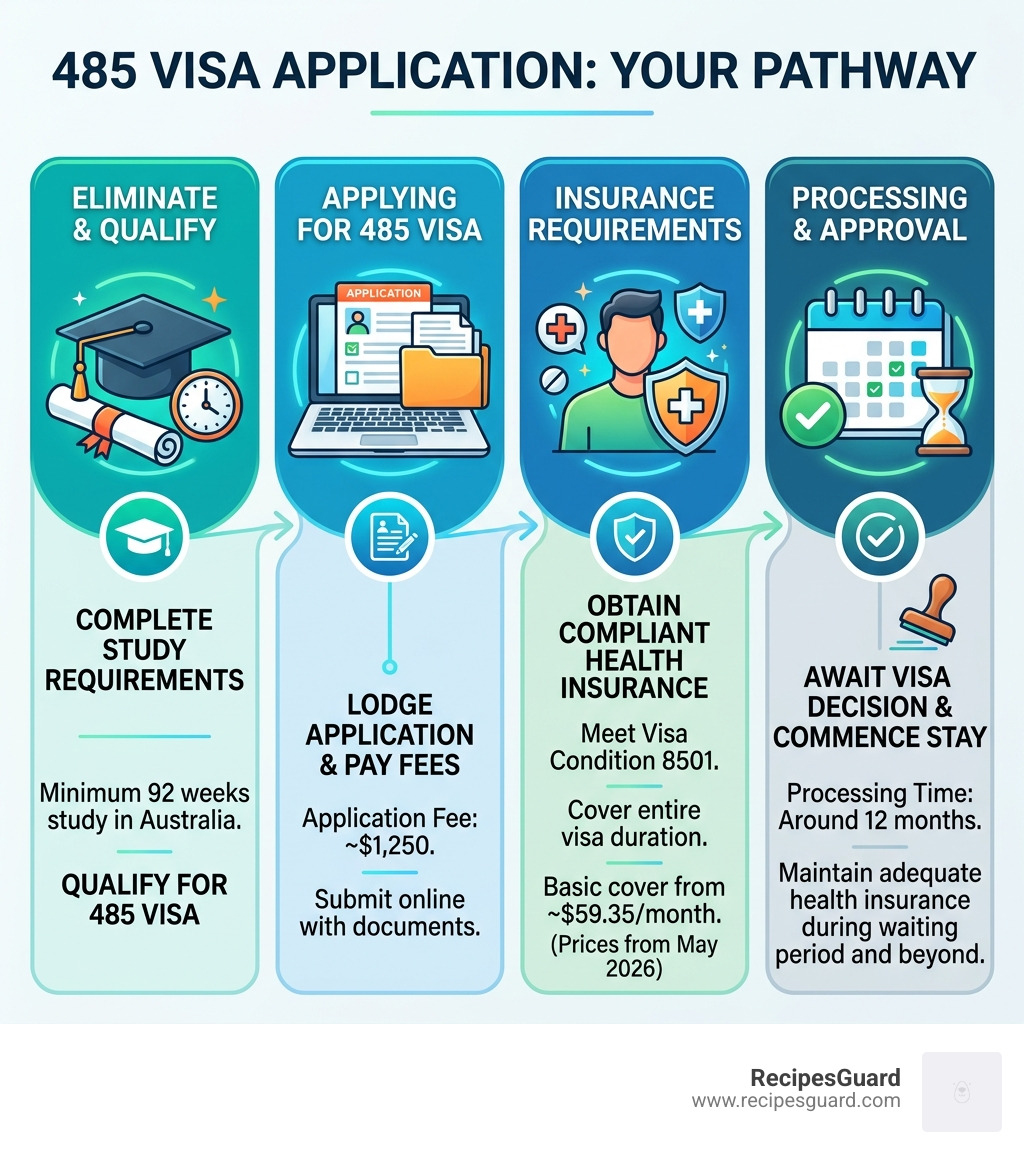
The 485 visa costs $1,250 to apply for, takes around 12 months to process, and requires at least 92 weeks of study to qualify. During that waiting period – and beyond – you need compliant health insurance in place.
The good news? Basic cover starts from as little as $59.35 per month. But with a 4.41% premium increase hitting on 1 April 2026, choosing the right plan before that deadline matters more than ever.
This guide breaks down what each plan covers, what it costs, and how to find the best fit for your situation.
485 health insurance compare definitions:
- student health insurance australia
- overseas student insurance guide
- health insurance coverage comparison
Understanding Visa Condition 8501 and OVHC Requirements
When we talk about the 485 health insurance compare process, the first thing you need to know is “Visa Condition 8501.” This is the Australian Government’s way of saying: “If you want to stay here, you must pay for your own medical bills.” Unlike Australian citizens who have Medicare, most temporary residents are responsible for their own healthcare costs.
To meet this condition, you need Overseas Visitor Health Cover (OVHC). This is a specific type of insurance designed for people on working or graduate visas. It is different from the Overseas Student Health Cover (OSHC) you had while studying.
According to Department of Home Affairs standards, a compliant policy must provide:
- Hospital Cover: Treatment in a hospital as an admitted patient.
- Medical Repatriation: Coverage for being sent back to your home country if you have a serious illness or life-threatening injury.
- $1 Million Annual Benefit: Most policies must provide at least $1 million in total benefits per person, per year.
- Ambulance Services: Emergency transport must be included.
When you apply for your 485 visa, you must provide a visa verification letter (also called a health insurance certificate) as proof that you have purchased a compliant policy. This letter is usually emailed to you instantly after you pay your first premium. If you are feeling a bit overwhelmed by the technical jargon, checking out The Best Ways To Compare Health Insurance Coverage Today can help you simplify the process.
How to 485 Health Insurance Compare: Costs and Coverage in 2026
As of May 2026, the landscape for health insurance has changed slightly. We recently saw a significant 4.41% premium hike on April 1st. While that might sound like just a few dollars, it adds up over the 2 to 4 years you might spend on a graduate visa.
When you perform a 485 health insurance compare search, you’ll find two main tiers of cover: Basic and Comprehensive.
| Feature | Basic OVHC (Budget) | Comprehensive OVHC |
|---|---|---|
| Monthly Cost | $59 – $75 | $130 – $250+ |
| Hospital Room | Shared Room (Public) | Private Room (Private Hospital) |
| GP Visits | Often 100% of MBS Fee | 100% of MBS Fee |
| Medical Repatriation | Included (Min. $10k-$20k) | Included (Higher Limits) |
| Extras (Dental/Physio) | Usually Not Included | Often Included or Add-on |
| Excess | Higher ($500 – $750) | Lower ($0 – $250) |

Most graduates opt for the basic plans to keep costs down while meeting visa requirements. In fact, research indicates that graduates can save an average of $295 by switching to more competitive plans. However, “Basic” often means you are covered for 100% of the Medicare Benefits Schedule (MBS) fee. If your doctor charges more than the MBS fee, you will have to pay the “gap” out of your own pocket.
Finding the Cheapest 485 Health Insurance Compare Options
If your primary goal is to satisfy the Department of Home Affairs for the lowest possible price, focus on budget-friendly OVHC policies that start at roughly $59.35 to $60.00 per month.
But here is the catch: the “cheapest” plan isn’t always the best value. You need to look at the excess. An excess is the amount you pay when you actually go to the hospital.
- If you choose a $750 excess, your monthly premium will be lower.
- If you choose a $250 excess, your monthly premium will be higher.
If you are young and healthy, a high-excess, low-premium plan might save you money. But if you have ongoing health needs, paying a bit more each month for a lower excess could save you thousands in the long run. At RecipesGuard, we always suggest looking at the “Total Cost of Ownership” rather than just the monthly sticker price.
Transitioning from OSHC to 485 Health Insurance Compare Plans
One of the most common questions we get is: “Can I just keep my student insurance?” The short answer is no. OSHC is specifically for student visas. Once you apply for your 485 visa, you need to transition to OVHC.
However, the timing can be tricky. You will likely be on a Bridging Visa while your 485 is being processed. During this time, you must maintain “adequate” cover.
- Keep OSHC until your student visa expires.
- Purchase OVHC to start the day your student visa ends.
- Apply for an OSHC refund. Many insurers will refund the “unused” portion of your student insurance once you prove your new visa status.
Maintaining continuous coverage is vital. If there is a gap between your OSHC ending and your OVHC starting, you are technically in breach of your visa conditions. For a deeper dive into managing these costs, see The Ultimate Guide To Student Health Coverage And Costs.
Key Features to Look for in Graduate Health Cover
When you 485 health insurance compare different policies, don’t just look at the price. Look at the “Waiting Periods.” A waiting period is the time you must hold the insurance before you can claim for certain services.
Standard waiting periods in Australia for OVHC include:
- 12 Months: For pre-existing conditions (illnesses you had before joining).
- 12 Months: For pregnancy and birth-related services.
- 2 Months: For psychiatric, rehabilitation, and palliative care.

Extras Coverage: Dental, Optical, and Physio
Basic OVHC is mostly about “Hospital” and “GP” visits. It usually does not cover the dentist, new glasses, or a trip to the physiotherapist. If you want these, you need to add “Extras” cover.
While Extras increase your monthly cost, they can be a lifesaver if you need wisdom teeth removed or regular dental cleans. Some plans offer “6 to 8 weeks free” promotions for new members, which can help offset the cost of adding Extras. If you are used to the US system, you might find Navigating The Maze Of Student Health Insurance Plans In The Usa interesting for comparison, but the Australian system relies heavily on the Pharmaceutical Benefits Scheme (PBS) for medication discounts.
Frequently Asked Questions about 485 Visa Insurance
Do family members or partners on a 485 visa need separate health insurance?
If you are bringing a partner or children on your 485 visa, they must be covered by adequate health insurance. You don’t necessarily need separate policies; you can get a Couples Policy or a Family Policy.
Usually, a couples policy is slightly cheaper than two separate single policies because it reduces administrative fees. Every person listed on the visa application must be named on the insurance certificate provided to the Department of Home Affairs.
What happens if my 485 visa health insurance lapses?
Letting your insurance lapse is a serious mistake. Under Condition 8501, the Department of Home Affairs can cancel your visa if they discover you do not have active health cover.
Insurers are required to report to the government if a visa holder cancels their policy without evidence of a new one. Furthermore, if you let your policy lapse and then try to rejoin later, you may have to re-serve all your waiting periods from scratch. This means if you get sick a month later, you won’t be covered for pre-existing conditions for another year.
Are there countries with Reciprocal Health Care Agreements (RHCA) that exempt 485 visa holders?
Australia has Reciprocal Health Care Agreements with several countries (including the UK, Ireland, New Zealand, Italy, and others) that allow citizens to access Medicare for “medically necessary” treatment.
Warning: Even if you are from an RHCA country and eligible for Medicare, you usually still need to purchase a private OVHC policy to satisfy the 485 visa requirements. The Department of Home Affairs typically requires a private insurance certificate regardless of Medicare eligibility. Plus, private insurance helps you avoid the long waiting times in the public hospital system for non-emergency surgeries.
Conclusion
Navigating 485 health insurance compare doesn’t have to be a headache. By understanding that insurance is a mandatory part of your visa success, you can plan ahead and save money. Remember to switch from OSHC to OVHC as soon as your student visa ends, keep an eye on those April 1st premium increases, and always check the excess levels before signing up.
At RecipesGuard, we specialize in helping students and graduates navigate the complexities of insurance. We know that the real stress starts when you actually have to make a claim. That’s why we provide step-by-step claim filing tutorials to ensure you get your money back without the stress.
Stay compliant, stay healthy, and enjoy your professional journey in Australia! For more guides on navigating your life as a graduate, visit us at https://www.recipesguard.com/.

My name is Bianca, and my journey into the world of fermentation and food safety began with a costly mistake. I once lost an entire season’s harvest of chili peppers because I relied on guesswork instead of science. That failure was my turning point.
