
What to Do When Your Student Claim Gets Denied
How appeal denied student claim decisions work is simpler than it looks — here is the short version if you need it fast:
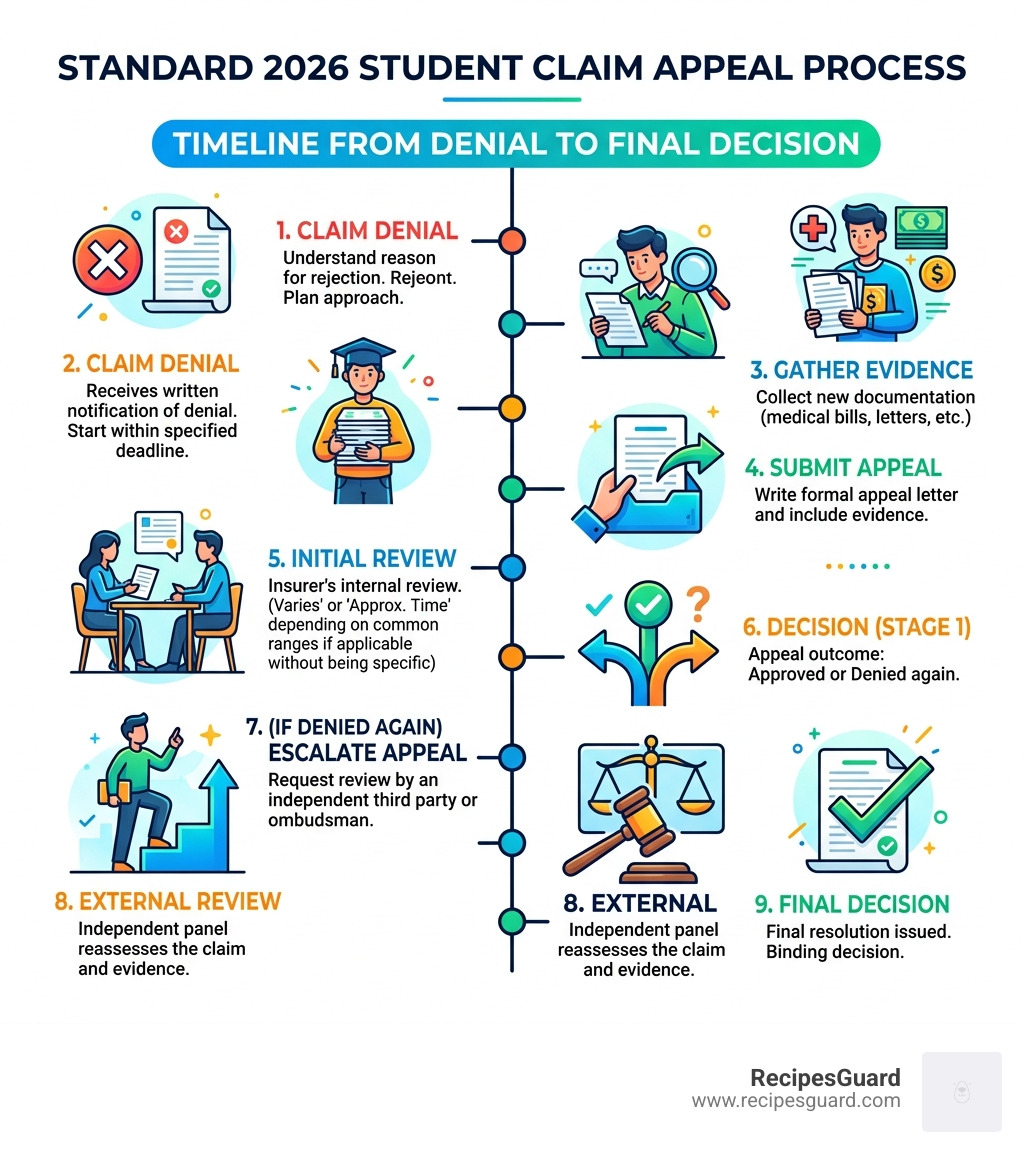
- Read the denial letter carefully to find the exact reason your claim was rejected.
- Contact the relevant office (financial aid, insurance provider, or university admin) to request written clarification.
- Gather new or missing documentation such as medical bills, pay stubs, or third-party letters.
- Submit a formal written appeal within the required deadline (often 14–180 days depending on claim type).
- Follow up and, if denied again, escalate to an independent reviewer or ombudsman.
Imagine opening your inbox to find a denial letter for a claim you were counting on. Maybe it is your travel insurance rejecting a medical emergency expense. Maybe your financial aid appeal did not go through. Either way, the feeling is the same — panic, confusion, and the pressure of not knowing what comes next.
The good news? A denial is rarely the final word.
Most student claim appeals follow a structured process, and knowing that process puts you back in control. Whether your claim involves travel insurance, financial aid, academic standing, or a student visa, the core idea is the same: you have the right to challenge the decision, and with the right steps, you have a real chance of reversing it.
This guide walks you through exactly how to do that — step by step, without the jargon.
Understanding Why Your Student Claim Was Rejected

Before you can fight a denial, you need to understand the “why.” In our experience at RecipesGuard, most students fail their first appeal because they address the wrong problem. A denial isn’t a personal rejection; it’s usually a bureaucratic mismatch between your situation and a specific policy rule.
In the Australian context, especially for 2026, we see several recurring themes for rejections:
- Adverse History: For financial claims like PLUS loans or private student loans, an “adverse credit history” is a common wall. This usually means you have debts (often totaling $2,085 or more) that are 90 days delinquent or in collection.
- Satisfactory Academic Progress (SAP): Universities have strict standards. If your GPA falls below a 2.0 or your completion rate drops below 66.5%, your aid might be cut off.
- The 150% Unit Rule: This is a big one. If you attempt 150% or more of the units required for your program, you are often disqualified from further aid. For a 3-year degree, if you’ve been “finding yourself” for 5 years, the funding tap might run dry.
- Medical Necessity: For insurance claims, the insurer might claim a treatment was “experimental” or not “medically necessary.”
Comparing Denial Reasons
| Claim Type | Common Denial Reason | The “Fix” |
|---|---|---|
| Academic | Lack of knowledge of requirements | Rarely successful; focus on “extenuating circumstances” instead. |
| Financial Aid | Missing documentation/signatures | Submit a correction through the portal immediately. |
| Insurance | Policy exclusion (e.g., pre-existing) | Provide a letter of medical necessity from a specialist. |
| Visa | Lack of “Genuine Temporary Entrant” proof | Show stronger ties to your home country (job offers, property). |
If you are wondering why your specific situation was flagged, check out our deep dive on Why Your Student Claim Might Get Rejected and How to Fix It.
How Appeal Denied Student Claim: The Step-by-Step Recovery Plan

Once the initial shock wears off, it is time to get to work. Your recovery plan starts with the Internal Review. This is where you ask the same organization that denied you to take a second look.
In 2026, the standard window for an internal insurance appeal is 180 days from the receipt of the denial. However, for university-specific academic appeals, that window is often much tighter—sometimes as little as 14 calendar days.
To start, you need to treat this like an audit. The reviewers are looking for facts, not just feelings. While your story matters, it needs to be backed by a paper trail. If you are feeling overwhelmed, many students have been exactly where you are. You can find more encouragement and strategy in our guide: Claim Denied: Here is How Students Can Fight Back and Win.
For those dealing with financial aid specifically, the Financial Aid Appeal Denied What to Do: A Painful “No” — and the Smart Next Steps resource provides an excellent framework for handling that specific “No.”
How Appeal Denied Student Claim Procedures Work in 2026
The 2026 landscape requires a digital-first approach. Here is how we recommend navigating the procedure:
- Immediate Research: Don’t just call and complain. Read your Explanation of Benefits (EOB) or the university’s decision letter line by line.
- EOB Analysis: Look for “Reason Codes.” Sometimes a claim is denied simply because a doctor used the wrong billing code. A quick phone call to the provider to resubmit can fix this in minutes.
- Contacting Representatives: When you call the insurer or the financial aid office, keep a log. Note the date, the name of the person you spoke to, and what they advised. Ask: “What specific information was missing that would have changed this decision?”
- Professional Judgment: Financial aid officers have the power of “professional judgment.” They can override standard rules if you can prove your situation is unique (e.g., a sudden death in the family or a natural disaster).
For a comprehensive look at the insurance side of things, see The Ultimate Student Guide to Navigating Insurance Claims.
Essential Evidence for How Appeal Denied Student Claim Success
To win, you need “bulletproof” evidence. We recommend the “One-Page Summary” method. Reviewers are often overworked; if you give them a 50-page stack of unorganized medical bills, they might miss the key point.
- The One-Page Summary: Create a cover sheet that lists the dates of the incident, the total costs, and a brief (3-4 sentence) explanation of the “extenuating circumstance.”
- Itemized Bills: Never send a “balance due” statement. Send the itemized bill that shows exactly what service was provided.
- Third-Party Verification: A letter from a doctor, a social worker, or even a professor can carry more weight than your own statement.
For more tips on documentation, read our guide on How to Provide Bulletproof Travel Insurance Claim Proof.
Navigating Different Types of Student Appeals
Not all appeals are created equal. The strategy for a GPA appeal is vastly different from a travel insurance claim for a stolen laptop.
Academic and Financial Aid Specifics
In Australia, academic appeals often center on “Special Consideration.” If you missed an exam or failed a unit due to illness, you must usually initiate the appeal within one calendar year of the term ending.
- The 45-Day Rule: Most university committees are required to provide a decision within 45 days of receiving your appeal.
- Reinstatement vs. Extension: If you lost aid due to SAP, you are asking for reinstatement. If you’ve run out of time (the 150% rule), you are asking for an extension. Extension appeals almost always require a “Student Educational Plan” signed by an academic advisor.
You can find official policy examples in the Student Appeals | Policy Library.
Visa and International Student Considerations
For international students in Australia, a claim denial can affect your visa status. If your university “releases” you or cancels your enrollment, you have a right to appeal the outcome.
- The Six-Month Rule: If you are denied a student visa twice, you must generally wait at least six months before reapplying.
- OSHC Claims: Overseas Student Health Cover (OSHC) is mandatory. If your OSHC claim is rejected, it’s often because of a “waiting period” for pre-existing conditions. Don’t panic; check out Don’t Panic if Your OSHC Claim Gets the Red Card for specific fixes.
International students should also be aware of the Appealing the outcome of your release request process to ensure they stay compliant with visa regulations.
Alternative Funding and Legal Recourse After a Denial
What if the internal appeal fails? This is where many students give up, but you still have cards to play.
- External Review: If an insurer denies your internal appeal, you can request an external review by an Independent Review Organization (IRO). Under many regulations, including those affecting Australian students, this is a legal right.
- Ombudsman Services: The Private Health Insurance Ombudsman or the Commonwealth Ombudsman can investigate if you’ve been treated unfairly by an insurer or a government agency.
- Legal Aid: Many universities offer free legal services through Student Assistance Programs. Organizations like Appealing a visa decision | Victoria Legal Aid provide vital support for visa-related denials.
- Alternative Funding: If financial aid is truly gone, look into emergency grants, tuition payment plans, or private student loans. Sometimes, starting at a community college or a lower-cost institution for a semester can save your degree—and up to $80,000 in the long run.
For more on navigating these complex disputes, see The Art of the Appeal: Navigating Travel Insurance Claim Disputes.
Frequently Asked Questions about Student Claim Appeals
Is a denied appeal final?
Not necessarily. While it might be the end of the road for that specific review committee, you can often escalate to a “Request for Second Review” or an external ombudsman. However, you usually need to provide “new information” that wasn’t included in the first attempt.
How long does the appeal process take?
It varies. Academic and financial aid appeals typically take 45 days. Insurance internal reviews can take up to 30-60 days. If you escalate to an external review or an ombudsman, the process can stretch to 120 days or more.
What are the most common mistakes to avoid?
- Missing Deadlines: Missing a 14-day window is the fastest way to lose your right to appeal.
- Emotional Arguments: Saying “I really need this money” is less effective than saying “Here is the hospital record proving I was incapacitated during the exam.”
- Lack of Follow-up: Don’t assume no news is good news. Follow up weekly.
Conclusion
Navigating how appeal denied student claim processes work is a test of persistence as much as it is a test of paperwork. The system is designed to be rigorous, but it is not infallible. By staying organized, keeping your tone professional, and meeting every deadline, you significantly increase your chances of a “Yes.”
At RecipesGuard, we’ve seen countless students turn a devastating denial into a successful outcome. Whether you are fighting for your tuition, your health coverage, or your right to stay in Australia, you are your own best advocate.
Your Final Appeal Checklist:
- [ ] Verify the exact deadline for submission.
- [ ] Request a written explanation of the denial.
- [ ] Collect itemized bills and third-party letters.
- [ ] Write a concise, one-page summary of your case.
- [ ] Submit via a method that provides a “receipt” (email or registered post).
- [ ] Set a calendar reminder to follow up in 7 days.
For more step-by-step guides on winning your case, visit How to Successfully Appeal a Denied Insurance Claim. Don’t let a “No” be the end of your story. Get back in the game and fight for the support you deserve.

My name is Bianca, and my journey into the world of fermentation and food safety began with a costly mistake. I once lost an entire season’s harvest of chili peppers because I relied on guesswork instead of science. That failure was my turning point.
