
Why Knowing How to Claim Optometry Student Insurance Can Save You Real Money
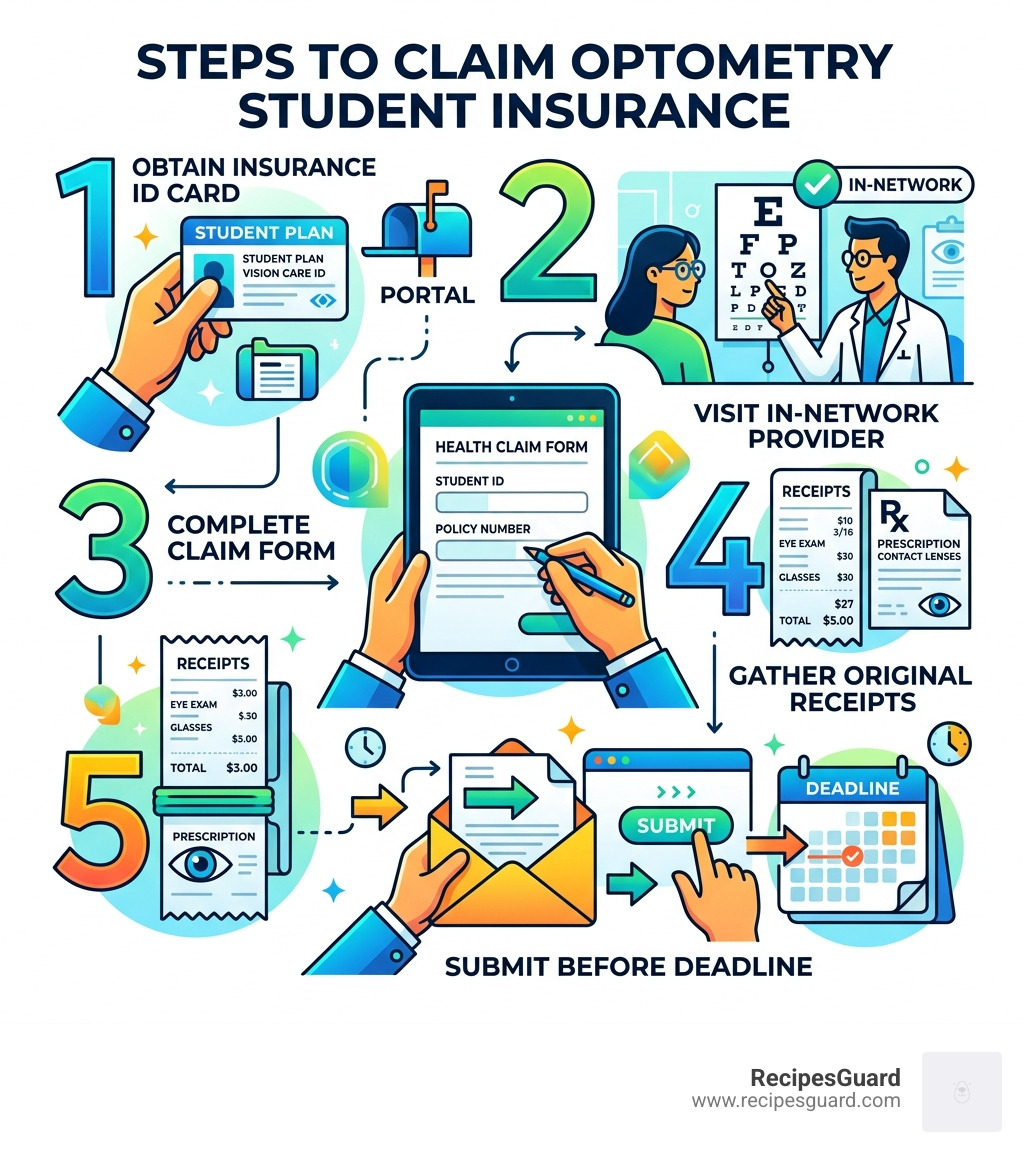
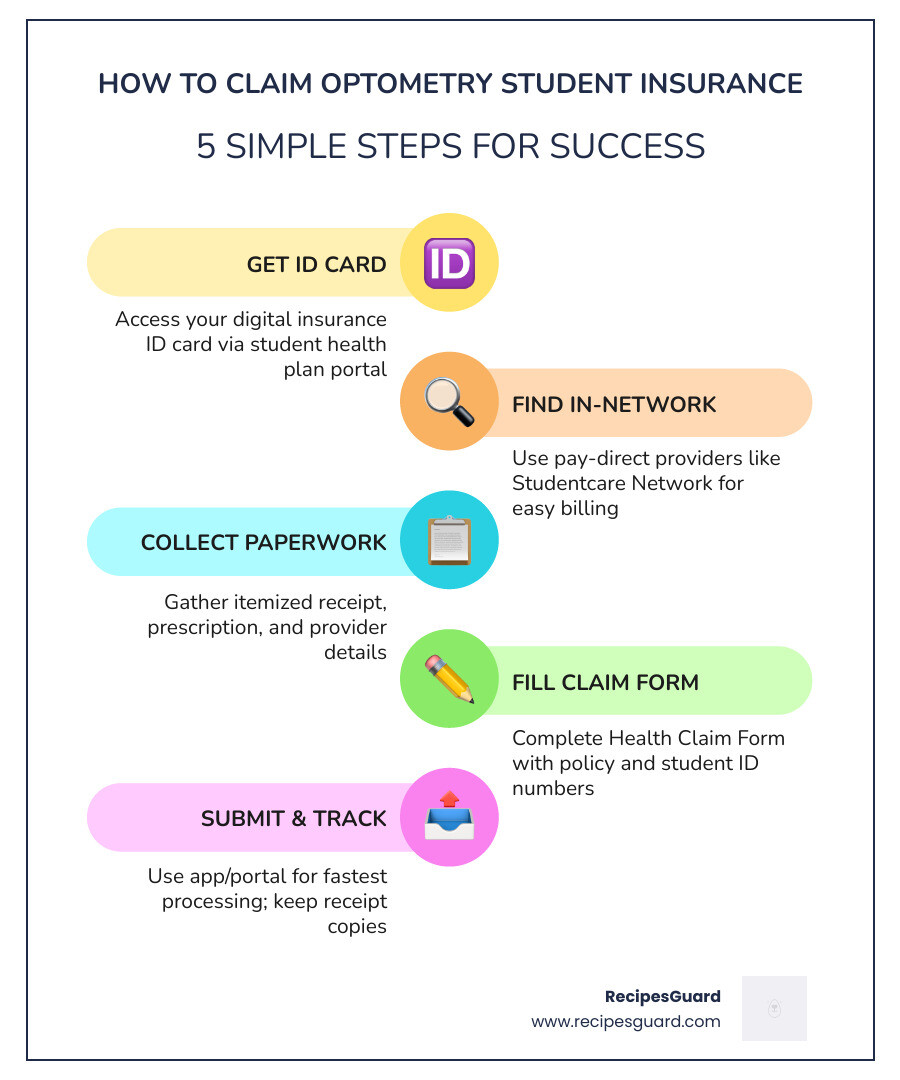
To claim optometry student insurance, follow these core steps:
- Get your insurance ID card from your student health plan portal or request it by mail (allow 7-14 business days).
- Visit an in-network optometrist — present your student ID card for pay-direct claims, or pay upfront and keep your receipt.
- Complete your plan’s Health Claim Form with your student ID and group/policy number.
- Attach original receipts and any required documents (including a copy of your prescription for contact lens claims).
- Keep photocopies of everything, then mail your claim or submit it online before your plan’s deadline (typically within 90 days of your policy year end).
You just paid out of pocket for an eye exam in a country you barely know, you’re not sure if your student plan even covers it, and the claim form looks like it was written by a lawyer. Sound familiar?
Navigating how to claim optometry student insurance is one of those things nobody warns you about when you enroll. Whether you’re an international student studying abroad or a domestic student on a university health plan, the process can feel confusing — especially when vision benefits are bundled into a broader health plan with its own rules, deadlines, and network requirements.
The good news? Most student plans do cover eye exams, glasses, and contact lenses to some degree. And once you know the process, filing a claim is straightforward.
This guide walks you through exactly what to do — from finding your ID card to getting reimbursed without missing a deadline.
Understanding Vision Care Benefits and Coverage Limits
Before you rush out to buy the trendiest frames on the rack, we need to talk about what is actually in your “insurance wallet.” Most student health insurance plans (SHIP) are designed for a younger, healthier population, which often means lower premiums but very specific rules about what they will pay for.
Common Vision Benefits
Typical plans cover a comprehensive eye exam once every 12 or 24 months. Beyond the exam, you will usually see a “vision allowance”–a fixed dollar amount (e.g., $150 or $200) that you can put toward either glasses or contact lenses. It is important to note that most plans won’t let you “double dip” by getting both a new pair of specs and a year’s supply of contacts in the same period using your insurance.
Deductibles and Reimbursement Rates
A deductible is the amount you pay out of pocket before your insurance kicks in. In student plans, vision care often has a $0 deductible if you use a network provider, but the reimbursement rate might only be 80% of the cost up to your limit. For example, if your exam costs $100 and your plan covers 80%, you will get $80 back.
Pediatric Benefits for Students Under 19
If you are a student under the age of 19, your plan likely includes “Pediatric Vision” and “Pediatric Dental” benefits. These are often more robust than adult plans because they are considered essential health benefits. They might cover one pair of basic glasses per year with no out-of-pocket cost. If you’re looking for more info on the dental side of things, check out our guide on Dental Insurance For Students Keeping Your Pearly Whites Protected.
| Service Type | Typical Coverage Frequency | Typical Coverage Amount |
|---|---|---|
| Eye Exam | Every 12-24 Months | 80% – 100% |
| Frames & Lenses | Every 24 Months | $100 – $250 Allowance |
| Contact Lenses | Every 24 Months | $100 – $250 Allowance |

A Step-by-Step Guide to Claim Optometry Student Insurance
Ready to file? We have broken this down into five easy steps to ensure you don’t get stuck in administrative limbo. This process is similar to what we discuss in our tutorial on Mastering The Student Medical Claim Process In 5 Easy Steps.
Step 1: Secure Your Insurance ID Card
You cannot claim optometry student insurance without your credentials. Most universities now use digital portals. Log in to your student health plan website to download your card. If you prefer a physical card, you can usually request one, but keep in mind that delivery takes between 7 to 14 business days. Make sure your mailing address is updated in the system so it doesn’t end up at your parents’ house!
Step 2: Find an In-Network Optometrist
Using a provider within your plan’s network (like the Studentcare Network or a Davis Vision provider) is the “easy mode” of insurance. Many of these providers offer “pay-direct” services. This means you show your ID card, pay only your portion (the co-pay), and the optometrist bills the insurance company directly. If you go out-of-network, you’ll have to pay the full bill upfront and fight for reimbursement later.
Step 3: Collect the Right Paperwork
If your provider doesn’t offer pay-direct, you will need:
- An itemized receipt (not just a credit card slip).
- Your prescription (especially important for contact lenses).
- The provider’s name, address, and license number.
Step 4: Fill Out the Claim Form
Download the “Health Claim Form” from your insurer (e.g., GreenShield, Blue Cross, or Pacific Blue Cross). You will need your Group Policy Number and your Student ID (which often acts as your Certificate Number). If you’re unsure about general claim steps, our Ultimate Student Guide To Insurance Claim Steps provides a great foundation.
Step 5: Submit and Track
Submit via the insurer’s mobile app or online portal for the fastest results. If you must mail it, keep photocopies of everything. We cannot stress this enough–receipts have a funny way of disappearing in the mail.
Required Documentation to Claim Optometry Student Insurance for Online Orders
Buying contacts or glasses online is often cheaper, but it adds a layer of complexity to your claim. To successfully claim optometry student insurance for an online purchase, you must provide:
- A copy of your valid prescription: Insurers will reject a contact lens claim if they don’t see a prescription dated within the last year or two.
- Proof of Payment: A screenshot of your “Order Confirmed” page isn’t enough; you need the final invoice that shows the itemized costs and that the balance was paid in full.
- Shipping Confirmation: Some insurers require proof that the items were actually delivered before they release funds.
For more specific details, you can also refer to the Studentcare Vision How-to-Claim guide or our Student’s Guide To Dental And Prescription Claims.
Deadlines and Coordination Rules to Claim Optometry Student Insurance Successfully
Timing is everything. If you wait until graduation to file a claim from your freshman year, you’re going to be disappointed.
- Submission Deadlines: Most plans require you to submit claims within 90 days of the policy year end (usually August 31st). If your coverage ends because you graduated, that 90-day clock starts the day you leave.
- Blackout Periods: At the start of the fall and winter semesters, there is often a “blackout period” while the school finalizes enrollment lists. You can still see the eye doctor during this time, but you might have to pay upfront and wait a few weeks to file your claim.
- Coordination of Benefits (COB): If you are still covered under your parents’ insurance, you have two plans! You must first claim optometry student insurance through your school plan (the “primary” plan). Once they pay their portion, you can take the “Explanation of Benefits” (EOB) they give you and submit it to your parents’ insurance (the “secondary” plan) to cover the remaining balance. If a claim gets rejected during this shuffle, don’t panic–read our guide on How To Successfully Appeal A Denied Insurance Claim.
Maximizing Savings with Vision Discount Programs
Sometimes, your insurance allowance isn’t enough to cover those designer frames you’ve been eyeing. This is where discount programs come in. Many student plans are partnered with networks like Davis Vision, which offer “Point-of-Purchase” savings.
The best part? No claim forms. You simply show your student ID at an accredited provider, and the discount is applied instantly.
Typical Savings through Davis Vision:
- 15% discount on eye examinations.
- Up to 40% savings on frames.
- Up to 30% savings on lenses.
- 10-20% discount on contact lenses.
- 20% discount on non-prescription sunglasses (perfect for those summer breaks!).
To find these providers, use your plan’s online “Provider Locator.” For example, if you’re in Australia, you might look for providers that accept Uni Health Insurance to ensure you’re getting the best student rates.

Transitioning from Student to Professional Optometrist
If you aren’t just a student using optometry services, but a student studying to become an optometrist, your insurance needs are about to change drastically. As you enter the workforce, you will need to protect your new career.
Malpractice Insurance for Grads
Most professional associations, such as the AOA Insurance Alliance, offer significant “starter” discounts for recent graduates. It is common to see 50% off your first year of malpractice coverage and 25% off your second year.
Key Policy Features to Look For:
- Portability: Ensure your coverage follows you, whether you’re working at a private practice, a hospital, or a retail clinic.
- Administrative Defense: This covers you during billing audits or HIPAA-related inquiries.
- Lost Income Coverage: Some premium policies offer up to $500 per day in lost income if you have to attend a trial or hearing that suspends your practice.
While you’re still a student, your school likely covers your liability during clinical rotations, but the moment you get that license, the responsibility shifts to you. Just as we help you navigate Prescription Claims, we recommend looking for policies that grow with your practice.
Conclusion
Getting your student insurance to pay for your specs doesn’t have to be a headache. By securing your ID card early, choosing in-network providers, and keeping meticulous records of your receipts and prescriptions, you can maximize your benefits and keep your out-of-pocket costs low.
Whether you’re using a domestic plan or Overseas Student Health Cover (OSHC), the rules are there to be followed, not feared. If you ever feel overwhelmed by the paperwork, just refer back to our Simple Student Tutorial For Filing Any Insurance Claim.
Keep your eyes on the prize (and the fine print), and you will be rocking those new glasses in no time!
Need help with other student claims? Visit RecipesGuard for more step-by-step tutorials on navigating student insurance.

My name is Bianca, and my journey into the world of fermentation and food safety began with a costly mistake. I once lost an entire season’s harvest of chili peppers because I relied on guesswork instead of science. That failure was my turning point.
