
Don’t Let a Late Bag Ruin Your Trip or Your Wallet
Don’t Get Stuck Out of Pocket: What You Need to Know About Delayed Baggage Compensation
Delayed baggage compensation is money or reimbursement you’re legally entitled to when an airline fails to deliver your checked bag on time — and most travelers don’t realize how much they can actually claim.
Here’s a quick summary of your key rights:
| Situation | What You’re Entitled To |
|---|---|
| Domestic bag delayed 12+ hours (US) | Baggage fee refund + reimbursement for reasonable expenses |
| International bag delayed 15-30+ hours | Baggage fee refund + up to ~$2,175 USD (1,519 SDR) in expenses |
| Bag declared lost (usually 5-14 days) | Full compensation up to $4,700 (domestic US) or 1,519 SDR (international) |
| Any significant delay | Right to claim costs for essentials like toiletries and clothing |
Picture this: you land in a new country for your semester abroad. Your classmates grab their bags and head to the exit. You’re still standing at an empty carousel 45 minutes later, watching the conveyor belt spin with nothing on it.
It’s stressful. And if you don’t know your rights, it can also be expensive.
The good news? Airlines are legally required to compensate you when your bag is delayed. Under US Department of Transportation (DOT) rules for domestic flights and the Montreal Convention for most international travel, you have real, enforceable rights — not just a goodwill gesture from the airline.
The bad news? Most passengers leave money on the table because they don’t know what to claim, how to document it, or how quickly they need to act.
This guide covers everything you need to know — from the moment you realize your bag is missing, to getting every dollar you’re owed back in your pocket.
Relevant articles related to delayed baggage compensation:
- Lost Luggage Insurance
- Travel Insurance Luggage Damage
- Insurance Lost Luggage Australia
Understanding Your Legal Rights to Delayed Baggage Compensation

When your bag doesn’t show up, you aren’t just at the mercy of the airline’s “customer service.” You are protected by a framework of laws that dictate exactly what an airline owes you. As of April 2026, these regulations are more robust than ever, specifically designed to ensure passengers aren’t left stranded without their belongings.
The primary regulation for international travel is the Montreal Convention. This treaty applies to most international flights and sets a maximum baggage liability for delayed bags at 1,519 Special Drawing Rights (SDR) per passenger. If you’re wondering what an SDR is, think of it as a “global currency” used by the International Monetary Fund. In April 2026, 1,519 SDR is approximately $2,175 USD (or roughly $3,300 AUD).
For domestic flights within the United States, the U.S. Department of Transportation (DOT) sets the bar even higher. The maximum liability amount allowed by U.S. DOT regulation for delayed baggage is $4,700 per passenger. For more detailed regulatory info, you can check out the Lost, Delayed, or Damaged Baggage | US Department of Transportation page.
Domestic vs. International Delayed Baggage Compensation Rules
The rules change depending on where you are flying. It’s not just about the distance; it’s about the legal “itinerary type.”
- Domestic US Flights: As mentioned, the limit is $4,700. Importantly, for domestic travel, airlines are generally not required to compensate you for “excluded items” like jewelry or electronics if they are listed in their contract of carriage.
- International Flights: Under the Montreal Convention, the airline is liable for damages even if they involve excluded items, provided the airline accepted the bag for transport.
- Australian and Canadian Context: For flights within Canada or international itineraries involving Canada, the liability limit is also tied to the 1,519 SDR (approx. $2,780 CAD). In Australia, while we follow the Montreal Convention for international legs, domestic rights are often governed by the airline’s specific “Conditions of Carriage,” though consumer law still demands “reasonable” care and compensation.
Understanding these limits is vital because it stops airlines from offering you a “standard” $50 voucher when you’ve actually spent $300 on essential professional attire for a meeting. For a deeper dive into these nuances, visit Delayed Baggage | Air Passenger Rights.
How to File a Claim for Delayed Baggage Compensation
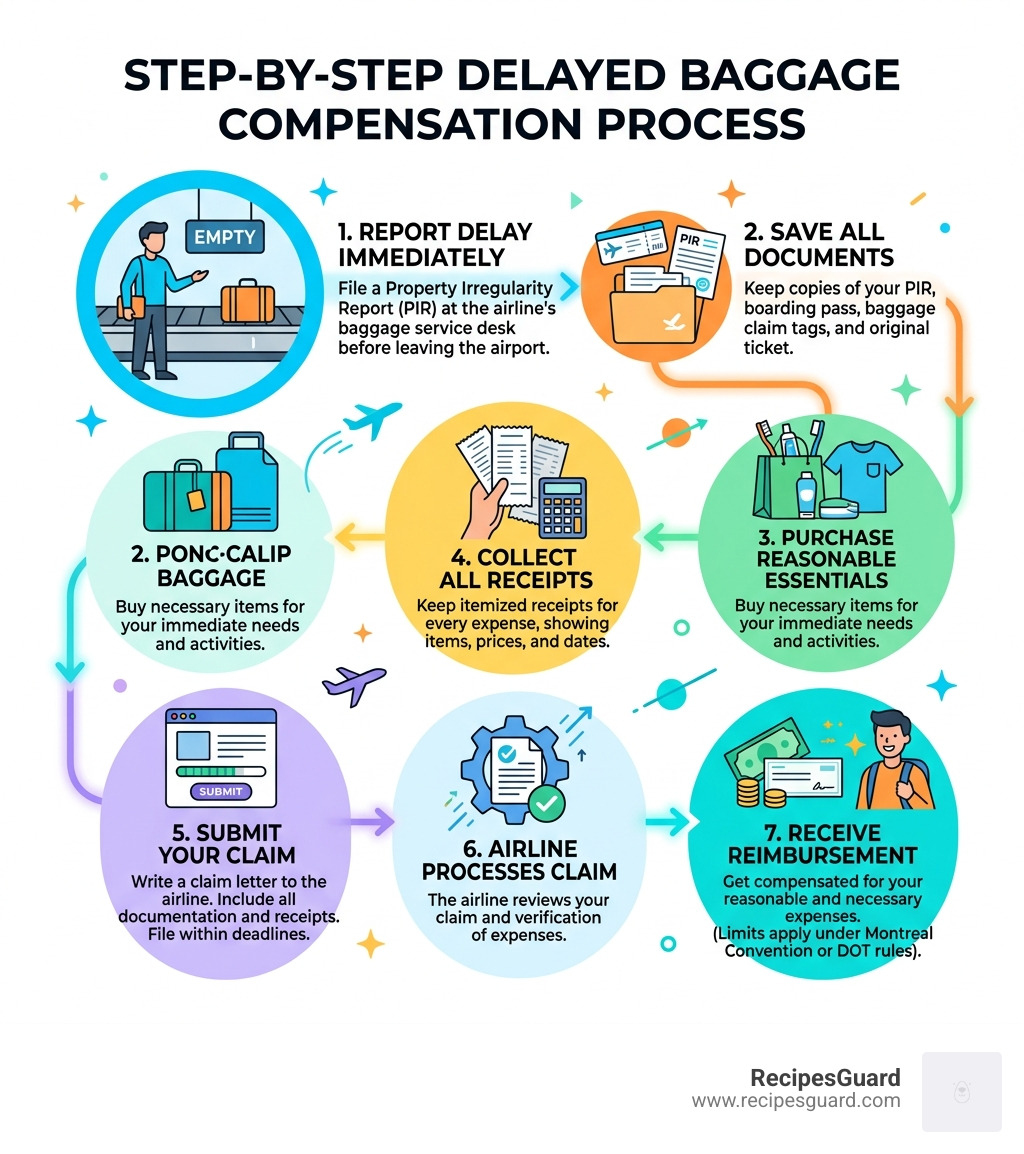
The “clock” starts the moment you realize your bag is missing. You cannot simply go home and call the airline the next day; you must act while you are still at the airport.
First, find the airline’s baggage service desk and file a Property Irregularity Report (PIR). This is a crucial document. It will contain a 10 or 13-character file ID (like SYDDA12345) that allows you to track your bag and serves as the legal record of your claim.
Once you have your PIR, the deadlines for follow-up written claims are strict:
- Damaged items: Usually within 7 days.
- Delayed international baggage: You must submit a written claim for expenses within 21 days of receiving your bag.
If you miss these windows, the airline can legally deny your delayed baggage compensation claim. For a complete breakdown of these deadlines, see Compensation for lost, damaged and delayed baggage – Air Passenger Protection.
Reporting Timelines and the Definition of a “Significantly Delayed” Bag

“Is my bag just late, or is it significantly delayed?” This isn’t just a matter of your frustration level; it’s a legal definition that determines when you get your baggage fees back.
According to DOT rules, a bag is officially “significantly delayed” based on the following timeframes:
- Domestic US Flights: 12 hours after your flight arrived.
- International Flights (under 12 hours duration): 15 hours after arrival.
- International Flights (over 12 hours duration): 30 hours after arrival.
When you hit these thresholds, you’ve moved past simple “inconvenience” and into the territory of mandatory refunds. You must ensure you have filed a Mishandled Baggage Report (MBR) to be eligible. The legal basis for these refunds is found in 14 CFR § 260.5 – Refunding fees for significantly delayed or lost bags..
When are Passengers Entitled to a Refund of Baggage Fees?
In April 2026, U.S. DOT rules require that baggage fees be automatically refunded if your bag meets the “significantly delayed” criteria. This refund should be processed within 7 business days for credit card payments and 20 calendar days for cash or check.
However, there are a few “gotchas” where the airline might not have to refund your fee:
- Voluntary Separation: If you were a standby passenger and agreed to travel without your bag to make the flight.
- Customs Issues: If you failed to pick up and re-check your bag at an international entry point (like landing in LAX before a domestic connection).
- Late Check-in: If you checked in after the cutoff time and the airline warned you the bag might not make it.
Maximizing Your Reimbursement for Incidental Expenses
This is where most travelers get confused. Airlines often try to quote a “daily limit” (like Delta’s guideline of $50 per day for the first 5 days). Ignore the idea that this is a hard cap.
Federal regulations explicitly state that airlines cannot set arbitrary daily limits on reimbursement. They must cover “reasonable, verifiable, and actual incidental expenses.”
What counts as “reasonable”?
- Toiletries: Toothbrush, toothpaste, deodorant, skincare.
- Clothing: A change of clothes, underwear, socks, or a suit if you have a specific business event.
- Equipment: If you’re on a ski trip and your gear is delayed, the cost of renting equipment is a reasonable incidental expense.
The key word is incidental. If you buy a $2,000 designer dress because your jeans are in your checked bag, the airline will likely reject that as “unreasonable.” But if you buy a $100 outfit to get through your first day of lectures, you’re on solid ground. For specific examples of airline policies, check out Damaged, Delayed or Lost Baggage | Delta Air Lines.
Documentation Required for Successful Claims
To get your delayed baggage compensation, you need to be a master of paperwork. We recommend keeping a digital folder on your phone with photos of:
- Your Baggage Claim Check (that little sticker they put on your boarding pass).
- Your PIR/MBR form from the airport.
- Itemized receipts for every single thing you buy. A bank statement is often not enough; the airline wants to see exactly what items were purchased.
- Photos of the items you bought.
Beyond the Airline: Insurance and Credit Card Protections
While airlines have liability limits, they often use “depreciated value” for items. This means if they lose your three-year-old laptop, they might only offer you a fraction of what it costs to buy a new one. This is where RecipesGuard comes in.
At RecipesGuard, we specialize in helping students navigate the complex world of travel insurance. As a student traveling from Australia to study abroad, your luggage often contains your entire life — expensive textbooks, laptops, and specialized gear. Airline compensation might not cover the full replacement cost of these high-value items.
Travel insurance or credit card baggage protection acts as “secondary coverage.” If the airline pays out their maximum and it’s still not enough, your insurance can bridge the gap. We provide step-by-step tutorials on how to file these claims so you don’t miss out on the protection you’ve already paid for.
Learn more about how we can help at RecipesGuard.
Supplementing Airline Liability for High-Value Items
Most airlines have a long list of “excluded items” for domestic travel. If you’re a student carrying a $3,000 camera for a media course, and it’s in your checked bag on a domestic flight, the airline might pay $0 if it’s damaged or lost.
By using a third-party policy or a premium credit card (like those offering travel protection in Australia), you can get coverage for:
- Electronics: Laptops, tablets, and cameras.
- Jewelry: Though we always recommend keeping this in your carry-on!
- Replacement Cost: Some high-end insurance policies pay the cost to buy a new item, rather than the depreciated value the airline offers.
Proactive Steps to Prevent and Track Delayed Luggage
The best delayed baggage compensation is the kind you never have to claim. In 2026, technology is your best friend.
- Use AirTags or Smart Tags: These are game-changers. Airlines like American and Delta now allow you to share your “Find My” location link directly with them during the claim process. This can speed up reunification by days.
- The 20-Minute Guarantee: Some airlines (like Delta and Alaska) offer a “20-minute baggage guarantee.” If your bag isn’t on the carousel within 20 minutes of the gate opening, they’ll give you 2,500 bonus miles or a discount voucher. You usually have to claim this within a few hours of landing!
- Carry-on Essentials: Never check your “must-haves.” This includes:
- All medications (with prescriptions).
- Passports and travel documents.
- One change of clothes and basic toiletries.
- Expensive electronics.
For more preventative tips, visit the Lost, delayed or damaged baggage | UK Civil Aviation Authority guide.
Tips to Speed Up Bag Reunification
- Remove Old Tags: Those little barcode stickers from your flight to Bali three years ago? They can confuse the automated scanners and send your bag to the wrong terminal.
- External and Internal Labels: Tags fall off. Put a business card or a piece of paper with your name, email, and phone number inside the bag on top of your clothes.
- Take a Photo: Having a photo of the outside of your bag helps the baggage agent identify it faster than just saying “it’s a black suitcase.”
Frequently Asked Questions about Delayed Bags
When is a delayed bag officially considered “lost”?
Most airlines will declare a bag “lost” between 5 and 14 days after the flight. However, under international rules (Montreal Convention), a bag is legally considered lost if it hasn’t arrived within 21 days. Once it’s lost, you transition from claiming “incidental expenses” to claiming the full value of the bag and its contents (up to the liability limits).
What happens if my bag is delayed on a multi-airline itinerary?
Always file your claim with the last airline you flew with. Even if the first airline lost it during a transfer, the final carrier is responsible for opening the PIR and coordinating the delivery. They have “interline agreements” to settle the costs behind the scenes.
Are there exceptions where airlines don’t have to pay?
Airlines are generally exempt if the delay was caused by factors outside their control, such as:
- Customs/Security Delays: If the TSA or Border Force held your bag for inspection.
- Inadequate Packing: If your bag burst open because it was overstuffed.
- Weather/Force Majeure: While they still have to try to get your bag to you, some jurisdictions limit compensation for “Acts of God,” though the Montreal Convention is quite strict about airlines proving they took all possible measures to avoid the delay.
Conclusion
Dealing with a missing bag is a rite of passage for many travelers, but it doesn’t have to be a financial disaster. By knowing your rights to delayed baggage compensation, filing your reports immediately at the airport, and keeping every single receipt, you can ensure the airline takes responsibility for their mistake.
As a student traveler, you have extra resources. Don’t settle for the first low-ball offer an airline gives you. Use our step-by-step tutorials at RecipesGuard to maximize your insurance claims and keep your travel budget intact.
Stay persistent, stay documented, and don’t let a late bag stop your adventure.
Protect your student travels with RecipesGuard

My name is Bianca, and my journey into the world of fermentation and food safety began with a costly mistake. I once lost an entire season’s harvest of chili peppers because I relied on guesswork instead of science. That failure was my turning point.
