Get Fermenting with This Easy Caraway Seed Sauerkraut Recipe
Why This Caraway Seed Sauerkraut Recipe Is Worth Making at Home
The caraway seed sauerkraut recipe below uses just three core ingredients — cabbage, salt, and caraway seeds — to create a tangy, probiotic-rich ferment you can make in a mason jar at home.
Quick overview:
- Shred 2 lbs (900g) green cabbage into thin strips
- Massage with 4 tsp (20g) fine sea salt until brine forms
- Mix in 2 tbsp (13g) whole caraway seeds
- Pack tightly into a clean jar, keeping cabbage submerged under the brine
- Ferment at 70–80°F for 4–8 weeks
- Refrigerate when it tastes right to you — it keeps for up to 12 months
That’s the short version. The details below will help you nail it every time.
Sauerkraut is one of the most forgiving ferments you can make. Cabbage breaks down easily with salt, releasing its own juice to create the brine — no fancy equipment required. The caraway seeds add a warm, earthy flavor with hints of anise and a long history in traditional German and Eastern European kitchens.
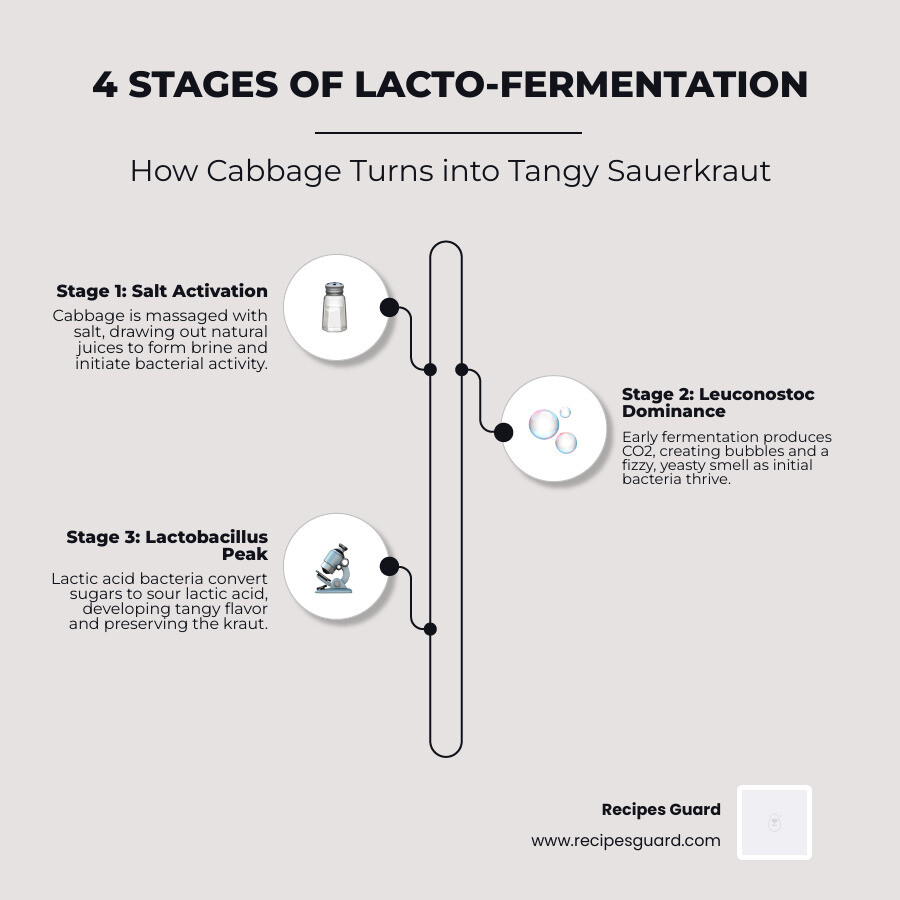
The science behind it is simple: Lactobacillus bacteria naturally present on the cabbage leaves feed on the sugars and produce lactic acid. That acid is what gives sauerkraut its signature sour taste and what keeps it shelf-stable.
Essential Ingredients for Your caraway seed sauerkraut recipe
To get started with your caraway seed sauerkraut recipe, you don’t need a massive pantry. In fact, the beauty of this traditional dish lies in its simplicity. As of April 2026, home fermentation has seen a massive resurgence because people are realizing that the best probiotics don’t come from a pill—they come from a jar on your counter.

The foundation of any good kraut is high-quality produce and the right ratio of salt. We always recommend weighing your ingredients. While “one head of cabbage” sounds simple, cabbages vary wildly in size. A 2-pound head and a 6-pound head require very different amounts of salt to ferment safely.
The 2% Salt Rule
The golden rule of sauerkraut is the salt-to-cabbage ratio. You want to aim for 1.5% to 2.5% of the cabbage’s weight in salt, but never more than 3%. Salt does three vital things: it draws out the water to create a protective brine, it keeps the cabbage crunchy by strengthening the pectin, and it inhibits “bad” bacteria while the Lactobacillus gets to work.
| Cabbage Weight | Salt Needed (approx. 2%) | Caraway Seeds | Yield |
|---|---|---|---|
| 2 lbs (900g) | 4 tsp (20g) | 2 tbsp (13g) | ~1 quart |
| 4 lbs (1.8kg) | 8 tsp (40g) | 4 tbsp (26g) | ~2 quarts |
| 6 lbs (2.7kg) | 12 tsp (60g) | 6 tbsp (39g) | ~3 quarts |
For more on the fundamentals of salt and prep, check out our guide on Preserving Basics.
Choosing the Best Cabbage and Salt
For a classic caraway seed sauerkraut recipe, green cabbage is king. If you can find the “flat” variety (often found in European markets), grab it! It’s sweeter and more tender than the standard round heads. Organic cabbage is ideal because we rely on the wild bacteria living on the leaves to start the fermentation. If you use conventional cabbage, just be sure to peel off and discard the outermost leaves.
When it comes to salt, avoid standard table salt. The iodine and anti-caking agents can turn your brine cloudy or give the kraut a metallic off-flavor. Instead, reach for mineral-rich sea salt, Himalayan pink salt, or pickling salt.
Why Add Caraway Seeds to Your caraway seed sauerkraut recipe?
Adding caraway isn’t just about that iconic “Bavarian” flavor profile. While they do provide a wonderful anise-like aroma and earthy depth, caraway seeds are functional powerhouses. They contain essential oils like carvone and limonene, which are known to aid digestion and reduce bloating—making them the perfect partner for fiber-rich cabbage.
Furthermore, caraway seeds possess mild anti-fungal properties that can help protect your ferment from unwanted yeast growth in the early stages. For a deeper dive into these benefits, see this guide on Unlocking Caraway Seeds in Sauerkraut. We recommend using whole seeds for a slow release of flavor, though you can lightly crush them with a mortar and pestle if you want a more intense punch. You can also explore Unlocking Caraway Seeds in Sauerkraut for specific dietary variations like Whole30.
Step-by-Step Guide to Making Caraway Seed Sauerkraut
Now that we have our ingredients, it’s time for the “cathartic” part of the process. Many fermenters find the rhythm of shredding and massaging cabbage to be a great emotional release!
1. Preparation and Shredding
Start by removing the tattered outer leaves of your cabbage. Pro tip: Save one or two large, clean outer leaves; we’ll use these later as a “follower” to keep the shredded bits submerged. Rinse the head under cold water.
Quarter the cabbage and cut out the tough inner core (you can grate the core into the mix or discard it). Slice the quarters into thin ribbons, about 1/8-inch thick. You can use a sharp chef’s knife for a rustic feel or a mandoline for perfect uniformity. Avoid using a food processor with a blade, as it can chop the cabbage too finely, leading to a mushy texture.
2. The Salt Massage
Place your shredded cabbage in a large, non-reactive bowl (glass or stainless steel). Sprinkle your weighed salt over the top. Now, get in there with clean hands! Massage the salt into the cabbage vigorously. You’ll notice the cabbage starts to shrink and turn translucent within a few minutes.
After about 5 minutes of massaging, let the cabbage sit and “sweat” for 10 to 20 minutes. This gives the salt time to break down the cell walls. When you return, give it another good squeeze. You should see a pool of bright green liquid at the bottom of the bowl. This is your “mother brine.”
3. Adding the Flavor
Once the cabbage is dripping with juice, stir in your caraway seeds. Ensure they are evenly distributed so every bite of your caraway seed sauerkraut recipe has that signature spice.
Packing and Submerging the Cabbage
This is the most critical step for safety. Fermentation is an anaerobic process, meaning it must happen without oxygen. If cabbage is exposed to air, it will grow mold.
- Pack it tight: Transfer the cabbage into a clean wide-mouth mason jar. Use a “kraut pounder” or the end of a wooden rolling pin to pack the cabbage down firmly. You want to eliminate all air pockets.
- The Brine Level: As you pack, the brine should rise above the cabbage.
- The Follower: Take that outer leaf you saved earlier and fold it to fit inside the jar, placing it on top of the shredded cabbage.
- The Weight: Place a glass fermentation weight or a small boiled rock on top of the leaf. This ensures everything stays under the “brine line.”
- Headspace: Leave at least 1 to 2 inches of space between the top of the brine and the rim of the jar. The kraut will expand and bubble as it ferments, and you don’t want a “kraut-cano” leaking all over your counter!
For more safety tips on maintaining an anaerobic environment, see our guide: Safety First: A Guide to Preserving Fermented Foods.
Monitoring the Fermentation Timeline
Place your jar in a spot out of direct sunlight. The ideal temperature for a caraway seed sauerkraut recipe is between 70°F and 80°F. If your kitchen is cooler (around 65°F), the process will simply take longer—often resulting in a more complex, nuanced flavor.
- Days 1–7: You’ll see bubbles forming and the brine might become cloudy. This is a great sign! If you aren’t using an airlock lid, you’ll need to “burp” the jar daily by slightly unscrewing the lid to let the CO2 escape.
- Weeks 2–4: The “funk” begins to develop. The cabbage will lose its raw crunch and take on a pleasant tang.
- Weeks 4–8: For the best flavor, we recommend a minimum of 4 to 6 weeks. At the 6-to-8-week mark, the flavors are fully mature.
We have plenty of other Fermented Recipes if you find yourself catching the “fermentation bug” during this wait!
Troubleshooting and Storage Tips for Success
Even the most seasoned fermenters run into hiccups. Here is how to handle the most common issues with your caraway seed sauerkraut recipe.
Common Issues and Solutions
- White Film (Kahm Yeast): If you see a thin, wavy white film on the surface of the brine, don’t panic. This is Kahm yeast. It’s harmless but can affect the flavor if left too long. Simply scrape it off and discard the top layer of kraut if it looks soft.
- Mold: If you see fuzzy spots that are green, black, or pink, the batch has been compromised by oxygen. Discard the entire jar and try again with better submergence.
- Smell: It should smell pleasantly sour and “fermenty.” If it smells putrid, like rotting garbage or sulfur, something went wrong. Trust your nose—when in doubt, throw it out.
- Soft Texture: This usually happens if the temperature was too high (above 80°F) or if you didn’t use enough salt. For a crunchier kraut next time, try a slightly higher salt percentage (up to 2.5%) and a cooler fermentation spot.
- Viscous Brine: Occasionally, the brine becomes thick or “slimy.” This is often caused by specific bacteria that thrive in cooler temperatures. It is usually safe to eat, though the texture can be off-putting.
If you enjoy the process but want something faster, you might like our guide on Quick and Easy Pickled Vegetables for Every Meal, which uses vinegar for immediate results.
How to Store Your caraway seed sauerkraut recipe
Once the kraut has reached a level of sourness you love, remove the fermentation weight and the “follower” leaf. Wipe the rim of the jar, put on a tight lid, and move it to the refrigerator.
Cold storage slows the fermentation process down to a crawl. In the fridge, your sauerkraut will keep for 12 months or even longer. However, for the peak probiotic benefits, we recommend consuming it within 6 months. Over time, the kraut will continue to soften and get more sour, even in the cold.
Serving Suggestions and Recipe Pairings
Your homemade caraway sauerkraut is incredibly versatile. It’s more than just a hot dog topping!
- The Classic Reuben: Pile your kraut onto sourdough rye bread with corned beef, Swiss cheese, and Russian dressing. The caraway in the kraut perfectly complements the caraway often found in rye bread.
- Roast Pork and Sausages: In German tradition, caraway kraut is the ultimate side for bratwurst or roast pork loin. The acidity cuts through the fat of the meat beautifully.
- Pierogi Filling: Mix your kraut with mashed potatoes and onions for a traditional Polish pierogi filling.
- Modern Toasts: Try it on avocado toast with a sprinkle of chili flakes. The “zing” of the kraut wakes up the creamy avocado.
- Salad Intrigue: Stir a few spoonfuls into a potato salad or a creamy coleslaw to add a probiotic punch and a complex flavor profile.
If you love these bold flavors, you have to try our other pungent favorites. Learn how to Don’t Be Afraid of the Funk with This Easy Fermented Garlic Recipe or level up your condiment game by Mastering the Art of Lacto-Fermented Hot Sauce.
Frequently Asked Questions about Caraway Sauerkraut
How long does caraway sauerkraut take to ferment?
The timeline depends heavily on your room temperature. At a steady 65°F, it might take 3 to 4 weeks to develop a good tang. At 75°F, it could be ready in just 7 to 10 days. However, for the most complex flavor and the highest probiotic count, we recommend letting it go for at least 4 to 6 weeks. The longer it ferments, the more the sugars are converted into lactic acid, and the more “sour” it becomes.
Why is my sauerkraut brine cloudy?
Cloudy brine is a perfectly normal sign of active Lactobacillus activity. During the middle stages of fermentation, the bacteria are so numerous that they create a milky appearance in the liquid. You might also see a white sediment at the bottom of the jar—this is simply spent bacteria and is completely safe to consume.
Can I use red cabbage for this recipe?
Absolutely! Red cabbage makes a stunning, vibrant purple sauerkraut. It contains anthocyanins (powerful antioxidants) that make it even more nutrient-dense. That red cabbage is often slightly tougher than green, so you may need to massage it a bit longer to release the brine. You can also mix red and green cabbage for a beautiful “confetti” look.
Conclusion
At Recipes Guard, we believe that the kitchen is the heart of the home, and fermentation is its soul. This caraway seed sauerkraut recipe is a bridge to a long culinary tradition that prizes both flavor and gut health. Whether you are a seasoned “fermentista” or a total beginner, making your own kraut is an empowering way to take control of your food supply.
By April 2026, we expect even more people to be ditching store-bought, pasteurized versions for the raw, “living” jars they made themselves. It’s cheaper, tastier, and infinitely more rewarding. So, grab a cabbage, find your favorite jar, and get pounding!
Ready to expand your fermentation station? Explore more fermented recipes and guides on our site to keep the “good bugs” growing in your kitchen. Happy fermenting!