
What Are Student Medical Repatriation Claim Steps — and Why They Matter
Understanding student medical repatriation claim steps could save you thousands of dollars during one of the most stressful moments of your life abroad.
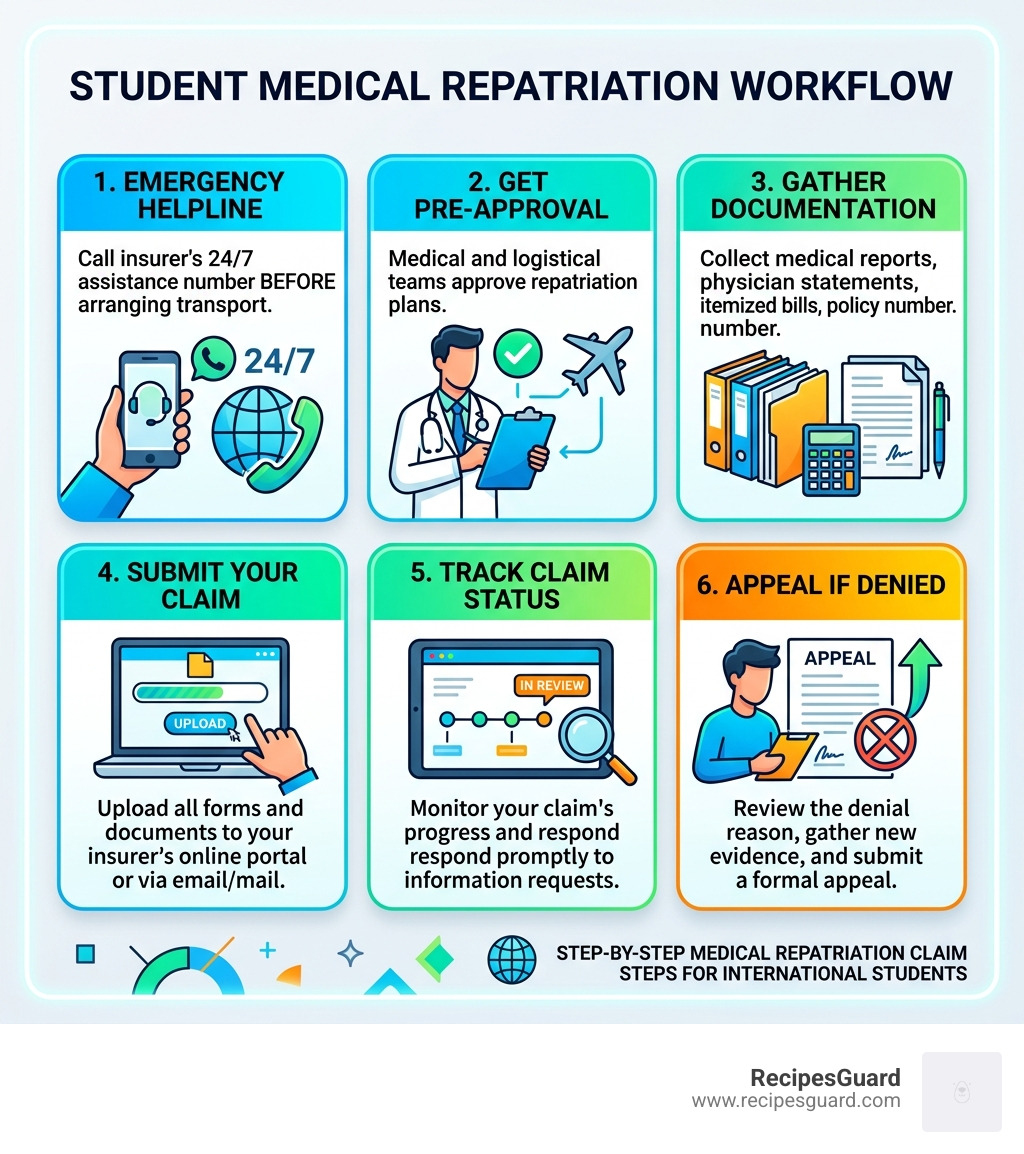
Here is a quick overview of the core steps:
- Call your insurer’s 24/7 emergency helpline immediately — before arranging any transport
- Get pre-approval from your assistance provider (such as International SOS or AXA Assistance)
- Gather documentation — medical reports, physician statements, itemized bills, and your policy number
- Submit your claim via your insurer’s online portal, email, fax, or mail
- Track your claim status and respond promptly to any requests for more information
- Appeal if denied — review the denial letter and submit additional supporting documents
Medical repatriation means being transported back to your home country for medical treatment — or, in the worst cases, having your remains returned home after a death abroad. For international students, this isn’t a distant possibility. A single medical evacuation can cost anywhere from $25,000 to $50,000 or more out of pocket without coverage.
Many students don’t realize their school-provided plan may not fully cover evacuation or repatriation. And even when it does, knowing how to actually file the claim is what determines whether you get reimbursed.
This guide walks you through every step — from the moment an emergency happens to the day your claim is resolved.
Understanding Medical Repatriation and Coverage Requirements
When we talk about medical repatriation, we are looking at two distinct but related services: Emergency Medical Evacuation and Repatriation of Remains. For international students in Australia or those traveling abroad for study, these aren’t just “nice-to-have” extras; they are often legal requirements for your visa.

Emergency Evacuation vs. Home Country Return
Medical evacuation usually involves moving a patient to the nearest medical facility that can provide the necessary care. Medical repatriation, however, is the process of returning you to your home country to continue treatment or to recover near your family.
In the context of Australian Overseas Student Health Cover (OSHC), the rules are strict. While OSHC covers many medical costs within Australia, the specific student medical repatriation claim steps for returning home often require a separate travel insurance policy or a high-tier health plan supplement.
Minimum Coverage Standards
If you are an international student, you must meet specific financial thresholds to ensure you aren’t a liability to the host government. Standard requirements usually include:
- Medical Evacuation: A minimum of $50,000 in coverage.
- Repatriation of Remains: A minimum of $25,000 to cover the costs of transporting a deceased student back home.
These limits are designed to cover the high costs of specialized air ambulances, medical escorts, and the complex logistics of international body transport. Without this coverage, families are often left with bills exceeding $50,000. To ensure you are meeting these standards, it is vital to understand the process of Making an insurance claim before you actually need to use it.
| Feature | Medical Evacuation | Repatriation of Remains |
|---|---|---|
| Purpose | Transport to a hospital or home for care | Transport of remains to home country |
| Typical Cost | $25,000 – $100,000+ | $10,000 – $25,000+ |
| Requirement | Often $50,000 minimum | Often $25,000 minimum |
| Trigger | Medical necessity/Physician order | Death of the insured |
Immediate Actions in a Medical Emergency
In May 2026, the speed of communication is your best friend. If you or a fellow student find yourselves in a situation where repatriation might be necessary, the very first thing you must do is contact the assistance provider.
The 24/7 Helpline
Every student insurance policy is backed by an emergency assistance company—names like International SOS, AXA Assistance, or On Call International. These companies are the “boots on the ground.” They don’t just pay the bills; they coordinate the planes, the doctors, and the paperwork.
Why you must call them first: If you arrange your own transport without pre-approval, your insurer will almost certainly deny the claim. The assistance provider must determine that the transport is “medically necessary.” They will conduct medical monitoring, speaking with the local doctors to decide if you are stable enough to fly and what level of medical care you need during the flight.
For a deeper dive into managing these high-stress moments, check out The International Student Guide To Emergency Claims And Evacuations and our guide on Mastering The Emergency Medical Student Claim Process.
Essential Student Medical Repatriation Claim Steps
Filing a claim for repatriation is more complex than a standard visit to a GP. It involves multiple international parties and high-stakes logistics. Following the student medical repatriation claim steps correctly is the difference between direct billing (where the insurer pays the transport company) and reimbursement (where you pay $40,000 and wait weeks to get it back).

Step 1: Pre-Authorization and Coordination
As mentioned, this is the “Golden Rule.” You must get the assistance company to authorize the evacuation. They will work with the hospital to get a medical report. If they approve it, they will often handle the payments directly with the air ambulance company. This is known as direct billing, and it is the ideal scenario because it protects your bank account.
Step 2: Managing Out-of-Pocket Expenses
Even with direct billing for the big stuff, you might have smaller out-of-pocket costs—like local ambulance rides, pharmacy bills, or extra hotel nights for a family member. Keep every single receipt. In Australia, insurers like Allianz Care or Bupa have specific portals where these can be uploaded instantly.
Step 3: Formal Submission
Even if the assistance company coordinated the flight, you still need to file a formal claim form to close the case. This links the medical records to the financial expenditures. For a full walkthrough of this journey, see the Complete Guide to Student Travel Insurance Claims | Step-by-Step Process.
Documentation Needed for Student Medical Repatriation Claim Steps
We cannot stress this enough: Documentation is the heart of your claim. If the paperwork is missing, the claim stops. You should gather:
- Physician Statement: A signed letter from the treating doctor explaining why you cannot be treated locally and must return home.
- Medical Reports: Full records of the diagnosis, treatments given, and your current stability.
- Itemized Bills: Standard invoices (often called HCFA or UB04 forms in some regions) that show exactly what you are being charged for.
- Pharmacy Receipts: These must show the drug name and dosage, not just a cash register total.
- Police Reports: If the medical emergency was caused by an accident or crime, a police report is mandatory.
- Death Certificate: In the tragic event of repatriation of remains, an official death certificate and a statement of the cause of death are required.
To make sure you don’t miss a single form, review our checklist: Everything You Need For A Student Medical Evacuation Claim.
Filing and Tracking Your Student Medical Repatriation Claim Steps
Once you have your “mountain” of paperwork, it’s time to submit. In May 2026, most Australian student insurers prefer digital submissions.
- Online Portals: This is the fastest method. You can upload photos of your documents directly from your phone.
- Deadlines: Be very careful here. Some plans, like Penn State’s Everest plan, require claims within 60 days. Others, like IMG Student Health Advantage, give you up to 180 days. If you miss the window, you lose the money.
- Processing Timelines: It typically takes 30 business days for an insurer to review a complex repatriation claim. If all documents are perfect, you might see a reimbursement in 5–15 business days.
- Tracking: Use the “Explanation of Benefits” (EOB) sent by your insurer to see what was paid and what was denied. Most modern insurers allow you to track this in real-time via an app.
For more tips on staying on top of the paperwork, read How To Manage The Medical Evacuation Claim Process.
Common Exclusions and Denial Reasons
It is a heartbreaking reality: some repatriation claims are denied. Understanding why can help you avoid these pitfalls.
1. Pre-existing Conditions
Many basic student plans exclude repatriation if the emergency is related to a condition you had before the policy started. However, many Australian OSHC and university-specific plans (like LSU SHIP) specifically waive this for repatriation to meet visa requirements. Always check your policy’s “Pre-existing Condition” clause.
2. Unauthorized Transport
If you decide to book a first-class ticket home because you “feel sick” without getting the assistance company’s approval, they will not pay. Repatriation is for medical necessity, not medical convenience.
3. Personal Travel
If your university insurance only covers you during “university-affiliated travel,” and you get injured while on a personal weekend trip to a different country, you might find yourself without coverage. We always recommend a standalone travel insurance policy for personal holidays.
4. Sanctions and High-Risk Zones
If you are studying in or traveling through a country under international sanctions, insurance providers may be legally unable to coordinate services or send funds there.
If you do face a denial, don’t panic. You have the right to an appeal process. You can submit new evidence, such as a more detailed doctor’s note, to prove the necessity of the claim. Learn more about navigating these hurdles in The Great Escape Filing An Emergency Evacuation Claim As A Student.
Frequently Asked Questions about Repatriation
How long does it take to process a repatriation claim?
While the actual flight is coordinated in hours or days, the financial claim processing usually takes 30 days. If you have submitted a perfect “clean claim” with all itemized bills and physician statements, reimbursement can happen as quickly as 5 to 15 business days.
Who coordinates the actual transportation?
The assistance company (like AXA or International SOS) does the heavy lifting. They coordinate with the hospital, the air ambulance company, and the receiving facility in your home country. They also handle the complex “wing-to-wing” transfers if you need to change planes.
Does student insurance cover family bedside visits?
Many premium student plans include a “Bedside Visit” or “Emergency Reunion” benefit. This typically pays for a round-trip economy ticket and a small daily allowance (around $1,500 to $2,500 total) for a family member to fly to you if you are hospitalized for more than a few days.
Conclusion
Navigating the student medical repatriation claim steps is undoubtedly daunting, especially when you are dealing with a health crisis. However, by acting quickly, involving your assistance provider immediately, and keeping a meticulous record of every document, you can protect yourself from life-altering debt.
At RecipesGuard, we are dedicated to making these complex insurance hurdles easy to clear. Whether you are an international student in Australia or a domestic student heading abroad, our step-by-step tutorials are designed to give you peace of mind.
Don’t wait for an emergency to learn the ropes. Start your student insurance claim today or browse our other guides to ensure you are fully protected for your academic journey. Safe travels!

My name is Bianca, and my journey into the world of fermentation and food safety began with a costly mistake. I once lost an entire season’s harvest of chili peppers because I relied on guesswork instead of science. That failure was my turning point.
