
Smart Student Travel Insurance for Your Gap Year Adventure
Why Gap Year Student Travel Insurance Can Make or Break Your Adventure
Gap year student travel insurance is a specialized type of travel policy designed to protect students during extended trips abroad – typically covering medical emergencies, trip cancellations, lost gear, and evacuation for trips lasting up to 365 days across multiple countries.
When evaluating student-focused gap year insurance in 2026, look for these key coverage benchmarks:
- Medical Coverage: Aim for at least $250,000 to $1,000,000 in emergency medical expenses.
- Trip Duration: Ensure the policy supports continuous travel for 180 to 365 days.
- Activity Inclusion: Check for at least 50-100 standard activities, including basic hiking and cycling.
- Emergency Assistance: 24/7 support is non-negotiable for international travel.
Here’s the hard truth: most standard health insurance plans stop working the moment you leave your home country. If you get hurt abroad, you’re looking at paying out of pocket – and international medical bills can run into tens of thousands of dollars.
Gap year travel is exciting. It’s also unpredictable.
A traveler once got cut off by a dog while cycling, fractured their foot and hand, needed surgery, and had to be repatriated home – all expenses that only travel insurance covered. That kind of situation can happen to anyone, at any time.
The right insurance policy is the difference between a setback and a financial disaster.
Travel insurance typically costs between 5% and 7% of your total trip cost. For students, age works in your favor – younger travelers pay lower premiums. But longer trips and adventure sports can push that cost up, so knowing exactly what to look for matters.
For general travel-health planning, it can also help to review official traveler advice from the Australian Government Smartraveller website.
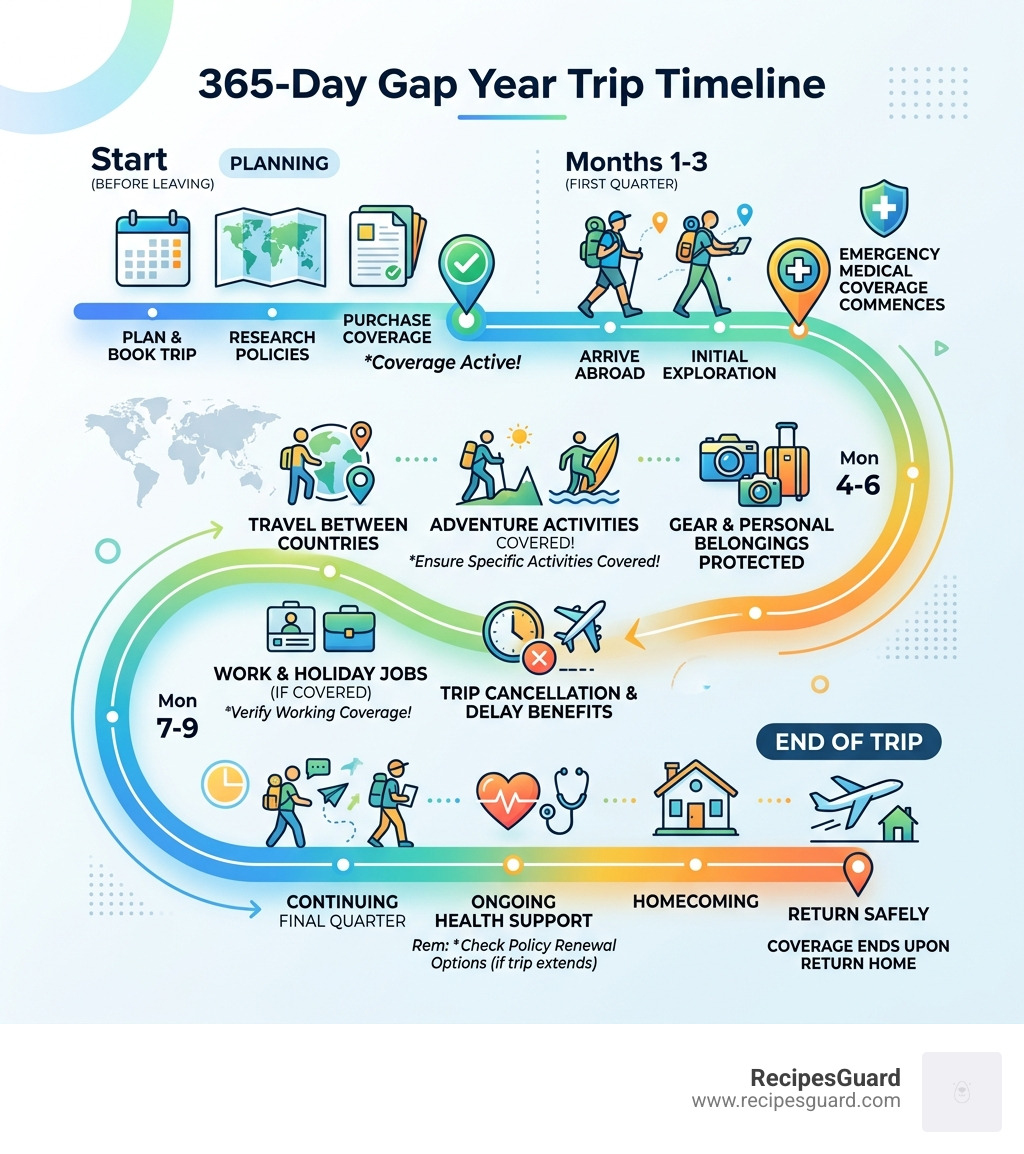
Easy gap year student travel insurance glossary:
- adventure activity injury claim
- backpacker insurance claim tips
- delayed baggage claim procedure
Understanding Gap Year Student Travel Insurance

When we talk about gap year student travel insurance, we aren’t just talking about a standard two-week holiday policy. A gap year is a marathon, not a sprint. Whether you are trekking through the Andes, working in a bar in London, or volunteering in Southeast Asia, your insurance needs to be as flexible and enduring as your itinerary.
Standard policies often cap a single trip at 30 or 60 days. For a student taking a full year off, that simply won’t cut it. Gap year policies are built for the long haul, often offering coverage for 12 to 18 months. They also understand that you might visit ten different countries in that time, meaning the policy needs to cover multiple regions under one umbrella.
For more foundational details, check out our guide on Everything You Need to Know About Gap Year Travel Cover.
What is gap year student travel insurance?
At its core, this is “backpacker insurance” with a academic-aged twist. It is designed for young travelers (usually aged 18 to 30, though some providers cover up to 75) who need extended duration protection.
The key features include:
- Extended Duration: Coverage for up to 365 days, often extendable while you are still on the road.
- Multi-Country Flexibility: You don’t need to list every single bus stop, but you do need to ensure the “region” (e.g., Worldwide excluding USA/Canada) matches your plans.
- One-Way Travel: Unlike standard annual multi-trip policies that require you to start and end every trip at home, gap year policies often allow for one-way journeys.
- Residency Requirements: Most insurers require you to be a permanent resident of the country where you buy the policy (like Australia) and to be registered with a national healthcare system back home.
Why students need specialized coverage
You might feel invincible at 19, but the world has a way of throwing curveballs. Specialized gap year student travel insurance is vital because it addresses the specific risks young adventurers face.
For instance, many structured gap year programs mandate high limits: $100,000 for accident and sickness and $150,000 for medical evacuation. Why such high numbers? Because a medical flight from a remote village back to a major hospital can easily cost $50,000 or more.
Without a student-focused plan, you might find yourself excluded from coverage if you decide to take a casual job or try a “high-risk” activity like bungee jumping. We explore these nuances further in our article on Why Specialized Student Coverage Matters.
Essential Coverage for Your Global Journey

When shopping for a policy, don’t just look at the price tag. Look at the “Emergency Medical” and “Repatriation” limits. We recommend looking for policies that offer at least $250,000 in medical coverage, though some premium plans offer unlimited emergency medical expenses.
Dental is another “essential” that often gets overlooked. Most gap year plans cover emergency dental (to relieve sudden pain), but they won’t pay for a routine check-up or a new set of braces.
For those on a budget, you can find Gap Year Insurance Policies That Won’t Break the Bank that still prioritize these life-saving essentials over “nice-to-have” extras like high-end luggage protection.
Adventure sports and high-risk activities
This is where many students get caught out. Did you know that some “standard” policies consider hiking above a certain altitude or even basic scuba diving to be “high-risk”?
Specialized gap year policies often include about 90+ activities as standard, including bungee jumping (usually limited to a specific number of jumps) and scuba diving down to 18 meters. However, if you plan on skydiving, white-water rafting, or trekking the Inca Trail, you often need to buy an “Adventure” or “Extreme” add-on.
Before you leap off that bridge in New Zealand, read our guide: Don’t Let Your Adrenaline Junkie Habits Void Your Policy.
Working and volunteering abroad
Many students fund their gap year by working in bars, hostels, or fruit picking. It is a classic “Aussie” rite of passage. However, standard travel insurance often excludes “manual labor.”
In gap year student travel insurance, “manual labor” usually has a specific definition. You are often covered for:
- Bar and restaurant work.
- Retail and clerical jobs.
- Volunteering (like building wells or teaching).
However, you are usually not covered for:
- Working at heights over 6 meters.
- Using heavy machinery or power tools.
- Lifting weights over 25kg.
If you are heading to the Outback or a farm in Europe, make sure your policy specifically allows for the type of work you’ll be doing. Check out our advice on Insurance for Working and Volunteering Overseas for more details.
Navigating Exclusions and Policy Limitations
Understanding what your insurance won’t do is just as important as knowing what it will. Most travel insurance is for “unforeseen” events. This means if you already knew about a problem, it probably isn’t covered.
We’ve seen students lose thousands because they didn’t realize that a pre-existing condition (like asthma or even a recently broken bone) wasn’t automatically covered. To avoid these traps, read How to Choose the Best Insurance for Your Overseas Adventure.
Common exclusions in gap year student travel insurance
Here are the “Big Four” exclusions that void most student claims:
- Alcohol and Drugs: If you get into an accident while intoxicated, your claim will almost certainly be denied. This applies even if you are in a country where the drinking age is lower than back home.
- Unlicensed Motorcycling: Riding a scooter in Bali is a gap year cliché, but if you don’t have a valid motorcycle license in Australia and the local country, you aren’t covered. And yes, you must wear a helmet.
- Reckless Behavior: Insurers won’t pay if you were “acting like an idiot.” This includes climbing on balconies or jumping off cliffs into water.
- Non-Emergency Treatment: Travel insurance is not a substitute for general health insurance. It won’t pay for a routine physical or that “weird rash” unless it’s an emergency.
Understanding the “Already Traveling” rule
Realized you forgot to buy insurance while sitting in a hostel in Hanoi? You aren’t alone. Some specialized providers allow you to buy a policy after you’ve already left home.
However, there are rules:
- Waiting Periods: There is usually a 48-hour to 72-hour waiting period before the cover kicks in to prevent people from buying insurance after they get hurt.
- Residency: You still usually need to be a resident of a supported country (like Australia).
- No Claims for Past Events: Obviously, you can’t claim for anything that happened before you bought the policy.
If you are planning a working holiday, see our specific guide: How to Pick the Best Insurance for Your Aussie Working Holiday.
Mastering the Claims Process with RecipesGuard
At RecipesGuard, we specialize in the part of insurance that everyone hates: the claims process. Having a policy is great, but getting paid is what matters. We provide step-by-step tutorials to ensure you don’t miss a single piece of documentation.
The most common reason for a rejected claim is a lack of evidence. If your phone is stolen, you need a police report. If you go to the hospital, you need the discharge papers and the itemized bill.
How to handle theft and lost property
Theft is a major concern for gap year students carrying laptops, cameras, and smartphones. To make a successful claim:
- Report it within 24 hours: You must get a written police report from the local authorities. If the police won’t help, report it to the hostel manager or the bus company and get it in writing.
- Proof of Ownership: You need to prove you actually owned the item. Keep digital copies of your receipts or even photos of you holding the device.
- Gadget Limits: Most policies have a “single item limit” (often around $500–$1,000). If your MacBook costs $3,000, you may need a high-value item add-on.
Learn more at How to Handle a Gap Year Theft Claim Without Losing Your Mind.
Managing medical claims and hospital direct pay
In a medical emergency, the last thing you want to do is figure out how to pay a $10,000 hospital bill.
- Contact the Emergency Hotline: Every policy has a 24/7 assistance number. Call them immediately. They can often arrange “Direct Pay,” meaning the insurer pays the hospital directly so you don’t have to.
- Reverse-Charge Calls: If you don’t have international roaming, ask the hospital to place a reverse-charge call to the insurer.
- Keep Every Scrap of Paper: Even if the insurer pays the hospital, you might have out-of-pocket costs for prescriptions or taxis that you’ll need to claim later.
For students studying abroad, see The Best Student Insurance for Your Semester Abroad.
Frequently Asked Questions about Gap Year Coverage
Does gap year insurance cover high-risk sports?
Yes, but usually through an “Adventure Pack” or “Extreme Activity” add-on. Standard policies cover basics like swimming and hiking, but things like bungee jumping, skydiving, or scuba diving usually require a higher tier of coverage. Always check the “Activity List” in your policy wording before you book that adrenaline hit.
Can I buy gap year student travel insurance if I’m already abroad?
Yes, certain providers specialize in “Already Travelling” cover. However, be prepared for a 48-hour waiting period before the policy becomes active. This is an anti-fraud measure to ensure people don’t buy insurance only after an accident has occurred.
How much does student travel insurance cost in 2026?
Typically, you should budget between 5% and 7% of your total trip cost for insurance. For a six-month trip, you might see prices ranging from $450 to $800 depending on your destination (the USA is always more expensive due to healthcare costs) and the activities you have planned.
Conclusion
Taking a gap year is one of the most rewarding things you will ever do. It’s a year of growth, adventure, and probably a few stories you shouldn’t tell your parents. But it only stays a “good story” if you have a safety net beneath you.
By choosing the right gap year student travel insurance, you aren’t just buying a piece of paper; you’re buying the freedom to explore with confidence. Whether it’s a long-stay policy that lets you return home for Christmas or a comprehensive backpacker plan that covers your bar work in Ibiza, the right choice today saves you a world of pain tomorrow.
Before you zip up your backpack, use this final checklist:
- [ ] Does my policy cover the entire duration of my trip (up to 365 days)?
- [ ] Are all the countries on my itinerary included in the coverage region?
- [ ] Have I added coverage for specific high-risk sports I plan to try?
- [ ] Do I have digital copies of my receipts and the 24/7 emergency assistance number?
Gap Year Policy Comparison for 2026
| Feature | Single-Trip Gap Year | Annual Multi-Trip |
|---|---|---|
| Max Trip Length | 365+ Days | 31–60 Days per trip |
| Best For | One long adventure | Multiple short breaks |
| Home Visits | Often allowed (e.g., 2 visits) | Requires return to start new trip |
| Working Abroad | Usually included for light labor | Often excluded |
For more expert advice on navigating student travel, visit us at www.recipesguard.com. Safe travels!

My name is Bianca, and my journey into the world of fermentation and food safety began with a costly mistake. I once lost an entire season’s harvest of chili peppers because I relied on guesswork instead of science. That failure was my turning point.
