
Patience is a Virtue: Managing Student Health Claim Delays
When a Student Health Delay Claim Stands Between You and Your Recovery
A student health delay claim is one of the most stressful things you can face as an international student — especially when you’re already dealing with a medical issue far from home.
Before we dive deep, here’s a quick answer if you need it now:
How to resolve a student health delay claim fast:
- Log into your insurance portal and check your claim status immediately
- Respond to any information requests from your insurer (missing records are the #1 cause of delays)
- Confirm your provider submitted the claim to the correct address and used the right Electronic Payer ID
- Call your insurer’s student-specific helpline (e.g., Aetna Student Health: 1-877-480-4161, Mon-Fri, 8AM-9PM ET)
- File a written appeal if your claim is formally denied
Most student health claims take 2 to 4 weeks to process. If yours is taking longer, something specific is holding it up — and it’s almost always fixable.
The US healthcare system is complicated enough for people who grew up in it. For international students, it can feel completely overwhelming.
You visit a doctor, you think you’re covered, and then — nothing. No payment. No clear explanation. Just a bill sitting on your desk and an insurer asking for documents you didn’t know you needed.
This is more common than you’d think. Claims get stuck for reasons that have nothing to do with whether you’re actually covered. A wrong mailing address. A missing signature. A provider who accidentally submitted your claim to the wrong insurance database.
The good news? Most delayed claims can be resolved — if you know the right steps to take.
This guide walks you through exactly what to do, from understanding why your claim is delayed to getting your money back as quickly as possible.
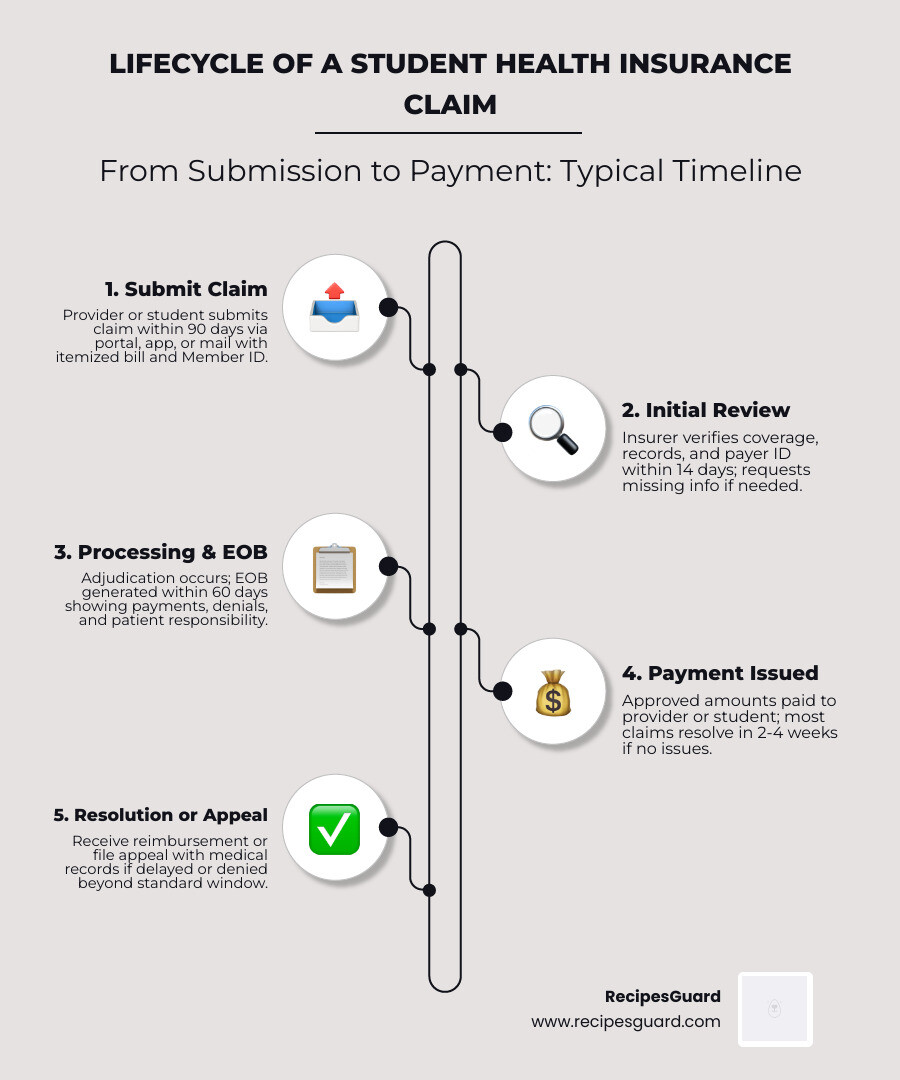
Understanding the Student Health Delay Claim Process
When we talk about a student health delay claim, we are referring to any medical insurance submission that has exceeded the standard processing window—typically 14 to 30 days—without a resolution or payment. Navigating this requires a basic understanding of insurance “paperwork” (which is mostly digital these days).
The most important document you will encounter is the Explanation of Benefits (EOB). Think of the EOB as a “healthcare report card” rather than a bill. It tells you what service was provided, how much the insurance company paid, and how much you might owe. Usually, an EOB is generated within 60 days of your appointment. If you haven’t seen one in your portal or mailbox after two months, your claim is likely stuck in a “delay” state.
For students, timing is everything. Most policies have a 90-day submission deadline. If your doctor’s office forgets to send the bill or sends it to the wrong place, and you don’t catch it within those three months, you could be left holding the bill yourself. We always recommend checking your claim status online every two weeks after a major appointment to ensure everything is moving through the system.
Navigating international student health requirements adds another layer of complexity. Many universities require specific “comparable coverage” that meets high standards. If you are traveling or studying abroad, you might also be dealing with The Ultimate Guide To Trip Interruption And Illness Claims/, where medical issues overlap with travel disruptions.
Common Reasons for a Student Health Delay Claim
Why do claims get stuck? In our experience, it’s rarely because the insurance company is just being “mean.” It’s usually a technical or administrative hiccup.
- Missing Records: The insurer might need your clinical notes to prove the visit was “medically necessary.” If your doctor doesn’t send these, the claim sits in limbo.
- Incorrect Address: Believe it or not, many claims are delayed because they were mailed to a general insurance office instead of the dedicated student resources P.O. Box.
- System Disconnects: This is a big one for students. Many providers see a “UnitedHealthcare” logo and try to verify you in the general UHC database. However, student plans often live in a separate system (like UHCSR). If the receptionist looks in the wrong “room,” they’ll tell you your coverage is expired when it isn’t.
- Electronic Payer ID Errors: Every insurer has a digital “zip code” called a Payer ID. If the hospital uses the wrong ID, your claim is essentially sent to a dead-letter office.
- Primary vs. Secondary Conflicts: If you are covered by your university plan AND a parent’s plan, both insurers might point at each other and say, “You pay first!” This “Coordination of Benefits” is a frequent cause of a student health delay claim.
To process refunds efficiently, always ensure the insurance company has your current local address and bank details for direct deposit.
The Impact of Prior Authorization on Processing Times
One of the biggest hurdles in modern healthcare is Prior Authorization (PA). This is a requirement where your doctor must get “permission” from the insurance company before performing certain procedures or prescribing expensive meds.
The administrative burden is staggering. Research shows that the average physician practice completes over 40 prior authorizations per physician per week. Doctors and their staff spend nearly two business days every week just filling out these forms.
When you are a student, this volume can lead to significant delays. If your PA isn’t approved before your appointment, the claim for that appointment will almost certainly be denied or delayed. There are currently nearly 90 reform bills in various state legislatures, as tracked by the American Medical Association, aimed at speeding this up, but for now, the burden often falls on the patient to follow up. Understanding the specific fund rules for your student cover is essential to knowing which services require this “pre-approval” to avoid a student health delay claim.
Step-by-Step Guide to Resolving a Student Health Delay Claim
If you’re staring at a “Pending” status or a surprise bill, don’t panic. Follow this sequence to get things moving.

- Verify the Payer ID and Address: Call your doctor’s billing office. Ask them exactly where they sent the claim. Compare this to the “Claims Submission” address on the back of your insurance ID card.
- Provide your Member ID (with the prefix): Student ID numbers often have specific letters at the beginning. If the provider leaves these out, the system won’t recognize you.
- Request an Itemized Bill: If the claim was rejected, ask the provider for a “HCFA” or “UB-04” form. This is the standard coded version of your bill that insurers require.
- Check for Questionnaires: Insurers often send “Accident Questionnaires” or “Other Insurance” forms. If you don’t fill these out and send them back, they will stop processing all your claims.
If your medical delay is part of a larger travel issue, you might find helpful strategies in our guide on Student Flight Delay Claims Tips To Get Your Money Faster/ or learn about broader administrative hurdles in Mastering The Visa Insurance Claim Process For Delays And Rentals/.
How to Expedite a Student Health Delay Claim
We all want our claims settled yesterday. While we can’t warp time, we can use technology to skip the line.
- Real-Time Benefit Tools (RTBT): Some modern plans offer tools that allow doctors to see your coverage and costs instantly while you are still in the office. Ask your provider if they use RTBT to check for prior authorization requirements on the spot.
- Stay In-Network: Using “In-Network” providers is like having a VIP pass. These doctors have contracts with your insurer and usually handle all the paperwork correctly. If you go out-of-network, you are often responsible for filing the claim yourself, which increases the chance of a student health delay claim.
- Digital ID Cards: Always keep a screenshot of your ID card on your phone. It contains the Electronic Payer ID, which is the “magic number” the billing office needs to get paid.
- Coordinate Specialty Care: If you are seeing a dentist or a specialist, ensure they have your primary student health info. Even though there are 262,000 dental practices in the US, many are not used to the specific requirements of international student plans.
For more tips on navigating the bureaucracy of insurance, check out The Art Of The Claim Getting Paid For Your Travel Delays/.
Documentation Required for Successful Appeals
If your claim is officially denied after a long delay, you have the right to appeal. You will need a “paper trail” to win:
- Detailed Medical Records: Ask your doctor for the “S.O.A.P. notes” from your visit.
- Signed Authorization: You may need to sign a HIPAA release form so the insurer can talk to your doctor.
- Physician’s Letter of Medical Necessity: A short note from your doctor explaining why the treatment was required can overturn a denial.
- Certificate for Study Delay: In some cases, if a medical issue has caused you to miss class or exams, you may need an official medical certificate. This is common in systems like the Netherlands (SGZ) or Australia, where a “study delay due to illness” certificate supports academic extensions and financial claims.
Navigating University-Specific Deadlines and Appeals
Every university has its own set of rules. Missing a deadline can be just as costly as a denied claim.
| Feature | Domestic Student Plan (SHIP) | International Student Cover (OSHC/Similar) |
|---|---|---|
| Enrollment | Often automatic if over 6 credits | Mandatory for visa compliance |
| Waiver Deadline | Usually first 2 weeks of semester | Often rigid; requires proof of equal cover |
| Payer System | Standard US PPO (e.g., Aetna, BlueCross) | Specialized International Networks |
| Refunds | Rare after the “Drop/Add” date | Possible for visa denials or early departure |
Protecting your finances during trip interruptions or medical emergencies requires staying ahead of these dates. If you miss a waiver deadline, you might be charged twice for insurance—once for your private plan and once for the university plan.
Handling Late Waiver Appeals and Fee Reversals
If you missed the deadline to waive the university insurance because you already had your own, you might be facing a bill for thousands of dollars. Most universities have a “Late Waiver Appeal” process, but they are strict.
To succeed, you usually need to provide Proof of Comparable Coverage. This means your private insurance must meet specific criteria: it must be active from the first day of the semester, have a local provider network, and cover mental health and emergencies.
If you experience a Qualifying Event (like losing coverage under a parent’s plan or getting married), you can often request a post-deadline change. Just remember that university health fees are often non-refundable once the semester is in full swing, so act the moment you notice an error on your student account.
Frequently Asked Questions about Student Health Claims
How long does it typically take to process a student health insurance claim in 2026?
In May 2026, the standard processing time for an electronic claim is 10 to 20 business days. If a claim is submitted via paper mail, it can take up to 30 to 45 days. If your claim has been “Pending” for more than 30 days, it is time to call your insurer and ask if they are waiting for additional information.
Who should I contact if my claim is stuck between my provider and the insurer?
Start with the Insurance Coordinator at your University Health Center. They are experts in the specific plan your school uses and often have “backdoor” contact numbers for the insurance company. If the issue is a billing error, contact the Provider’s Billing Office. If the insurer is the one delaying, call the Member Services number on your ID card.
What are my rights if a claim denial leads to financial hardship or delayed care?
You have the right to a full explanation of why a claim was denied. Under the law, insurers must provide a rationale and tell you how to appeal. If the delay is causing a “hazard to patient health,” your doctor can request an Expedited Appeal, which usually requires a decision within 72 hours. You can also contact your State Bureau of Insurance if you feel the insurer is acting in bad faith.
Conclusion
Managing a student health delay claim is a test of patience, but it is a winnable battle. By staying organized, keeping digital copies of your ID cards, and responding quickly to insurer requests, you can ensure that medical bills don’t derail your education.
At RecipesGuard, we believe that no student should have to choose between their health and their tuition. Whether you are dealing with a local medical bill or a complex international reimbursement, the key is to be proactive. Don’t wait for the “Final Notice” to arrive—check your EOBs early and often.
For more student-focused advice and step-by-step claim filing tutorials, we are here to help you navigate the paperwork so you can get back to what matters most: your studies.
More info about student claim services


My name is Bianca, and my journey into the world of fermentation and food safety began with a costly mistake. I once lost an entire season’s harvest of chili peppers because I relied on guesswork instead of science. That failure was my turning point.
