
Navigating Schengen Visa Insurance for Your Next European Escape
What Australians Need to Know About Schengen Visa Insurance
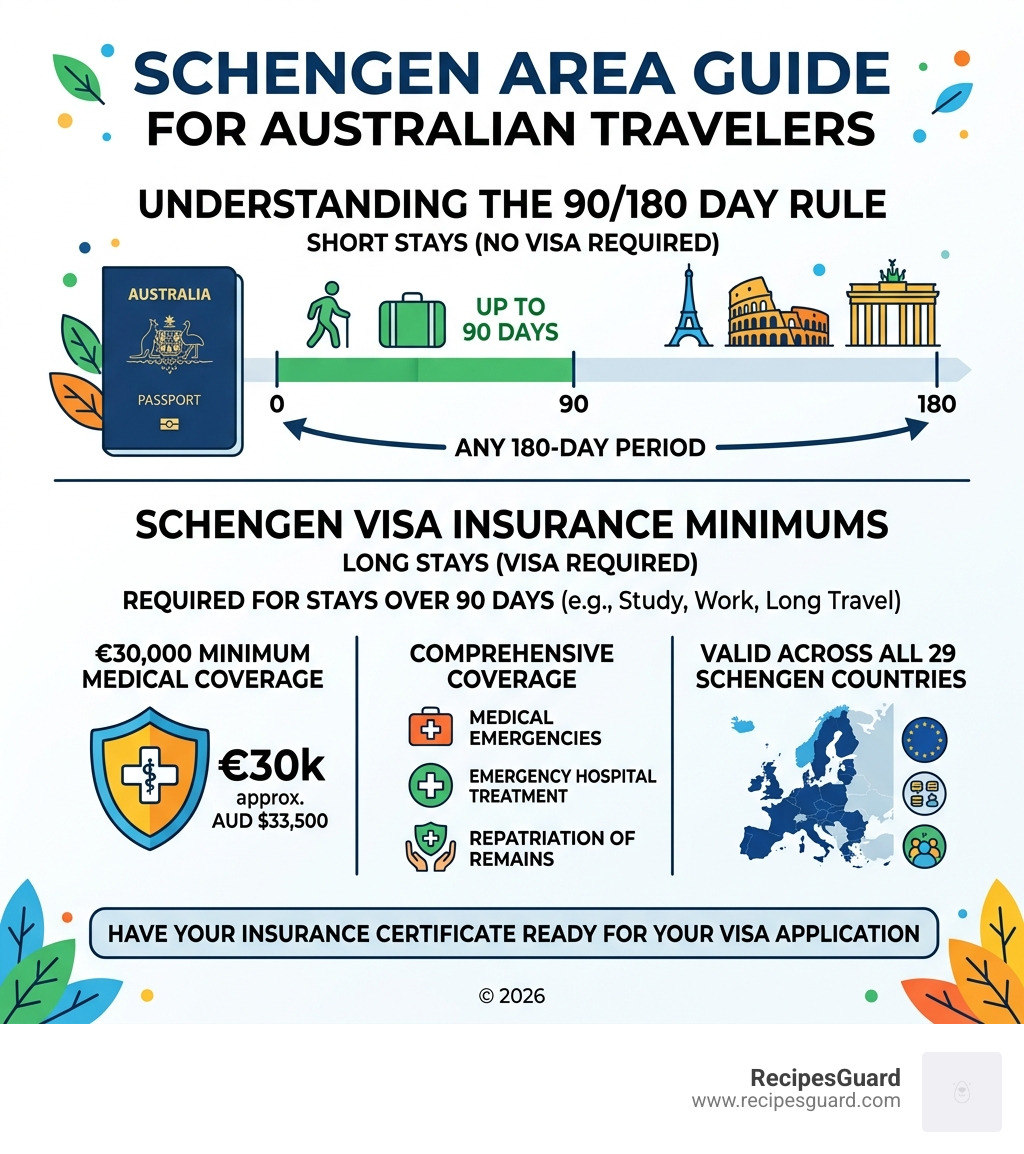
Schengen visa insurance Australia is a topic every Australian planning an extended European trip needs to understand before booking flights or walking into an embassy appointment.
Here’s a quick summary of the key requirements:
| Requirement | Details |
|---|---|
| Minimum medical coverage | €30,000 (approx. AUD $33,500) per person |
| What it must cover | Medical emergencies, emergency hospital treatment, repatriation of remains |
| Valid across | All 29 Schengen countries |
| Who needs it | Australians applying for a Schengen visa (stays over 90 days) |
| Short stays under 90 days | No visa required, but travel insurance is still strongly recommended |
| Proof required | Insurance certificate submitted with visa application |
Australia gives you a lot of freedom in Europe. As an Australian passport holder, you can travel visa-free across the Schengen Area for up to 90 days in any 180-day period — no visa, no insurance requirement from the embassy.
But the moment you go beyond that — for study, work, or a longer gap year — everything changes. You’ll need a Schengen visa, and with it, a travel insurance policy that meets strict EU standards.
Finding a policy that actually meets those standards is harder than it sounds. Many policies offer unlimited medical cover but fall short on the repatriation of remains clause — which must also reach the €30,000 threshold. Getting that detail wrong can mean a rejected visa application.
This guide walks you through exactly what’s required, which Australian insurers meet the mark, and how to get your documentation ready for your consulate appointment.
Schengen visa insurance australia glossary:
- claim timeline extension guide
- corporate travel insurance australia
Understanding the Schengen Area and Entry Requirements for Australians
The Schengen Area is one of the world’s most significant travel zones, comprising 29 European countries that have officially abolished all passport and other types of border control at their mutual borders. For us Australians, it’s essentially a giant playground where we can hop from the cafes of Paris to the canals of Amsterdam without showing our passport every few hours.
The current member countries include: Austria, Belgium, Bulgaria, Croatia, Czech Republic, Denmark, Estonia, Finland, France, Germany, Greece, Hungary, Iceland, Italy, Latvia, Liechtenstein, Lithuania, Luxembourg, Malta, Netherlands, Norway, Poland, Portugal, Romania, Slovakia, Slovenia, Spain, Sweden, and Switzerland.
The 90/180 Day Rule
As of April 2026, the rule for Australian citizens remains the same: we enjoy visa-exempt status for short stays. This means we can enter the Schengen Zone for up to 90 days within any 180-day period for tourism or business.
However, if you are a student planning a semester abroad or a professional heading over for a long-term contract, the “visa-free” party ends at day 90. For stays exceeding this limit, you must apply for a National Visa (D-type) or a specific Schengen Visa. A non-negotiable part of this application is providing proof of Schengen visa insurance australia that meets the Essential Documents & Coverage requirements set by the European Union.
Upcoming Changes: EES and ETIAS in 2026
If you are planning your escape for later this year or into 2027, you need to be aware of two major digital shifts in European border management.
- The Entry/Exit System (EES): This is a digital border management system that replaces the old-fashioned passport stamping. It records your name, type of travel document, biometric data (fingerprints and facial images), and the date and place of entry and exit. Full biometric implementation is expected to be standard across the zone by April 2026.
- ETIAS (European Travel Information and Authorisation System): By late 2026, Australians will need to apply for an ETIAS authorization before flying. It’s not a visa, but rather a pre-travel screening similar to the US ESTA. It will cost roughly €7–€10 and be valid for three years.
While ETIAS is for short-term travelers, those of us applying for full visas still need to focus on the mandatory insurance requirements to ensure our applications aren’t tossed out.
Mandatory Schengen Visa Insurance Australia Requirements
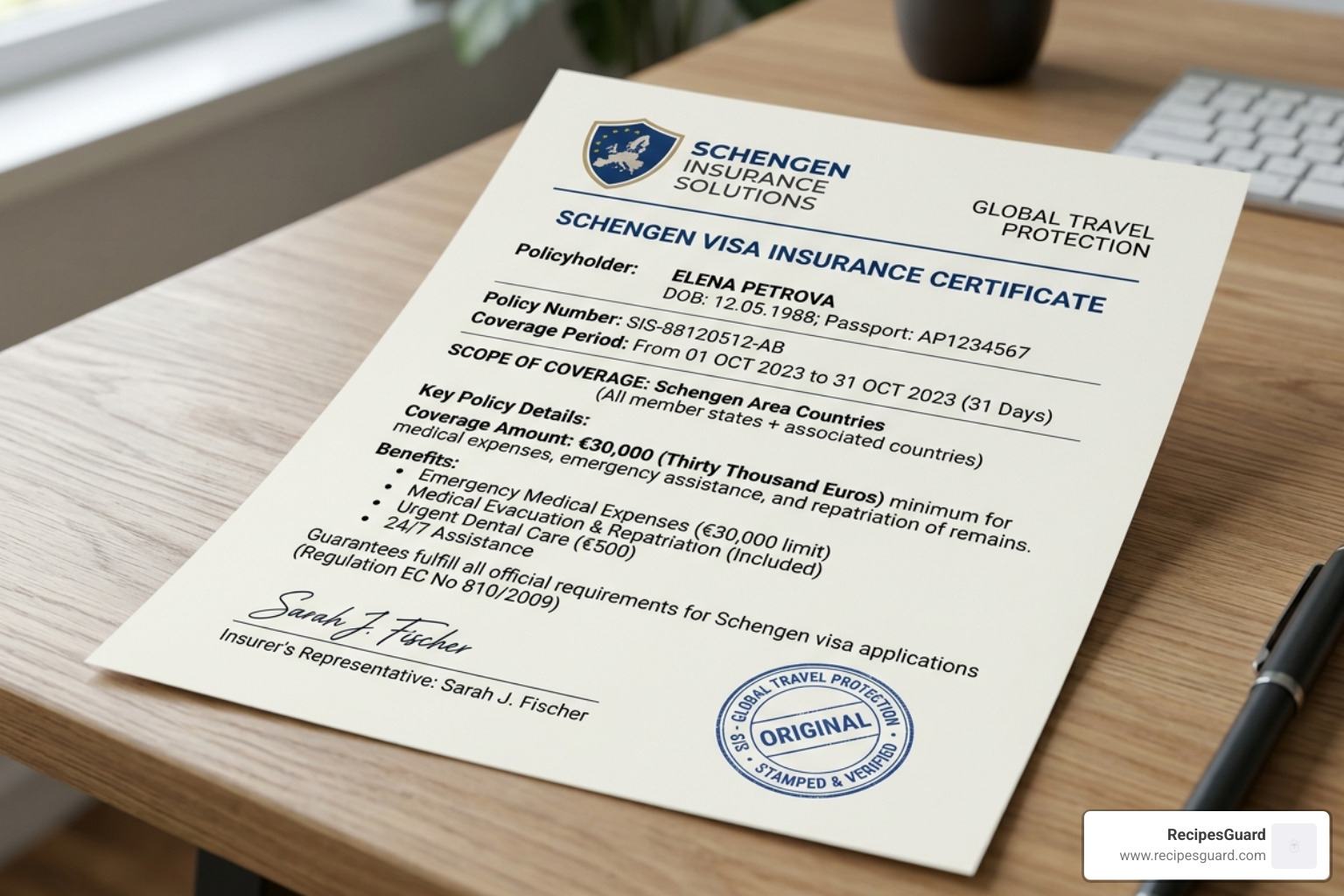
The European Union is very specific about what they want to see in your insurance policy. They aren’t just checking that you “have insurance”; they are looking for specific clauses that protect their public health systems from footing the bill for foreign visitors.
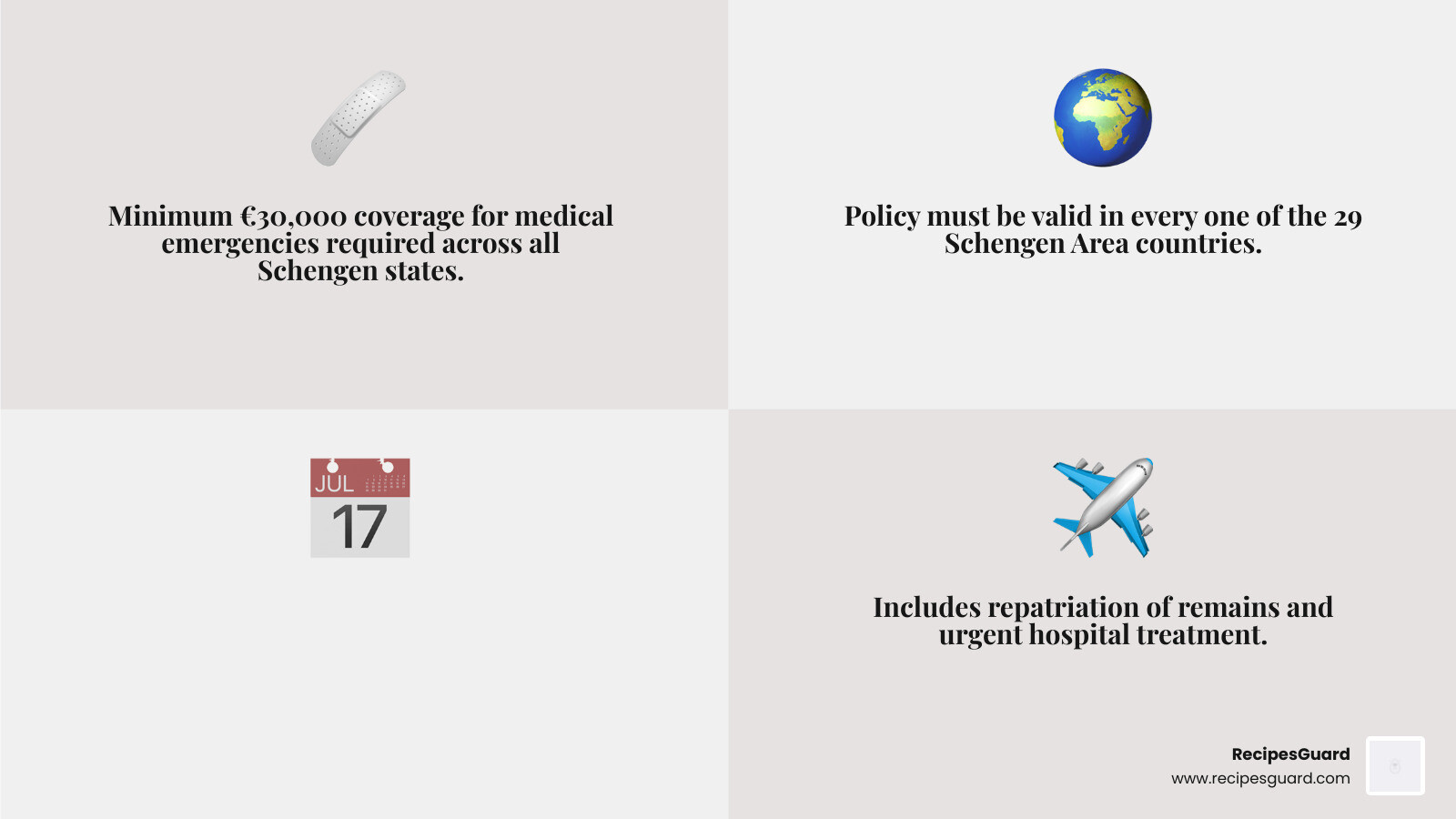
To be compliant, your Schengen visa insurance australia must meet these four pillars:
- Minimum Coverage: At least €30,000 (roughly $33,500 AUD).
- Geographic Scope: It must be valid in all member states of the Schengen Area, not just the country you are visiting first.
- Duration: It must cover the entire period of your intended stay.
- Specific Coverage Items: It must include emergency medical expenses, urgent hospital treatment, and—crucially—repatriation of remains (the cost of sending you home in the event of death or severe illness).
Why Australians Need Schengen Visa Insurance Australia for Long Stays
You might wonder, “If I’m healthy and young, why do I need to pay for this?” For the Australian government and European consulates, it’s about risk management.
- Students: Most European universities require proof of compliant insurance before they will even issue your enrollment confirmation for a student visa.
- Gap Year Travelers: If you’re planning to spend six months van-lifing through Portugal and Spain, you will exceed the 90-day limit. Without a visa and the accompanying insurance, you risk being deported and banned from the zone.
- Work Visas: If you’ve landed a dream job in Berlin, your employer might provide health insurance once you start, but the embassy requires travel insurance to cover the gap between your arrival and your first day of work.
How to Choose and Apply for Compliant Coverage
Choosing a policy isn’t just about finding the cheapest price. You need to ensure the insurer provides a “Visa Letter” or “Schengen Certificate.” This is a one-page document that explicitly states the policy meets Article 15 of the Visa Code.
Comparison Table: What to Look For
| Feature | Basic Schengen Plan | Comprehensive Australian Plan |
|---|---|---|
| Medical Limit | Usually exactly €30,000 | Often Unlimited |
| Repatriation | Included (Min €30,000) | Included (Check PDS for limits) |
| Cancellations | Often not included | Up to $20,000+ |
| Luggage/Gear | Minimal coverage | High limits for tech/cameras |
| Deductible | Usually $0 | Usually $100 – $250 |
We often recommend that students look for policies with a zero deductible (or “excess”). While this might raise the premium slightly, it ensures that if you have a minor accident, you aren’t paying the first $250 out of your own pocket before the insurance kicks in.
Visa Refusal Refund Policies
One pro-tip we always share at RecipesGuard: check if the insurer offers a full refund if your visa is rejected. Many reputable providers offer a refund if you can show a rejection letter from the embassy, provided the policy hasn’t started yet.
Securing Your Schengen Visa Insurance Australia Certificate
Once you’ve purchased your policy, you’ll receive a mountain of paperwork. The only piece the consulate truly cares about is the Insurance Certificate.
To ensure it passes the test:
- Language: It must be in English (which Australian policies are) or the official language of the country where you are applying.
- Personal Details: Your name and date of birth must match your passport exactly. No nicknames!
- Explicit Coverage: It must mention “Repatriation” and “Medical Emergencies” alongside the €30,000 figure.
- Dates: The insurance must start on or before the day you enter the Schengen Area and end on or after the day you leave.
Navigating the Application and Claims Process

Applying for the visa is a multi-step marathon. You’ll likely need to book an appointment at a VFS Global center or a specific consulate in Sydney, Melbourne, or Canberra.
The Documentation Checklist:
- A valid passport (must be less than 10 years old and valid for 3 months after you leave Europe).
- Two recent passport-sized photos.
- The signed application form.
- Your Schengen visa insurance australia certificate.
- Proof of accommodation (hotel bookings or an invitation letter).
- Proof of financial means (usually three months of bank statements showing you can support yourself).
How to File a Claim (The RecipesGuard Specialty)
At RecipesGuard, we specialize in helping students navigate the messy world of claims. If you do end up in a European hospital, follow these steps:
- Contact the 24/7 Assistance Line: Every policy has one. Call them before you agree to major surgeries if possible. They can often arrange “direct billing” so you don’t have to pay thousands of Euros upfront.
- Keep Every Receipt: Even the €10 receipt for bandages from a local pharmacy.
- Get a Medical Report: Ask the doctor for a written report in English (or a local version you can have translated) explaining the diagnosis.
- File Promptly: Don’t wait until you get back to Australia. Most insurers require claims to be filed within 30 days of the incident.
Frequently Asked Questions about Schengen Insurance
Do Australian citizens need insurance for short trips under 90 days?
Legally, no. You won’t be asked for it at the border for a two-week holiday. However, a single night in a Swiss hospital can cost upwards of $5,000 AUD. Since Medicare does not cover you overseas, we strongly advise never leaving Australia without it.
Can I use the travel insurance provided by my credit card for a visa application?
This is risky. Many credit card insurers provide a generic letter that doesn’t explicitly mention the €30,000 repatriation requirement. If you plan to use this, you must contact the bank and ask for a specific “Schengen Visa Letter.” If they can’t provide one that meets all EU criteria, your visa will likely be denied.
What should I do if I have a pre-existing medical condition?
You must disclose it. Many “cheap” Schengen policies exclude pre-existing conditions entirely. If you have asthma, diabetes, or a recent surgery, look for a comprehensive Australian provider that offers “Assessment of Pre-existing Conditions.” You might pay a small additional premium, but it ensures you are actually covered if something goes wrong.
Conclusion
Navigating Schengen visa insurance australia doesn’t have to be a headache. Whether you’re heading to Spain for a language course or trekking through the Alps, the key is preparation. The €30,000 requirement is the minimum—for true peace of mind, especially for students on a budget, a policy that offers unlimited medical and clear claim procedures is worth its weight in gold.
At RecipesGuard, we are dedicated to making sure Australian students and travelers aren’t left stranded. From our step-by-step claim filing tutorials to our guides on navigating embassy requirements, we’re here to help you focus on the croissants and cathedrals rather than the fine print.
For more tailored advice, check out our resources on travel insurance for students traveling to Australia or dive into our step-by-step guide to travel insurance claims. Safe travels, and enjoy your European escape!

My name is Bianca, and my journey into the world of fermentation and food safety began with a costly mistake. I once lost an entire season’s harvest of chili peppers because I relied on guesswork instead of science. That failure was my turning point.
