
Will Medicare pay for your Parisian ER visit
What Medicare Actually Covers in a Foreign Medical Emergency
Does medicare cover emergencies in foreign countries — and the short answer is: almost never.
If you’re a Medicare beneficiary heading abroad, here’s what you need to know right away:
| Situation | Does Medicare Cover It? |
|---|---|
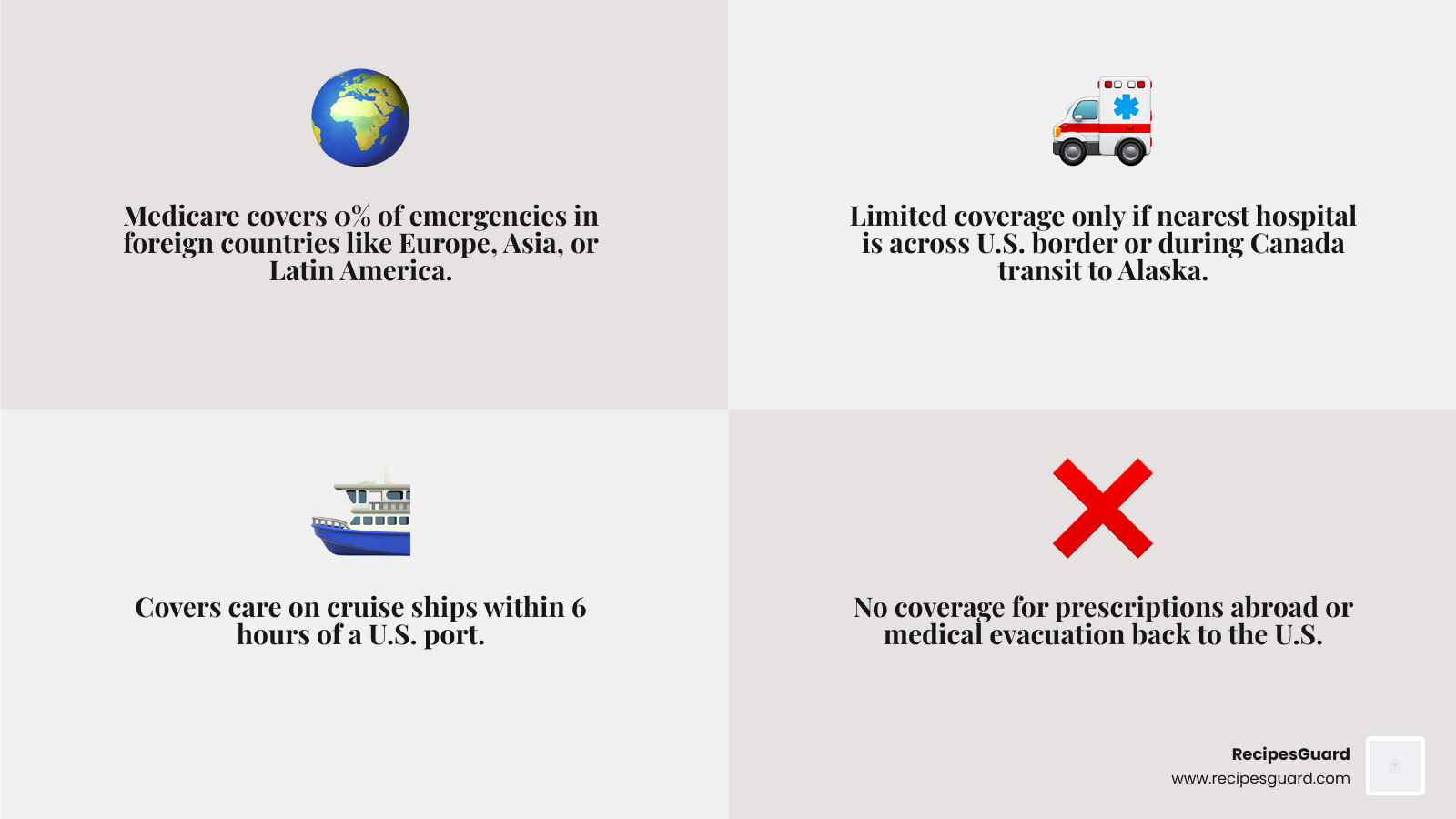
| Medical emergency in Europe, Asia, or Latin America | No |
| Emergency where the nearest hospital is across a U.S. border | Yes (limited) |
| Emergency in Canada while traveling between Alaska and another U.S. state | Yes (limited) |
| You live in the U.S. and the closest hospital is foreign | Yes (limited) |
| Care on a cruise ship within 6 hours of a U.S. port | Yes (limited) |
| Prescription drugs bought abroad | No |
| Medical evacuation back to the U.S. | No |
In the vast majority of international trips — think Paris, Tokyo, or Cancún — Medicare simply does not follow you. You would be responsible for 100% of your medical bills.
The exceptions are narrow and very specific. They apply mostly to border situations or unusual travel routes, not typical vacations.
This matters more than most people realize. A single emergency room visit abroad can cost tens of thousands of dollars out of pocket. Without a plan, that bill lands entirely on you.
Medigap and travel insurance can help fill the gap — but only if you set them up before you board the plane.
Does medicare cover emergencies in foreign countries terms at a glance:
- Abroad Emergency Claim Steps
- Insurance Claim for Injury
Does Medicare cover emergencies in foreign countries?
As we move through April 2026, the rules surrounding Medicare’s reach remain quite strict. For most of us, Medicare is a “domestic-only” benefit. This means that once you step outside the 50 United States and the District of Columbia, your red, white, and blue card carries very little weight.
According to the official Medicare Coverage Outside the United States guidelines, Original Medicare (Part A and Part B) generally does not pay for healthcare services or supplies if they are received outside the U.S. boundaries. This isn’t just a suggestion; it’s a fundamental rule of the program.
However, the “limited exceptions” mentioned in the research are what we call the “Border Rules.” These are designed for people who live near the edges of the country or those traveling through Canada to get to Alaska. If you find yourself in a medical crisis where a foreign hospital is physically closer than the nearest U.S. facility, Medicare might step in. But even then, the care must be deemed a “medical necessity,” and the circumstances must meet very specific geographic criteria.

Specific situations where Original Medicare covers care outside the U.S.
There are exactly three “Golden Ticket” scenarios where Original Medicare might pay for a foreign hospital stay:
- The Border Emergency: You are inside the U.S. when a medical emergency occurs, and the nearest hospital that can treat you is actually in a foreign country (like Mexico or Canada).
- The Canada Transit (Alaska Route): You are traveling through Canada via the most direct route between Alaska and another U.S. state when an emergency strikes. If the Canadian hospital is closer than the nearest U.S. hospital, Medicare may cover your inpatient care. Note: “Unreasonable delays” like stopping for a three-day sightseeing tour in Banff will void this coverage!
- The Border Resident: You live in the U.S., and a foreign hospital is closer to your home than the nearest U.S. hospital, regardless of whether it is an emergency. This is a rare situation for those living in very specific border communities.
In these cases, Medicare Part A covers the inpatient hospital stay, and Part B covers the doctor and ambulance services received immediately before and during that stay.
Medicare coverage for emergencies in U.S. territories
It is a common misconception that places like Puerto Rico are “foreign” for Medicare purposes. Thankfully, they are not! If you are traveling to any of the following U.S. territories, you are covered just as if you were in Ohio or Arizona:
- Puerto Rico
- Guam
- U.S. Virgin Islands
- American Samoa
- Northern Mariana Islands
For our student travelers heading to these islands for a semester abroad or a spring break trip, your Original Medicare remains fully active. You don’t need to worry about the “foreign” label here; you are still within the Medicare “zone.”
Coverage limits: What Medicare Part A and Part B pay for abroad
Even in those rare exceptions where Medicare agrees to pay, it doesn’t mean the bill is $0. You are still responsible for the standard cost-sharing amounts.
- Medicare Part A (Hospital Insurance): This covers your room and board in the hospital. You will still have to pay the Part A deductible for each benefit period.
- Medicare Part B (Medical Insurance): This covers the doctors who treat you and the ambulance that gets you there. After you meet your annual Part B deductible, you typically pay 20% of the Medicare-approved amount.
As noted by AARP, foreign hospitals are not required to file claims for you. This means you might have to pay the full bill upfront in euros, pesos, or yen and then fight for reimbursement later.
What Medicare will NOT cover when traveling abroad
The “No” list is unfortunately much longer than the “Yes” list. Even if you are admitted to a foreign hospital under a covered exception, Medicare will strictly refuse to pay for:
- Prescription Drugs: Medicare Part D plans are legally prohibited from covering drugs purchased outside the U.S. If you lose your heart medication in Rome, you are paying the Italian pharmacy price out of pocket.
- Routine Care: Physicals, check-ups, and “just checking on this cough” visits are not covered.
- Dialysis: Unless it is part of a covered inpatient stay under the three exceptions, routine dialysis is not covered abroad.
- Return Trips: Medicare will not pay for an ambulance to take you home after you are discharged from a foreign hospital.
- Medical Evacuation: This is the big one. If you need a private jet with a medical team to fly you from a remote island to a specialist in the U.S., the cost (often $50,000 to $200,000) is entirely your responsibility. Medicare never covers international med-evac.
Cruising and travel: Medicare rules for ships and dialysis
Cruising is a favorite pastime for many of us, but the insurance rules on the high seas are as murky as the deep ocean. Medicare coverage on a cruise ship depends entirely on your distance from the shore.
The “6-Hour Rule” is the standard: Medicare may cover medically necessary services on a ship if:
- The doctor is authorized to provide the services.
- The ship is in a U.S. port or no more than 6 hours away from a U.S. port when the services are rendered.
If you are 7 hours out or in international waters, Medicare coverage vanishes. Most cruise lines strongly recommend private travel insurance for this very reason. Regarding dialysis, the same “inpatient exception” applies. If you aren’t an admitted inpatient in one of the three rare border scenarios, your cruise ship dialysis will not be reimbursed by Medicare.
Supplemental protection: Medigap and Medicare Advantage
Since Original Medicare leaves such a massive gap in international coverage, many of us look to supplemental plans.
Medicare Advantage (Part C) plans are offered by private companies. While they must cover everything Original Medicare covers, many Advantage plans go a step further and offer “Worldwide Emergency Coverage.” However, these plans often have their own deductibles and limits. You must check your specific Plan Document before you leave.
Medigap (Medicare Supplement) plans are often the better “safety net” for international travelers.
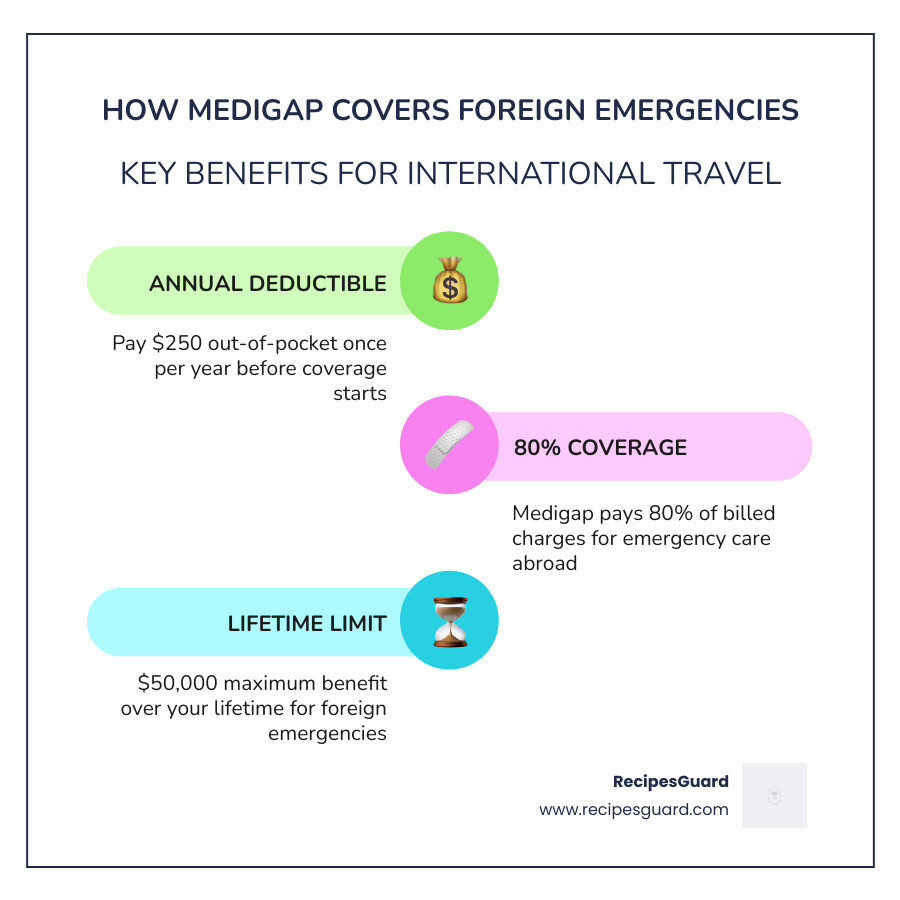
How Medigap plans cover emergencies in foreign countries
If you have Medigap Plans C, D, F, G, M, or N, you have a specific “Foreign Travel Emergency” benefit. This is a lifesaver for those of us who enjoy traveling to Australia, Europe, or beyond.
Here is how the Medigap benefit works:
- The 80% Rule: Medigap pays 80% of the billed charges for “medically necessary” emergency care.
- The Deductible: You must pay a $250 annual deductible first (as of 2025/2026).
- The Lifetime Limit: There is a $50,000 lifetime cap. Once you’ve used $50,000 in foreign emergency benefits, that’s it—the well is dry.
- The 60-Day Window: The emergency must occur during the first 60 days of your trip. If you are on a 90-day tour of the Outback, you have no Medigap coverage from day 61 onwards.
Preparing for your trip: Claims, vaccines, and travel insurance
Before you pack your bags, there are a few administrative hoops to jump through. First, check your vaccines. While Part D doesn’t cover drugs bought abroad, it does cover ACIP-recommended travel vaccines (like Yellow Fever or Hepatitis) administered in the U.S. before you leave.
We also strongly recommend consulting your doctor about your “travel fitness” and ensuring you have an ample supply of medications. Since you can’t use your Part D plan at a foreign pharmacy, having a 90-day supply in your carry-on is a smart move.
How to file a claim when Medicare does cover emergencies in foreign countries
If you are lucky enough to fall into one of the rare exceptions where Medicare pays, don’t expect the foreign hospital to do the paperwork. You will likely be the “claims adjuster” for your own case.
- Get Itemized Bills: You need a detailed, line-by-line bill from the foreign hospital. If it’s in a foreign language, you may need to have it translated.
- Fill out Form CMS-1490S: This is the “Patient Request for Medical Payment” form.
- Include a Cover Letter: Explain why you were at that specific hospital and how it meets the “nearest hospital” or “Alaska transit” rules.
- Observe the Deadline: You generally have 12 months from the date of service to file your claim.
At RecipesGuard, we specialize in helping students and travelers navigate these exact types of hurdles. Filing a claim for a foreign emergency is notoriously difficult, and having a step-by-step tutorial can be the difference between getting a $20,000 check or a $20,000 headache.
Frequently Asked Questions about Medicare Abroad
Does Medicare cover prescriptions bought in a foreign country?
No. Medicare Part D plans only cover medications purchased at pharmacies within the United States and its territories. Even if it is a life-saving medication needed during an emergency, you will have to pay the full local price out of pocket. We recommend bringing a backup prescription and a full supply of your meds from home.
What happens if I reach the $50,000 Medigap lifetime limit?
Once you hit that $50,000 cap, your Medigap foreign travel benefit is exhausted forever. This is why many frequent travelers choose to buy separate, primary travel medical insurance for every trip. It protects that $50,000 lifetime “reserve” and provides higher limits for catastrophic events.
Does Medicare cover medical evacuation back to the U.S.?
Absolutely not. Medicare does not pay for “repatriation” or air ambulance services to bring you back to U.S. soil. This is perhaps the most dangerous gap in coverage. An air ambulance from Australia to the U.S. can easily cost six figures. Private travel insurance is the only way to cover this risk.
Conclusion
Navigating the question does medicare cover emergencies in foreign countries reveals a sobering reality: your domestic coverage is largely left at the border. While the “Border Rules” and U.S. territories offer some solace, the vast majority of international destinations require a more robust plan.
As of April 2026, the best strategy remains a “triple-threat” approach: keep your Original Medicare for when you return, maintain a Medigap plan for that 80% emergency cushion, and always purchase comprehensive travel medical insurance for every trip.
At RecipesGuard, we are dedicated to providing students and international travelers with the tools they need to handle the unexpected. From step-by-step claim filing tutorials to expert advisory on insurance gaps, we make sure you aren’t left stranded. Whether you are studying in Sydney or vacationing in Venice, don’t let a medical bill ruin your journey.
More info about travel insurance services

My name is Bianca, and my journey into the world of fermentation and food safety began with a costly mistake. I once lost an entire season’s harvest of chili peppers because I relied on guesswork instead of science. That failure was my turning point.
